Genetic Engineering
Use of Biological Resources
The general procedure for inserting a new gene into a host organism has the same five steps every time.
Step 1: Isolate the desired gene
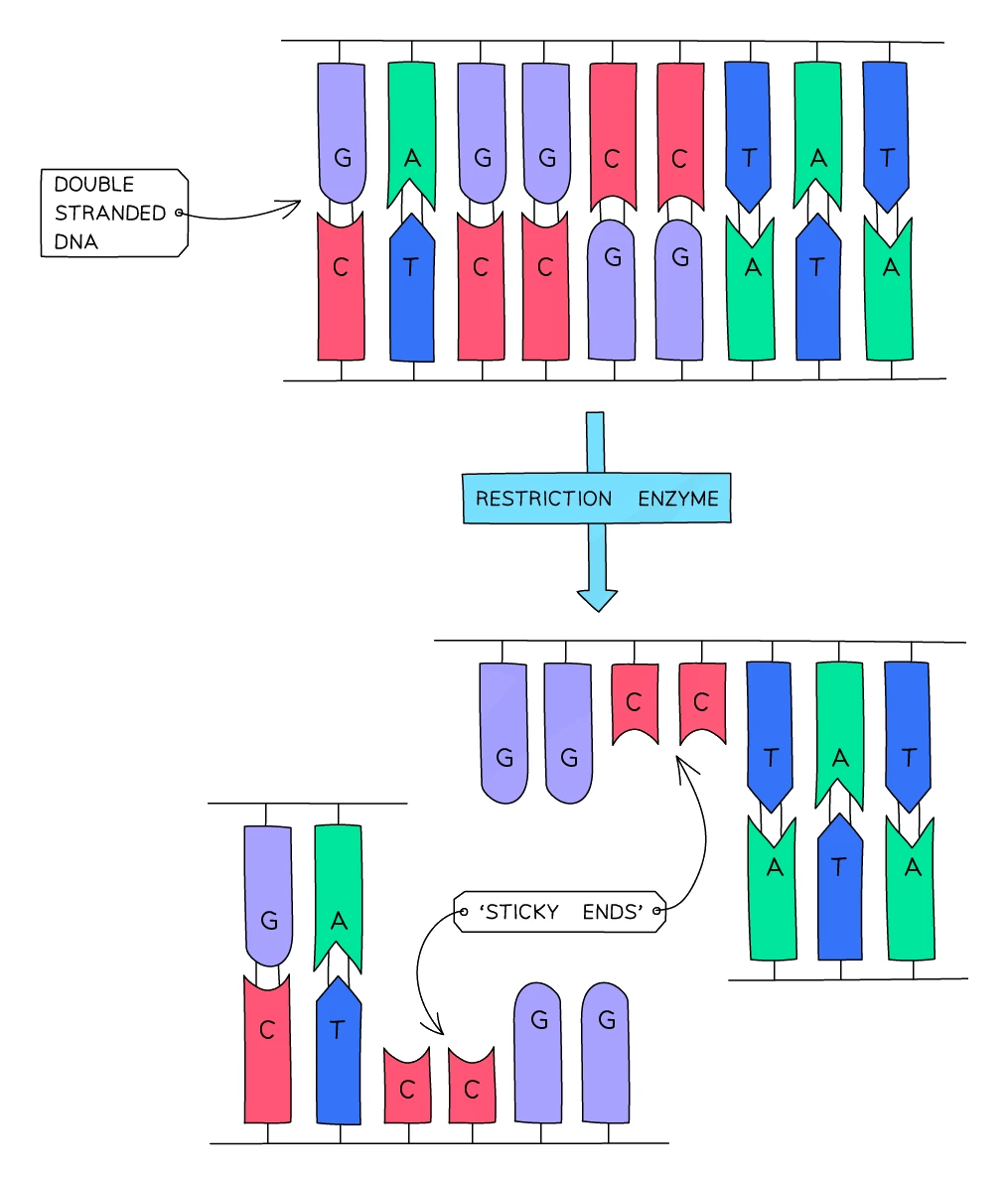
The gene that codes for the desired protein is first found within the source organism's DNA. A specific then cuts the gene out. Restriction enzymes are remarkable: each one only cuts the DNA at a specific base sequence (called a recognition site), so you can choose the right enzyme to cut out exactly the gene you want.
When a restriction enzyme cuts double-stranded DNA, it leaves short overhangs of unpaired bases on each cut end. These overhangs are called because they will pair up with any other piece of DNA that has matching complementary bases.
Step 2: Prepare the vector
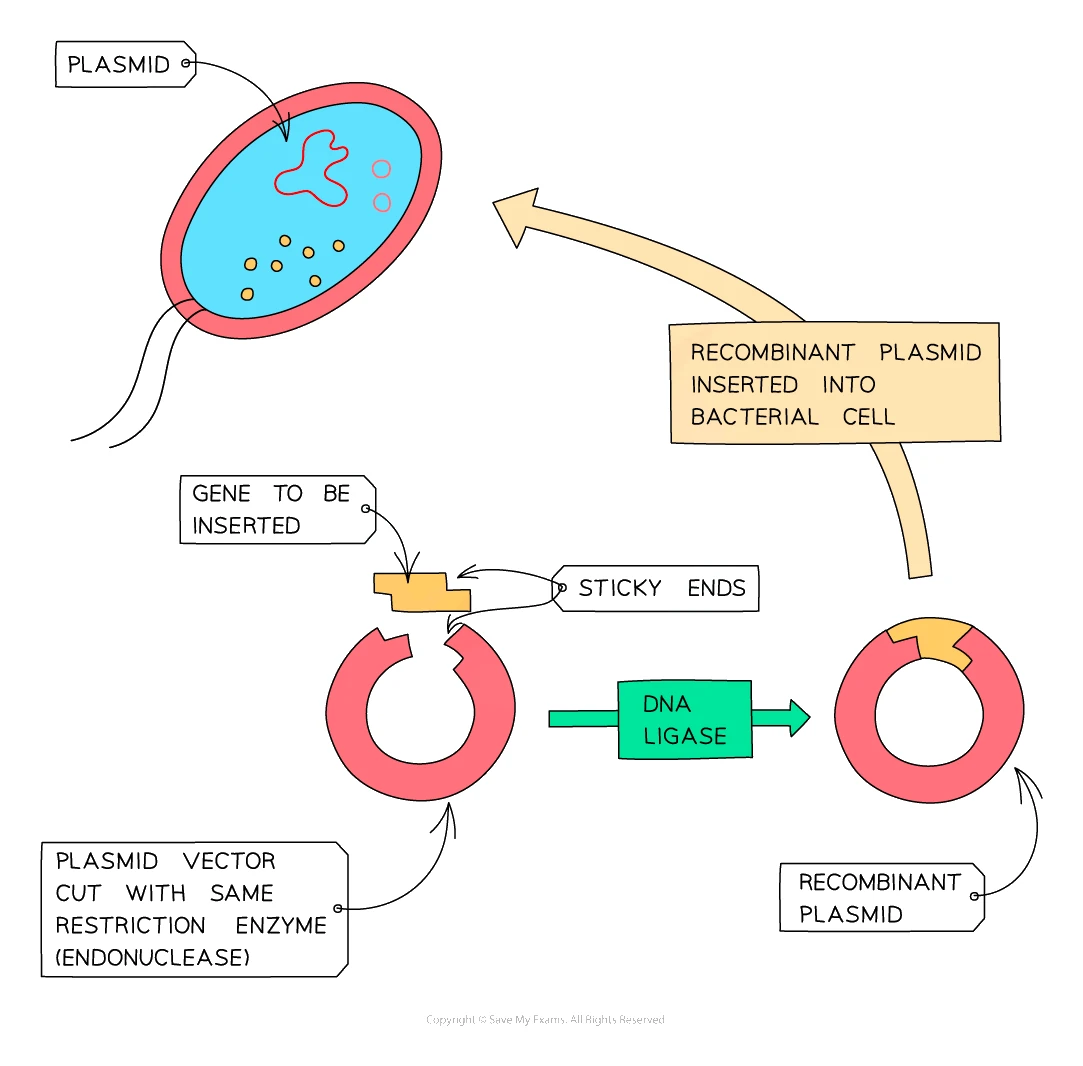
The vector is usually a bacterial (a small circular piece of DNA found inside bacteria, separate from the main chromosome). The same restriction enzyme is used to cut the plasmid open. Because it is the same enzyme, the plasmid ends up with complementary sticky ends to the desired gene.
Using the same enzyme to cut both the gene and the plasmid is crucial. It is what guarantees the sticky ends will match and pair up.
Step 3: Join the gene to the vector
The cut gene and the opened plasmid are mixed together. Their sticky ends find each other and pair up using the base-pairing rules (A with T, G with C). The enzyme DNA then seals the joints, forming a single complete molecule of (DNA made from two different sources joined together).
Step 4: Insert the vector into the host cell
The recombinant plasmid is added to a culture of host cells (usually bacteria). Some of the cells take the plasmid in (a process called transformation). The host cell now contains the new gene and can use it to make the new protein.
Step 5: Grow the host cells in a fermenter
The transformed bacteria are placed in a large industrial fermenter along with their nutrients and the right temperature, pH and oxygen conditions. They multiply rapidly. Every time a bacterium divides, the plasmid is copied too, so every new bacterium contains the gene and makes the protein. Within a few days the fermenter contains millions of bacteria all producing the desired protein, which can then be extracted and purified.
Common exam question
Describing how a recombinant plasmid is made
Question: Describe how named enzymes are used to make a recombinant plasmid or vector, or explain how genetically modified bacteria are produced (2–4 marks).
Asked in 5 of the 23 papers, once as a multiple-choice question on which enzyme removes a gene from DNA. Name both enzymes and give each its job: a restriction enzyme cuts the gene out of the DNA and cuts the plasmid open; DNA ligase joins the gene into the plasmid. Each enzyme is a mark in the 2-mark versions. "Endonuclease" is accepted for the restriction enzyme; "lipase" for ligase is rejected.
A 3-mark version also credits naming the plasmid as the vector. The 4-mark version offers five points: the restriction enzyme cuts out the gene; the same enzyme cuts the bacterial plasmid; this gives matching sticky ends; ligase joins the gene into the plasmid; the recombinant plasmid is taken up by the bacterium. No scheme credits growing the bacteria in a fermenter.