Genetic Engineering
Use of Biological Resources · 6 question types
Cloning means producing genetically identical copies of an organism. Cloning of plants by tissue culture / micropropagation was covered in topic 17. Cloning of animals is much harder because animal cells, unlike plant cells, lose their ability to develop into a whole organism very early in life. Only stem cells in the embryo can do this.
There are two main techniques for cloning animals.
Adult cell cloning (somatic cell nuclear transfer)
This is the technique that produced Dolly the sheep in 1996, the world's first mammal cloned from an adult cell. The five steps:
- Take an unfertilised egg cell from a female of the species. Using a fine needle, remove its nucleus. The egg is now enucleated (it has no DNA of its own).
- Take a body cell (any normal somatic cell, often a skin or udder cell) from the adult animal you want to clone. This cell contains the full diploid set of chromosomes.
- Insert the diploid nucleus from the body cell into the enucleated egg. The egg now contains DNA identical to the adult animal.
- Give the cell a mild electric shock to fool it into thinking it has been fertilised. The cell starts to divide by mitosis, forming an embryo.
- Once the embryo has reached a small ball of cells, implant it into the uterus of a surrogate mother. The embryo develops normally and is eventually born.
The newborn is a genetic clone of the animal that supplied the body cell, with the same DNA in every cell. The surrogate mother contributes nothing genetically; she just carries the pregnancy.
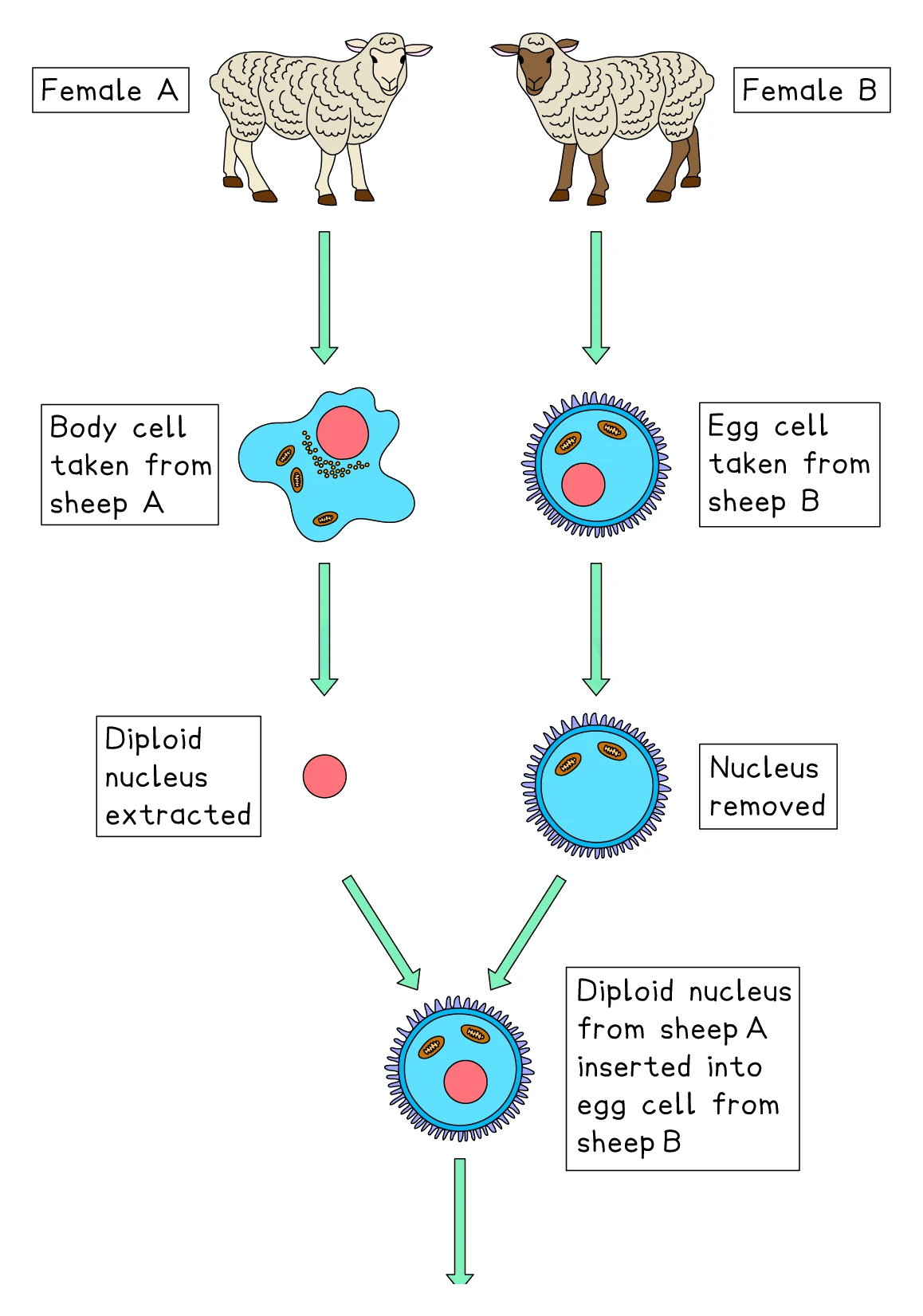
Describing the stages of somatic cell cloning (4-mark question)
What comes up: "Describe the stages scientists use to clone an animal" — 4 marks.
Write (four marks): (1) Take the nucleus from a body cell (diploid somatic cell) of the animal to be cloned. (2) Insert this nucleus into an enucleated egg cell (an unfertilised egg from which the nucleus has been removed). (3) Apply an electric shock to stimulate the cell to divide by mitosis, forming an embryo. (4) Implant the embryo into the uterus of a surrogate mother.
Watch out: the mark scheme rejects "from the udder" as the source of the body cell for horse cloning (it only accepts body cell generically); do not specify an unusual tissue unless the question names it. The egg cell must come from a female — the mark scheme rejects "egg cell from the male" as a source.
Dolly the sheep
In 1996, scientists at the Roslin Institute in Scotland used this technique on sheep:
- DNA donor: a 6-year-old Finn Dorset ewe (white-faced)
- Egg donor: a Scottish Blackface ewe
- Surrogate mother: another Scottish Blackface ewe
Dolly was born with a white face like the DNA donor, not black like the surrogate, proving she was a true clone of the DNA donor and not a normal offspring of the surrogate. She lived to age 6 and had several lambs of her own. Dolly's success started the whole modern field of mammalian cloning.
Embryo cloning (embryo splitting)
A simpler technique called embryo has been used in livestock breeding for decades:
- Two parent animals with the desired traits are mated normally, producing a fertilised egg (zygote).
- The zygote divides into an early embryo (a ball of identical stem cells).
- The embryo is divided into smaller groups of cells, each of which is genetically identical.
- Each piece is implanted into a separate surrogate mother.
- Each pregnancy results in a clone of the original embryo, so all the offspring are genetically identical to each other (but not identical to either parent, since they come from a normal fertilised egg).
This is how naturally identical twins form: a single fertilised egg accidentally splits into two embryos that develop separately. Embryo cloning just does it on purpose, with more pieces, in more surrogates.
Uses of animal cloning
- Multiplying valuable livestock: one prize bull or top dairy cow can produce thousands of genetically identical offspring through cloning
- Producing transgenic animals at scale: once one transgenic animal has been engineered, cloning makes many more identical copies, all producing the same useful protein
- Conservation of endangered species: cloning could help restore populations of nearly-extinct animals
- Preserving extinct species: there is research into using preserved DNA to clone extinct species (woolly mammoths, dodos), though no successful cases yet
- Medical research: cloned animals provide genetically uniform test subjects, removing variation between individuals as a confounding factor
Limitations and risks
- Very low success rate: only a few percent of cloning attempts produce a healthy live birth. It took 277 attempts to produce Dolly.
- Health problems in clones: cloned animals often have shortened lifespans, premature ageing, weakened immune systems, and various other problems
- Loss of genetic variation: a herd of clones is genetically uniform, so vulnerable to any disease the clones cannot resist
- Ethical concerns (covered below)