Genetic Engineering
Use of Biological Resources · 6 question types
The classic example of genetic engineering, and the first to be commercialised in 1982, is the production of human insulin for treating people with type 1 diabetes. Before genetic engineering, diabetics had to use insulin extracted from cow or pig pancreases, which was expensive, in short supply, and slightly different from human insulin (some patients developed allergic reactions).
Step by step
Applying the general five-step process specifically to insulin:
- Locate the human insulin gene on human chromosome 11.
- Use a specific to cut the gene out of human DNA. The gene now has sticky ends.
- Use the same restriction enzyme to cut open a bacterial . The plasmid now has matching sticky ends.
- Mix the gene with the cut plasmid. The sticky ends pair up by complementary base pairing.
- DNA seals the joints, forming a recombinant plasmid containing the human insulin gene.
- The recombinant plasmid is inserted into bacterial cells (usually Escherichia coli).
- The bacteria are grown in industrial fermenters under controlled conditions (temperature, pH, oxygen, nutrients). They multiply rapidly.
- Each bacterium reads the human insulin gene and produces human insulin protein from it. (The bacterium's own ribosomes do not care that the gene is human; they read the code the same way they would for any bacterial gene.)
- The insulin is extracted and purified from the fermenter and packaged as medical-grade insulin.
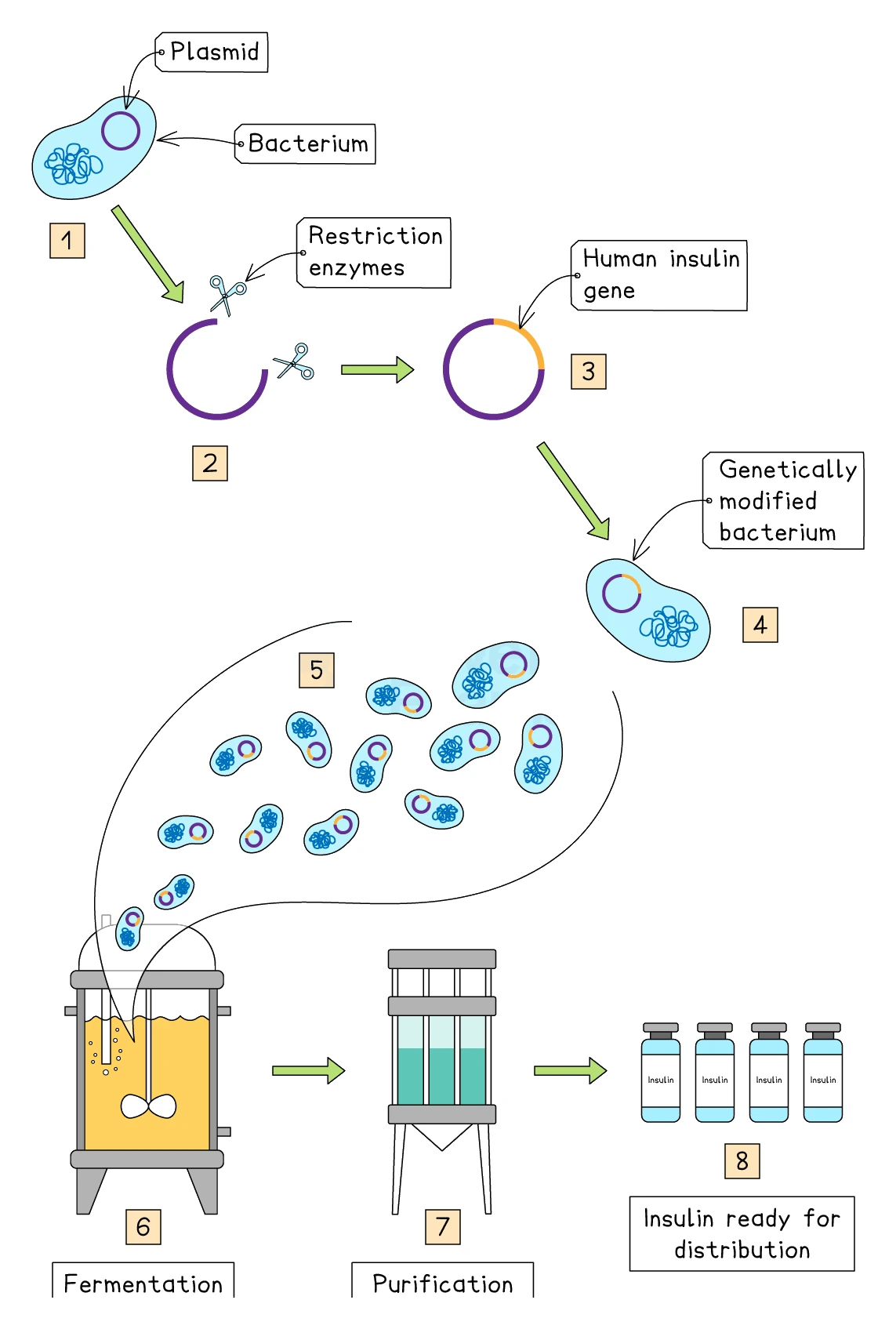
Explaining how GM bacteria are produced (4-mark question)
What comes up: "Explain how genetically modified bacteria are produced" — typically 4 marks, so you need four distinct credited points.
Write (four marks): (1) A restriction enzyme is used to cut the human insulin gene out of human DNA (producing sticky ends). (2) The same restriction enzyme is used to cut open a bacterial plasmid, producing complementary sticky ends. (3) DNA ligase joins the insulin gene into the plasmid, forming a recombinant plasmid. (4) The recombinant plasmid is inserted into a bacterium (the bacterium is transformed).
Watch out: you do not earn a mark just for saying "the bacteria are grown in a fermenter" unless the question specifically asks about insulin production at scale. The four-mark version targets the gene-cutting and joining steps. If the question asks for a fifth point, add: bacteria are cultured and the insulin is extracted and purified.
Why bacteria are ideal for this
Bacteria are the workhorse of genetic engineering for several reasons:
- They have plasmids, which are easy to remove, modify and put back. This is the natural vector for engineering bacteria.
- They reproduce extremely fast (one cell can become billions in a day), so you can rapidly produce large quantities of the modified organism.
- They use the same genetic code as humans (and every other organism), so they can read and translate human genes correctly.
- They don't raise the same ethical concerns as engineering animals or plants. There is no animal welfare issue with bacteria.
- They are cheap and easy to grow.
Insulin today
Today, almost all of the world's medical insulin is made by GM bacteria using exactly this process. The insulin produced is chemically identical to human insulin, with no risk of allergic reaction. It can be made in unlimited quantities at low cost. This was one of the great medical successes of the late 20th century.
Other proteins made by GM bacteria include human growth hormone, blood-clotting factors for haemophilia patients, and several vaccines.