MathematicsExam code: 0580
Working with Fractions, Decimals and Percentages
Number
Ordering fractions only
- Rewrite every fraction over the lowest common denominator, then compare numerators
- For 2/3, 5/8, 7/12 and 3/4 the lowest common denominator is 24
- These become 16/24, 15/24, 14/24 and 18/24
- Ascending order is therefore 7/12, 5/8, 2/3, 3/4
- Give the answer in the form the values were originally written in
Ordering a mixed list
- Convert every value to a decimal, since decimals are the one form that can be compared column by column
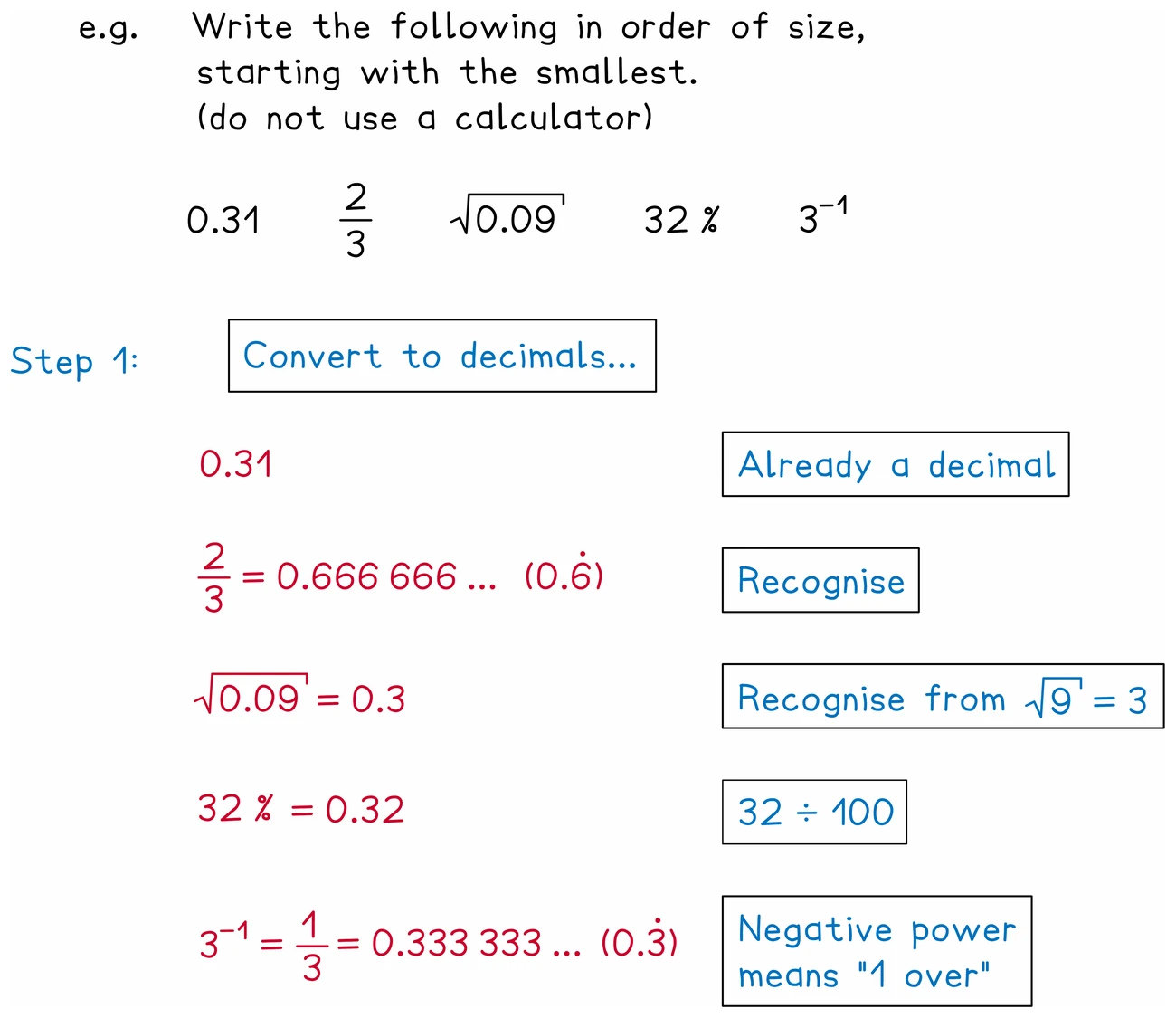
- Pad the decimals to a common number of places before comparing
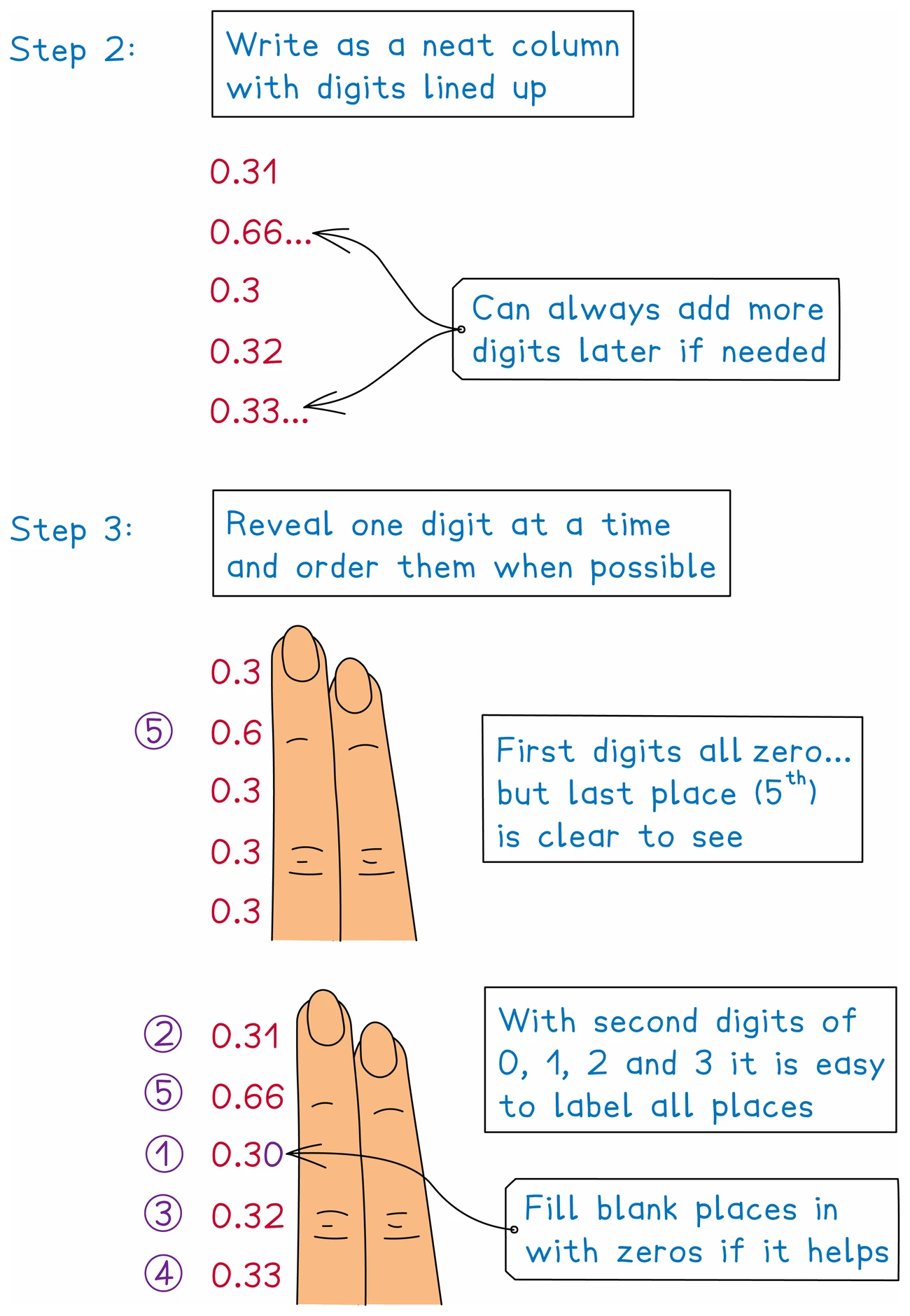
- Order the decimals, then rewrite each in its original form
Comparison symbols
- A chain of values can be joined with the inequality symbols rather than listed
- 1/5 < 1/4 < 1/3
- Recall that > is greater than, < is less than, ⩾ is greater than or equal to, and ⩽ is less than or equal to
Worked example
Ordering a mixed list without a calculator
Write these values in ascending order: 0.62, 5/8, 63%, 3/5
Solution:
- Convert each to a decimal
- 0.62 is already a decimal
- 5/8 by repeated halving: 5, 2.5, 1.25, 0.625
- 63% divided by 100 gives 0.63
- 3/5 is equivalent to 60/100, so 0.6
- Pad to three places: 0.620, 0.625, 0.630, 0.600
- Ascending order of the decimals: 0.600, 0.620, 0.625, 0.630
- Rewritten in their original forms: 3/5, 0.62, 5/8, 63%