MathematicsExam code: 0580
Working with Fractions, Decimals and Percentages
Number
Decimal to fraction
- The number of decimal places fixes the denominator: one place gives tenths, two gives hundredths, and n places gives 10ⁿ
- 0.9 is 9/10
- 0.23 is 23/100
- 0.041 is 41/1000
- Write the digits after the point as the numerator, then simplify
- 0.44 is 44/100, which cancels to 11/25
- A whole number is written as a fraction by placing it over 1
Percentage to fraction
- Every percentage is already a number of hundredths, so it goes straight over 100 and is then cancelled
- 44% is 44/100, which cancels to 11/25
Fraction to decimal
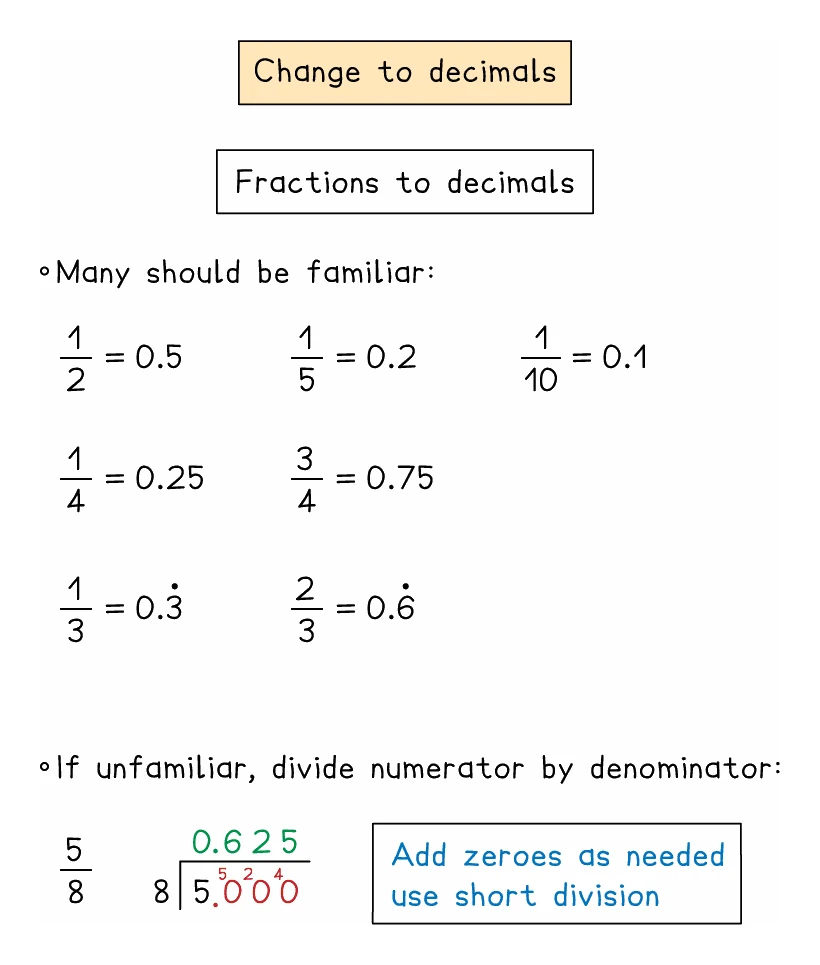
- Where the denominator divides into a power of ten, scale up to that power and read the decimal straight off
- 25 goes into 100 four times, so 7/25 becomes 28/100, or 0.28
- Otherwise divide the numerator by the denominator
- Denominators that are powers of 2 can be reached by repeated halving
- 3/8: halving 3 gives 1.5, then 0.75, then 0.375
Fraction to percentage
- Convert to a decimal first, then multiply by 100
- 9/20 scales to 45/100, which is 0.45, and therefore 45%
Worked example
The four conversions
Write 0.36 as a fraction in its simplest form, and write 3/8 as a decimal and as a percentage.
Solution:
- 0.36 has two decimal places, so it is 36 hundredths: 0.36 = 36/100
- Cancel by 4: 36/100 = 9/25
- For 3/8, divide the numerator by the denominator: 3 ÷ 8 = 0.375
- To reach a percentage, multiply the decimal by 100: 0.375 × 100 = 37.5%
- Check the other way round: 37.5 ÷ 100 = 0.375, and 0.375 × 8 = 3