MathematicsExam code: 0580
Surds
Number
Taking out a square factor
- Look for a factor of the number that is a perfect square, then split the root across the factor pair
- Choosing the largest square factor finishes the job in one step
- 48 = 16 × 3, so √48 = √16 × √3 = 4√3
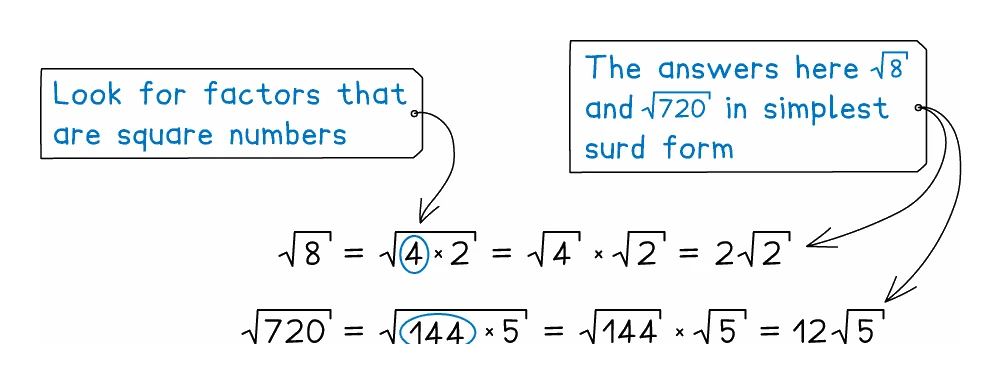
- A smaller square factor still works but leaves more to do afterwards
Collecting after simplifying
- Where several surds appear, simplify each one first: terms that looked unlike often become like
- √75 = 5√3 and √12 = 2√3, so √75 + √12 = 7√3
Expanding brackets
- Brackets containing surds expand exactly as algebraic brackets do, then simplify using (√a)² = a
- (2 + √5)(3 − √5) = 6 − 2√5 + 3√5 − 5, which collects to 1 + √5
Worked example
Expanding brackets that contain surds
Expand and simplify (4 + √3)(5 − 2√3), giving your answer in the form a + b√3.
Solution:
- Multiply each term in the first bracket by each term in the second, keeping every sign
- 4 × 5 = 20 and 4 × (−2√3) = −8√3
- √3 × 5 = 5√3 and √3 × (−2√3) = −2 × (√3)² = −2 × 3 = −6
- Write all four terms down: 20 − 8√3 + 5√3 − 6
- Collect the whole numbers and the root terms separately: 20 − 6 = 14 and −8√3 + 5√3 = −3√3
- The answer is 14 − 3√3, so a = 14 and b = −3