MathematicsExam code: 0580
Simultaneous Equations
Algebra and Sequences
Always substitute
- Where one equation contains a squared term, elimination will not work and substitution is used instead
- Make an unknown the subject of the linear equation, then substitute into the non-linear one
- The result is a quadratic, so bring everything to one side to equal zero, then factorise, or use the formula or completing the square when it does not factorise
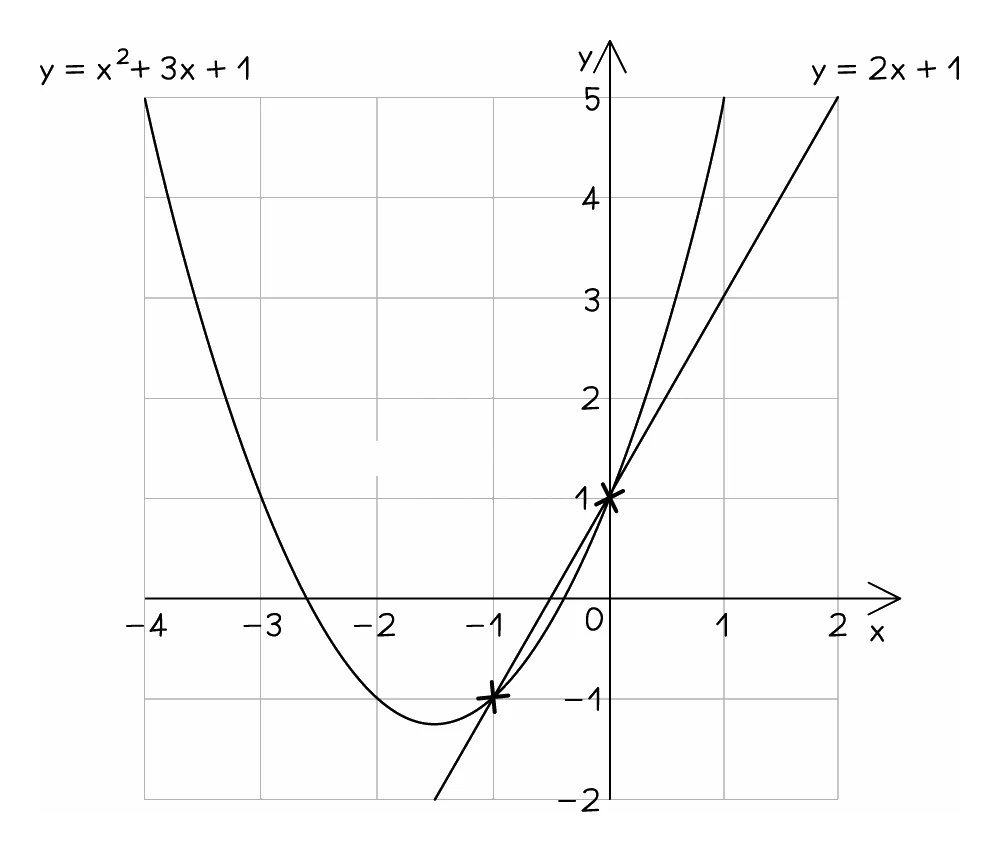
- Two solutions for one unknown give two matching values of the other, so answers come in pairs
- A quadratic with a repeated root gives a single solution pair, and graphically that is a line touching the curve rather than cutting it
- A quadratic with no real solutions means the line and the curve never meet, so the pair has no solution at all
- Powers no higher than two appear in this specification
Worked example
A linear and a quadratic equation
Solve y = x² − 4 and y = 3x simultaneously.
Solution:
- Elimination does not work on a non-linear pair, so always substitute
- Both right-hand sides are equal to y, so they are equal to each other: x² − 4 = 3x
- One unknown is now gone, leaving a quadratic to solve
- Bring every term to one side so it equals zero, which is the only form that can be factorised usefully: x² − 3x − 4 = 0
- Two numbers multiplying to −4 and adding to −3 are −4 and 1
- Factorise: (x − 4)(x + 1) = 0
- A product is zero only if a bracket is zero, so x = 4 or x = −1
- Substitute each value back to get its partner, using the simpler equation y = 3x
- The solutions are x = 4, y = 12 and x = −1, y = −3
- Expect two solution pairs here and give both, keeping each x with its own y
- Check the first in the other equation: 4² − 4 = 12
Exam tip
Show the substitution that finds each y
Work out each y on its own line, such as y = 3 × 4 = 12, rather than writing the pairs straight down. If a slip in the quadratic makes your x-values wrong after a correct start, most schemes still give a mark for substituting both of them correctly into one of the two equations, but only when that working is shown.
Worked example
A line and a curve, answers to 2 decimal places
Solve y = 3x + 2 and y = 2x² + x − 1 simultaneously, rounding each value to 2 decimal places.
Solution:
- Set the two expressions for y equal: 2x² + x − 1 = 3x + 2
- Bring every term to one side: 2x² − 2x − 3 = 0
- This does not factorise, so use the quadratic formula with a = 2, b = −2 and c = −3
- x = (2 ± √((−2)² − 4 × 2 × (−3))) ÷ (2 × 2) = (2 ± √28) ÷ 4
- So x = 1.8228… or x = −0.8228…
- Keep the unrounded values and substitute each into the linear equation: y = 3 × 1.8228… + 2 = 7.4686… and y = 3 × (−0.8228…) + 2 = −0.4686…
- The solutions are x = 1.82, y = 7.47 and x = −0.82, y = −0.47
- Check the first in the curve's equation: 2 × (1.8228…)² + 1.8228… − 1 = 7.4686…
- Working out y from the rounded values 1.82 and −0.82 gives 7.46 and −0.46, both wrong in the second decimal place
- Graphically these solutions are the points where the line and the curve cross, which is why there can be two of them