MathematicsExam code: 0580
Quadratic Equations
Algebra and Sequences
The rule for the first two terms
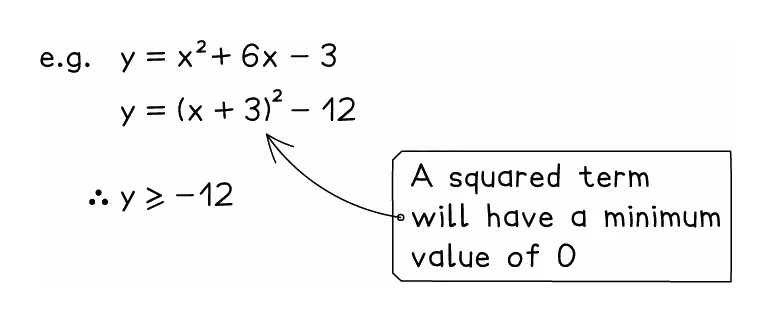
- Completing the square rewrites a quadratic so that x appears only once, inside a squared bracket
- Halve b and call the result p; the pair of terms x² + bx can then be replaced by (x + p)² − p²
- The subtraction removes the extra p² that expanding the bracket creates
- A negative b changes the sign inside the bracket but never the sign in front of p²
- x² − 14x becomes (x − 7)² − 49
- Once the first two terms are replaced, add on whatever constant the original had and tidy the numbers
- Expanding your answer takes seconds and confirms it is right
When a number sits in front of x²
- Remove it as a factor from the x² and x terms, leaving the constant sitting outside
- Complete the square inside, multiply back through, and simplify until the expression reads a(x + p)² + q
- Square brackets around the inner working keep it clearly separate from the squared bracket
Worked example
Completing the square with a leading number
Write 2x² − 12x + 5 in the form a(x + p)² + q.
Solution:
- Completing the square rewrites the expression so x appears once, inside a squared bracket
- The method needs the coefficient of x² to be 1, so take that factor out of the first two terms only, leaving the constant outside
- 2x² − 12x + 5 = 2[x² − 6x] + 5
- Inside the bracket, halve the coefficient of x: half of −6 is −3, so the bracket becomes (x − 3)²
- But (x − 3)² expands to x² − 6x + 9, which is 9 too many, so subtract it back
- x² − 6x = (x − 3)² − 9
- Substitute that in: 2[(x − 3)² − 9] + 5
- Multiply the 2 through the square brackets, making sure it reaches the −9 as well: 2(x − 3)² − 18 + 5
- Collect the constants: 2(x − 3)² − 13
- Check by expanding: 2(x² − 6x + 9) − 13 = 2x² − 12x + 18 − 13 = 2x² − 12x + 5
- Leaving the 2 outside only the bracket, as 2(x − 3)² − 9 + 5, is the standard slip
Reading off the turning point
- A squared bracket can never be negative, so the smallest value it takes is zero, which happens when the bracket itself is zero
- For y = a(x + p)² + q the curve turns at (−p, q), and the minus sign in the x-coordinate is the step most often missed
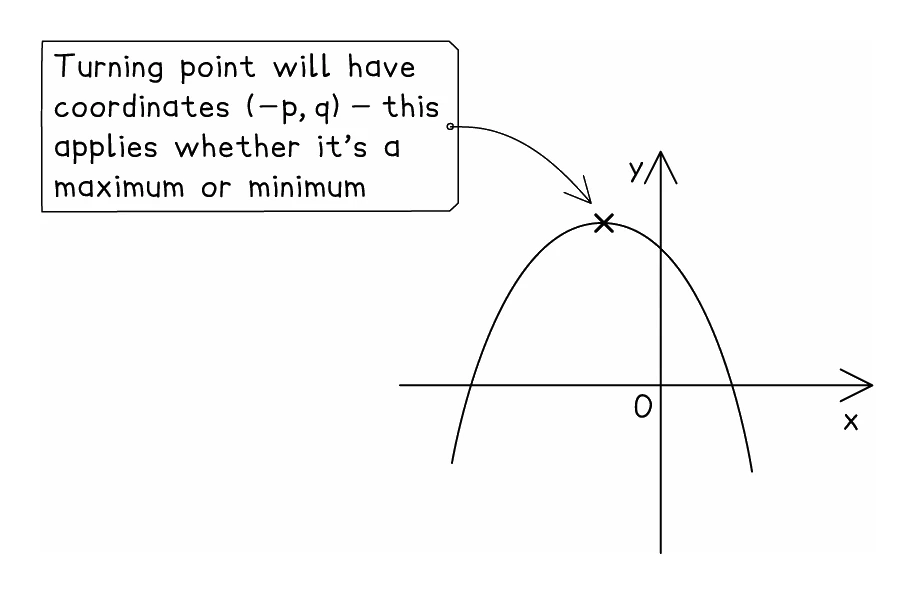
- A positive a makes that point a minimum, and a negative a makes it a maximum
- From 2(x − 3)² − 13 the bracket is zero at x = 3, so the turning point is (3, −13) and it is a minimum
- The same "a square is never negative" argument is what proves a quadratic expression is always above some value