MathematicsExam code: 0580
Probability Diagrams
Probability
Building one
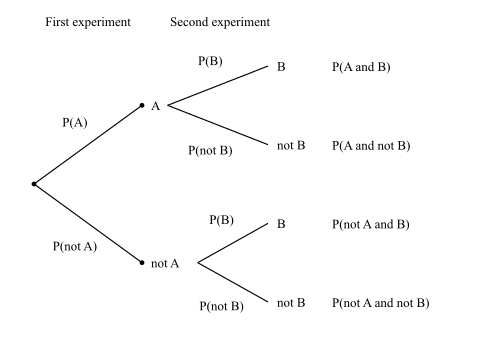
- A tree diagram sets out two or more stages, with a branch for each outcome at each stage
- The syllabus states the convention these papers follow: outcomes at the ends of the branches, probabilities beside them
- Each pair or group of branches from one point must add to 1, which fills in any missing probability
- When a question prints a tree diagram, it asks you to complete it first, and that alone carries marks
Reading one
- Follow one complete route across the diagram and multiply the probabilities you pass, which gives that path its own probability
- Add between separate paths when more than one outcome satisfies the question
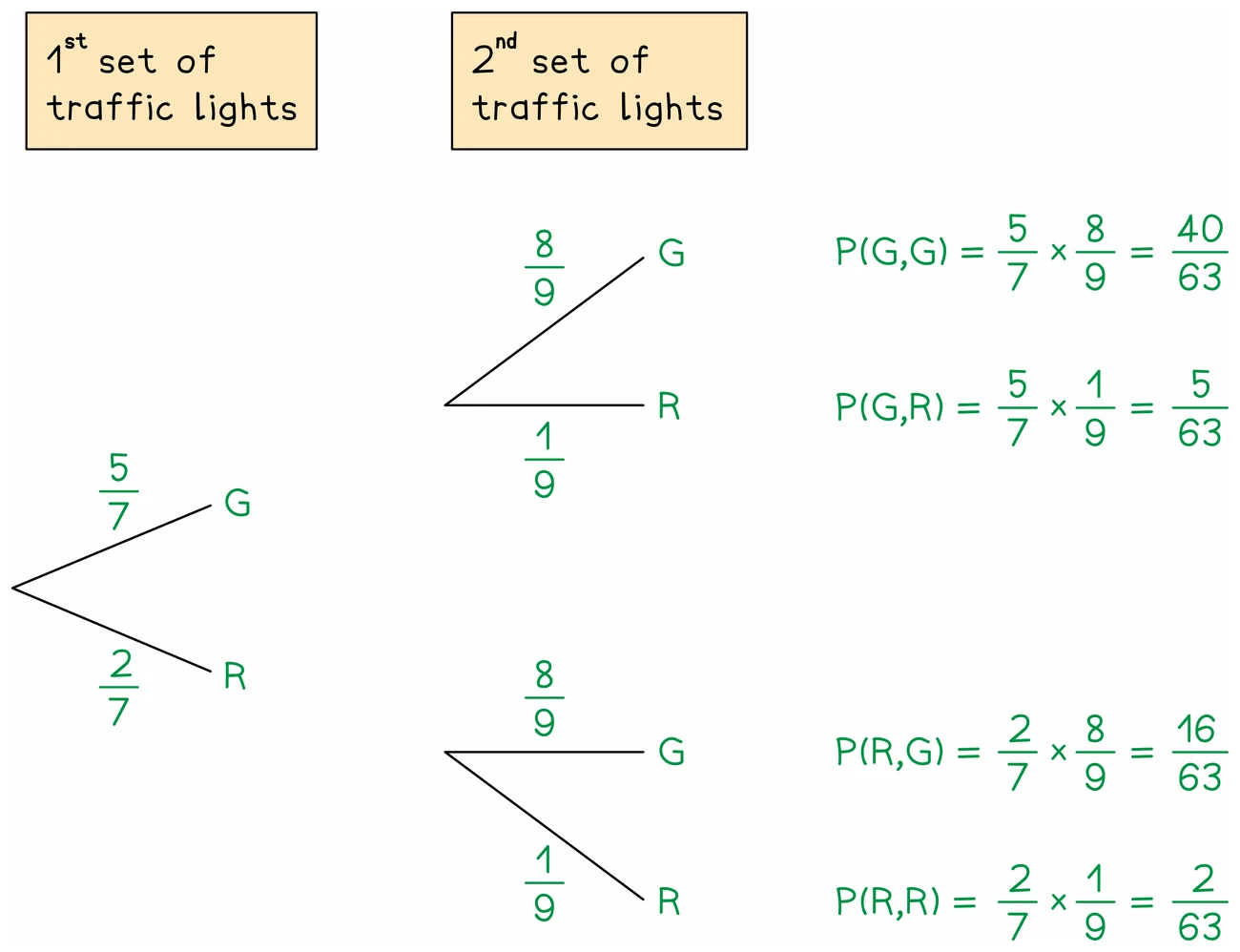
- The probabilities of all the complete paths add to 1
- For "without replacement", the second set of branches carries different numbers depending on which first branch you came along
Worked example
Two counters without replacement
A bag holds 6 green counters and 4 white counters. Two counters are taken at random without replacement. Find the probabilities that both are green, that one of each colour is taken, and that at least one is white.
Solution:
- There are 10 counters, so the first probabilities are 6/10 for green and 4/10 for white
- If a green is taken first, 5 greens and 4 whites remain out of 9
- If a white is taken first, 6 greens and 3 whites remain out of 9
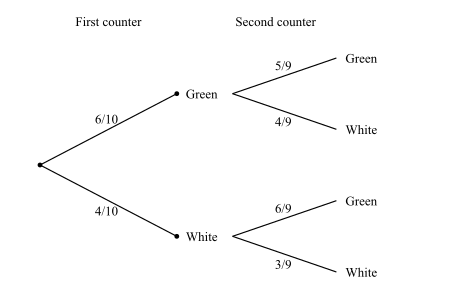
- P(both green) = 6/10 × 5/9 = 30/90, which simplifies to 1/3
- One of each means green then white or white then green
- P(one of each) = 6/10 × 4/9 + 4/10 × 6/9 = 24/90 + 24/90 = 48/90 = 8/15
- At least one white is everything except both green, so subtract from 1
- P(at least one white) = 1 − 30/90 = 60/90 = 2/3
- Check: both green, both white and one of each come to 30/90 + 12/90 + 48/90 = 1