MathematicsExam code: 0580
Prime Factors, HCF and LCM
Number
Building a factor tree
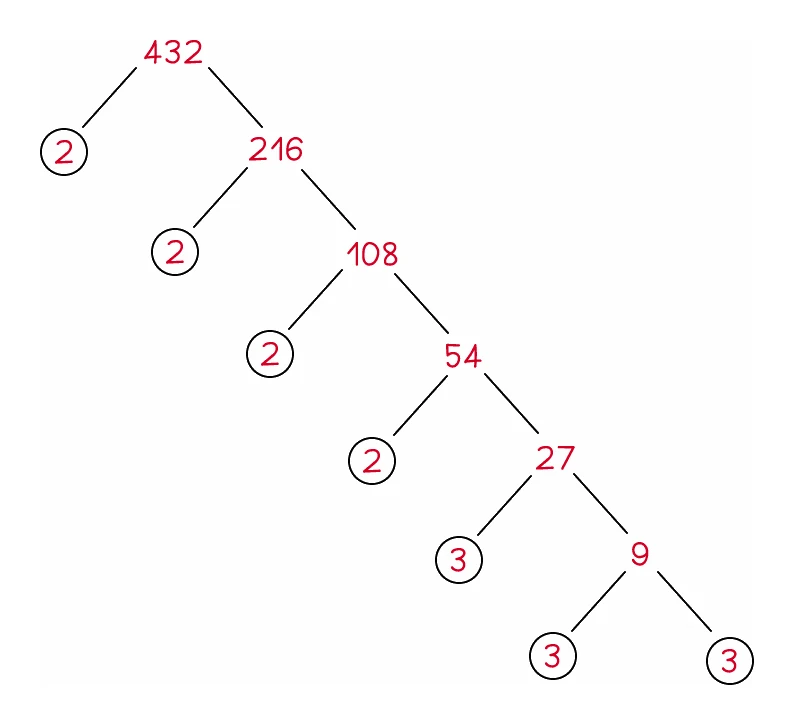
- Split the number into any factor pair, then split each factor again
- Continue down every branch until only primes remain, circling each prime as it appears
- Dividing repeatedly by the smallest prime that fits produces a prime at every stage and keeps the tree tidy
- Splitting by a convenient number such as 10 is equally valid, but non-prime results must then be split further
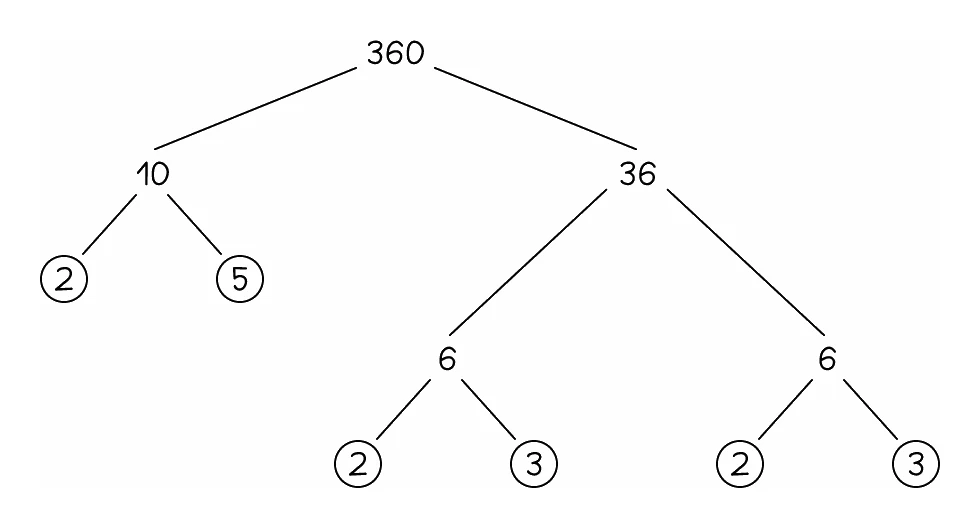
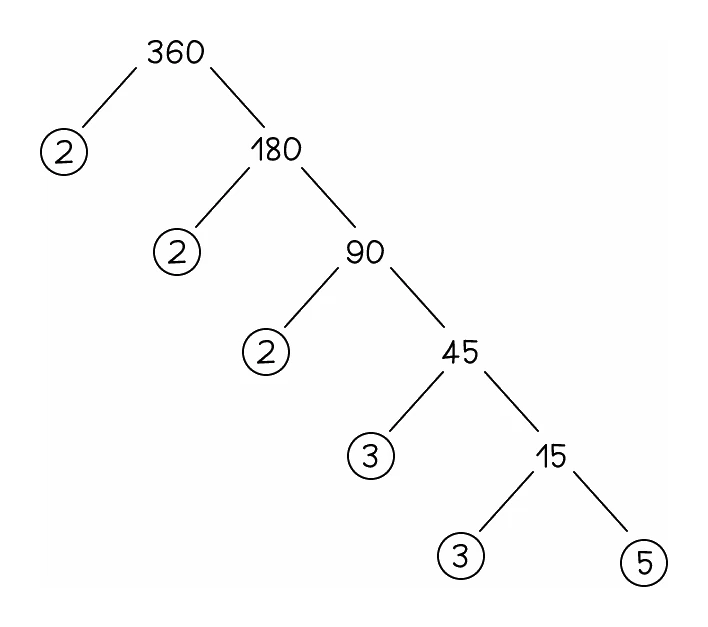
- The circled primes are the same whichever pairs were chosen
Writing the answer
- Multiply the circled primes together, writing them in ascending order
- 252 = 2 × 2 × 3 × 3 × 7
- Collect repeated primes into index form, which is the form to give whenever a question asks for index form or the simplest form
- 252 = 2² × 3² × 7
Worked example
A number as a product of its prime factors
Write 360 as a product of its prime factors, in index form.
Solution:
- Split 360 into any two factors and keep splitting until every branch ends on a prime
- 360 = 36 × 10
- 36 = 6 × 6, and each 6 = 2 × 3
- 10 = 2 × 5
- The primes at the ends of the branches are 2, 3, 2, 3, 2, 5
- Collect them in ascending order: 2 × 2 × 2 × 3 × 3 × 5
- In index form, 360 = 2³ × 3² × 5
- Check by multiplying back: 8 × 9 × 5 = 360
- Starting from a different split, such as 360 = 4 × 90, gives the same answer: the tree's shape does not matter
Worked example
A product of primes from a number already in primes
N = 2⁴ × 3 × 7. Write 18N² as a product of its prime factors, in index form.
Solution:
- There is no need to work out N: use its indices
- Squaring doubles every index (3 and 7 count as 3¹ and 7¹): N² = 2⁸ × 3² × 7²
- Only N is squared, not the 18, so write 18 in primes on its own: 18 = 2 × 3²
- Multiplying adds the indices of each prime: 2⁸ × 2 = 2⁹, 3² × 3² = 3⁴, and 7² is unchanged
- 18N² = 2⁹ × 3⁴ × 7²