MathematicsExam code: 0580
Prime Factors, HCF and LCM
Number
What each one means
- Where a single value divides two numbers exactly, it is a common factor of the pair, and 1 always qualifies
- The highest common factor, or HCF, is the largest such value
- A value sitting in both numbers' times tables is a common multiple
- Of the infinitely many such values, the smallest is the lowest common multiple, or LCM
- The HCF is what cancels a fraction to its simplest form; the LCM is what supplies a common denominator
Finding them by listing
- List every factor of both numbers, then take the largest value common to the two lists
- List the multiples of both, then take the smallest value common to the two lists
- Listing is quick for small numbers and unreliable for large ones
Finding them from prime factors
- Decompose both numbers into primes first
- Place the primes the two numbers share in the overlap of a Venn diagram, taking each shared prime only as many times as it appears in both
- Place the remaining primes in the outer region belonging to their own number
- Multiplying the overlap gives the HCF; multiplying everything in the whole diagram gives the LCM
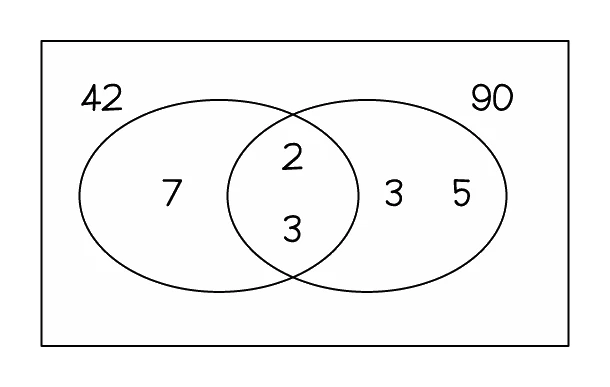
- Where no primes are shared, the overlap holds a 1 and the HCF is 1
Worked example
Finding the HCF and LCM from prime factors
Find the highest common factor and the lowest common multiple of 60 and 144.
Solution:
- Decompose each into primes
- 60 = 2² × 3 × 5
- 144 = 2⁴ × 3²
- Both contain 2 and 3. Take the lower index of each for the shared part: 2² and 3
- HCF = 2² × 3 = 12
- For the LCM collect every prime occurring anywhere, each at its highest index: 2⁴, 3² and 5
- LCM = 16 × 9 × 5 = 720
Exam tip
Keep the prime factor working on the page
Before you give an HCF or LCM, write both numbers as products of primes, or draw a factor tree or division table for each, splitting right down to primes. That working earned a mark on its own even when the final answer was wrong. The same holds when a single number has to be written as a product of primes: a correct tree or table earned a mark there too.
Worked example
HCF and LCM of algebraic terms
Find the highest common factor and the lowest common multiple of 20p⁴q² and 30p³q⁵.
Solution:
- Deal with the number part and each letter separately
- 20 = 2² × 5 and 30 = 2 × 3 × 5, so the numbers have HCF 2 × 5 = 10 and LCM 2² × 3 × 5 = 60
- For the HCF, each letter takes its lower power: p³ and q²
- HCF = 10p³q²
- For the LCM, each letter takes its higher power: p⁴ and q⁵
- LCM = 60p⁴q⁵
- Check: 20p⁴q² = 10p³q² × 2p and 30p³q⁵ = 10p³q² × 3q³, and 2p and 3q³ share no factor, so no larger term divides both