MathematicsExam code: 0580
Conditional Probability
Probability
Where the branches already do it
- On a tree diagram the second set of branches is already conditional, because each one assumes that its first branch has happened
- So a "without replacement" question uses conditional probabilities on its second branches, whether or not it says so
- From a bag of 5 red and 3 blue counters, if the first taken is red then 4 reds remain out of 7, so P(second red, given first red) = 4/7
- Reading such a value straight off the tree needs no calculation at all
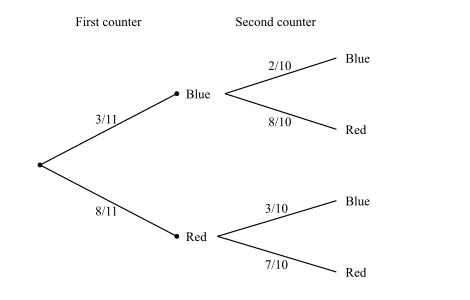
- Where the condition refers to the second stage instead, the paths have to be compared: find the probability of the paths that satisfy both, then divide by the probability of all the paths satisfying the condition
Worked example
Reading a condition off a tree
A bag holds 5 red and 7 blue counters. Two are taken at random without replacement. Given that the first counter is red, find the probability that the second is also red.
Solution:
- The condition fixes what has already happened: the first counter was red
- After it is removed, 11 counters remain and 4 of them are red
- P(second red, given first red) = 4/11
- That is exactly the number written on the second-stage branch of the tree diagram
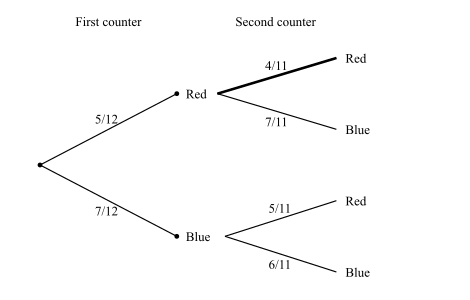
- No formula is needed: a tree diagram's second-stage probabilities are already conditional
- Multiplying 5/12 by 4/11 would answer a different question: the probability that both are red, which is 5/33