MathematicsExam code: 0580
Circles, Arcs and Sectors
Lengths, Areas and Volumes
Parts of circles
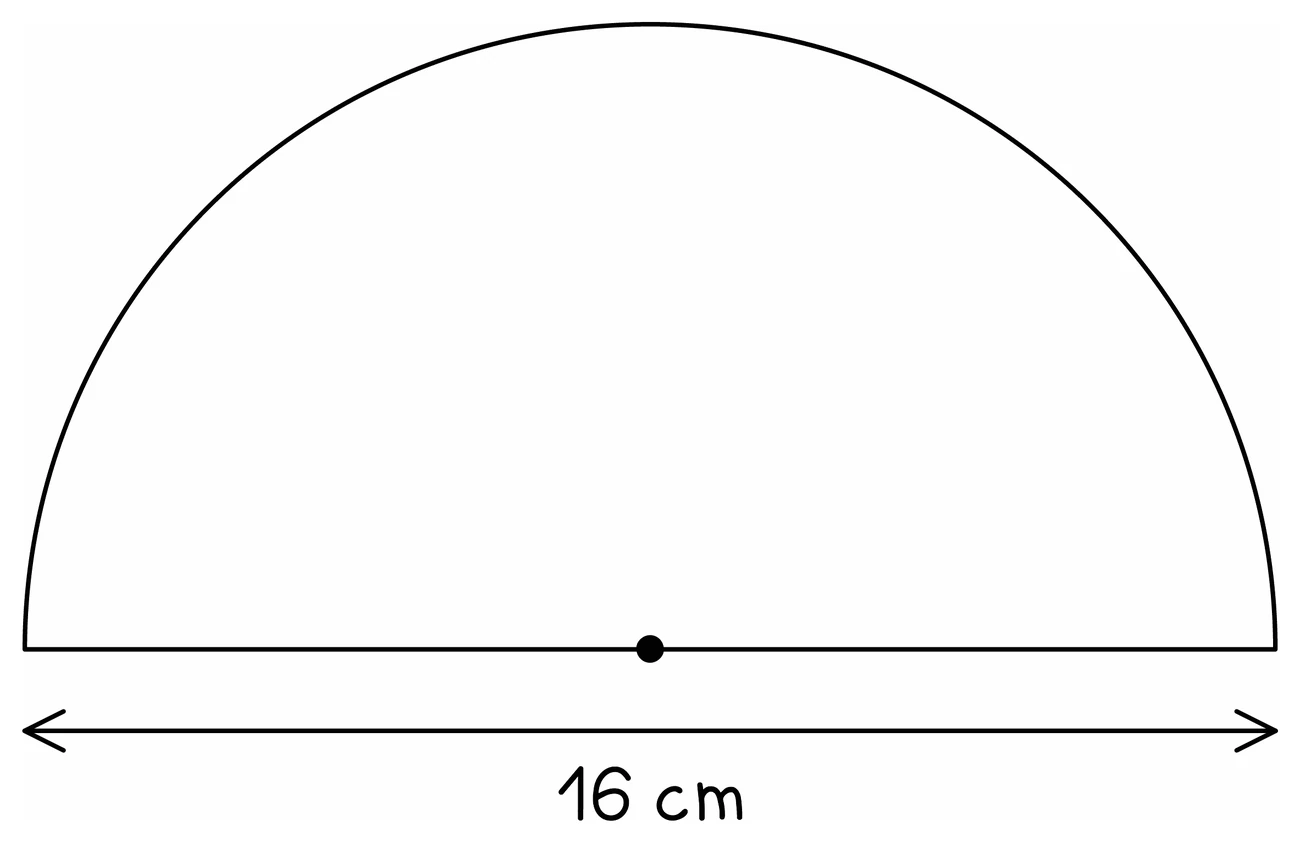
- A semicircle is half a circle, so work out the whole circle's area and take half of it
- Its perimeter is not half the circumference: it is the curved half plus the straight diameter across the bottom
- A semicircle of radius 6 cm has area 18π cm² and perimeter (6π + 12) cm
- A quarter circle works the same way, with two radii forming the straight edges
- Whenever a shape has a curved edge and a straight one, list the pieces of the perimeter before adding, so none is left out
Shapes built from circles
- Compound shapes combine circles or parts of circles with rectangles and triangles
- Add the pieces where the shape is built up, and subtract where a piece has been removed
- A shaded region between two circles with the same centre is the larger area minus the smaller
- Sketch the split and label each piece, since the separate areas carry the method marks
- Keep every part in terms of π until the end, which makes the final collecting much easier
Worked example
A semicircle's area and perimeter
A semicircle has diameter 12 cm. Find its area and its perimeter, in terms of π.
Solution:
- The radius is half the diameter, so r = 6 cm
- For the area, find the whole circle's area and halve it
- Whole circle: π × 6² = 36π
- Area of the semicircle = 36π ÷ 2 = 18π cm²
- The perimeter is not half the circumference: the straight edge counts too
- Curved part = half of 2π × 6 = 6π
- Straight part = the diameter = 12
- Perimeter = (6π + 12) cm
- Stopping at 6π is the standard error: it leaves out the 12 cm straight edge