Bearings, Constructions and Scale Drawings
Geometry
The three rules
- A bearing describes a direction, and it follows three rules without exception
- Measured from north
- Measured clockwise
- Written with three figures, so 59° is recorded as 059°
- Bearings therefore run from 000° round to 360°
- The compass directions have fixed bearings: north 000°, east 090°, south 180°, west 270°, with north-east 045°, south-east 135°, south-west 225° and north-west 315°
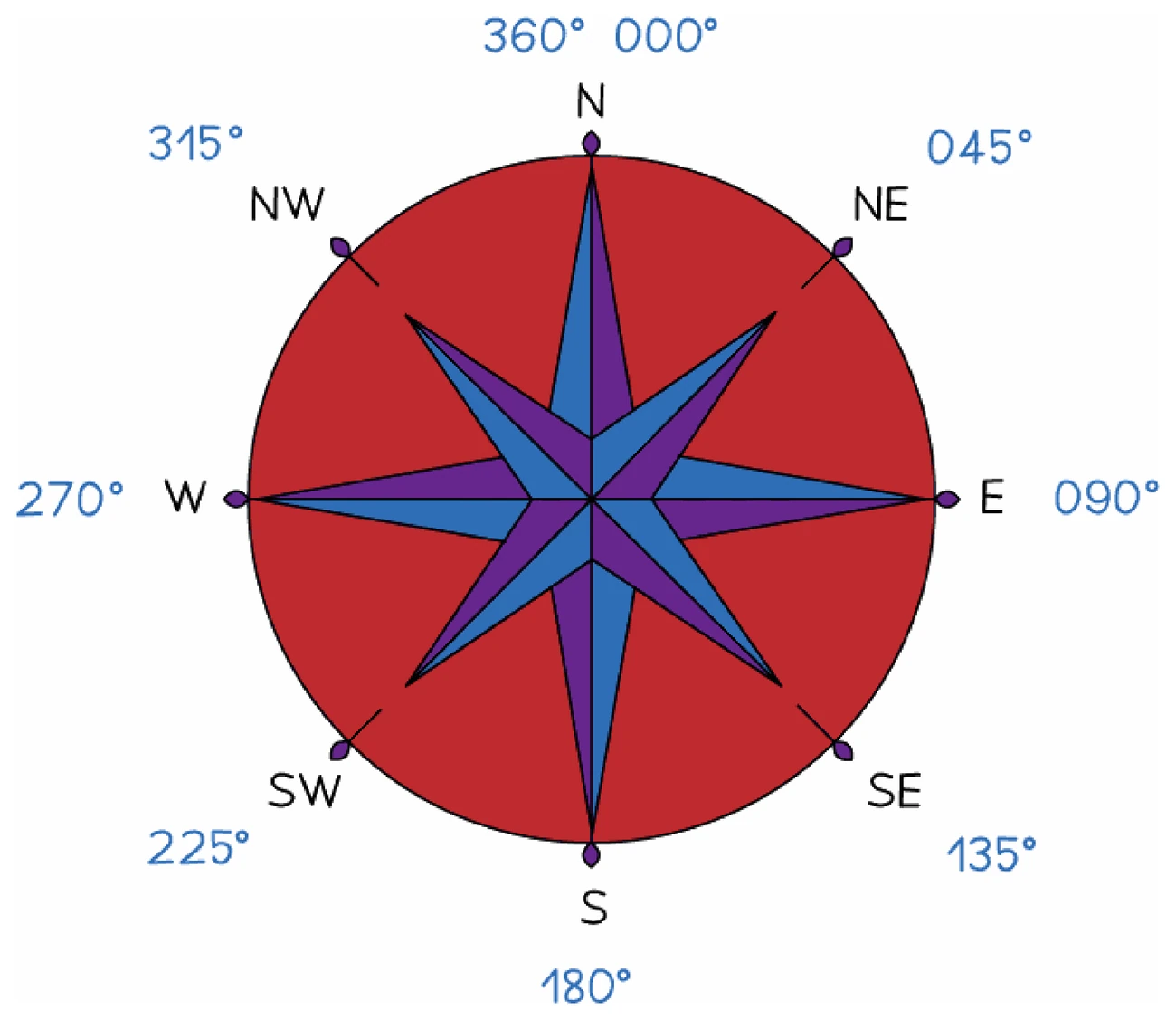
- "Due east" means exactly 090°, and the word "due" signals an exact compass direction
Which point to start from
- "The bearing of B from A" means stand at A and look towards B, so the north line is drawn at A
- The point after "from" is where the north line goes, and getting this the wrong way round reverses the answer
- To measure one, start by drawing north at wherever you are standing, join the two points, and take the clockwise angle with a protractor
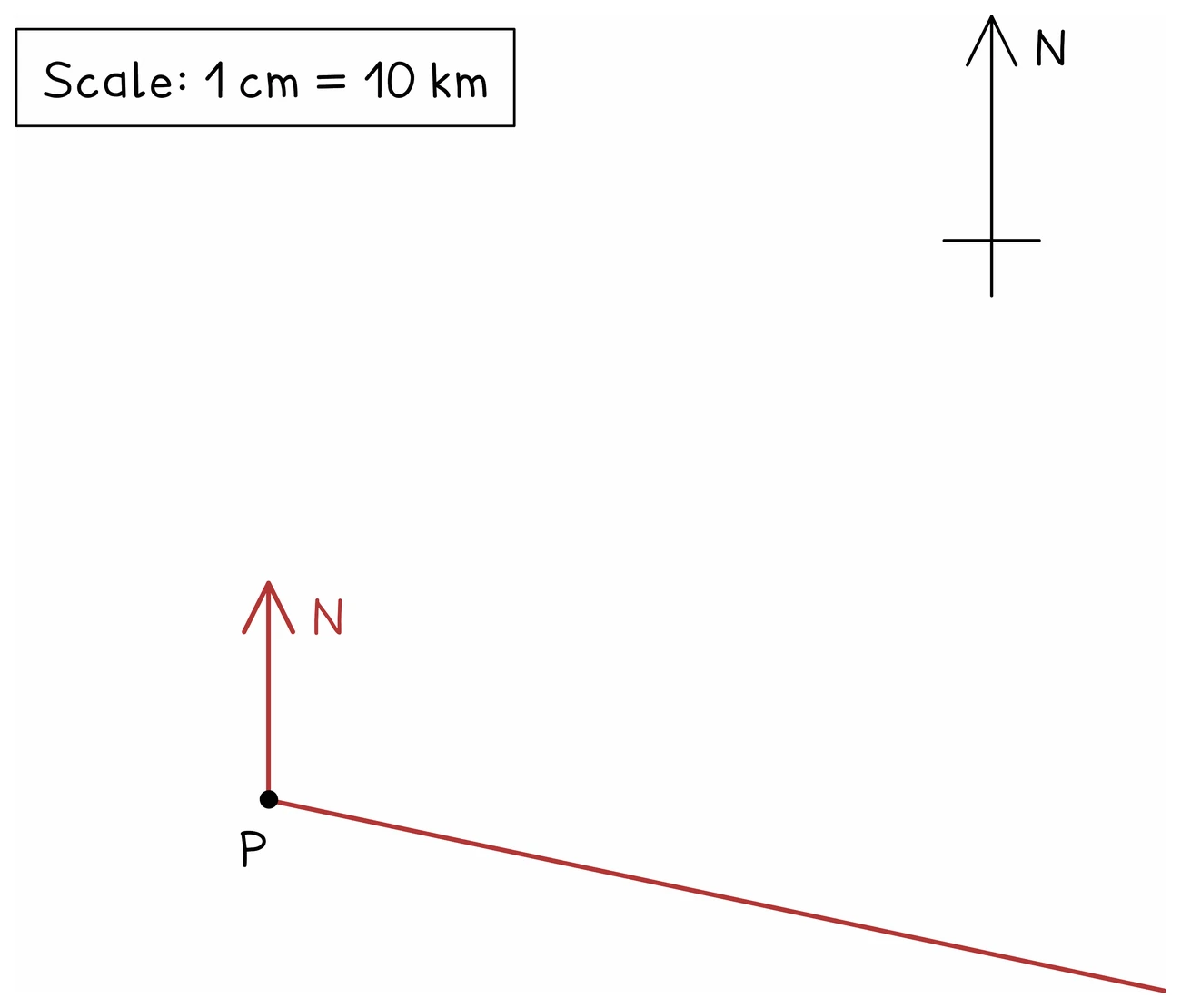
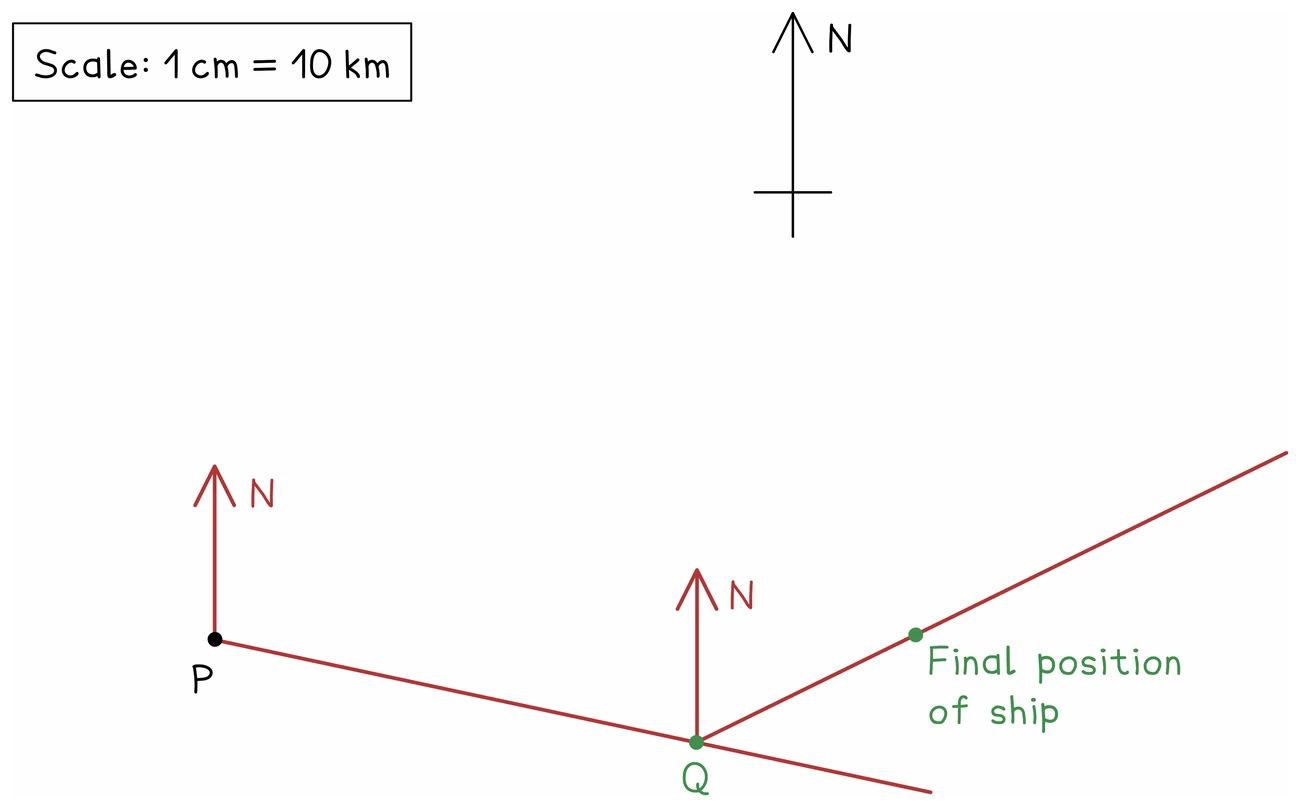
- To plot one, draw the north line, measure the angle clockwise, rule a long line, then mark the distance along it using the scale
Back bearings
- The bearing of A from B and the bearing of B from A always differ by exactly 180°
- Reverse a bearing below 180° by adding on a further 180°
- Reverse one above 180° by taking 180° away instead, which keeps the answer inside the 000° to 360° range
- The rule follows from the two north lines being parallel: the angle at A between north and AB and the angle at B between north and BA are co-interior, so they add up to 180°, and that puts the two bearings exactly 180° apart
Worked example
Reversing a bearing both ways
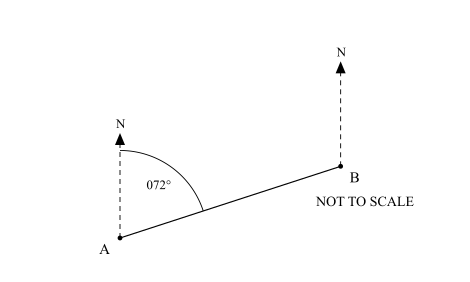
The bearing of B from A is 072°. The bearing of Q from P is 295°. Find the bearing of A from B, and the bearing of P from Q.
Solution:
- For the first, 072° is less than 180°, so add 180°
- 72 + 180 = 252, so the bearing of A from B is 252°
- For the second, 295° is more than 180°, so subtract 180°
- 295 − 180 = 115, so the bearing of P from Q is 115°
- Both answers are written with three figures and lie between 000° and 360°
- A question may give one bearing as an expression and the other as a number, which turns the same rule into an equation to solve
- Harder bearings questions combine this with Pythagoras or trigonometry, so draw and label a clear diagram before calculating
Worked example
A bearing from angles on a diagram
Points A, B and C are shown in the diagram. B is on a bearing of 118° from A, and angle ABC = 75°. Find the bearing of C from B.
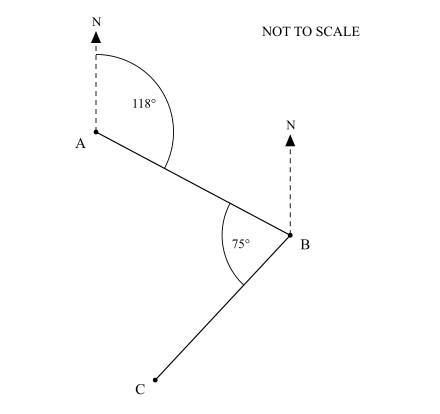
Solution:
- The bearing is measured from B, so work with the north line at B
- The north lines at A and B are parallel, so the bearing of A from B is the reverse of 118°: 118 + 180 = 298°
- Seen from B, the line to C is a further 75° anticlockwise from the line to A, so subtract: 298 − 75 = 223
- The bearing of C from B is 223°
- Check another way: the angle between north at B and BA is co-interior with the 118° at A, so it is 180 − 118 = 62°, and the clockwise angle from north round to BC is 360 − 62 − 75 = 223°
- C lies to the south and west of B, so its bearing must be between 180° and 270°, and 223° lies in that range
Exam tip
Mark the angle on the diagram as you work
Draw a north line at the point after "from" and mark the angle you want there, even when you then work the bearing out by calculation. The schemes give a mark for the correct angle shown in the right place on a sketch or on the printed diagram, so it can still score when the final bearing is wrong. Mark only the one angle you mean.