Mathematics (Core)Exam code: 0580
Transformations
Transformations
Doing and describing one
- A translation slides the shape without turning or resizing it, so the orientation is unchanged
- The movement is given as a column vector, with the top number the horizontal move and the bottom number the vertical one
- Positive top means right and negative means left; positive bottom means up and negative means down
- Move every vertex by the same vector, then join them up
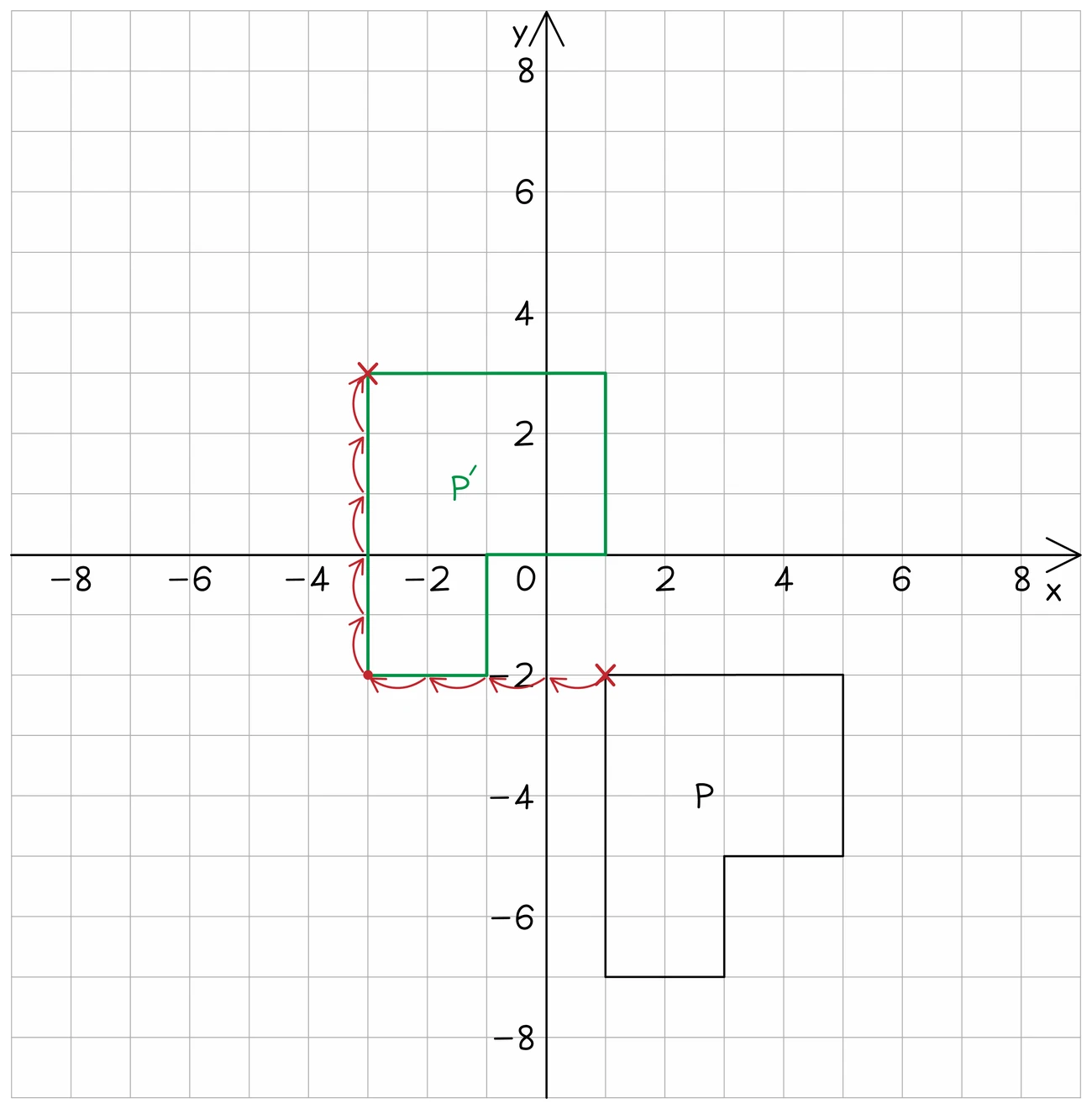
- To describe one, say translation and give the vector
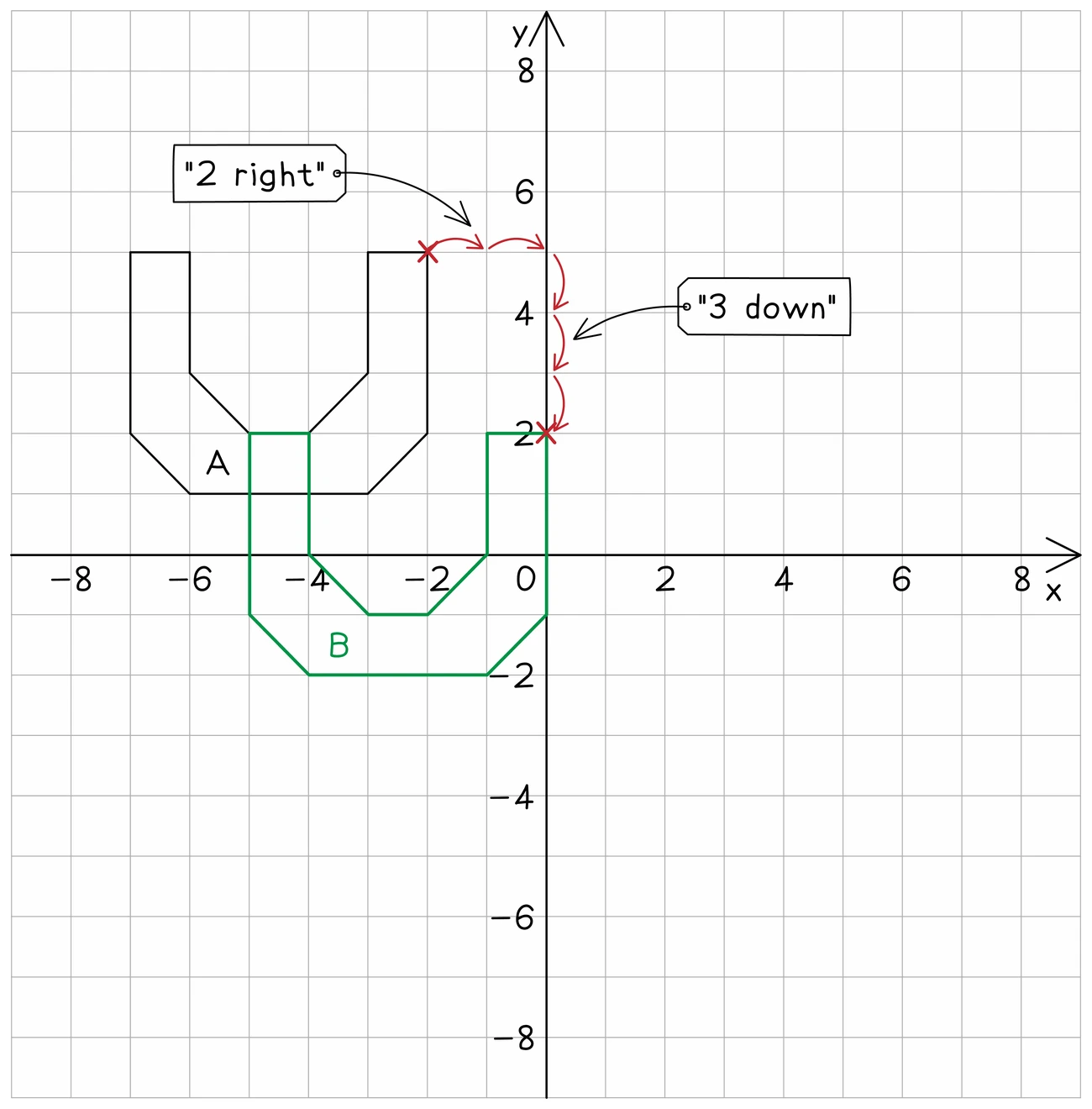
- Mark schemes also accept the movement in words, such as "2 right, 7 down"
Worked example
Translating by a column vector
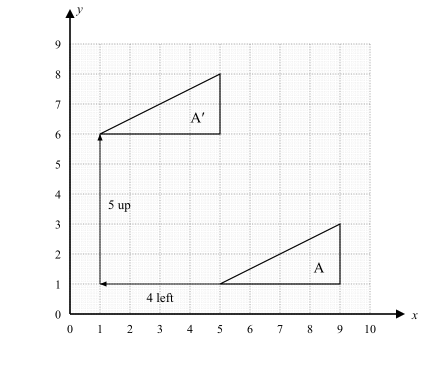
Triangle A has vertices (5, 1), (9, 1) and (9, 3). Draw the image of A after a translation by the column vector with top number −4 and bottom number 5.
Solution:
- The top number −4 means 4 squares to the left, and the bottom number 5 means 5 squares up
- Move every vertex by the same amount: (5, 1) goes to (5 − 4, 1 + 5) = (1, 6)
- In the same way, (9, 1) goes to (5, 6) and (9, 3) goes to (5, 8)
- Join the three points with a ruler: the image has vertices (1, 6), (5, 6) and (5, 8)
- Check: the image is the same size, shape and way round as A, and its base from (1, 6) to (5, 6) is horizontal and 4 long, like A's base from (5, 1) to (9, 1)
Worked example
Describing a translation
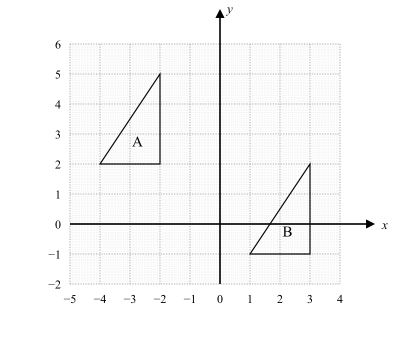
Triangle A has vertices (−4, 2), (−2, 2) and (−2, 5). Triangle B has vertices (1, −1), (3, −1) and (3, 2). Describe fully the single transformation that maps A onto B.
Solution:
- A and B are the same size, the same way up and not turned, so this is a translation
- Take one vertex of A and its matching vertex on B: (−4, 2) goes to (1, −1)
- Count from A to B: from −4 across to 1 is 5 to the right, and from 2 down to −1 is 3 down
- So the column vector has top number 5 and bottom number −3
- Check with a second pair: (−2, 5) goes to (3, 2), again 5 right and 3 down
- The answer is a translation by the column vector with top number 5 and bottom number −3
- Counting from B back to A gives the opposite signs, −5 and 3, so always count from the object to the image