Mathematics (Core)Exam code: 0580
Set Notation and Probability Diagrams
Probability
Building one
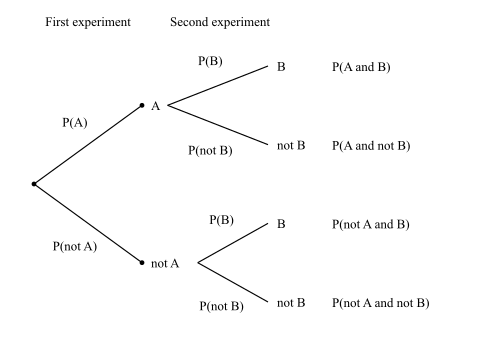
- A tree diagram sets out two or more stages, with a branch for each outcome at each stage
- The syllabus states the convention these papers follow: outcomes at the ends of the branches, probabilities beside them
- Each pair or group of branches from one point must add to 1, which fills in any missing probability
- When a question prints a tree diagram, it asks you to complete it first, and that alone carries marks
Reading one
- Follow one complete route across the diagram and multiply the probabilities you pass, which gives that path its own probability
- Add between separate paths when more than one outcome satisfies the question
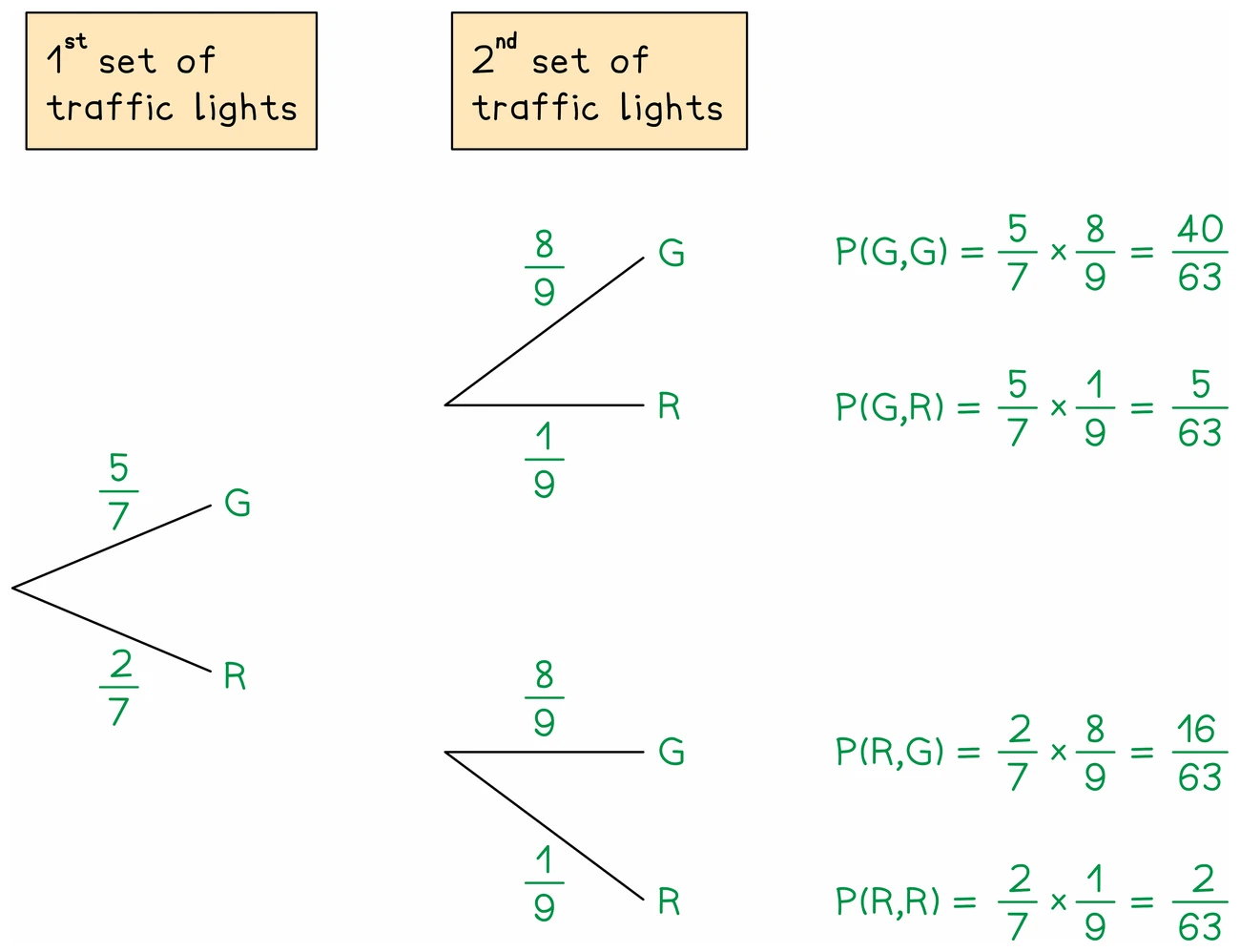
- The probabilities of all the complete paths add to 1
- In these papers the first stage never changes the second, so each second pair of branches carries the same probabilities whichever first branch it follows: the first pair again when one spinner or bag is used twice, or a new pair for a different event, like the second set of traffic lights above
Exam tip
Multiply the values on your tree
The probability of a route is marked from your own tree: writing the multiplication with the values on your branches, such as 3/8 × 3/8 below, earns the method mark even if one of them is wrong. So always write that line before the answer. It counts only while each value is a probability between 0 and 1, so a branch value such as 8/3 is a slip to fix first.
Worked example
Two spins on a tree diagram
A spinner has 3 red sections and 5 blue sections, all the same size. It is spun twice. Find the probability that both spins are red, and the probability that exactly one spin is red.
Solution:
- There are 8 sections, so each spin is red with probability 3/8 and blue with probability 5/8
- The spinner is unchanged between spins, so the second pair of branches repeats the first
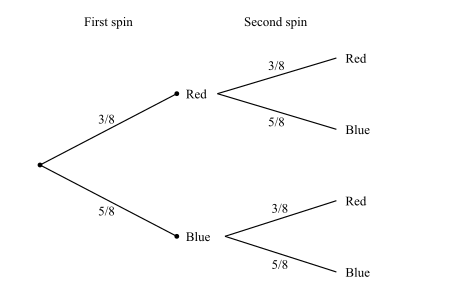
- Both red is a single route, so multiply along it: P(red, red) = 3/8 × 3/8 = 9/64
- Exactly one red happens two ways: red then blue, or blue then red
- P(red, blue) = 3/8 × 5/8 = 15/64, and P(blue, red) = 5/8 × 3/8 = 15/64
- Add the separate routes: 15/64 + 15/64 = 30/64 = 15/32
- Check: the four routes come to 9/64 + 15/64 + 15/64 + 25/64 = 1