Supply-side Policy
Government and the Macroeconomy · 1 question type
Supply-side policy is the use of government measures designed to increase the of the economy, so that it can produce more goods and services.
Fiscal policy and monetary policy work on aggregate demand: the total amount of spending in the economy. Supply-side policy works on the other side, on the economy's ability to produce. Instead of changing how much is being spent, it changes how much the economy is capable of making. On a production possibility curve, a successful supply-side policy shifts the whole curve outward, so the economy can produce more of both types of good.
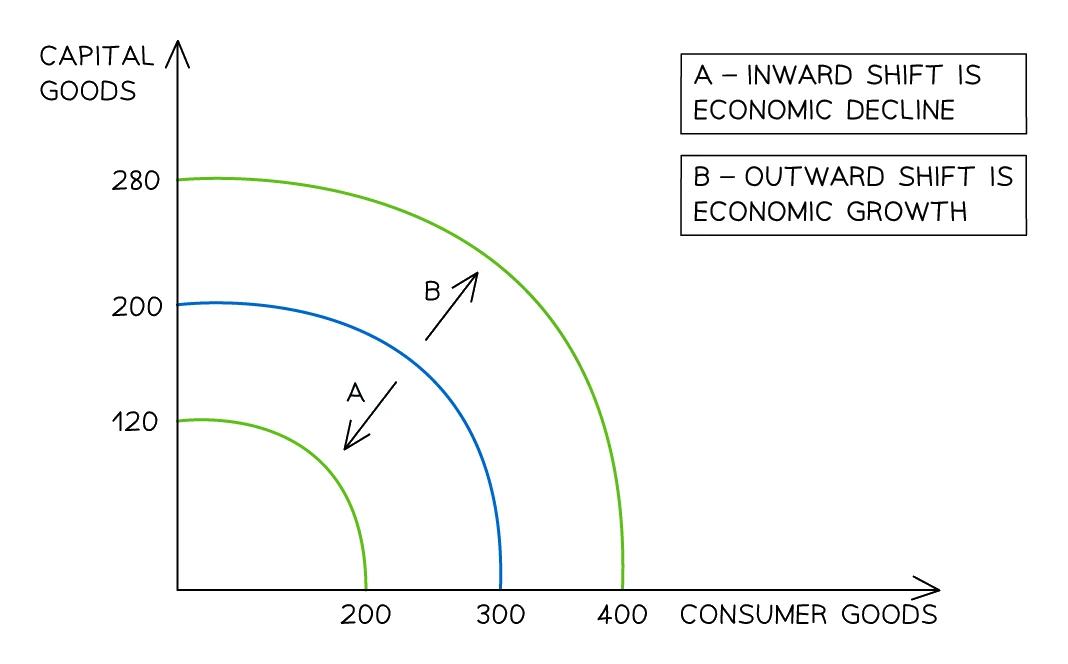
The attraction of supply-side policy is that it can raise output without the usual inflation problem. When a government pushes up demand too hard, prices rise. When it raises productive capacity instead, the economy can produce more at the same or lower cost, so growth comes with stable prices rather than higher ones. That is why supply-side measures are often described as the long-run route to the macroeconomic aims of topic 12.
The trade-off is time. Most supply-side measures take years to bear fruit, because they work by slowly changing the quantity and quality of resources, the skills of workers, and the efficiency of firms.