Price Elasticity of Demand (PED)
Allocation of Resources · 4 question types
Total revenue (TR) = Price × Quantity.
The same Price × Quantity figure can be read from two directions. To the firm it is (the money it takes in); to consumers it is their total expenditure (the money they spend on the good). The two are always equal, so everything that follows about a firm's revenue applies in mirror image to consumer spending: when a price change raises a firm's revenue, it raises consumer expenditure by exactly the same amount.
When a firm changes its price, two things happen at once:
- Price goes up (or down): that pushes TR up (or down).
- Quantity demanded goes down (or up): that pulls TR in the opposite direction.
Whether total revenue ends up higher or lower depends on which of the two effects is bigger, and that is exactly what PED measures.
The PED-TR rule
| If demand is... | A price rise does what to TR? | A price fall does what to TR? |
|---|---|---|
Inelastic (|PED| < 1) | TR rises (Qd falls only a little) | TR falls (Qd rises only a little) |
Unitary elastic (|PED| = 1) | TR unchanged | TR unchanged |
Elastic (|PED| > 1) | TR falls (Qd falls a lot) | TR rises (Qd rises a lot) |
The rule can also be shown as a calculation, which is how a question usually asks for it. Take a chocolate bar selling 1,000 bars a day at $2.00 each. The price rises to $2.20 and daily sales fall to 950.
- Before: TR = $2.00 × 1,000 = $2,000 a day
- After: TR = $2.20 × 950 = $2,090 a day
- PED = −5% ÷ +10% = −0.5, so demand is inelastic and total revenue rises by $90. Consumers now spend $2,090 a day instead of $2,000, which is the same $2,090 the firm receives as total revenue.
Now take a designer handbag selling 1,500 units a month at $200. The price rises to $240 and monthly sales fall to 900.
- Before: TR = $200 × 1,500 = $300,000 a month
- After: TR = $240 × 900 = $216,000 a month
- PED = −40% ÷ +20% = −2.0, so demand is elastic and total revenue falls by $84,000. Consumers spend $84,000 a month less on handbags, which is exactly the revenue the firm has lost.
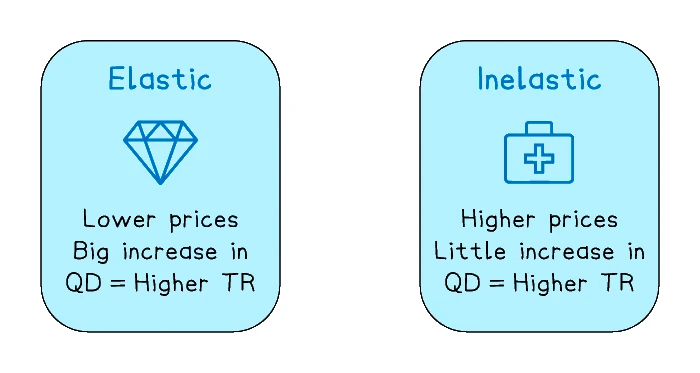
The simplest way to memorise it: price and TR move in the same direction when demand is inelastic; in opposite directions when demand is elastic.
PED and total revenue (a recurring MCQ and explain question)
What comes up: "Which PED value would cause total revenue to rise when the price increases?" or "Explain one advantage of producing a good with price-inelastic demand."
Write: when demand is price-inelastic (|PED| < 1), a price rise leads to a less than proportionate fall in quantity demanded, so total revenue (price × quantity) rises. When demand is price-elastic (|PED| > 1), a price rise leads to a more than proportionate fall in quantity demanded, so total revenue falls. If |PED| = 1 (unitary elastic), total revenue is unchanged when price changes.
Watch out: a common slip is saying that inelastic demand means quantity demanded does not change at all — it does fall, just by a smaller percentage than the price rise. The mark scheme specifically credits the idea of a "less than proportionate" fall in quantity, not "no change." Also note: the advantage of inelastic demand is that a price rise increases revenue; the disadvantage is that a price cut reduces revenue (since quantity rises by less than the price falls).
What firms should do
A firm that knows its PED can pick its pricing strategy.
- Selling an inelastic good? Raise the price. The fall in quantity sold is smaller than the rise in price, so TR rises.
- Selling an elastic good? Cut the price. The rise in quantity sold is larger than the fall in price, so TR rises.
The same rule explains why some firms charge different customer groups different prices for a similar service. A train operator can charge more at peak times, when commuters have few alternatives and demand is inelastic, and less off-peak, when demand is elastic and a lower fare attracts many extra passengers. In each case the firm is applying the PED-revenue rule to the group in front of it.