Price Elasticity of Demand (PED)
Allocation of Resources · 4 question types
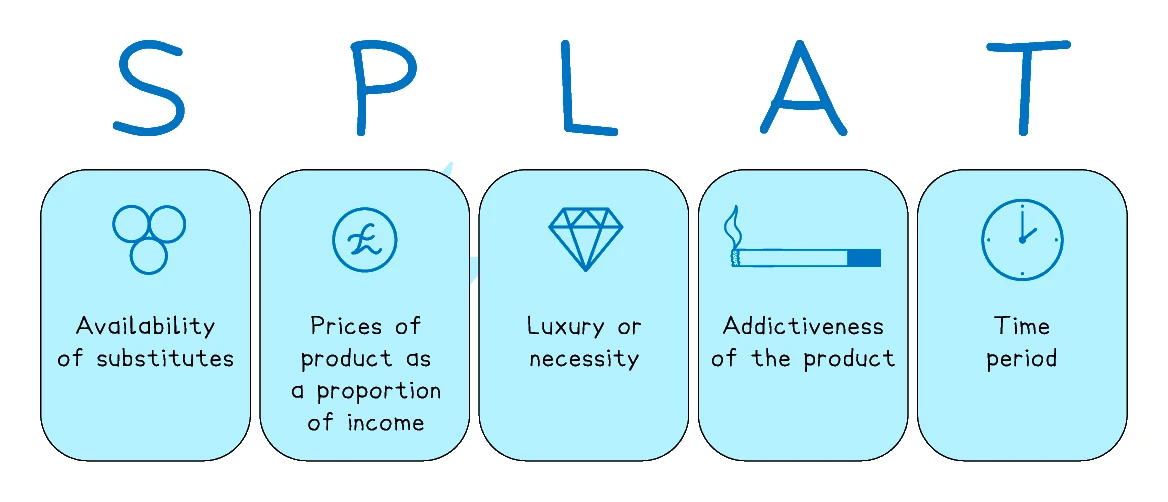
The PED of a good depends on five non-price factors. The mnemonic SPLAT is the one most commonly used.
| Letter | Stands for | Effect on PED |
|---|---|---|
| S | Substitutes (number and closeness) | More (and closer) substitutes → demand is more elastic (consumers can switch easily). Fewer substitutes → more inelastic. |
| P | Proportion of income spent on the good | A good that takes a large share of consumer income → more elastic (consumers notice the price rise). A small share → more inelastic. |
| L | Luxury or necessity | Luxuries (designer bags, holidays, expensive electronics) → more elastic (consumers can do without). Necessities (basic food, medicine) → more inelastic. |
| A | Addictiveness / habit / brand loyalty | Addictive or habit-forming products (cigarettes, caffeine, gambling) → more inelastic (consumers keep buying despite price rises). Strong brand loyalty has a similar effect. |
| T | Time period | Short run: more inelastic (consumers cannot change habits or find substitutes quickly). Long run: more elastic (alternatives are found, habits change). |
A trap that examiners specifically test:
- A change in the price of substitutes is a demand shifter (topic 4), not a PED determinant. The number and closeness of substitutes is the PED determinant. The two phrases sound similar but mean different things.
- A change in income shifts the demand curve. The proportion of income the good represents is what determines its PED.
Identify or explain two determinants of PED
What comes up: "Identify two determinants of price elasticity of demand" (2 marks) or "Explain two influences on PED" (4 marks, one mark per factor identified plus one mark per explanation).
Write (two marks): any two from: (1) availability of close substitutes (more substitutes → more elastic); (2) whether the good is a luxury or a necessity (luxury → more elastic); (3) proportion of income spent on the good (larger share → more elastic); (4) whether it is habit-forming or addictive (addictive → more inelastic); (5) time period (longer run → more elastic as consumers find alternatives).
Watch out: "a change in the income of consumers" is NOT a determinant of PED — it shifts the demand curve instead. The mark scheme credits the proportion of income the good represents (a fixed characteristic of the good), not a change in income. Similarly, "a change in the price of substitutes" is not a PED determinant; the number and closeness of substitutes is.