Population
Economic Development
A growing population has both benefits and costs. A typical "discuss" question rewards a balance of both.
Benefits of a rising population
- Larger workforce. More working-age adults can produce more output. Potential GDP rises.
- Larger domestic market. Firms have more customers and can spread fixed costs over more units (economies of scale).
- More innovation. A larger talent pool produces more entrepreneurs, scientists and skilled workers.
- Higher tax base. More workers means more income tax and VAT revenue to fund public services.
- Counters ageing. Growth through the immigration of working-age people reduces the dependency ratio.
Costs of a rising population
- Pressure on housing. Faster population growth than housing supply pushes up rents and prices.
- Pressure on public services. Schools, hospitals, GP surgeries, transport must expand to keep up.
- Pressure on resources. Water, energy, raw materials are all consumed faster.
- Environmental damage. More pollution, more emissions, more congestion, faster depletion of natural resources.
- Strain on infrastructure. Roads, rail, broadband all need extra capacity.
- Possible falling output per head. If population grows faster than GDP, GDP per capita falls even though total GDP rises.
The optimum population
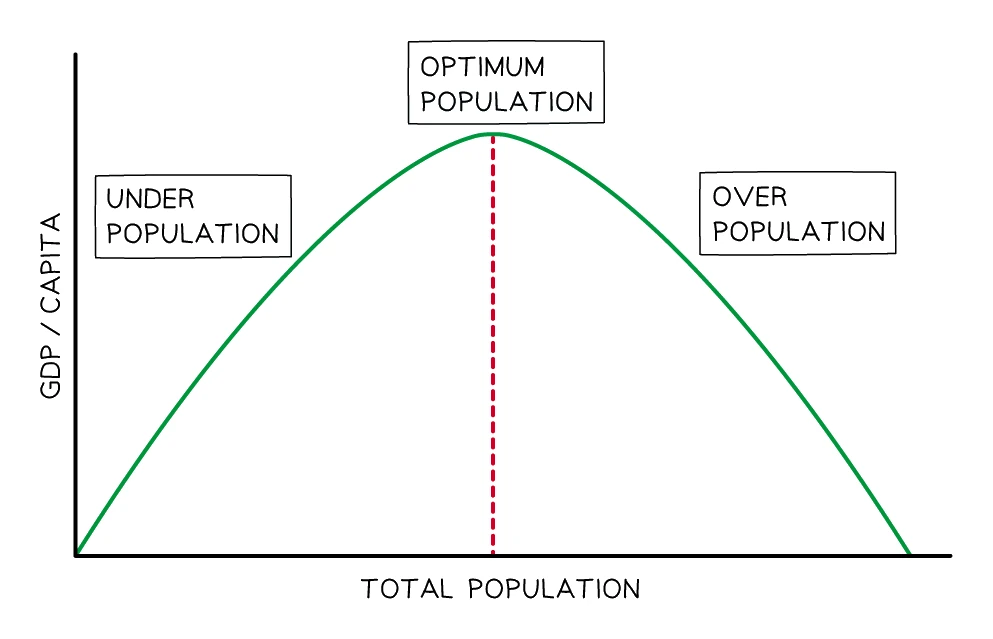
The optimum population is the size of population that, with the country's existing resources and technology, produces the highest output per head.
If a country is below its optimum, adding people raises output per head, because there are resources (land, capital) standing idle that the extra workers can use. If a country is above its optimum, adding more people lowers output per head, because the existing resources have to be shared among more workers. The optimum is not fixed: a rise in the capital stock, better technology or the discovery of new resources all raise the optimum population, so a number that was "too many" in one decade can be productively employed in the next.
Effects of a falling population
A population falls either through natural decrease (deaths exceeding births) or through net emigration. The cause matters: emigration-led decline removes working-age and often skilled people first, so its effects arrive quickly, while a low birth rate takes a generation to shrink the workforce.
Costs:
- Shrinking labour force. Fewer workers means lower potential output and slower long-run growth.
- Smaller domestic market. Fewer consumers means weaker aggregate demand, and firms lose economies of scale as output falls, so unit costs rise.
- Falling demand for housing and land. Prices and rents fall, which helps buyers but cuts the wealth of existing owners.
- Smaller tax base. Fixed public costs and any national debt are spread over fewer taxpayers, so the burden per head rises.
- Regional decline. Where the fall is concentrated, schools, shops and transport services close because too few people use them, which encourages further emigration.
Benefits:
- Less pressure on housing, public services and infrastructure, so existing capacity goes further per person.
- Less strain on the environment: lower congestion, less pollution and slower depletion of natural resources.
- Possible rise in output per head. This depends on the optimum population: a country above its optimum moves back towards the peak, so GDP per capita rises, while a country already below its optimum moves further away and GDP per capita falls.
Whether population growth is "good" or "bad"
The right answer depends on whether investment and productivity keep pace with the rising population, and on whether the country is below or above its optimum.
- If a country adds 1% to its population each year and invests enough to keep the capital stock, housing, infrastructure and public services growing at the same rate, the rising population is broadly positive. Output per head can hold steady or rise.
- If the population grows faster than investment, output per head falls: the new workers do not have the tools, capital or infrastructure they need to be productive.
This is the Malthusian concern: that population growth tends to outpace the resources needed to support it, dragging down living standards. The modern view is more nuanced: with enough investment in technology, education and capital, population growth need not impoverish a country, but it does require active policy.
Common exam question
Whether a larger or smaller population helps
Question: Discuss whether a country gains from a larger or fast-growing population, explain how firms gain, or identify benefits of a smaller population (2–8 marks).
Asked in 4 of the 11 structured papers. For: a bigger labour force raises output and tax revenue; more consumers raise total demand; firms gain a bigger market, economies of scale and easier recruitment. Immigrants may bring new skills. Below the optimum population, extra people use resources better.
Against: congestion, pollution, pressure on housing and welfare spending, inflation, and extra people who cannot find work; above the optimum, resources run down faster. It turns on where the extra people come from: working-age immigrants can lower the dependency ratio, while more births or longer lives add dependants and raise it. The 6-mark version allows up to 4 marks a side; the 8-mark one needs both sides developed.
A smaller population reverses these: fewer dependants, less pressure on resources and pollution, lower government spending.