Exam Frequency Analysis
Past paper frequency (2018 to 2024)
This topic accounts for approximately 13% of your exam marks.
stable
High
Stable13%
Comparative advantage, free trade benefits, and protectionist tools (tariff, quota, subsidy) appear regularly in Section B evaluate questions.
Protectionism is government policy that restricts imports to shelter domestic industries from foreign competition.
Even countries that publicly support free trade use some protectionism in practice, usually for politically sensitive sectors (agriculture, steel, certain manufactured goods). The IGCSE syllabus expects familiarity with the main tools and their effects.
The main protectionist tools
1. Tariff (import duty).
A tariff is an import duty: a per-unit charge added to the price of foreign goods at the border, which makes domestic alternatives more attractive.
Effects:
- Imports become more expensive; quantity of imports falls.
- Domestic producers gain market share.
- Government collects tariff revenue.
- Consumers pay higher prices.
A tariff is a tax, so it raises money for the government. This is one of its appeals.
2. Quota.
A quota is a physical limit on the quantity of a good that can be imported in a given period. For example, "no more than 100,000 cars from country X this year".
Effects:
- Quantity of imports is capped directly.
- Domestic producers gain market share.
- Consumers face higher prices (since imports are scarcer).
- The government collects no revenue (unlike a tariff) unless the quota rights are auctioned.
3. Subsidy to domestic producers.
A government payment that lowers the cost of producing the good at home. The domestic price falls; domestic firms can compete with, or even undercut, imports.
Effects:
- Domestic output rises (S shifts right).
- Domestic producers receive both revenue from sales and the subsidy from the government.
- Imports lose market share.
- The government bears the cost of the subsidy.
4. Embargo.
A complete ban on imports of a particular good from a particular country. Used in extreme cases (sanctions, war, public-health bans).
Effects:
- All imports from the targeted source stop.
- Domestic producers (or imports from non-targeted countries) fill the gap.
- Consumers face higher prices and reduced choice.
5. Other tools.
- Administrative barriers: paperwork, certification, customs delays that effectively block imports.
- Quality standards: set high enough that imports cannot easily comply.
- Voluntary export restraints: informal agreements where the exporting country agrees to limit its sales.
- Exchange-rate manipulation: keeping the domestic currency artificially weak to make exports cheap and imports expensive.
How a tariff works on a diagram
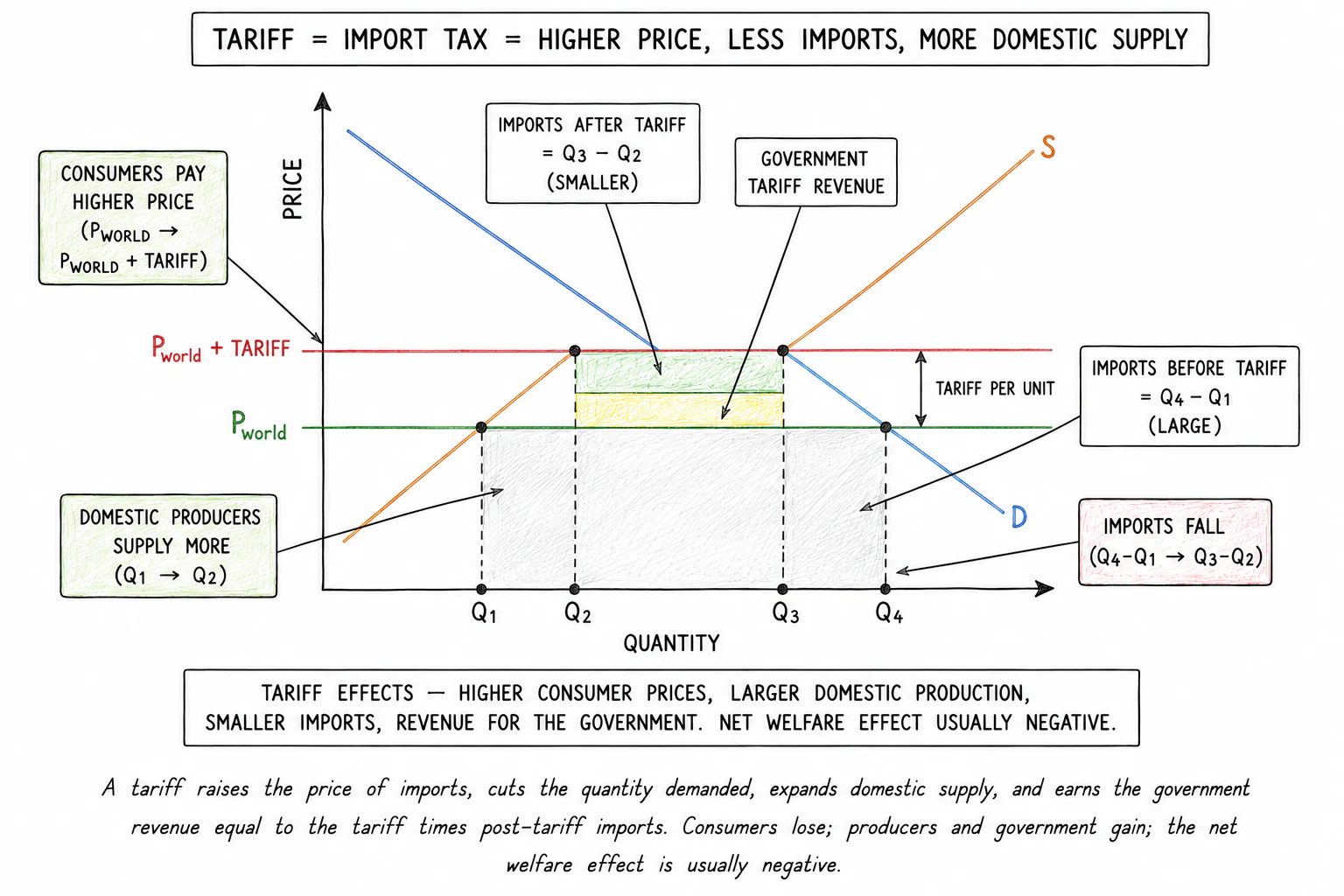
On a market diagram, a tariff:
- Raises the price paid by domestic consumers by the amount of the tariff.
- Reduces quantity demanded of the good (extension up the demand curve).
- Increases quantity supplied by domestic firms (extension up the supply curve).
- The gap between domestic demand and domestic supply at the new price is the reduced quantity of imports.
- The rectangle formed by the tariff × quantity of imports is the tariff revenue to the government.
The net welfare effect is usually negative: consumer losses outweigh producer and government gains because some trade is choked off that would have benefited both sides.