Specialisation & Free Trade
International Trade & Globalisation
Free trade is international trade between countries with no government-imposed barriers to the flow of goods and services: no tariffs, no quotas and no restrictive subsidies.
Free trade is what specialisation points toward if a country follows the logic to its conclusion: produce what you are best at, and buy everything else from wherever it is cheapest. In practice almost no country has completely free trade with every partner; most combine low barriers with some protected sectors.
Advantages of free trade
A typical "explain the benefits of free trade" question rewards distinct benefits affecting different groups.
For consumers:
- Lower prices. Imports add competition, so domestic firms must keep prices down to compete.
- Wider choice. Consumers can buy goods that could not be produced at home, such as tropical fruit in cold countries or advanced electronics in countries without those industries.
- Better quality. Foreign competition pushes domestic firms to raise their standards.
For firms:
- Larger markets. Exporters can sell to the whole world, not just their domestic population, allowing them to expand output and gain economies of scale.
- Cheaper inputs. Firms can import the cheapest raw materials, machinery and components from anywhere, lowering their costs of production.
For the economy as a whole:
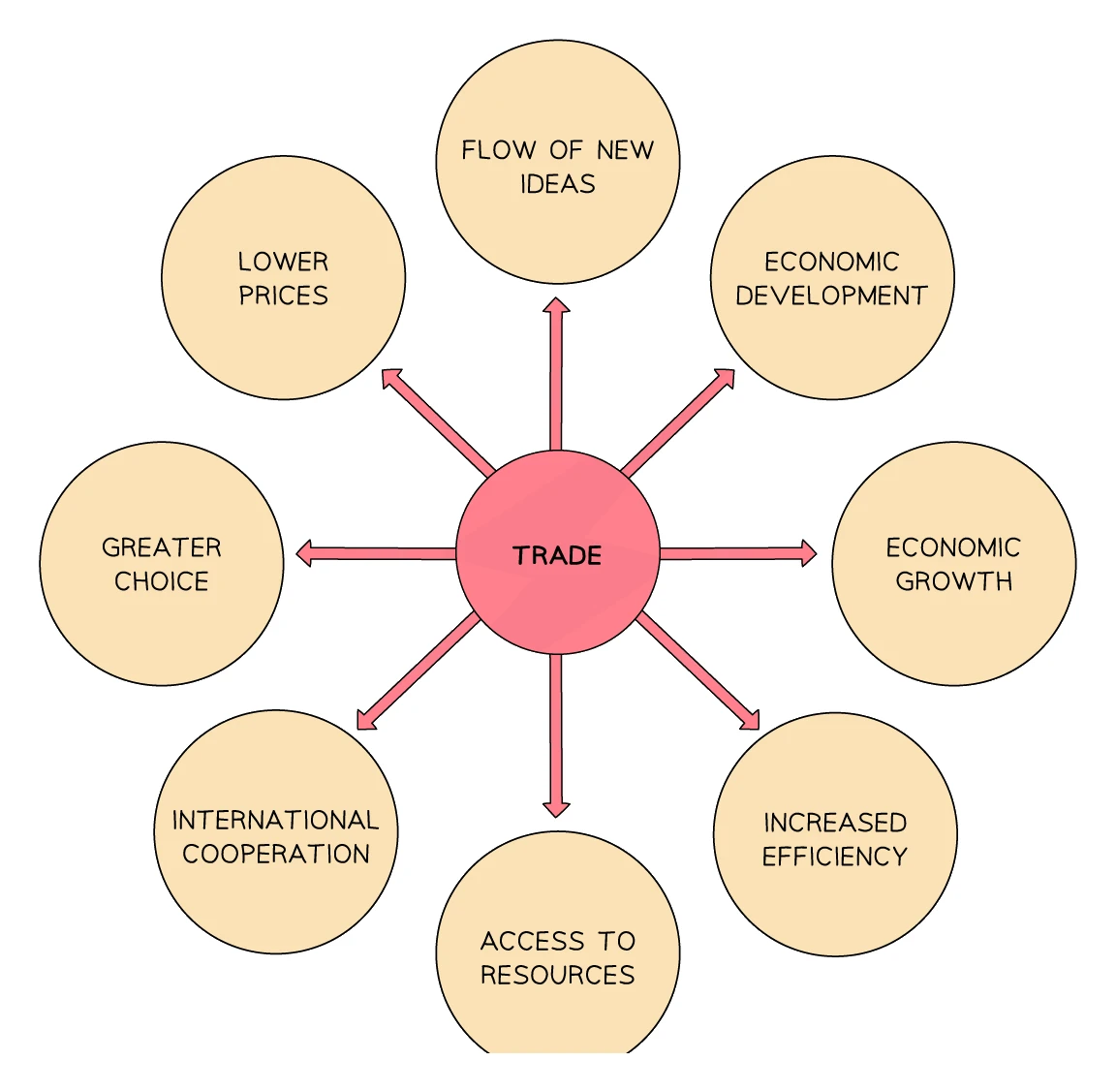
- Faster economic growth. Export earnings finance imports of capital goods, and competition raises productivity, both of which lift GDP.
- More efficient use of resources. Resources flow toward the industries where the country is most productive.
- Transfer of ideas and technology. Contact with foreign firms spreads new techniques and designs.
Taken together, these gains spread across consumers, firms and the wider economy, as the diagram summarises.
Disadvantages of free trade
Free trade is not costless, and honest "discuss" answers acknowledge the drawbacks.
- Structural unemployment in domestic industries that cannot compete with imports.
- Over-dependence on foreign suppliers for essential goods.
- Harm to infant industries. New industries may be wiped out by established foreign rivals before they have a chance to grow.
- Loss of strategic industries, such as the ability to produce food, energy or defence equipment.
- Wider inequality, as the gains may flow disproportionately to skilled workers and to firms in the country's strongest industries.
- Environmental costs from long transport chains and from production in countries with weaker regulation.
The standard view is that free trade raises total welfare but creates winners and losers, so it works best alongside policies that help those who lose out to adjust.
Exam tip
Discuss whether free trade benefits an economy (8 marks)
What comes up: "Discuss whether or not free trade benefits a country" (or "increases economic growth") — an 8-mark question needing both sides and a supported judgement.
Write: Cover at least two developed points on each side, then judge.
Why it benefits: free trade lets a country specialise where it is most efficient (1), raising total output (1); competition from imports forces domestic firms to cut costs and raise quality (1), making them more productive (1); firms gain access to larger markets (1), enabling economies of scale and lower average costs (1); firms can import cheaper raw materials and capital goods (1), reducing production costs (1).
Why it may not: free trade can prevent infant industries from developing because they cannot yet compete with foreign rivals (1); it can speed the closure of declining industries, causing structural unemployment (1); imports may replace domestic output, reducing domestic GDP in the short run (1); a country may become over-dependent on foreign suppliers for essentials (1).
Judgement: state whether the benefits outweigh the costs and why, for example that free trade tends to benefit the economy in the long run because competition and specialisation permanently raise efficiency, provided the government supports workers displaced from declining industries.
Watch out: a one-sided answer is capped below the top band. Each point needs development, not just identification.