Firms & Production
Microeconomic Decision Makers · 2 question types
To produce, a firm must hire the four factors of production: land, labour, capital and enterprise. A firm's demand for any factor is a derived demand: the firm does not want the factor for its own sake, but for the output it helps to produce. Several influences decide how much of a factor a firm demands.
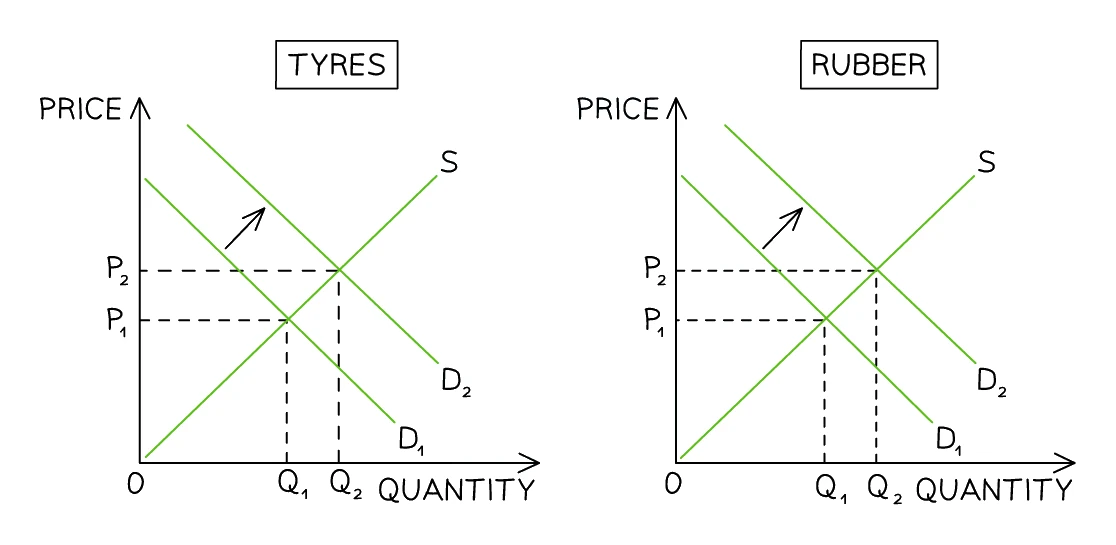
Because demand is derived, a rise in demand for a final product feeds straight through to the inputs used to make it. When demand for tyres rises (from D₁ to D₂), the price and quantity of tyres both rise; and because tyres are made from rubber, demand for rubber shifts out in the same way, raising its price and quantity too.
| Influence | How it affects demand for the factor |
|---|---|
| Demand for the product | A rise in demand for the product (higher total demand / economic activity) raises demand for the factors used to make it. |
| Price of the factor | A lower price of a factor tends to raise the quantity of it demanded; a higher price reduces it and may push the firm towards a cheaper substitute factor. |
| Price of other factors | If capital becomes cheaper than labour, firms switch towards capital, lowering demand for labour, and the reverse. |
| Availability of the factor | If a factor is scarce or hard to obtain, firms may have to demand alternatives. |
| Productivity of the factor | A more productive factor (better-trained workers, more advanced machines) is worth more to the firm, so demand for it rises. |
Explain influences on demand for factors of production (4 marks)
What comes up: "Explain two influences on the demand for factors of production" — a 4-mark question, one identification and one explanation mark for each of two influences.
Write (two marks each): (1) Demand for the product produced (1) — a rise in demand for the product is likely to raise demand for the factors used to make it, because demand for factors is a derived demand (1). (2) The price of the factor itself (1) — a lower price will tend to raise the quantity of that factor demanded (1). The mark scheme also credits productivity of the factor and the method of production chosen.
Watch out: Develop each influence with its effect on demand, and use the term derived demand where it fits. Listing influences without explaining the direction of the effect earns only the identification marks.