Differences in Development between Countries
Economic Development · 4 question types
Topic 16 introduced some of these. The gap between developed and developing countries usually involves several reinforcing factors at once.
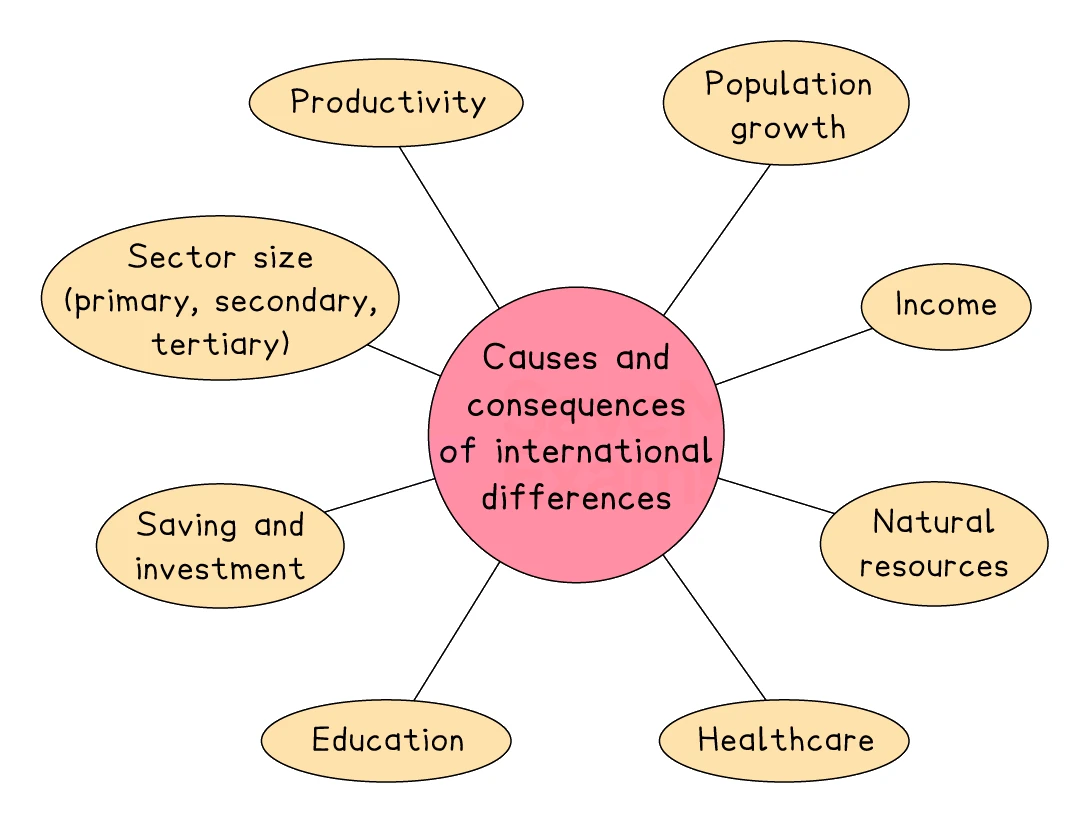
Differences in physical capital
Developed countries have more machinery, factories, infrastructure, transport networks and communication systems per worker. A worker with better tools produces more output per hour. The accumulated capital stock is the result of decades of investment, and investment requires saving, which is harder in low-income countries where most income is spent on immediate needs.
Differences in human capital
Developed countries have higher levels of education, training and healthcare. A more educated workforce is more productive; a healthier workforce works more hours and learns faster. Most developing countries have made huge progress in human capital over recent decades, but gaps remain in tertiary education and specialised skills.
Differences in technology and innovation
Developed countries are usually the source of new technologies (R&D investment, patents, world-class research universities). Developing countries can adopt technology from elsewhere, but the adoption is rarely as fast or as complete as making it in-house.
Natural resources (with the resource-curse caveat)
Natural resources can support development (Norway's oil wealth, Australia's mineral exports, Saudi Arabia's hydrocarbons). But they do not guarantee it. The resource curse describes how some resource-rich countries actually grow slower than resource-poor ones:
- Commodity-price volatility. A country heavily dependent on one resource swings between booms and busts.
- . A strong export of one commodity raises the exchange rate, making other industries (manufacturing, services) less competitive.
- Corruption and rent-seeking. Resource wealth concentrates in the hands of those who control the resource, which can fuel corruption.
- Failure to diversify. Countries that focus on one commodity may neglect the institutions, education and infrastructure needed for broader growth.
Resource-rich countries that diversify, save resource revenues sensibly, and maintain strong institutions (Norway) escape the curse. Those that do not (some African oil exporters) stay poor despite the wealth.
Political stability, governance and institutions
- Political stability encourages investment because firms need predictability before committing capital.
- Rule of law protects property and contracts. Without it, firms cannot trust their investments will pay off.
- Low corruption ensures public spending reaches public services.
- Stable democracy (or stable governance more generally) avoids policy reversals and conflict.
Countries with weak institutions struggle to develop even when they have other advantages.
Trade patterns and dependence
Many developing countries are trade-dependent on a narrow range of primary exports. This creates two risks:
- Volatile export earnings, as commodity prices swing widely.
- Slow-growing world demand: as global incomes rise, extra spending goes mostly to manufactured goods and services rather than basic commodities, so demand for primary exports grows only slowly and the country's relative income stagnates.
Countries that diversify into manufacturing and services tend to grow faster than those stuck in primary exports.
Analyse: causes of differences in economic development between countries
What comes up: A 6-mark Analyse question asks for the causes of differences in economic development between countries. Each mark point needs a factor plus its development chain.
Write: Pick two or three factors and chain each one. (1) Education: countries with higher education levels have a more skilled and productive workforce, creating better job opportunities and higher purchasing power. (2) Healthcare: stronger healthcare systems reduce worker absences and raise life expectancy, sustaining productive capacity. (3) Population growth rate: rapid population growth increases the dependency ratio, reducing the resources available per worker for investment in capital and services. (4) Sector structure: a large primary sector yields lower value added per worker than secondary or tertiary production — countries dominated by agriculture therefore generate lower income and development. (5) Government expenditure and FDI in infrastructure, education and healthcare directly raises productivity and creates employment, breaking the low-income trap.
Watch out: Do not confuse economic growth (rise in GDP) with economic development (broader improvement in living standards and wellbeing). The mark scheme explicitly states these are not the same — reward the development dimension.
Demographic structure
A country with a young dependency-heavy population (many children per worker) has less to invest in capital and infrastructure. A country with a (a large working-age share with few dependants) can grow rapidly. Most developing countries are somewhere in transition between these states.