Boolean Logic and Expressions
Boolean Logic
Given a circuit, the safest method is to label each gate's output with its Boolean sub-expression, working from the inputs through to the final output.
Method. (1) Identify each gate and the signals feeding it. (2) Working left to right, write the output of each gate as a Boolean sub-expression using its input labels. (3) Use that sub-expression as the input to any gate it feeds. (4) The final gate's output is the expression for
Q.
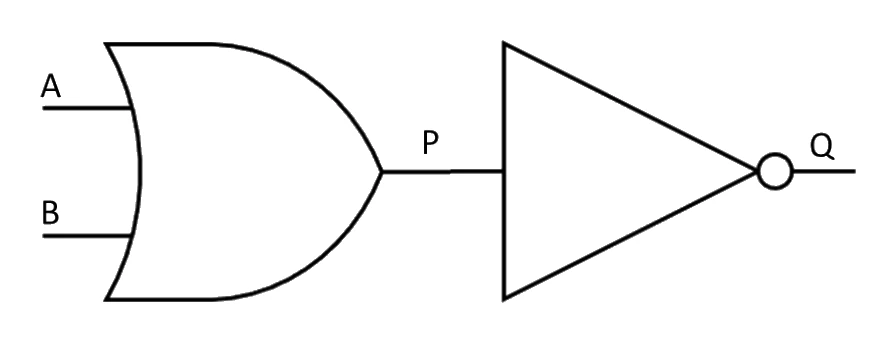
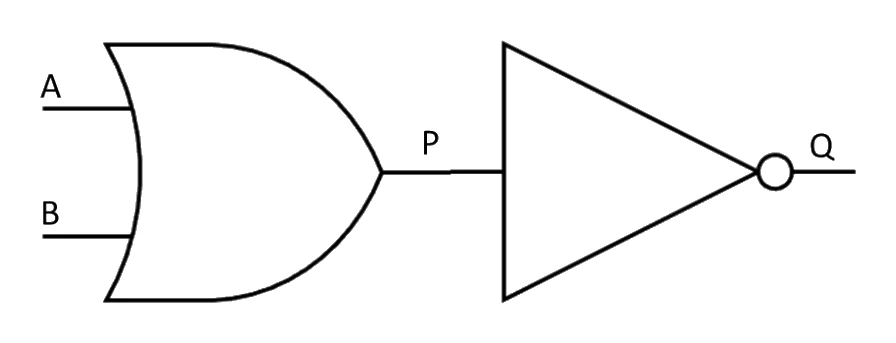
A second circuit to work through: label the OR gate's output P, and the following NOT gate then gives the final output Q.
Exam tip
Writing a logic expression for a circuit (do not simplify)
What comes up: you are given a logic circuit and asked to write the logic expression for its output (often worth around four marks).
Write: label the output of each gate as a Boolean sub-expression, working left to right from the inputs; feed each sub-expression into the next gate it connects to, so that the final gate's output becomes the whole expression for the output (Q or X). Any accepted notation scores: a dot or nothing for AND (A·B or AB), + for OR, and an overbar, ¬ or ' for NOT.
Watch out: the paper almost always tells you "do not simplify" — write the expression exactly as the circuit is wired, gate for gate, keeping the brackets that match how the gates are grouped. Simplifying is not asked for, earns no extra marks, and risks introducing an error that costs the marks you had already secured.