Human Impact on the Environment
Ecology and the Environment · 8 question types
The biggest environmental challenge of the 21st century is caused by rising levels of greenhouse gases in the atmosphere.
The natural greenhouse effect
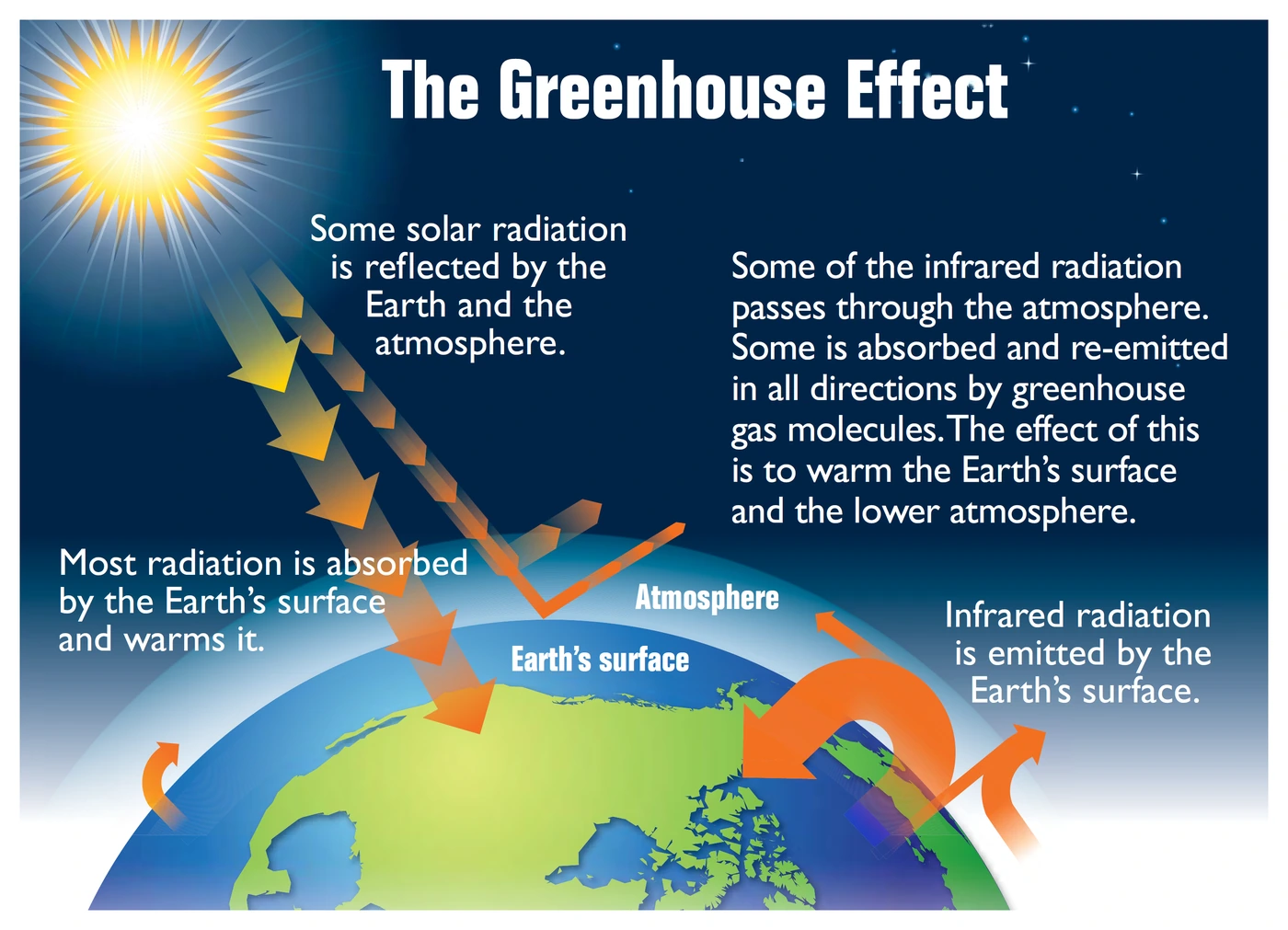
The Earth would be far too cold to support life without the natural . Here is how it works:
- The Sun emits high-energy radiation (mostly visible light) towards the Earth.
- Most of this passes through the atmosphere and reaches the surface.
- The Earth's surface absorbs the energy and warms up.
- The warm surface re-emits the energy as lower-energy infrared radiation (heat).
- Some of the infrared radiation escapes back to space.
- Some is absorbed by greenhouse gases in the atmosphere (carbon dioxide, water vapour, methane and others). The trapped energy keeps the lower atmosphere warm.
The natural greenhouse effect keeps the Earth's average surface temperature at about 15 °C instead of the -18 °C it would otherwise be. Without it, the oceans would be ice and there would be no life.
The enhanced greenhouse effect
The problem is not the natural greenhouse effect itself, but the enhanced version of it that humans have created by adding extra greenhouse gases to the atmosphere. The most important human-emitted greenhouse gases are:
| Gas | Where it comes from | Notes |
|---|---|---|
| Carbon dioxide (CO₂) | Burning fossil fuels (coal, oil, gas); deforestation; cement production | The single biggest contributor by volume |
| Methane (CH₄) | Cattle (and other ruminants) burping; rice paddies; landfills; leaks from natural gas pipelines | Around 25× more powerful than CO₂ per molecule but present in much smaller quantities |
| Nitrous oxide (N₂O) | Agricultural fertilisers; some industrial processes | Around 300× more powerful than CO₂ but very minor in total |
| Water vapour | The atmosphere holds more water vapour as it warms (a feedback loop) | The dominant natural greenhouse gas, but humans do not directly emit it |
| CFCs (chlorofluorocarbons) | Old refrigerators, aerosol sprays | Banned by the Montreal Protocol (1987); now declining |
The result of adding all these extra greenhouse gases is that more infrared radiation is trapped in the atmosphere, and the Earth's average temperature is rising. Atmospheric CO₂ has risen from about 280 ppm in 1750 to over 420 ppm today, and global average temperature is about 1.2 °C above pre-industrial levels.
Explain how greenhouse gases cause global warming
What comes up: "explain how greenhouse gases cause global warming" or "explain how carbon dioxide contributes to climate change" — typically 2 marks.
Write (two marks): (1) greenhouse gases such as carbon dioxide and methane absorb (trap) infrared radiation re-emitted from the Earth's surface, preventing it from escaping into space; (2) this causes the temperature of the Earth's atmosphere to rise (global warming).
Watch out: the mark scheme requires absorbs/traps infrared radiation — a vague answer like "heats up the Earth" or "warms the atmosphere" on its own does not score the mechanism mark. Also, carbon monoxide is not a greenhouse gas and is explicitly rejected by the mark scheme, so do not list it as an example.
Consequences of climate change
A warming planet has many cascading effects:
- Melting polar ice and glaciers, raising sea levels and threatening coastal cities and low-lying countries
- Warming oceans, which expand and add further to sea-level rise
- Coral bleaching: corals expel the algae they depend on when water is too warm, turning white and often dying
- More frequent and severe extreme weather: heatwaves, droughts, wildfires, storms, flooding
- Shifts in habitats and species ranges: some species move towards the poles or to higher altitudes; those that can't, decline or die out
- Disruption to food chains and loss of as ecosystems struggle to adapt at the speed change is happening
- Spread of disease: warmer climates allow tropical diseases (malaria, dengue) to spread to new areas
- Crop failures in regions hit by drought; some agricultural land becomes unproductive
What is being done
Reducing emissions is the only long-term solution. International agreements (Kyoto Protocol, Paris Agreement) have set targets for emission reduction. National measures include:
- Renewable energy (wind, solar, hydro, nuclear) replacing fossil-fuel power stations
- Electric vehicles replacing petrol and diesel cars
- Insulation of buildings to reduce heating energy
- Reforestation to absorb CO₂ from the atmosphere
- Carbon capture (still experimental) to remove CO₂ from power station exhaust