Human Impact on the Environment
Ecology and the Environment
Eutrophication is the over-enrichment of a body of water with nutrients, leading to the collapse of its ecosystem. It is the leading cause of dead zones in lakes, rivers and coastal seas worldwide.
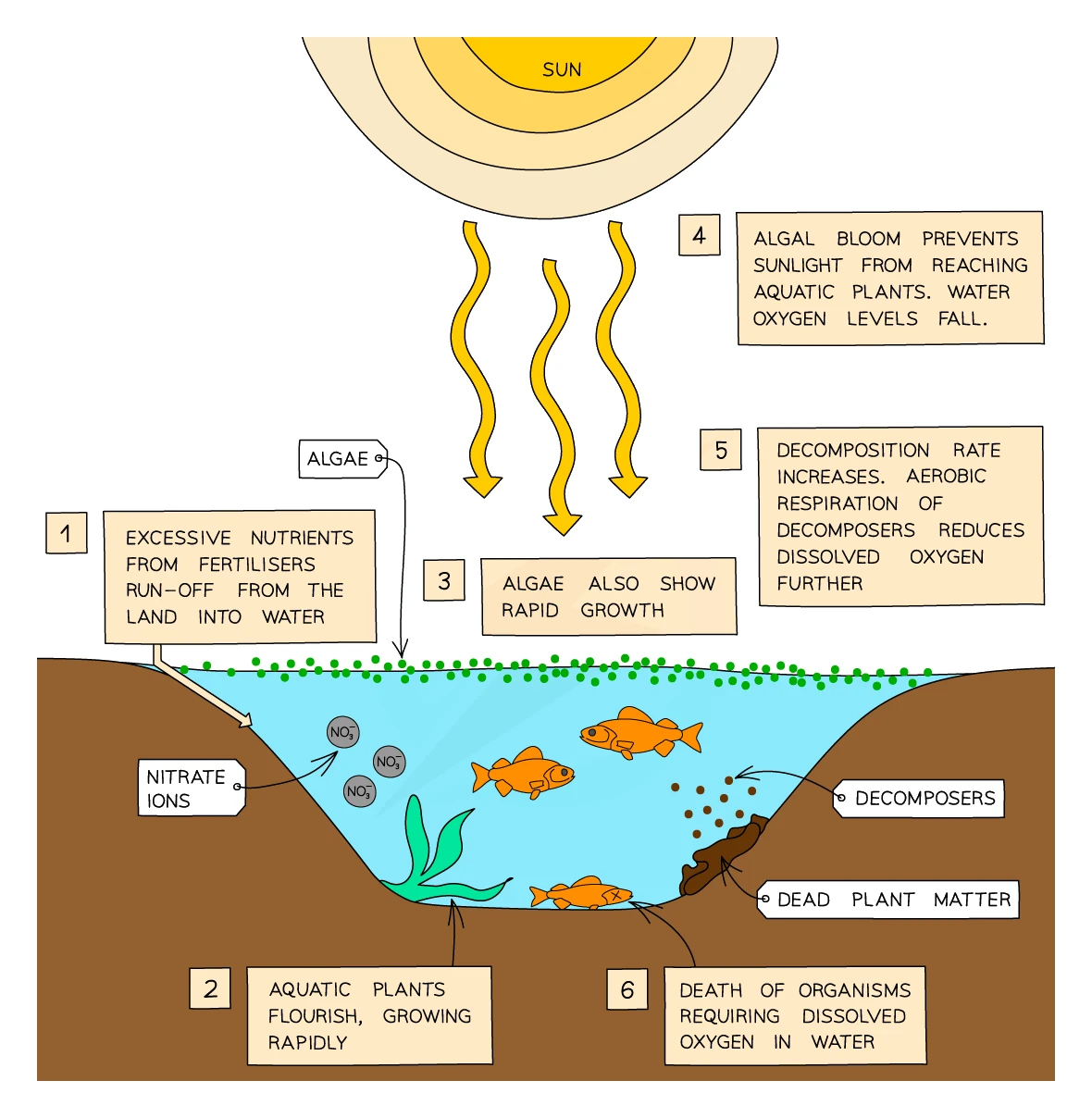
The five-step sequence
- Excess nutrients (nitrate and phosphate) enter a body of water. Most commonly from agricultural fertilisers washed off fields by rain, or from sewage containing detergents.
- The extra nitrates and phosphates cause explosive growth of algae at the water surface (an algal bloom).
- The thick algal layer blocks sunlight from reaching the deeper-water plants. Those plants cannot photosynthesise and die.
- The dead plants and (later) the algae are broken down by decomposer bacteria. The decomposers multiply rapidly and use up the dissolved oxygen in the water as they respire.
- Fish, invertebrates and other aquatic animals suffocate because there is no longer enough oxygen in the water. The water body becomes a "dead zone".
Common exam question
Eutrophication after fertiliser leaches into a river
Question: Describe or explain how fertiliser, or a rise in nitrate, washing into a river or lake affects the aquatic ecosystem (3–5 marks).
Asked in 4 of the 23 papers, all on Paper 2, and marked as a chain, one mark per link, so give every link in order: nitrate (and phosphate) leaches or runs off into the water; algae grow rapidly into an algal bloom (name eutrophication, a mark of its own in one scheme); the bloom blocks light, so underwater plants cannot photosynthesise and die; bacteria decompose the dead material; their respiration uses up the dissolved oxygen; fish and other animals die.
Two schemes give separate marks for the bacteria, their respiration and the fall in oxygen, so a bare "the oxygen runs out" leaves marks behind. Say nitrate, not "nutrients", which two schemes ignore. The same chain scores for a fish farm; for sewage only its second half does, as bacteria feed on the sewage itself.
Why fertilisers are the main culprit
Modern agriculture uses huge amounts of nitrogen-based fertiliser to maximise crop yields. Plants only absorb a fraction of the applied nitrate; the rest stays in the soil and is leached out by rainfall into rivers and groundwater. Even small fields can release enough nitrate to disturb a downstream lake.
Phosphates from older washing detergents used to make the problem worse; phosphate-free detergents have largely solved this part of the problem in the UK, but agricultural runoff remains the dominant source.
Where eutrophication happens
- Lakes and slow rivers in farming areas
- Coastal seas at the mouths of large rivers draining intensive agricultural land. The Gulf of Mexico has a dead zone the size of New Jersey every summer, fed by nitrate runoff from the Mississippi River
- The Baltic Sea, surrounded by farming countries, has experienced widespread eutrophication
Solutions
- Reduce fertiliser use by applying only as much as the crop will absorb, at the right time of year
- Buffer strips: leave strips of grass and trees along rivers and ditches to absorb runoff before it reaches the water
- Improve sewage treatment to remove nitrate and phosphate before discharging treated water
- Use phosphate-free detergents (now standard in the UK)
- Restore wetlands that naturally filter excess nutrients