1. Work done
What it means to "do work"
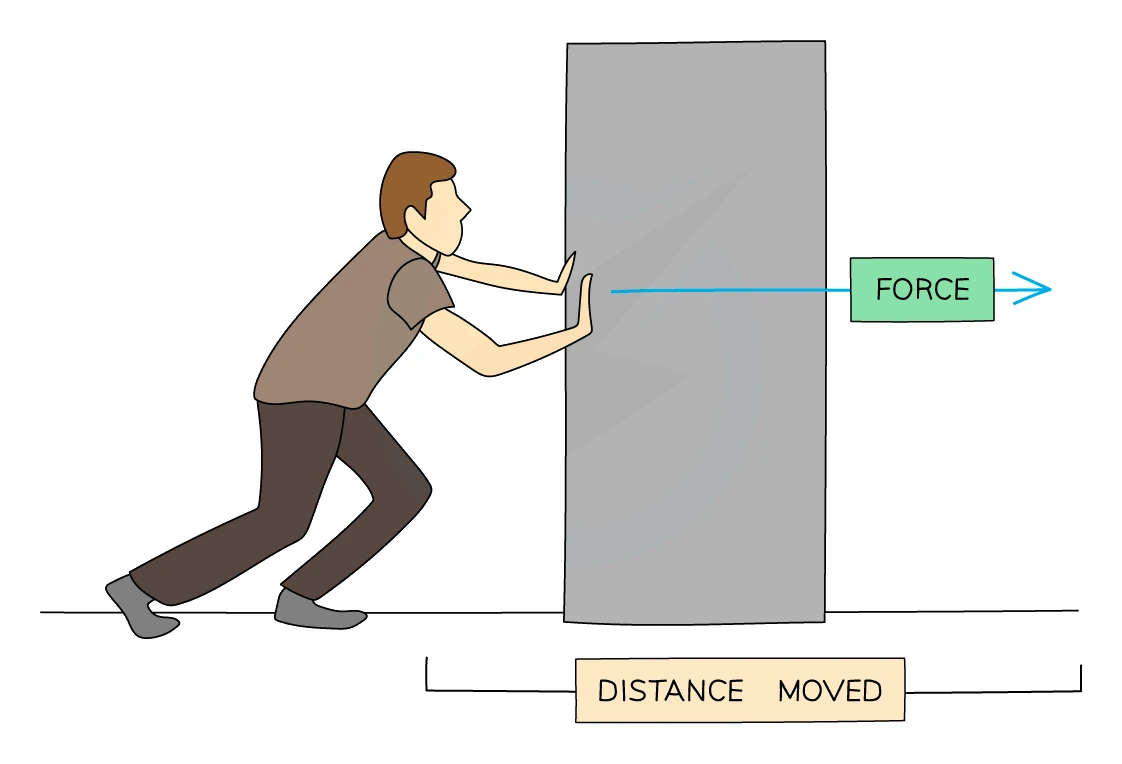
- Work is done whenever a force moves the object it is acting on through a distance in the direction of that force
- If the force does not move the object, no work has been done. Pushing on a stationary wall for ten minutes transfers no energy to the wall, no matter how tired your arms feel
- "Doing work" is just the mechanical pathway in different language. The amount of work done equals the amount of energy transferred between stores:
energy transferred = work done
- Both quantities are measured in joules (J); 1 J = 1 N m (one newton acting through one metre)
Sign of the energy transfer
- If a force acts in the same direction as the motion, the object gains energy (usually into its kinetic store, sometimes into gravitational potential if it is being lifted)
- If a force acts in the opposite direction to the motion, the object loses energy; in everyday cases this is friction or drag dissipating energy as heat into the surroundings
- Lifting a 5 kg sack of flour onto a kitchen shelf does work against gravity and fills the sack's gravitational potential store; sliding a box across a carpet does work against friction and dumps that energy into the thermal stores of the carpet and the box
The work-done equation
W = F × d
- where:
- W = work done (J or N m)
- F = force acting on the object (N)
- d = distance the object moves in the direction of the force (m)
- Use SI units throughout (newtons and metres); the result then comes out in joules
Common exam question
Calculating work done, or the force from it
Question: State the formula connecting work done, force and distance moved, then calculate the work done or the force (1 mark for the formula, 2–3 for the working).
Set in 4 of the 24 papers. The formula mark is separate and takes words or standard symbols: work done = force × distance moved, or W = F × d. The calculation is marked in steps, substitution, rearrangement when the force is the unknown, then evaluation, and a powers-of-ten slip (a kilojoule value left unconverted, a distance left in centimetres) loses one mark. One scheme gives its first mark just for turning centimetres into metres. In a "show that" part, write the unrounded value before rounding it to the target.
Work done equals energy transferred, so when a later part simply says "state the work done" after an energy has been given or found, the answer is that energy. The schemes credit the earlier value, with no calculation wanted.
Worked example
Calculating force from work done and distance
A motorised winch does 48 000 J of work pulling a crate 20 m along level ground. Calculate the force the cable exerts on the crate.
Solution:
- Write the equation: W = F × d
- Substitute: 48 000 = F × 20
- Rearrange: F = 48 000 ÷ 20
- F = 2400 N
2. Gravitational potential energy
Definition
- Gravitational potential energy (GPE) is the energy an object holds because of its position in a gravitational field, specifically its height above some chosen reference level (usually the ground or floor)
- Lifting an object pushes energy into its gravitational store; letting an object fall pulls energy out
The GPE equation
GPE = m × g × h
- where:
- GPE = energy in the gravitational potential store (J)
- m = mass of the object (kg)
- g is the gravitational field strength of the planet (N/kg). On Earth's surface, g ≈ 10 N/kg
- h = height above the chosen reference level (m)
- g is given on the exam equation sheet; the Moon's g is about 1.6 N/kg, Jupiter's surface (where there is one) feels about 25 N/kg
Common exam question
Calculating GPE, or the height from it
Question: State the formula for gravitational potential energy, then calculate the energy an object gains when it is lifted, or the height it rises for a stated gain in energy (1 mark for the formula, 3 for the working).
Set in 4 of the 24 papers. Write GPE = m × g × h; standard symbols are accepted, but call g the gravitational field strength, because "gravity" is ignored. When no separate formula part is set, writing the formula is the first of the three marks; otherwise the three are substitution, rearrangement (for a height) and evaluation, in either order, with g = 9.8 N/kg accepted as well as 10 N/kg.
The mass must be in kilograms. A mass left in grams is a powers-of-ten error that costs one mark, and only once if the same slip runs on into a later step, but that leniency does not cover a physics error such as leaving g out altogether.
Why GPE is linear in h
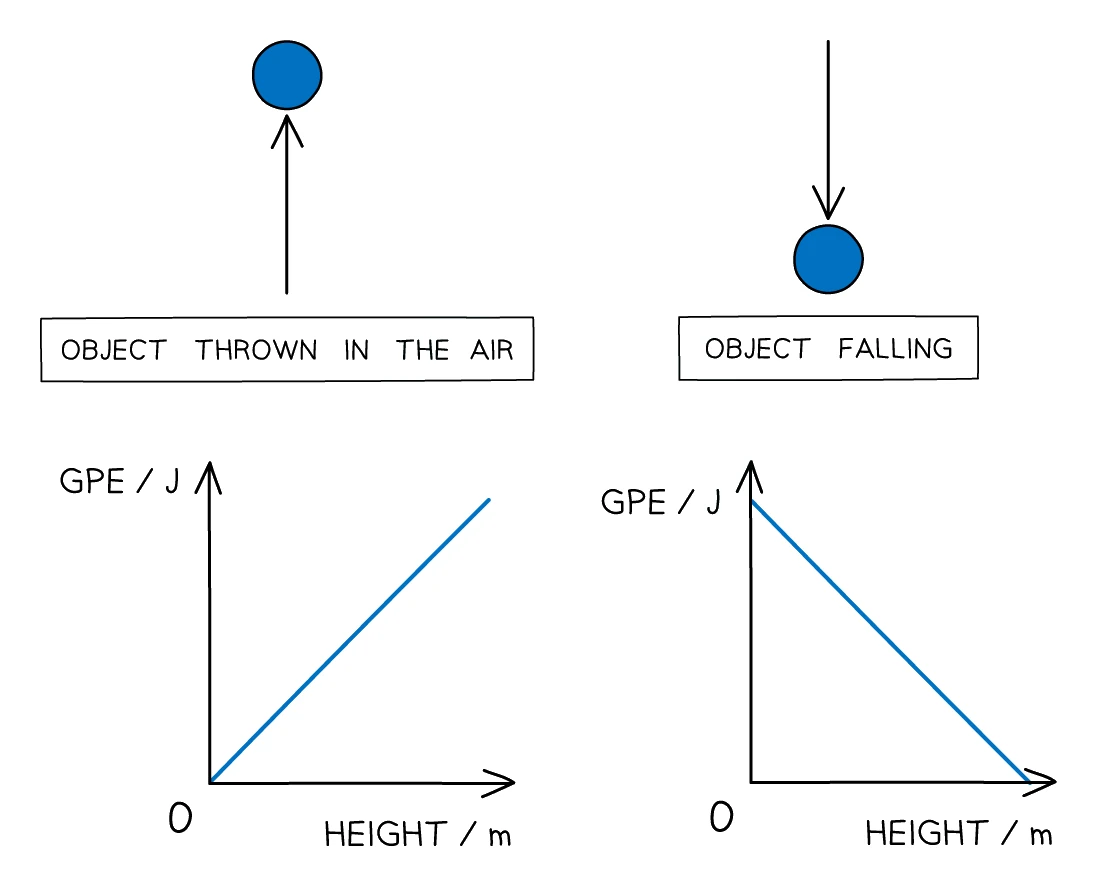
- For a fixed mass on a given planet, both m and g are constants, so the GPE rises linearly with the height h
- Doubling the height doubles the GPE; halving the height halves the GPE
- A graph of GPE against height is a straight line passing through the origin
3. Kinetic energy
Definition
- Kinetic energy (KE) is the energy an object has because of its motion. Any object with a mass and a speed has kinetic energy
The KE equation
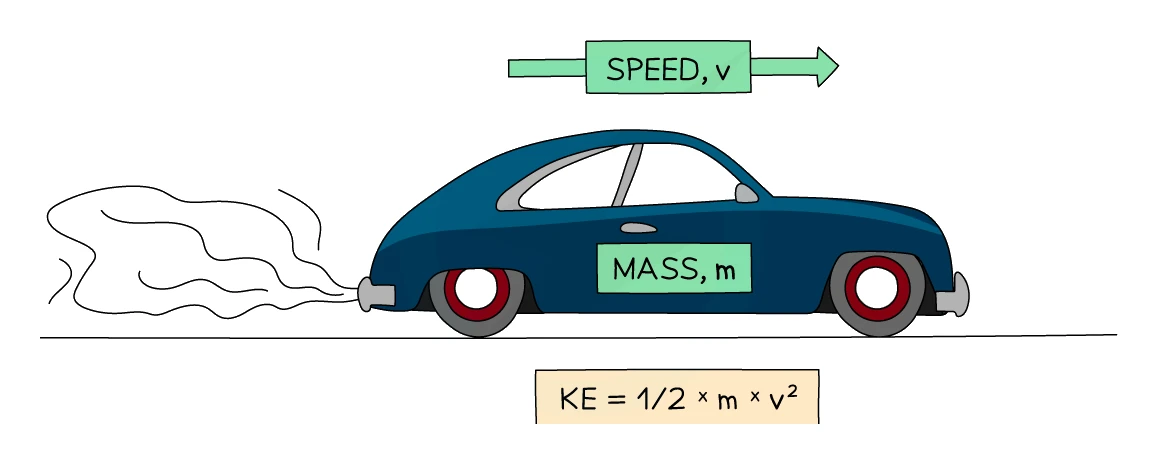
KE = ½ × m × v²
- where:
- KE = energy in the kinetic store (J)
- m = mass of the object (kg)
- v = speed of the object (m/s)
- The square on v is the most important feature of this equation:
- doubling the speed quadruples the kinetic energy
- tripling the speed gives nine times the kinetic energy
- the same factor of four shows up in braking-distance rules (topic 02): twice as much kinetic energy needs twice the distance to remove
Common exam question
Calculating kinetic energy, or a speed from it
Question: State the formula for kinetic energy, then calculate the kinetic energy of a moving object, or the speed of a particle that has a stated kinetic energy (1 mark for the formula, 2–3 for the working).
Set in 8 of the 24 papers. Write KE = ½ × m × v²; a word equation is accepted, as is velocity in place of speed. The calculation marks are substitution and evaluation, with a third for rearrangement when the speed is the unknown, and a correct answer with no working still earns full credit.
Square the speed before multiplying, and finish a speed calculation with the square root. Convert the mass first: tonnes or grams used as they stand are a powers-of-ten error, and a kinetic energy a thousand times too small keeps only one of the two marks. With standard-form data, a wrong power of ten in the final speed is capped at two of the three marks.
4. Work, GPE and kinetic energy together
Energy equivalence in a perfect transfer
- When a force acts through a distance, the energy that leaves one store and enters another equals the work done by that force (mechanical pathway)
- In a perfect transfer (one with no friction or air resistance), no energy is dissipated as waste, so the full amount can be equated:
energy in one store before = energy in another store after
- The phrase "ignore air resistance" or "ignore frictional effects" in an exam question is the signal that you should use this energy-equivalence shortcut
Pendulum: GPE ↔ KE swap
- A swinging pendulum bob exchanges energy back and forth between its two stores on every swing:
- At the highest point of the swing, the bob is momentarily at rest. All its energy sits in the gravitational potential store
- At the lowest point of the swing, the bob is at its fastest. All its energy sits in the kinetic store
- For a frictionless pendulum, the maximum GPE at the top equals the maximum KE at the bottom:
m × g × h_max = ½ × m × v_max²
- The mass cancels from both sides, leaving:
v_max = √(2 × g × h_max)
Rollercoaster: same idea on a track
- A rollercoaster carriage starting at rest at the top of a tall hill arrives at the bottom with maximum speed; all the GPE lost during the descent has been converted to KE (ignoring friction and air drag)
- The maximum speed depends only on the drop in height, not on the route the track takes between the top and bottom
Common exam question
Finding a speed, a height or energy lost from GPE = KE
Question: Calculate the speed of an object that has fallen a given height, the height it reaches from a take-off speed, or the energy lost between two points (3–5 marks).
Set in 6 of the 24 papers. Write m × g × h = ½ × m × v²; the mass cancels. The schemes accept this energy route and v² = u² + 2as equally. The marks are substitution, rearrangement and evaluation (g = 9.8 N/kg is allowed), and a four-mark version pays separately for v² and for its square root.
Found the take-off kinetic energy and then asked for the gain in gravitational potential energy at the top? It is the same number: the stores are equal when air resistance is ignored. For the energy lost between two points, find the GPE lost and the KE gained separately and subtract: the subtraction is a mark of its own, and a slip in either value is carried forward.
5. Power
Definition
- Power is the rate at which work is done, or equivalently the rate at which energy is transferred
- The SI unit is the watt (W), where 1 W = 1 J/s (one joule transferred per second)
- Common multiples: 1 kW = 1000 W; 1 MW = 1 000 000 W
Common exam question
Defining power
Question: State what the term power means (1 mark).
Asked in 2 of the 24 papers. Power is the rate of doing work, or the rate at which energy is transferred. "Energy transferred per second" and "per unit time" are accepted, and one scheme lets the equation P = W/t or its word form stand in for the sentence. Both schemes reject P = I × V, which is a way of calculating electrical power rather than what power means, and each rejects an "in" wording, "energy transferred in a unit time" in one and "the amount of energy in a given time" in the other: "in" describes an amount, "per" describes a rate.
Why time matters
- Two machines that do the same total work over different times have different powers. A weightlifter and a forklift may both lift a 200 kg crate onto a shelf, but if the forklift does it in 1 s while the weightlifter takes 30 s, the forklift's power is 30 times larger
- High-power devices either deliver large amounts of useful work very quickly (a rocket engine) or low amounts of useful work continuously over long periods (a wall-mounted clock running for years)
The power equation
P = W / t
- where:
- P = power (W)
- W = work done, or energy transferred (J)
- t = time taken for the transfer (s)
- Useful rearrangements:
- W = P × t (the energy a device transfers in a given time)
- t = W / P (how long a device of fixed power needs to deliver a target amount of energy)
Typical power ratings
| Device | Approximate power |
|---|---|
| Pocket torch | ~1 W |
| Incandescent light bulb | ~60–100 W |
| Hair dryer | ~1500 W |
| Electric oven | ~3 kW |
| Family car at cruise | ~25 kW |
| Large coal-fired power station | ~2 GW (2000 MW) |
| Saturn V rocket at launch | ~60 GW |
Worked example
Calculating time from power and energy
A pump transfers 1 350 000 J of energy at a constant power of 4500 W. Calculate the time taken.
Solution:
- Write the equation: P = W ÷ t
- Rearrange: t = W ÷ P
- Substitute: t = 1 350 000 ÷ 4500
- t = 300 s
If a time is given in minutes, turn it into seconds before you substitute: that conversion is a mark in its own right. A power or energy written in standard form earns the same substitution, rearrangement and evaluation marks, and a powers-of-ten slip loses one of them.
6. Energy resources
What an energy resource is
- An energy resource is a large natural store of energy that humans can tap to do useful work, most commonly generating electricity for the National Grid or heating homes and businesses
- The Edexcel syllabus splits energy resources into two camps based on whether they can be replenished
Renewable vs non-renewable
- A energy resource is one that is replenished at least as quickly as it is being used up, so it will not run out as long as the underlying natural process keeps going
- A energy resource is one that is being used faster than it is being replenished; the stockpile is finite, so eventually it will be exhausted
| Renewable | Non-renewable |
|---|---|
| Solar (heating panels and photovoltaic cells) | Coal |
| Wind | Oil |
| Hydroelectric | Natural gas |
| Wave | Nuclear fuel (uranium, plutonium) |
| Tidal | |
| Geothermal | |
| Biofuels (from short-cycle crops) |
The shared electricity-generating chain
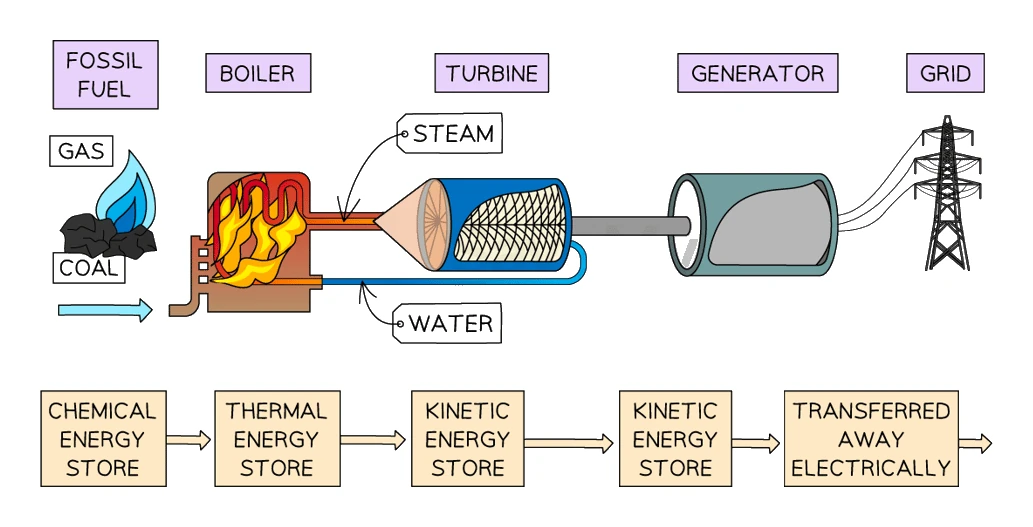
- Almost every large-scale electricity source uses the same final two stages: spin a turbine, which spins a generator, which produces an alternating current via electromagnetic induction (topic 18)
- What differs between resources is how the turbine is spun:
- Steam from boiling water (coal, oil, gas, nuclear, geothermal, solar thermal): chemical or nuclear or thermal store → thermal store of water → kinetic store of steam → kinetic store of turbine → kinetic store of generator → electrical output
- Moving water directly (hydroelectric, tidal, wave): gravitational potential or kinetic store of water → kinetic store of turbine → kinetic store of generator → electrical output
- Moving air directly (wind): kinetic store of wind → kinetic store of turbine → kinetic store of generator → electrical output
- Photovoltaic cells skip the turbine entirely: radiation from the Sun → directly into electrical output via charge release inside the cell
Resource-by-resource detail
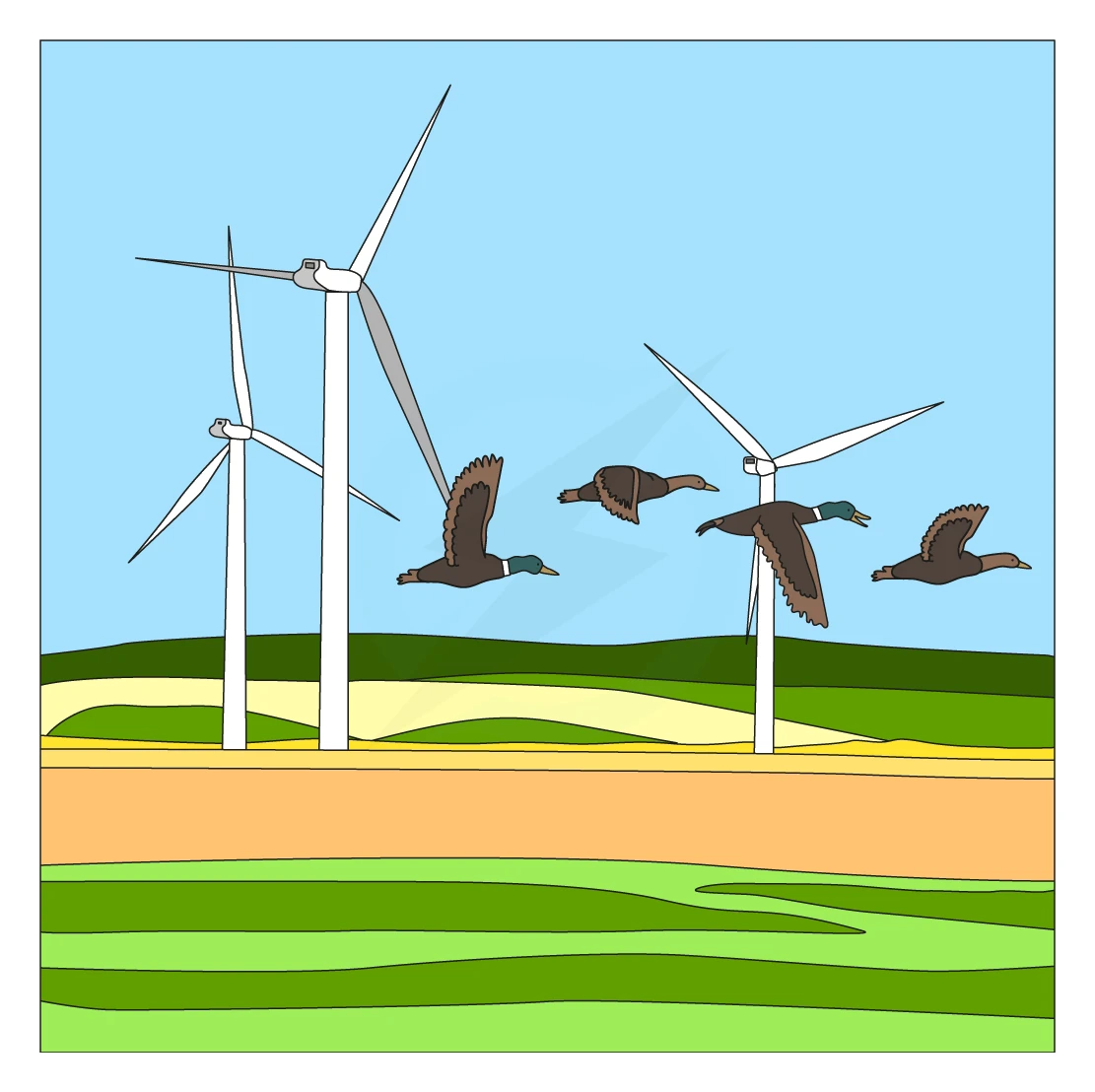
- Wind: wind pushes the blades of large rotor towers; no boiling, no steam. Energy chain: kinetic of wind → kinetic of turbine → kinetic of generator → electrical
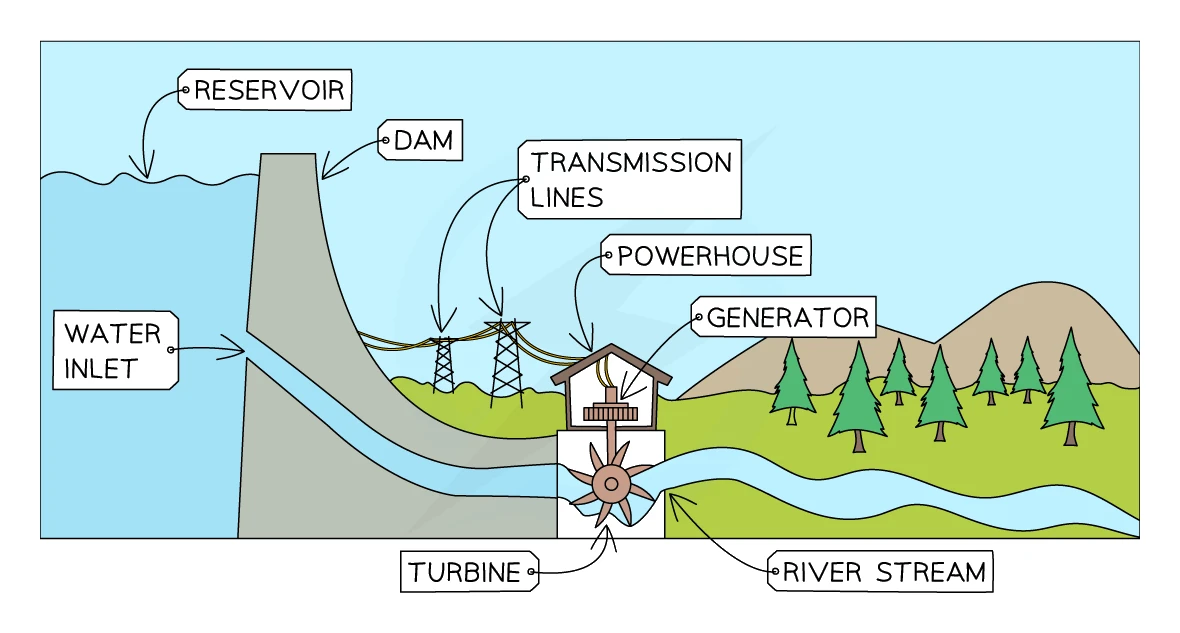
- Hydroelectric: water stored in a reservoir behind a dam is released and falls through a turbine in the dam wall. Energy chain: gravitational potential of water → kinetic of falling water → kinetic of turbine → kinetic of generator → electrical
- Tidal: a barrage holds back high tides and releases the water through turbines as the tide ebbs (or fills against turbines as it rises). Same energy chain as hydroelectric, but driven by the Moon's pull on the seas
- Wave: floating or hinged surface devices rock with passing waves, turning a turbine inside. Energy chain: kinetic of waves → kinetic of turbine → kinetic of generator → electrical
- Geothermal: a borehole sunk into hot rock far below the surface heats water into steam, which then drives a steam turbine. Energy chain: thermal of rocks → thermal of water → kinetic of steam → kinetic of turbine → kinetic of generator → electrical
- Solar heating panels: black-painted pipes on a roof absorb sunlight and warm water flowing through them. Energy chain: nuclear of the Sun → radiation through space → thermal of the water in the pipes. This is direct heating, not electricity
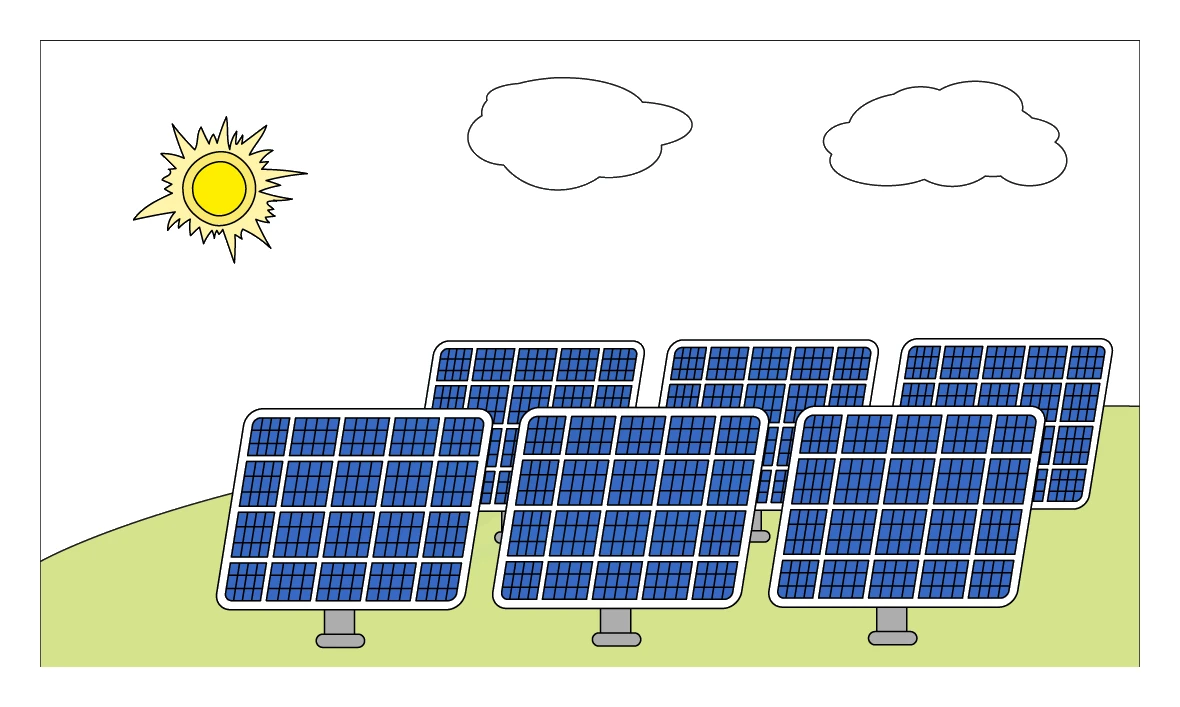
- Solar photovoltaic cells: a semiconductor wafer releases electrons when struck by sunlight, producing a direct current. Energy chain: nuclear of the Sun → radiation through space → electrical output (no turbine needed)
- Fossil fuels (coal, oil, gas): the fuel is burned to boil water into steam; the steam drives a turbine. Energy chain: chemical of fuel → thermal of water → kinetic of steam → kinetic of turbine → kinetic of generator → electrical
- Nuclear: heat from controlled fission reactions (topic 21) boils water into steam; the steam drives a turbine. Energy chain: nuclear of fuel → thermal of water → kinetic of steam → kinetic of turbine → kinetic of generator → electrical
- Biofuels: plant material (or biogas) is burned to boil water into steam; the steam drives a turbine. Energy chain: chemical of biofuel → thermal of water → kinetic of steam → kinetic of turbine → kinetic of generator → electrical
Common exam question
Describing the energy transfers in generating electricity
Question: Describe the energy transfers involved when a named resource (falling water, wind, burning gas) is used to generate electricity, or name the store that changes (1–4 marks).
Asked in 3 of the 24 papers, with a mark per stage. In a hydroelectric station, water starts with gravitational potential energy, loses it as it gains kinetic energy, it is transferred mechanically to the turbine and generator, then electrically from the generator, and some is wasted by heating the surroundings. "Turns into" or "becomes" is condoned for "transfers", but name the store at every step. For a wind turbine speeding up, the kinetic store increases; "kinetic energy of the wind to kinetic energy of the turbine" earns both marks. Once it turns at a steady speed the thermal store grows; "heat" is not a store name (rejected or ignored). Burning natural gas empties a chemical store.
Asked what renewable means? Replenished, so it will not run out.
7. Comparing energy resources
Two axes for comparison
- Renewable or not: will it eventually run out?
- Reliable or not: can it generate on demand? A reliable resource produces energy whenever it is needed; an unreliable one depends on the weather or the time of day
- These two axes do not line up cleanly: some renewables (geothermal, tidal, hydro) are reliable, while others (wind, wave, solar) are not
Trade-offs at a glance
| Resource | Renewable | Reliable | Main advantages | Main disadvantages |
|---|---|---|---|---|
| Fossil fuels | No | Yes | Large, steady output; output can be ramped to match demand; well-established technology | Burn produces carbon dioxide (greenhouse gas → global warming) and sulfur dioxide (contributes to acid rain); finite reserves |
| Nuclear | No | Yes | Very large output from a small mass of fuel; no CO₂ at the power station | Produces long-lived radioactive waste that must be stored safely for thousands of years; very expensive and slow to build; cannot quickly respond to demand changes; rare but serious accident risk |
| Biofuels | Yes | Yes | CO₂ released on burning is roughly balanced by CO₂ absorbed when the plant grew (near-carbon-neutral) | Crops grown for fuel compete with food crops for land and water |
| Wind | Yes | No | No fuel cost; no greenhouse gases in operation; cheap to install and maintain | Stops generating when the wind drops; can be seen as visually intrusive; can affect bird populations |
| Hydroelectric | Yes | Yes | Large output; output can be increased on demand by opening more gates; no greenhouse gases in operation | Building a reservoir floods a large area, destroying habitats and displacing people; few new sites left in the UK |
| Tidal | Yes | Yes (predictable) | Tides are perfectly predictable months in advance; no fuel | Few suitable estuaries; tidal barrages disturb shipping and damage estuarine wildlife |
| Wave | Yes | No | No fuel; no greenhouse gases | Output varies with the sea state; ocean devices are expensive to install and survive in harsh conditions |
| Geothermal | Yes | Yes | Steady year-round output; no fuel | Limited to volcanically active regions or sites with very deep boreholes; can release trapped greenhouse gases such as methane |
| Solar (PV) | Yes | No | No moving parts; ideal for remote or off-grid locations; cheap and quick to install on existing roofs | Generates nothing at night and far less in cloudy weather; each cell produces only a small amount of power |
| Solar (heating) | Yes | No | Cheap supplementary hot water; no greenhouse gases | Produces heat, not electricity; less effective in winter sunlight |
Common exam question
Advantages and disadvantages of a generating method
Question: Discuss the advantages and disadvantages of two ways of generating electricity, or give one advantage or disadvantage of a method (1–4 marks, one per point).
Asked in 3 of the 24 papers. A four-mark comparison wants an advantage and a disadvantage of each method. Gas or hydroelectric: output changes quickly to meet demand, and supply does not depend on the weather. Against gas: non-renewable, so it runs out, and burning it releases carbon dioxide, a greenhouse gas. Wave or wind: renewable, no polluting gases. Against them: waves or wind may be absent when needed, storms damage the equipment, wildlife is harmed. Hydroelectric floods land and habitats and needs a mountainous site. Nuclear: radioactive waste needing long-term storage, accident risk, non-renewable.
Cost is ignored in all three schemes unless it is nuclear's higher setup or decommissioning cost, named as such, and both comparison questions ignore visual pollution.
Why a real grid uses a mix
- No single resource is perfect on both axes. The UK's National Grid therefore runs many resources in parallel:
- Steady-output sources (nuclear, gas, biofuel, geothermal) provide the base load, the minimum demand that exists 24 hours a day
- Fast-ramping sources (gas turbines, hydroelectric) handle peaks in demand, switching on or off within minutes
- Renewables (wind, solar, wave) feed in whenever conditions allow, displacing fossil-fuel use
- Reducing total greenhouse-gas emissions means pushing the mix away from fossil fuels and towards renewables and nuclear, while accepting that some non-renewable backup is still needed when the wind is calm and the sun is down