1. Transverse and longitudinal waves
What a wave is
- A wave is a disturbance produced by an oscillating source that transfers energy (and information) from place to place without transferring matter
- The particles of the medium oscillate about a fixed position; the wave moves through them, but they do not travel with it
- A toy duck floating on water is the classic visualisation: a passing ripple lifts the duck up and lets it back down, but the duck itself stays roughly where it was
Two ways a wave can vibrate
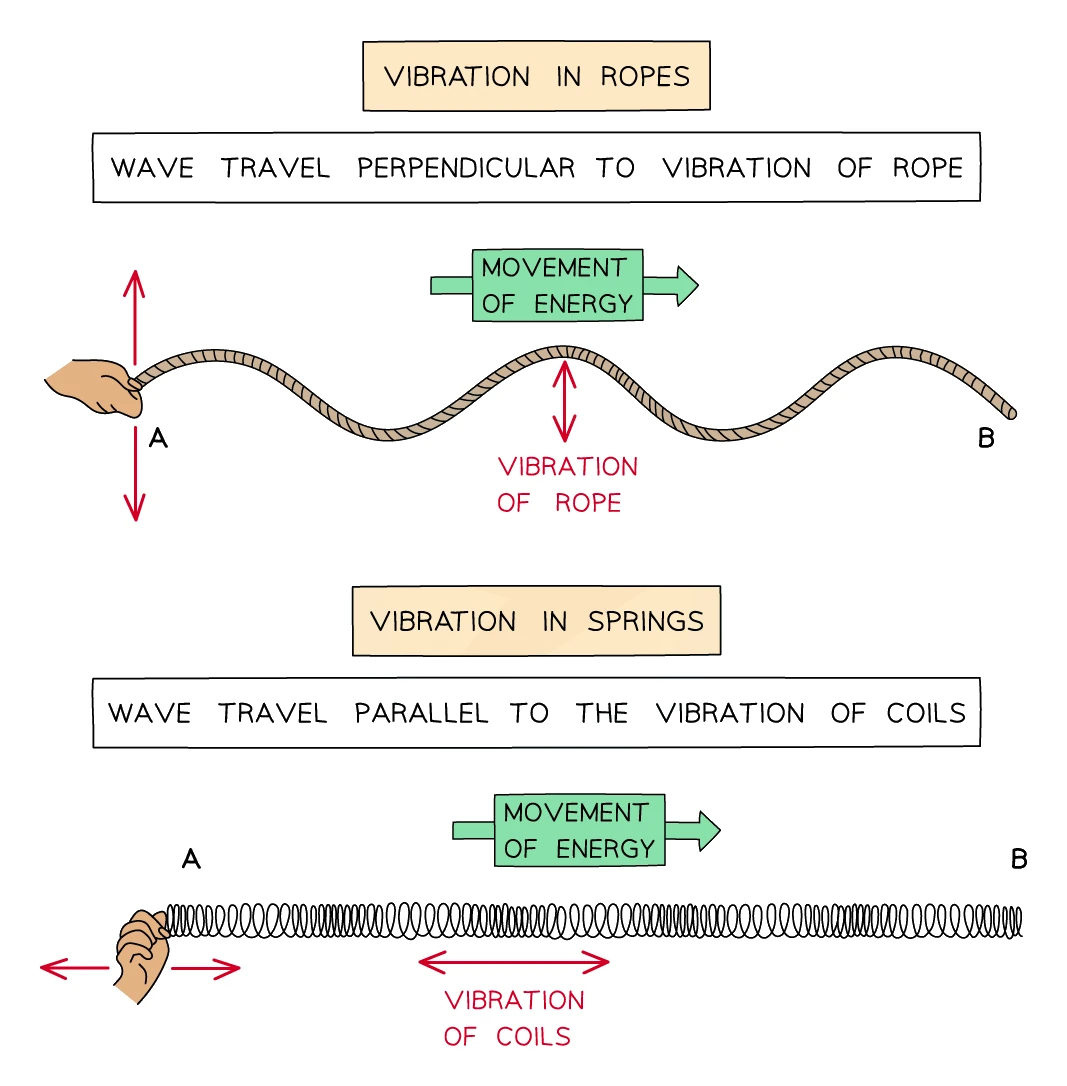
- All waves fall into one of two categories, set by which direction the medium vibrates relative to the wave's travel:
- Transverse waves: the oscillation is perpendicular to the direction of energy transfer
- Longitudinal waves: the oscillation is parallel to the direction of energy transfer
Transverse waves
- A transverse wave shows alternating peaks (the highest points above the rest position) and troughs (the lowest points below it)
- Transverse waves can travel through solids and along the surface of a liquid, but a mechanical transverse wave cannot travel through the body of a liquid or any gas (the molecules have no lateral spring to vibrate against)
- Electromagnetic waves are transverse and can travel through solids, liquids, gases, and a vacuum; they are the only transverse waves not bound by needing a material medium
- Everyday examples of transverse waves:
- ripples on the surface of a pond
- a flicked rope or skipping line
- the vibrations of a plucked guitar string
- S- in earthquakes (one of the two main seismic wave types)
- all (light, radio, X-rays, microwaves and so on)
Longitudinal waves
- A longitudinal wave shows alternating compressions (particles bunched closer together than average) and rarefactions (particles spread further apart than average)
- The medium's density and pressure rise and fall as the wave passes
- Longitudinal waves travel through solids, liquids and gases because the medium can be compressed and expanded along the line of travel; they cannot travel through a vacuum because there are no particles to compress
- Everyday examples of longitudinal waves:
- sound waves in air, water and steel
- P-waves in earthquakes (the faster of the two main seismic wave types)
- pressure waves in any fluid (a sudden push on a piston of water)
Side-by-side comparison
| Feature | Transverse waves | Longitudinal waves |
|---|---|---|
| Direction of oscillation | Perpendicular to energy transfer | Parallel to energy transfer |
| Visible features | Peaks and troughs | Compressions and rarefactions |
| Density of medium | Stays roughly constant | Rises and falls as wave passes |
| Pressure of medium | Stays roughly constant | Rises and falls as wave passes |
| Travels in solids? | Yes | Yes |
| Travels in liquids? | On the surface only (or as EM through liquid) | Yes (right through) |
| Travels in gases? | EM only | Yes |
| Travels in a vacuum? | EM waves only | No |
| Common examples | Ripples, guitar strings, all EM waves | Sound, P-waves, pressure waves |
Common exam question
The difference between transverse and longitudinal waves
Question: Describe the difference between transverse and longitudinal waves, or between the motion of their particles; a diagram may be used (2–3 marks).
Asked in 4 of the 24 papers. Every scheme wants two ideas: the particles vibrate (oscillate), and the direction of that vibration compared with the direction the wave travels or transfers energy. Write parallel (along the line of travel) for longitudinal and perpendicular (at right angles, 90°) for transverse. In three of the four schemes naming the vibration is a mark on its own and the directions earn the rest, and a clearly labelled diagram of each wave can earn every mark; the fourth scheme gives one mark per wave type.
One scheme ignores "up and down" and "forwards and backwards" for the vibration mark, so use the word vibrate or oscillate, then give each direction relative to the direction the wave travels.
2. Describing wave motion
Wavefronts and rays
- A wavefront is a line joining all the points of a wave that are currently in step (for example, every point at the top of its peak)
- Wavefronts are usually drawn from above, like contour lines on a map:
- Closely spaced indicate a short
- Widely spaced wavefronts indicate a long wavelength
- A ray is an arrow drawn perpendicular to the wavefronts, showing the direction of travel of the wave
Amplitude
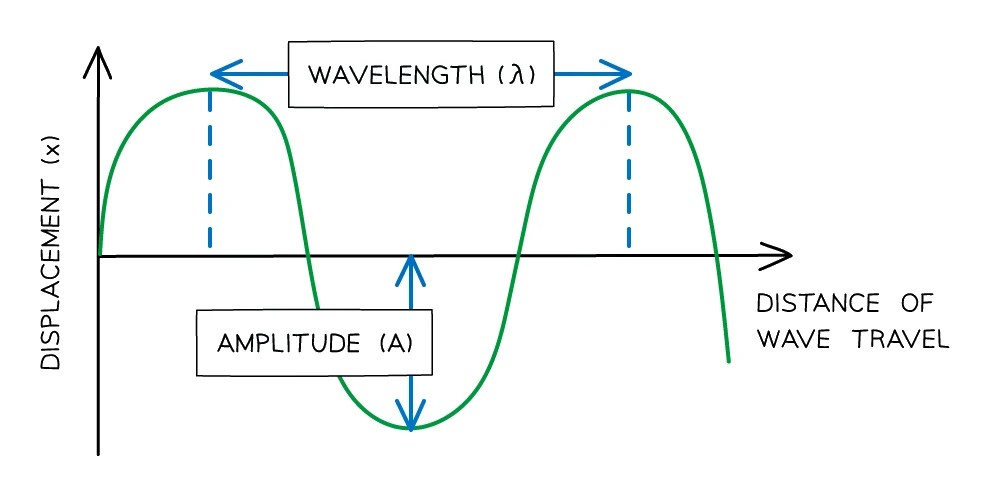
- The (A) of a wave is the distance from the undisturbed (rest) position to either a peak or a trough, not the full peak-to-trough height
- Amplitude is measured in metres (m)
- The amplitude of a wave is a measure of how much energy it carries; a wave with twice the amplitude transfers roughly four times the energy in the same time
Wavelength
- The wavelength (λ) of a wave is the distance from one point on the wave to the same point on the next wave:
- in a transverse wave, peak-to-peak (or trough-to-trough)
- in a longitudinal wave, centre of one compression to centre of the next
- Wavelength is measured in metres (m) and uses the Greek letter lambda (λ)
Common exam question
Reading amplitude and wavelength off a wave diagram
Question: Determine the amplitude or the wavelength of the wave shown in the diagram, by measuring it with a ruler or from the distance scale printed beneath it (1–2 marks).
Asked in 2 of the 24 papers. Amplitude is measured from the rest position to a peak (or to a trough), not from peak to trough. Wavelength is one complete wave: peak to the next peak, or any point to the matching point on the next wave. Each reading was accepted within a small range, and the answer line gave the unit (centimetres in both papers), so measure in the unit printed there.
When a distance scale runs under several complete waves, divide the length of the span by the number of waves rather than estimating one wave by eye: in one paper a value in the right range earned one mark and the exact value earned both.
Frequency
- The (f) of a wave is the number of complete waves that pass a fixed point each second
- Frequency is measured in hertz (Hz); 1 Hz = one per second
- A wave with a higher frequency carries more energy per second (for the same amplitude and medium)
Period
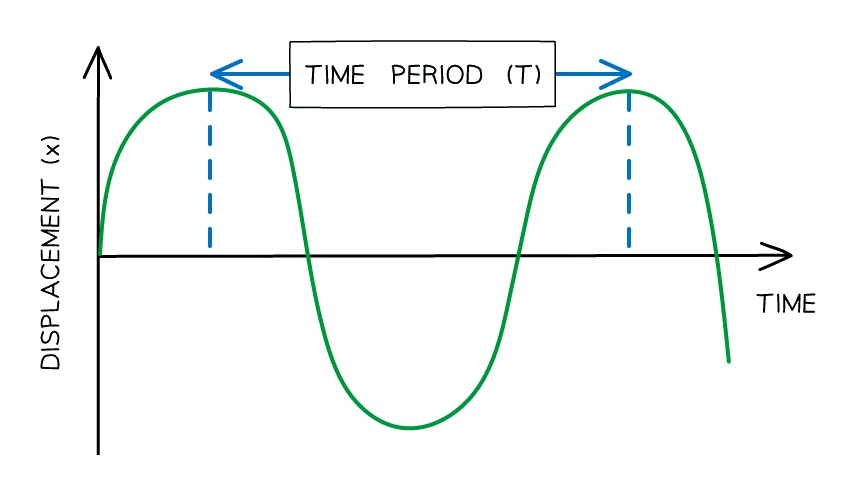
- The (T) of a wave is the time taken for one complete wave to pass a fixed point
- Period is measured in seconds (s)
- Frequency and period are reciprocals of one another:
f = 1 / T and equivalently T = 1 / f
3. The wave equation
The basic equation
v = f × λ
- where:
- v = wave speed (m/s)
- f = frequency (Hz)
- λ = wavelength (m)
- The equation applies to every kind of wave, including sound, water ripples, and every band of the electromagnetic spectrum
- Rearrangements:
- λ = v / f (a higher-frequency wave has a shorter wavelength at fixed speed)
- f = v / λ
Common exam question
Calculating with the wave equation
Question: Calculate a wave's speed, frequency or wavelength from the other two, or show that a speed is about 3 × 10⁸ m/s (2–3 marks).
Asked in 10 of the 24 papers. Three marks are one each for substitution, rearrangement and evaluation (for a speed, one scheme credited the formula instead); two-mark versions give one for substituting or rearranging and one for the answer. One mark comes off for a power-of-ten error, so convert MHz, GHz, kHz and centimetres before you evaluate. One scheme states that a right answer with no working scores in full, and a wrong value carried from an earlier part still earns these marks. In a "show that", converting the prefix was itself a mark and the result needed two or more significant figures. Round, never truncate: one scheme rejected truncation.
A one-mark part asking for the formula often comes first: words, standard symbols and any rearrangement are accepted, with v or c for speed.
Linking frequency to period
f = 1 / T
- When a question gives you the period rather than the frequency, find f first, then use the wave equation
Worked example
Calculating frequency using the wave equation
A mobile phone transmits microwaves with a wavelength of 20 cm. Microwaves travel at 3.0 × 10⁸ m/s. Calculate the frequency of the microwaves.
Solution:
- Convert the wavelength to metres: 20 cm = 0.20 m
- Write the wave equation: v = f × λ
- Rearrange for frequency: f = v ÷ λ
- Substitute: f = 3.0 × 10⁸ ÷ 0.20
- = 1.5 × 10⁹ Hz
Leaving the wavelength in centimetres gives 1.5 × 10⁷ Hz, a power-of-ten error that costs one mark.
4. The Doppler effect
What the Doppler effect is
- The Doppler effect is the apparent change in the and of a wave heard or seen by an observer, when the source of the wave is moving towards or away from them
- Note the word "apparent": the source itself emits the same wave as always, and it is the relative motion that distorts what the observer detects
Why it happens
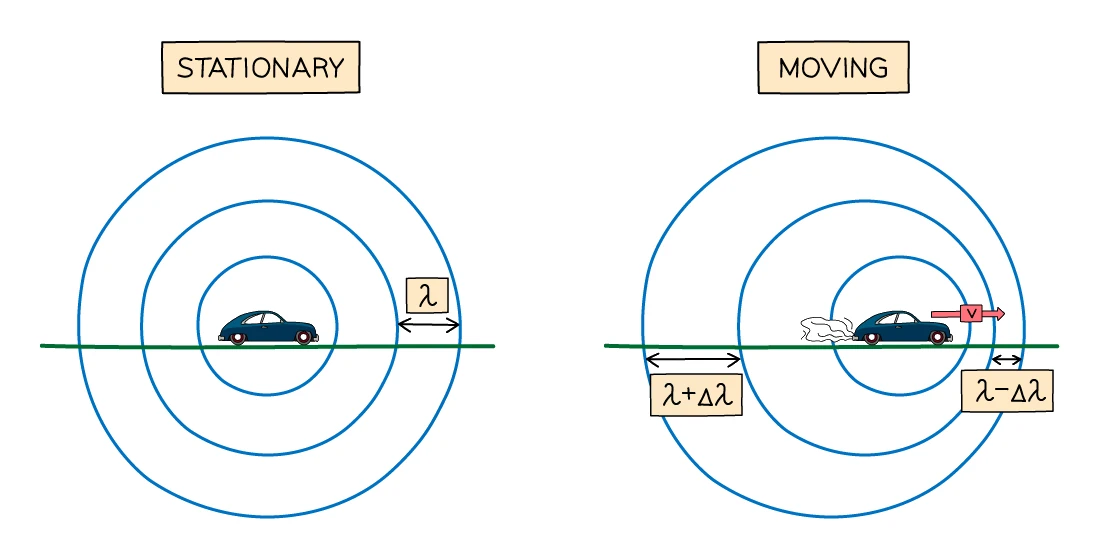
- For a stationary source, each new wavefront is emitted from the same point, and the wavefronts spread out as a series of equally-spaced concentric circles in every direction
- For a source moving along a line:
- Wavefronts emitted in front of the source are emitted from positions that have themselves moved forward, so each new front is closer to the previous one. The waves arrive at an observer ahead of the source with shorter wavelengths and higher frequencies
- Wavefronts emitted behind the source are emitted from positions that have moved away, so each new front is further from the previous one. The waves reach an observer behind the source with longer wavelengths and lower frequencies
- The speed in the medium does not change; only the spacing of the wavefronts. The change in wavelength is therefore balanced by an opposite change in frequency (v = f λ is still obeyed)
Common exam question
Explaining the Doppler effect
Question: Explain why the frequency detected by an observer differs from that emitted by a moving source, or discuss what a driver and a bystander hear from a car horn (3–6 marks).
Asked in 5 of the 24 papers. The source moves, so wavefronts ahead of it are closer together (shorter wavelength) and those behind further apart (longer wavelength). The wave speed stays constant, so by v = f × λ the frequency (pitch) heard is higher in front and lower behind. Say which way it changes and describe the observer's side: for a receding source, one scheme ignored all comment on the approaching side. In one scheme the equation scores only when linked to another point you have made, not merely quoted.
For the driver the frequency does not change: there is no relative motion between driver and horn. Two schemes credit naming the Doppler effect in itself, a third only as a fallback, so name it.
Everyday examples
- An ambulance siren passing you: pitch is high while the vehicle approaches, then drops sharply as it passes and recedes. A spectator near the road hears a sudden change in note as the source crosses
- Red-shift of distant galaxies: light from a galaxy moving away from Earth arrives with longer wavelengths than it left with, shifting the spectrum towards the red end. The greater the recession speed, the larger the red-shift; this is the headline evidence that the universe is expanding (covered in topic 24, Cosmology)
- Police radar guns: a radar pulse aimed at a moving car returns at a slightly different frequency from the one transmitted; the difference reveals the car's speed
5. Electromagnetic waves
The shared properties
- All electromagnetic (EM) share four key features:
- They are transverse waves
- They all travel through a vacuum (and through air, water, glass, etc.)
- They all travel at the same speed in a vacuum: c = 3.0 × 10⁸ m/s
- They all obey the wave equation v = f × λ, so within the spectrum, longer wavelengths come with lower frequencies and vice versa
Common exam question
Stating a property that all electromagnetic waves share
Question: State a property that all electromagnetic waves have in common, give two similarities between two named bands, or tick the true statements about the spectrum (1–3 marks).
Asked in 5 of the 24 papers, twice as a tick-the-correct-statements table. The credited properties: every band shares one speed in a vacuum, they all travel through a vacuum, they are transverse, they transfer energy, and they can be reflected and refracted; visible light and infrared are also both non-ionising. When the stem has already listed "transverse" and "transfers energy", give the speed or the vacuum.
The false statements in the tick tables are the traps: electromagnetic waves are not longitudinal, do not transfer matter, do not all cause cancer, and X-rays do not have the highest frequency (gamma rays do). Extra ticks cost marks in both schemes. Asked for differences, compare the wavelength and the frequency; if the stem gives the frequencies, give the wavelength. One scheme ignored amplitude.
The seven bands of the spectrum
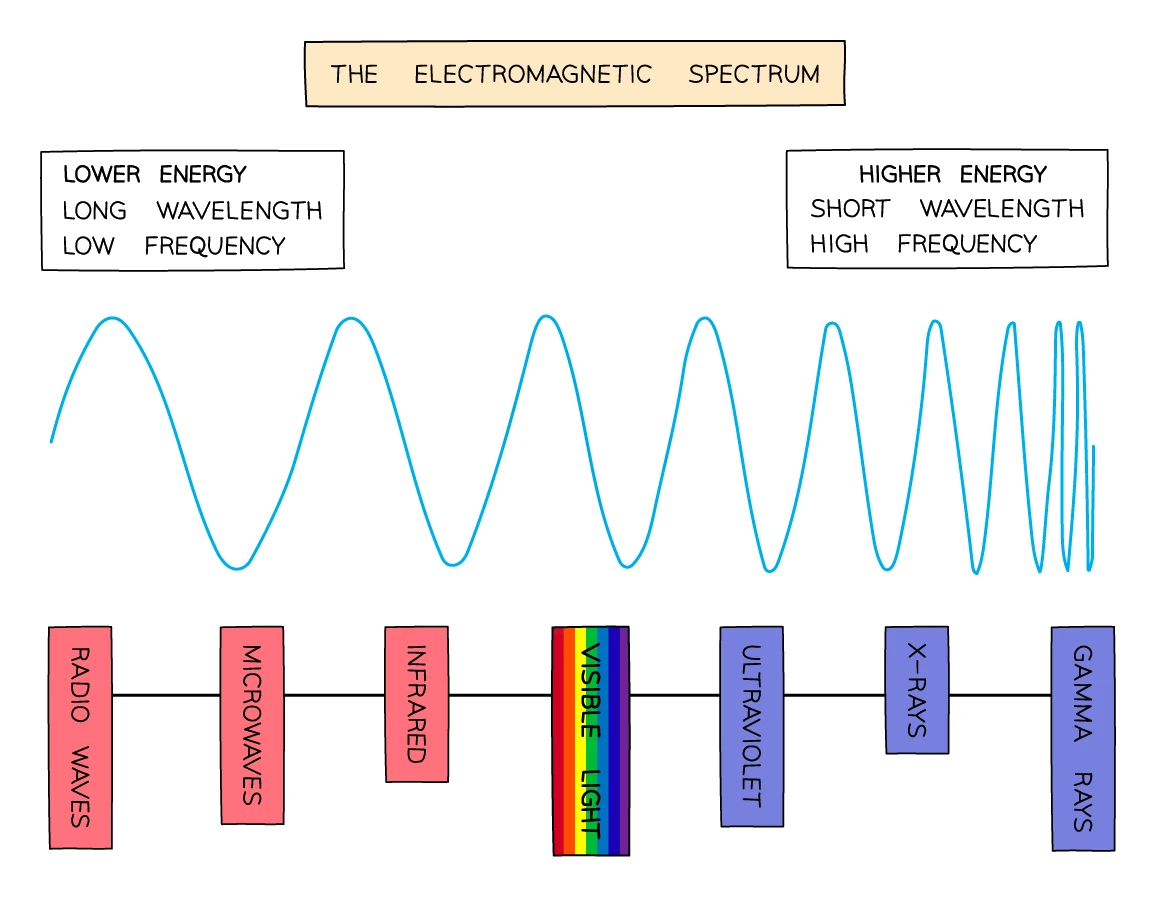
- The continuous electromagnetic spectrum is divided into seven named bands, listed below from longest / lowest to shortest wavelength / highest frequency:
- Radio
- Microwaves
- Infrared
- Visible light
- Ultraviolet
- X-rays
- Gamma rays
- Mnemonics to lock the order in:
- "Rock Musicians Invariably Vote United at X-mas (mostly Guitarists)"
- "Roman Men Invented Very Unusual X-ray Guns"
- The frequency of an EM wave is inversely proportional to its wavelength; longer wavelength means lower frequency
The visible spectrum
- Of all seven bands, only visible light is picked up directly by the human eye, and even that occupies just a sliver of the full electromagnetic spectrum
- Within visible light, the colours run from longest to shortest wavelength as:
- Red → Orange → Yellow → Green → Blue → Indigo → Violet
- mnemonics: "Roy G. Biv" or "Richard Of York Gave Battle In Vain"
- Red has the longest wavelength and lowest frequency in the visible range
- Violet has the shortest wavelength and highest frequency in the visible range
- Other animals see beyond the visible band; bees pick up ultraviolet patterns on flowers, and some snakes detect infrared signatures of warm prey
Common exam question
Naming a part of the spectrum from its position
Question: Name the part of the electromagnetic spectrum that is missing from a table, or that has a lower frequency than a named band, or state which colour of visible light has the shortest wavelength (1 mark each).
Asked in 4 of the 24 papers. Learn the order both ways: radio, microwaves, infrared, visible, ultraviolet, X-rays, gamma runs from the longest wavelength and lowest frequency to the shortest and highest. So the band with a lower frequency than microwaves is radio waves, the gaps either side of visible light are infrared and ultraviolet (IR and UV are accepted), and in a prism experiment the region just beyond red is infrared, which gives the largest temperature rise, while just beyond violet is ultraviolet. Red has the longest visible wavelength and violet the shortest.
Precision matters for one mark: "radioactive" and "radiation" were rejected for radio, and "purple" and "ultraviolet" were rejected for violet.
6. Applications of electromagnetic waves
Band-by-band uses
| Band | Typical uses |
|---|---|
| Radio waves | Television and radio broadcasting; long-range two-way radio communication; air-traffic control |
| Microwaves | Mobile phone signals; Wi-Fi and Bluetooth; satellite communications and weather radar; heating food in a microwave oven |
| Infrared (IR) | Heating elements in toasters and grills; thermal-imaging cameras and night-vision goggles; television remote controls; short-range data links and optical fibres |
| Visible light | Sight; photography and video; visible-wavelength fibre-optic data transmission; lasers |
| Ultraviolet (UV) | Fluorescent strip lighting; security marks on banknotes that glow under UV; sterilising medical instruments and water supplies; producing vitamin D in skin |
| X-rays | Medical imaging of bones, teeth and dense tissues; airport security scanners; checking welds and pipework for cracks in industrial sites |
| Gamma rays | Sterilising surgical instruments and food without heating; treating cancer (radiotherapy); medical imaging using radioactive tracers (PET scans) |
Common exam question
Giving a use of a band of the spectrum
Question: Give a use of microwaves, gamma rays or X-rays, or draw lines matching each band to its use (1 mark per use).
Asked in 4 of the 24 papers. Safe answers: microwaves for communication (mobile phones, satellites, radar) or heating food; gamma rays for sterilising medical equipment or food, treating cancer by radiotherapy, or medical tracing; X-rays for imaging broken bones or the inside of objects. In the matching version, infrared goes with cooking food, ultraviolet with checking banknotes for forgery under fluorescent lamps, radio waves with television broadcasts and visible light with human vision.
Be specific about the job: one scheme ignored "cleaning" for gamma rays (the word is sterilising) and "chemotherapy" (the treatment is radiotherapy).
Why each band suits its job
- Radio waves are absorbed only weakly by air and the ground, and pass through walls; that makes them ideal for long-range broadcasting
- Microwaves of certain frequencies are absorbed strongly by water molecules in food, transferring energy quickly to the water and heating the meal. Other microwave frequencies pass through the atmosphere and most weather, so they are used by mobile-phone and satellite networks
- Infrared is given off by anything warm (including human bodies), so cameras tuned to IR can see in the dark; the same waves can be aimed at heating elements where the goal is to deliver warmth quickly
- Visible light can be focused with simple lenses and detected by the eye and by silicon sensors, which is the basis of vision, photography and fibre-optic data
- Ultraviolet carries enough energy per photon to break some chemical bonds, which is why it can sterilise surfaces and make fluorescent inks glow in security applications
- X-rays are absorbed by dense materials such as bone but pass through soft tissue, producing a "shadow" image
- Gamma rays are the most energetic band, easily killing living cells, which is exactly what is wanted when sterilising equipment or targeting tumour cells in radiotherapy
7. Dangers of electromagnetic waves
The general rule
- Going left to right across the spectrum, shortens and rises, and so does the energy per photon
- Beyond the visible band the energy becomes large enough to ionise atoms (knock electrons off them); ionising radiation can damage DNA and kill living cells
- The further into the short-wavelength end of the spectrum, the more damaging the radiation: ultraviolet < X-rays < gamma rays
Specific hazards by band
- Microwaves: at high intensity they can heat internal body tissue (the same effect as inside a microwave oven). Modern phones and ovens are designed so that levels at the user are far below the heating threshold
- Infrared: strong infrared can burn the skin, just as touching a hot stove would. This is why grills and heaters are guarded
- Ultraviolet: over-exposure causes sunburn in the short term and skin cancer in the long term; it can also damage the retina if shone directly into the eye, and in extreme cases cause blindness
- X-rays and gamma rays: kill cells outright (useful in radiotherapy, dangerous to healthy tissue) and damage DNA, increasing the risk of cancer and genetic mutations
Common exam question
Giving a harmful effect of a band of the spectrum
Question: Give a harmful effect of excessive exposure to a named band (microwaves, infrared, ultraviolet, X-rays or gamma rays), or explain a hazard of ultraviolet to the body (1–2 marks).
Asked in 6 of the 24 papers; the effect must match the band. Microwaves: internal heating of body tissue; one scheme rejected "cancer" and another ignored skin, burning, cell damage and mutation. Infrared: skin burns (damage to skin cells is allowed); one scheme rejected skin cancer, cell mutation and sunburn. Ultraviolet: cell mutation or damage leading to skin cancer or blindness; sunburn and killing cells are also allowed. X-rays and gamma rays: cancer, cell mutation or DNA damage; cell damage and radiation sickness were also accepted for X-rays.
Only ultraviolet, X-rays and gamma rays ionise, so cancer is wrong for microwaves and infrared. Give one effect: in two schemes a wrong extra answer cancels a right one. Ultraviolet precautions: less time exposed, more distance, or a barrier (sunscreen, clothing, sunglasses).
Safety measures
- Microwave ovens: the metal walls and the wire-mesh grid in the door reflect microwaves back into the cavity; the oven also switches off as soon as the door is opened
- Infrared heaters and grills: protective gloves and screens, kept-out distances, and clear warning labels
- Ultraviolet (sun and sunbeds): sunscreen with a high SPF absorbs UV before it reaches the skin; UV-blocking sunglasses protect the eyes; outdoor workers wear long-sleeved clothes
- X-rays in hospitals: only the smallest dose needed for the image is used; radiographers leave the room (or sit behind a lead screen) when the X-ray is fired; pregnant women are not given X-rays except for essential reasons
- Gamma-ray workers: those who routinely handle radioactive sources wear film or thermoluminescent badges that record their cumulative dose, and their total dose over the year is monitored by an occupational-health team