1. Classifying stars by colour and temperature
Stars come in different colours
- Look at the night sky carefully and you can pick out different colours: Betelgeuse in Orion looks distinctly orange-red; Rigel in the same constellation is a brilliant blue-white; the Sun is yellow; many faint stars look a quiet red
- A star's colour is set by the temperature of its surface. Hot objects glow blue-white; cooler objects glow red. This is exactly the same physics as a piece of metal heated in a furnace: at moderate heat it glows red, at higher heat it turns orange, then yellow, then white-hot, then blue-white
Colour ↔ surface temperature
Hotter star → bluer colour
Cooler star → redder colour
| Star colour | Surface temperature (K) | Examples |
|---|---|---|
| Blue | ≈ 30 000 K | Spica, Mintaka |
| Blue-white | ≈ 10 000 K | Rigel, Sirius, Vega |
| White | ≈ 7500 K | Deneb |
| Yellow | ≈ 6000 K | The Sun, Alpha Centauri A |
| Orange | ≈ 4500 K | Aldebaran, Arcturus |
| Red | ≈ 3000 K | Betelgeuse, Proxima Centauri |
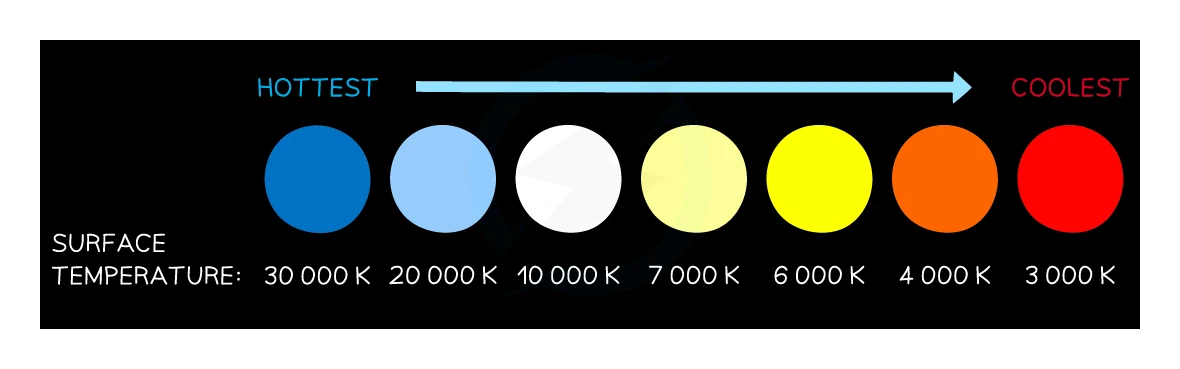
- Be careful: in everyday life we associate red with hot (red-hot iron, red flames) and blue with cold (cold water taps, ice). For stars it is the other way around: blue is the hottest, red is the coolest. The flame analogy is closer to the truth than the tap one, since a Bunsen burner's blue cone is hotter than its yellow tip
Common exam question
Comparing star temperatures from their colours
Question: Put a table of stars in order of increasing surface temperature from their colours, or explain which star (or which side of an HR diagram) is hottest (1–3 marks).
Asked in 7 of the 24 papers. One fact does all the work: colour is set by surface temperature, with blue hottest, then blue-white, white, yellow and orange, and red coolest. In the ordering tables one star in its correct place earns a mark, two earn two and the full order earns three; one scheme also accepts colours instead of star names.
In an explain question, one mark is for picking the blue star and the second for saying that colour depends on surface temperature; "the Sun is hotter than Betelgeuse" earns both on its own. Leave mass out of it, since the mark scheme ignores any link between mass and temperature. For the hottest side of an HR diagram say the left (blue) side: "white" alone is ignored.
What sets a star's temperature?
- A star's surface temperature depends on its mass and the stage of its life it is in
- Massive young stars on the main sequence are blue-white and very hot
- Lighter main-sequence stars (like the Sun) are yellow
- Aging stars that have swelled into red giants or red supergiants are cool and red, even though they may be very large and very bright
- As a star expands, its surface cools; as a star contracts, its surface heats up. So when the Sun eventually becomes a red giant, its outer layers swell out and cool to red; when it then collapses to a white dwarf, those layers contract again and heat to white-hot
2. How a star is born
All stars, regardless of how massive they end up, start the same way.
Nebula
- A nebula is a giant cloud of dust and gas (mostly hydrogen) drifting through interstellar space
- Some patches of a nebula are denser than others. The dense patches have stronger gravitational pull on the surrounding gas
Protostar
- Inside a dense patch, gravity pulls the gas and dust together. The cloud begins to collapse inwards
- As the gas gets squeezed:
- The density rises
- Particles collide more frequently, transferring kinetic energy
- The temperature rises sharply
- The hot ball of contracting gas is called a , a star not yet fully alive, because fusion has not yet begun
Main-sequence star
- Once the core of the protostar reaches about 10 million K, the hydrogen nuclei in the core start to fuse into helium, releasing huge amounts of energy
- A star that is fusing hydrogen in its core is called a
- The Sun has been a main-sequence star for about 4.6 billion years and will continue for another 5 billion or so before its hydrogen runs out
- During the main-sequence stage, the star is stable, because the outward pressure from fusion balances the inward pull of gravity. The star stays the same size for billions of years (covered in topic 21)
Every star starts the same way: → protostar → main-sequence star
Common exam question
Describing how a main sequence star forms from a nebula
Question: Describe how a main sequence star forms from a nebula, or show how the energy stores of the collapsing gas change before the star is created (3–4 marks).
Asked in 3 of the 24 papers. The credited steps form a sequence: a nebula is a cloud of dust and gas; gravity makes the cloud collapse; its temperature rises as it contracts; a protostar forms; and the star joins the main sequence when fusion starts. Any three earn the marks, so give them in order, naming both the force and the process. In the fill-in version, it is the particles' kinetic energy store that increases and raises the temperature.
The energy-store table is marked a row at a time: the gravitational potential store decreases and the thermal store increases as the gas falls inward, while the chemical store stays the same, and so does the nuclear store because fusion has not begun. A row with two ticks scores nothing.
3. The life cycle of a solar-mass star
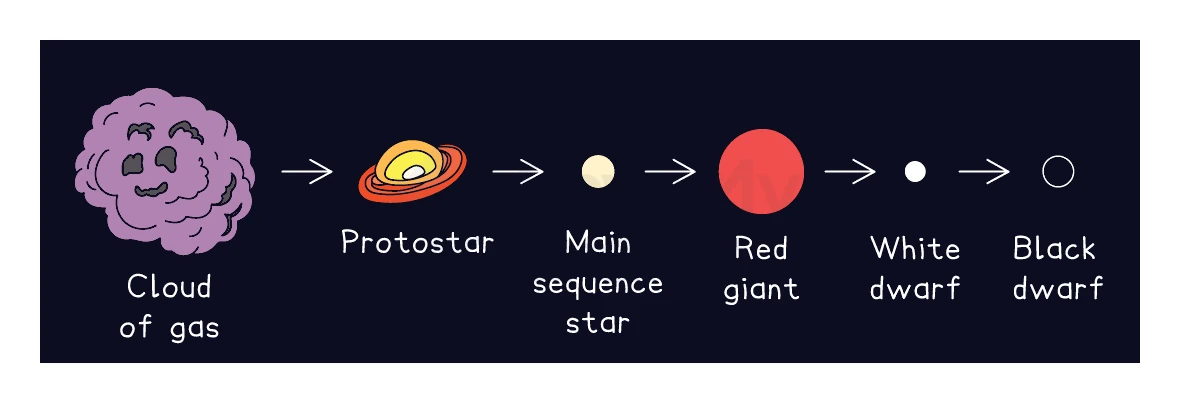
Stars roughly the same mass as the Sun (or smaller) finish their lives differently from much heavier stars. The full life cycle of a solar-mass star is:
nebula → protostar → main sequence → → →
Red giant
- Once the star has spent billions of years on the main sequence, the hydrogen fuel inside its core is used up. Core fusion slows and then stops altogether
- With no outward pressure to oppose it, gravity squeezes the core, which contracts and heats up
- The intense heat reaches a fresh shell of hydrogen around the dead core; this shell begins to fuse, and the core gets hot enough to fuse helium → carbon and oxygen
- The new burst of energy pushes the outer layers of the star outwards by a huge factor. The Sun, for example, will swell out to roughly the orbit of Earth
- As the outer layers expand they cool, glowing red. The star is now a red giant
Planetary nebula
- After the helium runs out, the red giant becomes unstable. Its outer layers drift off into space, forming a glowing shell of gas around the exposed hot core. This shell is called a planetary
- The name is misleading, since planetary nebulae have nothing to do with planets. Early astronomers thought they looked vaguely like planets through small telescopes, and the name stuck
White dwarf
- The exposed core left behind is a white dwarf, a small, very hot, very dense object roughly the size of the Earth but containing most of the Sun's mass
- A white dwarf has no fusion happening inside it. It simply cools and dims over billions of years, fading from white through yellow to orange and eventually red
- Eventually it becomes a black dwarf (cold, dark, no longer emitting light). The Universe is too young for any black dwarfs to exist yet, because white dwarfs take far longer to cool than the age of the Universe
Common exam question
Describing the life cycle of a Sun-like star
Question: Describe how a main sequence star ends up as a white dwarf or the Sun's whole evolution, or tick the stages in the Sun's life cycle (1–4 marks).
Asked in 5 of the 24 papers. The credited points, any four for full marks: hydrogen fusion stops as the core's hydrogen runs out; the core collapses and heats; the star expands into a red giant and its surface cools; helium fusion begins; when that stops the core is left as a white dwarf; the rest is released as a planetary nebula. The whole-life version needs nebula, main sequence and white dwarf, plus one of protostar, red giant or planetary nebula correctly placed.
No supernova: one scheme rejects it, another notes the Sun is not massive enough. "Black dwarf" is ignored. Tick only nebula, main sequence, red giant and white dwarf: each tick beyond four costs a mark. Mass alone decides the path; "size" or "weight" earns nothing.
4. The life cycle of a massive star
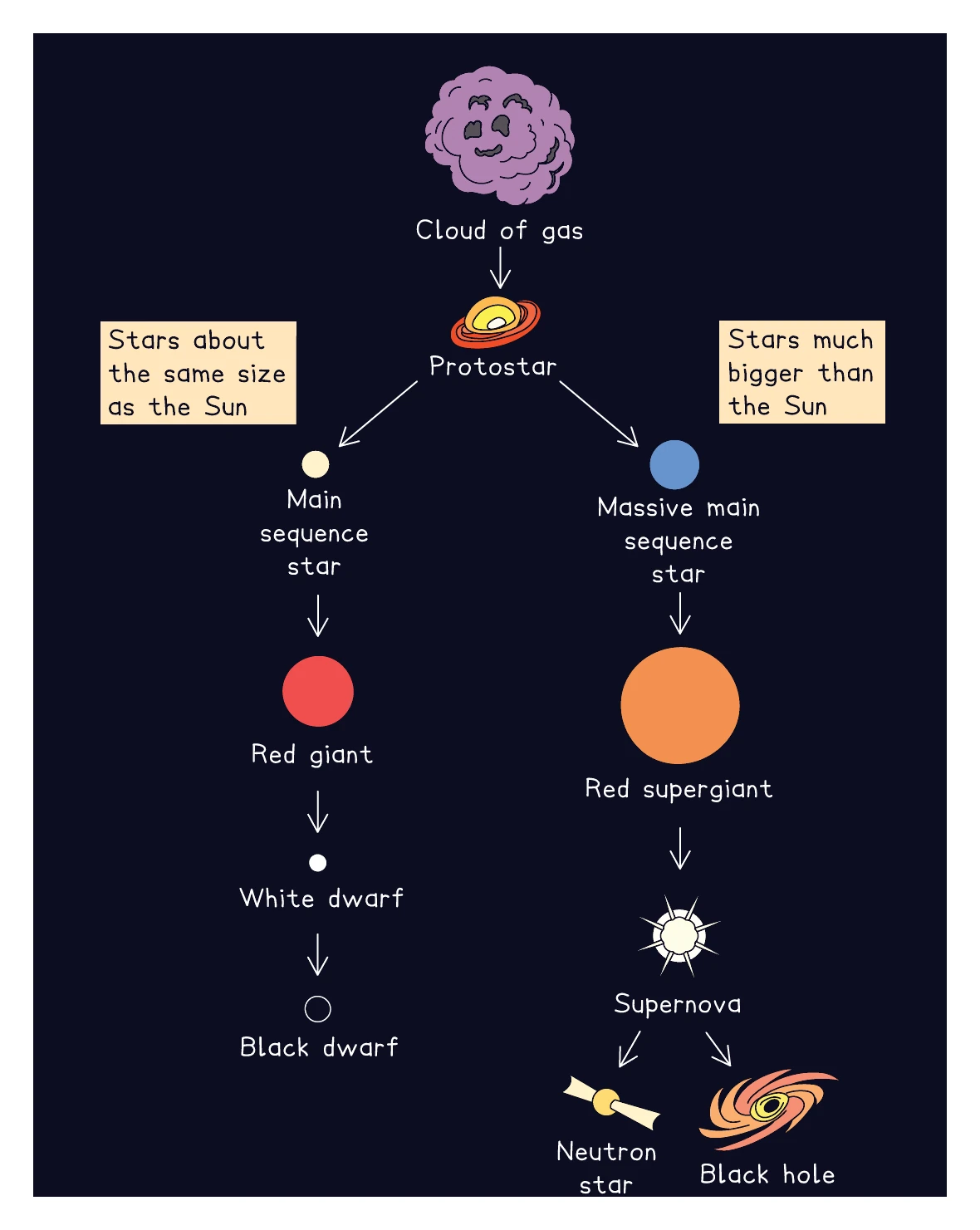
Stars much more massive than the Sun (typically more than about 8 solar masses) live faster and die more violently. Their life cycle is:
nebula → protostar → main sequence → → → or
A faster main sequence
- A more massive star has much more fuel to burn, but it burns it far faster because the core is hotter and denser
- A 10-solar-mass star spends only about 20 million years on the main sequence, compared to 10 billion for the Sun
Red supergiant
- When the core hydrogen runs out, the same expansion happens as for a solar-mass star, but on a much grander scale. The star swells to enormous size, far bigger than a red giant
- A red supergiant can be hundreds of times the diameter of the Sun. Betelgeuse, for example, would extend out past Jupiter's orbit if placed where the Sun is
- A massive star can fuse much heavier elements than a solar-mass star. It can build up successive layers of fusion all the way to iron in its core. Iron is the most tightly bound nucleus, so fusing it does not release energy
Supernova
- Once the core is iron, fusion can no longer support the star against gravity. The core collapses suddenly, in less than a second, to about the size of a city
- The infalling outer layers bounce off the collapsed core in a colossal explosion called a supernova
- A supernova is, for a few weeks, the brightest object in its host galaxy, outshining all the other hundreds of billions of stars combined
- The supernova:
- Hurls most of the star's mass out into space, enriching the surrounding gas
- Forges all of the elements heavier than iron (gold, lead, uranium and everything else) and scatters them through space
- Leaves behind a tiny, ultra-dense remnant
- The dust and gas thrown out by a supernova eventually mixes back into interstellar space and may become part of a new , from which the next generation of stars and planets will form. The carbon in your body, the oxygen you breathe and the iron in your blood were all forged in stars that exploded as supernovae billions of years ago
Neutron star
- For most massive stars, the collapsed core left behind is a neutron star, an object of roughly 20 km diameter containing more mass than the Sun
- The matter in a neutron star is so dense that protons and electrons have been squeezed together into neutrons. A sugar-cube-sized lump of neutron-star material would weigh as much as a mountain
Black hole
- For the most massive stars (above about 25 solar masses), even the neutron-star stage cannot stop the collapse. Gravity wins, and the core continues to contract to a point of effectively zero size, a black hole
- A black hole is a region of space where gravity is so overwhelmingly strong that nothing, including light itself, can get back out once it has crossed the boundary (the event horizon). Anything that falls in is gone forever
Common exam question
Describing the evolution of a massive star
Question: Describe the evolution of a star much more massive than the Sun after the main sequence, order its stages, or complete a passage on them (3–6 marks).
Asked in 6 of the 24 papers. In order: the core runs out of hydrogen and fusion stops; the core contracts and heats; fusion restarts and the star expands into a red supergiant; heavier elements fuse in the core until that stops; then a supernova; the core becomes a neutron star or black hole. "Super red giant" is accepted. The ordering table is marked row by row: three rows right earn three marks.
One scheme caps a 3-mark answer at 2 for stages out of order, or for padding with earlier stages such as the gas cloud or protostar. Comparing two stars, say which is high mass and which low, then give each path; "blue supergiant" is accepted, and the expected remnant is a neutron star (black hole condoned).
Quick comparison of the two paths
| Solar-mass star | Massive star | |
|---|---|---|
| Time on main sequence | ≈ 10 billion years | ≈ 1 to 100 million years |
| Heaviest element fused | Carbon, oxygen | Iron |
| Late stage | Red giant | Red supergiant |
| Death event | Quiet; outer layers drift off as a planetary nebula | Violent supernova explosion |
| End-state core | White dwarf (Earth-sized) | Neutron star (~20 km) or black hole (size of a point) |
| Recycles material? | Yes, mildly | Yes, dramatically; also creates heavy elements |
5. Brightness: luminosity, apparent magnitude, absolute magnitude
Luminosity: how bright a star actually is
- The of a star is:
the total amount of light energy the star emits per second
- Units: watts (W). Luminosity is a measure of the star's power output
- Luminosity is an intrinsic property and does not depend on where you are looking from. The Sun has a luminosity of about 4 × 10²⁶ W, whether you are standing on Earth or on Pluto
- Astronomers often express luminosity in solar units, where the Sun's luminosity = 1. So a star with luminosity 100 emits 100 times as much energy per second as the Sun
Apparent magnitude: how bright a star looks
- The of a star is:
a measure of how bright the star looks from Earth
- Apparent magnitude depends on two things:
- The star's luminosity, because a more luminous star looks brighter
- The star's distance from Earth, because a closer star looks brighter (light spreads out with distance, so a distant star looks fainter than the same star nearby)
- A bright nearby star and a luminous but very far star can have the same apparent magnitude
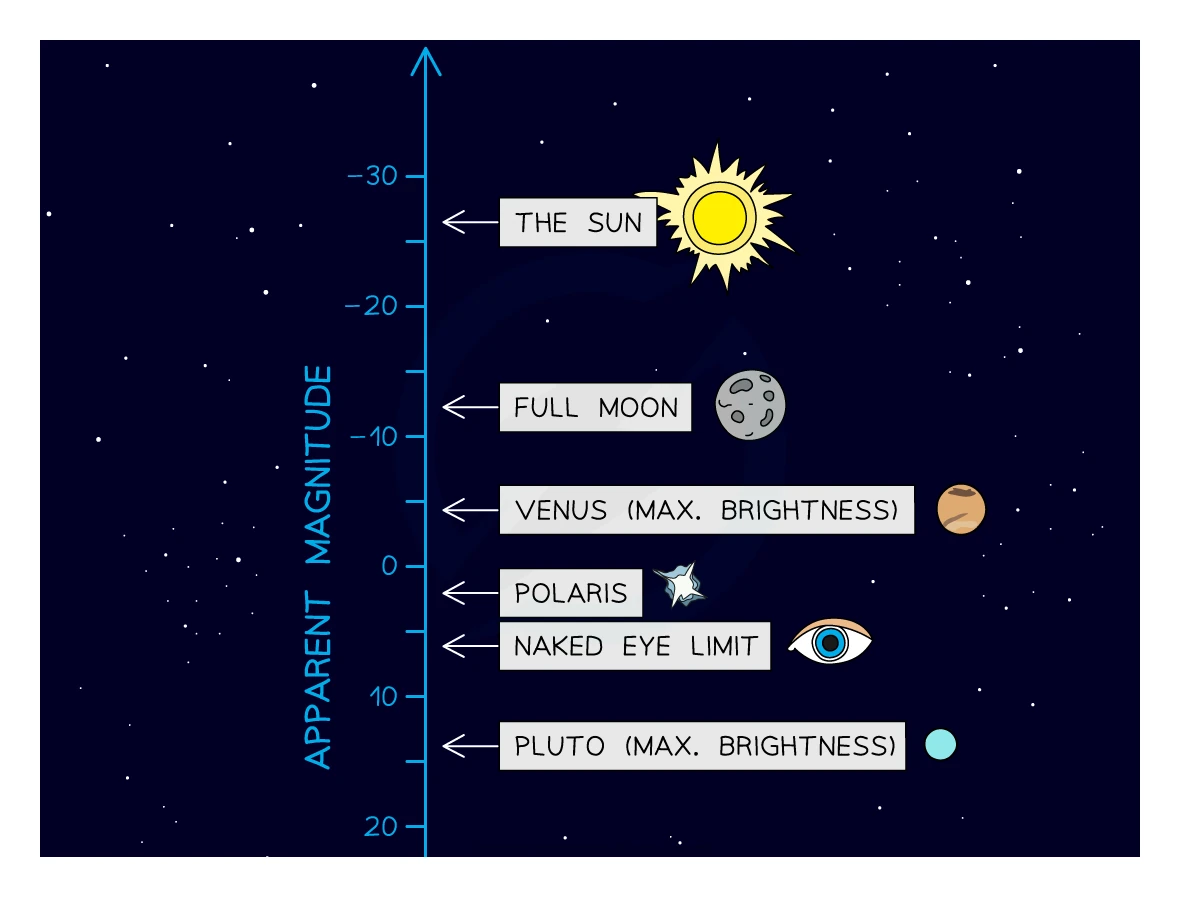
The reversed scale: lower number = brighter
- The apparent magnitude scale is back to front from what you might expect:
- The brighter the star looks, the smaller (or even negative) the magnitude
- The dimmer the star looks, the larger the magnitude
- Examples of apparent magnitude:
| Object | Apparent magnitude |
|---|---|
| Sun | −26.7 (brightest object in the sky) |
| Full Moon | −12.6 |
| Venus at brightest | −4.6 |
| Sirius (brightest star at night) | −1.5 |
| Polaris | +2.0 |
| Faintest stars visible to the naked eye | +6 |
| Faintest objects seen with Hubble Space Telescope | +31 |
- Each step of 5 magnitudes is exactly a factor of 100 in brightness. So a magnitude 1 star is 100 times brighter than a magnitude 6 star
Exam tip
A lower absolute magnitude means a brighter star
The magnitude scale runs backwards, so read tables and HR axes with care: a star at −5 is far brighter than one at +10, and on an HR diagram the negative values sit at the top, where the red giants are. Asked which star in a table is in its supernova stage, pick the one with a mass much larger than the Sun's, backed by its much lower absolute magnitude; each reason scores only if you name the right star, which is the first mark, and bringing in colour or temperature caps the answer at two of the three marks.
Absolute magnitude: putting all stars at the same distance
- To compare two stars fairly, you have to remove the distance effect. does exactly that:
absolute magnitude = how bright the star would look if it were placed at a standard distance of 10 parsecs (about 32.6 light-years, or 3 × 10¹⁴ km) from Earth
- This puts every star on the same footing. A star with a low absolute magnitude is truly very luminous; a star with a high absolute magnitude is truly dim, regardless of where they actually are
- The Sun's absolute magnitude is +4.8. From 10 parsecs away the Sun would be a dim naked-eye star, confirming that the Sun is a fairly modest star intrinsically; it looks bright only because it is so close
Common exam question
Absolute magnitude and why distance changes brightness
Question: Define absolute magnitude, or explain how two stars can look equally bright (or one brighter) from Earth whatever their true brightness (1–2 marks).
Asked in 4 of the 24 papers, all on Paper 2. The definition has two halves, one mark each: a measure of a star's brightness (power, luminosity or intensity accepted) at a standard distance (fixed, set or the same distance count, as does 10 parsecs or 32.6 light years). Describing the scale does not earn the brightness half.
The explaining part is one idea: the stars are not at the same distance from Earth, so the nearer one looks brighter. Say which is nearer: the brighter-looking star (that alone scores both marks) or, for two stars that look equally bright, the less powerful one. Apparent magnitude is how bright a star looks from Earth and depends on distance; absolute magnitude removes that, which is why it is the vertical axis of an HR diagram.
Why both scales are useful
- answers "what will I see in the sky?", useful for navigation, for telescopes, for finding objects
- (and luminosity) answers "what is this star really like?", useful for classifying stars and understanding their life cycles
6. Hertzsprung–Russell diagrams
What an HR diagram is
- A Hertzsprung–Russell (HR) diagram is a plot that arranges stars by their two most important properties:
- on the vertical axis (more luminous stars near the top, less luminous near the bottom). Often plotted on a log scale, with the Sun's luminosity = 1 as a reference point
- Surface temperature on the horizontal axis, plotted backwards, with the hottest (blue) stars on the left, the coolest (red) stars on the right
- The diagram is named after the two astronomers who discovered it independently in the early 20th century
The reversed temperature axis
- The horizontal axis runs from high temperature on the left to low temperature on the right, the opposite way round from a normal physics graph. This is a historical convention you just have to remember
- The colour of each region of the diagram matches the temperature scale: blue on the left, white-yellow in the middle, orange-red on the right
The four key regions
A scatter plot of all stars in the night sky reveals four clusters:
- The main sequence is a long, diagonal band of stars running from the top-left (hot, luminous, blue) to the bottom-right (cool, dim, red). About 90% of all stars lie on the main sequence at any given time. The Sun sits on the main sequence in the middle of the band
- form a clump of stars in the bottom-left, which are hot (which would normally mean blue) but dim (because they are tiny). They lie below the main sequence
- form a cluster in the upper-right, which are cool (red) but bright (because they are huge). They sit above the main sequence
- sit at the very top-right, even cooler and even more luminous than red giants. They are the brightest stars known by sheer luminosity
What a star's position tells you
| Region | Temperature | Luminosity | Size |
|---|---|---|---|
| Top-left main sequence | Hot (blue) | Very high | Large hot blue stars |
| Middle main sequence | Yellow | Moderate | Sun-like stars |
| Bottom-right main sequence | Cool (red) | Low | Red dwarf stars |
| Bottom-left of diagram | Hot but dim | Very low | White dwarfs (very small) |
| Upper-right of diagram | Cool but bright | High | Red giants (very large) |
| Top-right of diagram | Cool but extremely bright | Very high | Red supergiants (huge) |
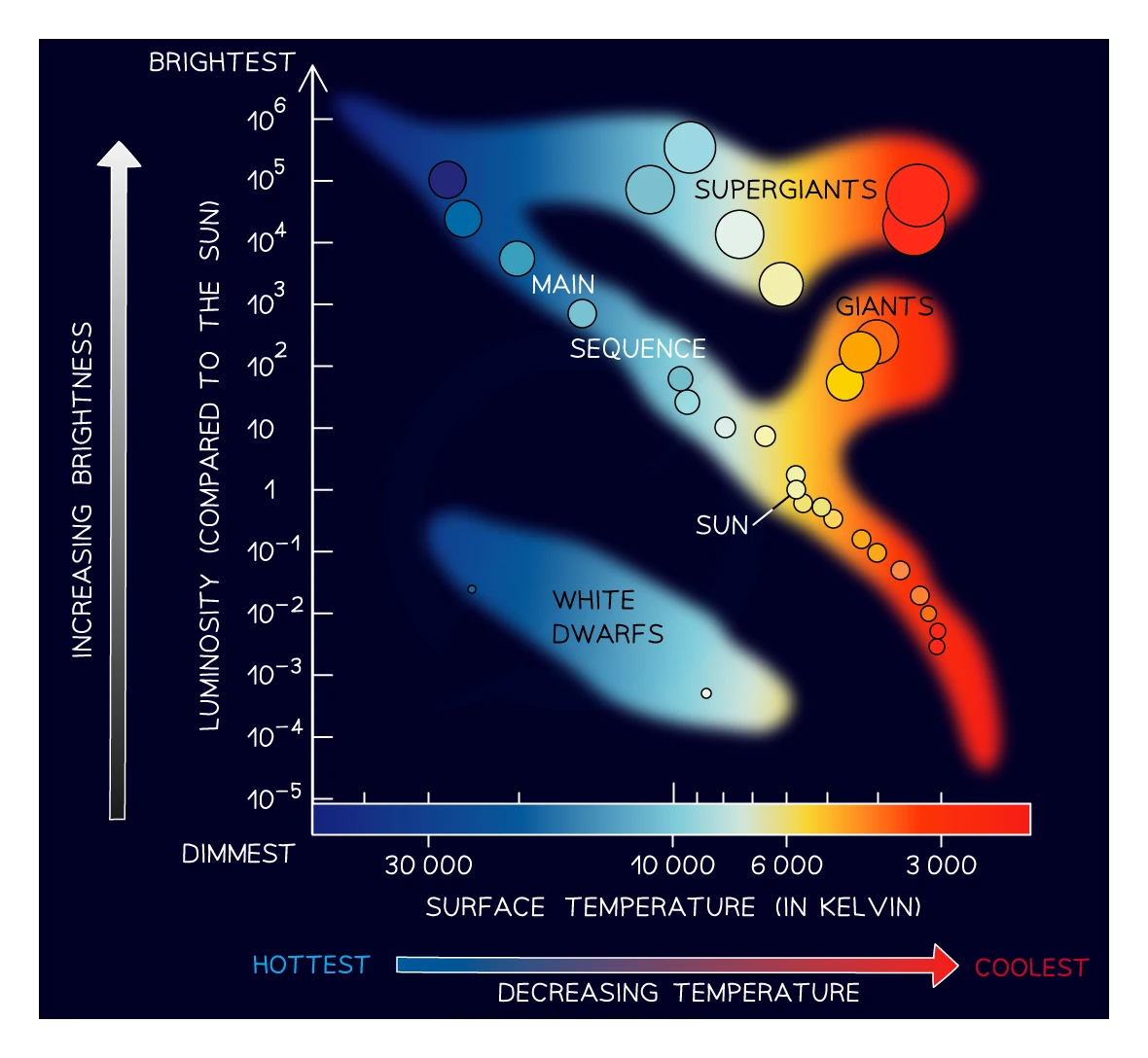
Common exam question
Identifying the regions of an HR diagram
Question: Name the star type in each labelled region of an HR diagram (or join regions to types), mark the Sun's position, or circle where it will be at its next stage (1–4 marks).
Asked in 4 of the 24 papers, all on Paper 2. The regions are always the same: the diagonal band is the main sequence, the clump at the bottom left the white dwarfs, the group at the top right the red giants; a very bright blue star sits top left on the main sequence, a Sun-like star in its middle. The word box's distractors (black holes, supernovae, neutron stars, nebulae) have no region on the diagram.
Give one answer per region: two names or two lines lose its mark. The Sun's cross goes on the main sequence; its next stage is the red giant region at the top right, and the circle must overlap that area only. The vertical axis is absolute magnitude, not apparent magnitude.
Common exam question
Describing or comparing types of star
Question: Describe the stars in one corner of an HR diagram, or discuss the differences between a red giant and a white dwarf (2–4 marks).
Asked in 2 of the 24 papers. Each mark is a separate property, so work through the list: surface temperature, brightness (luminosity or power), colour, size, mass, density and whether fusion is still happening. The stars at the top left are hot, very bright, blue or white and high in mass. Compared with a white dwarf, a red giant is brighter, far larger, cooler and still fusing, while the white dwarf is denser and has a planetary nebula around it. Each point can be made from either side, so "the white dwarf is hotter" is as good as "the red giant is cooler". Write "bright" or "high luminosity" rather than a bare reference to absolute magnitude, which one scheme ignores.
Reading the life cycle off an HR diagram
- A star's position on the HR diagram changes over its lifetime as it evolves through the stages described in sections 3 and 4
- For a solar-mass star:
- Main sequence: sits at the Sun's position for billions of years
- Red giant: moves up and to the right (cooler surface, much higher luminosity because the star is huge)
- White dwarf: moves down and to the left (much hotter exposed core, much lower total luminosity because the star is tiny)
- For a massive star:
- Main sequence: top-left of the diagonal band (hot, blue, very luminous)
- Red supergiant: moves all the way across to the upper-right (cools as it expands, stays extremely luminous)
- Supernova → neutron star or black hole: leaves the HR diagram altogether; the remnants are too small and dark to plot