1. Conductors and insulators
Conductors
- A conductor is a material that lets electric charge flow through it readily
- Familiar conductors are almost all metals:
- silver, copper, gold (excellent conductors)
- aluminium, steel, iron (good conductors)
- Why metals conduct so well:
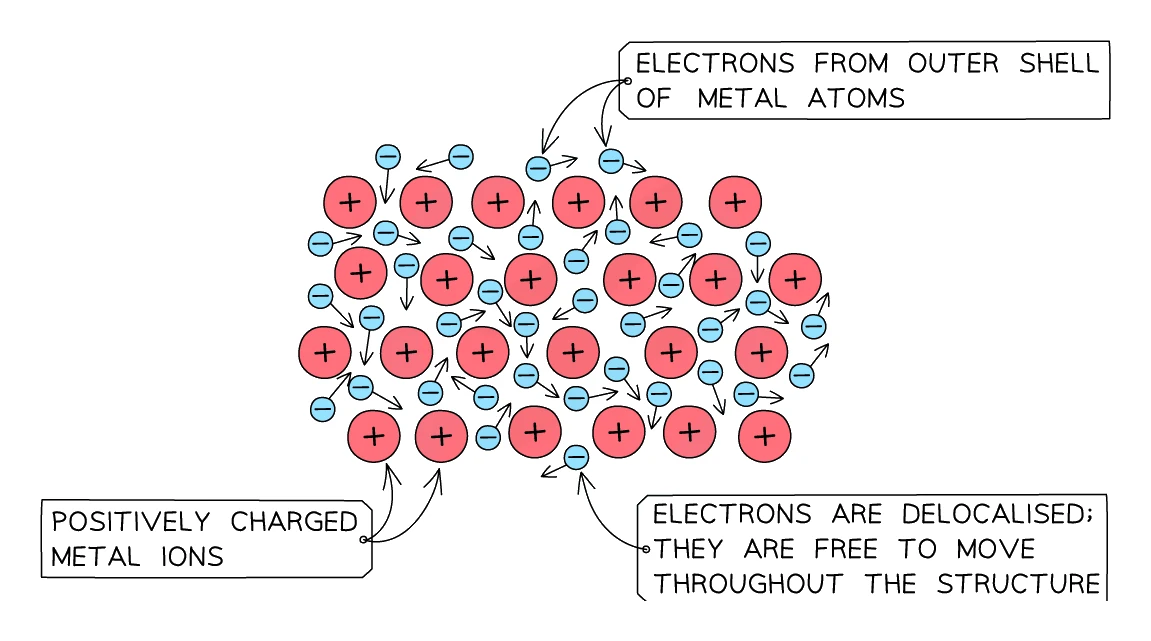
- inside a metal, the outermost electrons of each atom are delocalised, so they are no longer tied to one particular atom and drift freely through the lattice of fixed positive ions
- an electric field set up across the metal makes these free electrons drift along the wire, and a current is simply the rate at which they move
Insulators
- An insulator is a material with no free electrons: every electron is bound to a particular atom, so charge cannot drift through the bulk of the material
- Familiar insulators include:
- plastic, rubber, dry wood, glass, dry paper, ceramic
- Insulators do not conduct current, but charge can still be deposited on their surface by rubbing, and that surface charge is what static electricity is all about
- Some insulators (wood, paper, hair) can build up a noticeable surface charge that leaks slowly into the surroundings; truly dry, pristine plastics can hold a charge for hours
Why the distinction matters for static electricity
- Excess charge on a spreads itself evenly across the surface and flows away to earth almost instantly if any conducting path exists
- Excess charge on an stays put on the surface where it was deposited; it cannot leave by flowing through the bulk
- Static-electricity experiments therefore use insulating rods (polythene, acetate, perspex) so that the charge built up by friction stays on the rod long enough to test
2. Core practical: investigating charging by friction
Aim
- Show that rubbing two insulators together transfers electrons between them, leaving one with a net negative charge and the other with an equal net positive charge
- Identify which rods, when rubbed with a cloth, end up with the same sign of charge and which end up oppositely charged
Variables
- Independent variable: the material of the rod being tested (polythene, acetate, perspex, glass, ebonite, etc.)
- Dependent variable: whether the test rod attracts or repels a known, similarly charged reference rod, when both have been rubbed with the same kind of cloth
- Control variables:
- the type of cloth used (e.g. duster, silk, or woollen pad; pick one and keep it)
- the length of time spent rubbing each rod
- the length of each rod
- the room kept still and free from draughts
Apparatus
| Equipment | Purpose |
|---|---|
| Polythene rod (the reference rod) | Charged once, suspended from a cradle, used to test every other rod against |
| Test rods (acetate, perspex, glass, ebonite, dry wood) | Each one rubbed and brought near the suspended reference rod |
| Cloth (one per rod) | Used to rub the rod and so charge it |
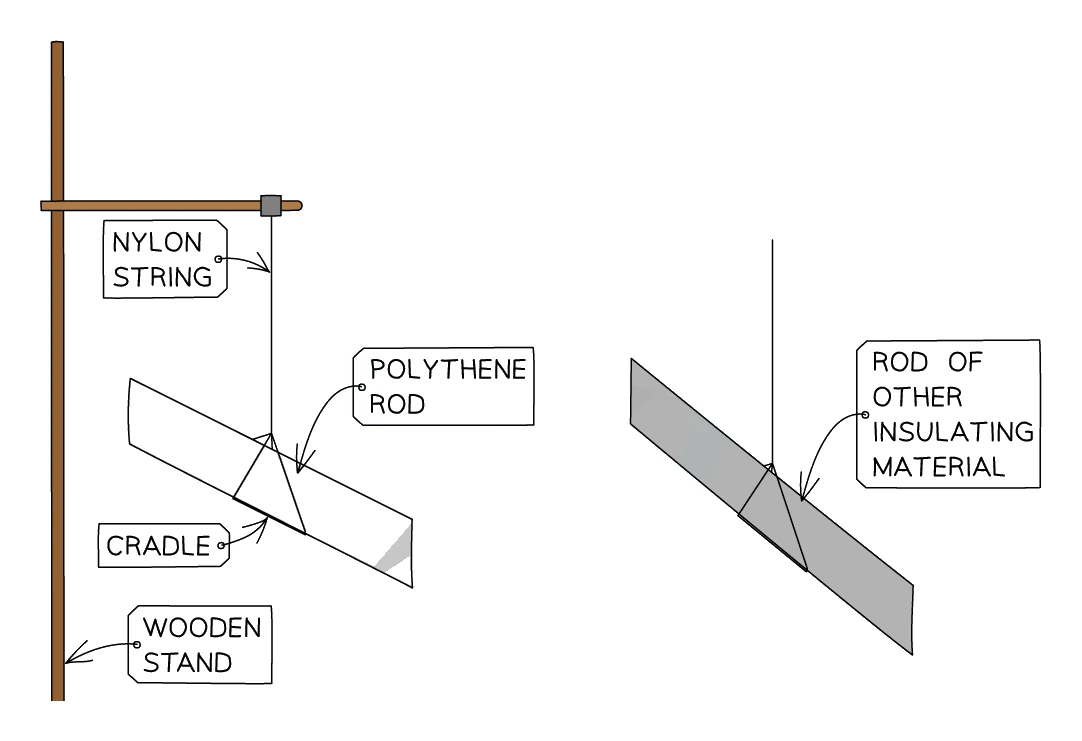
| Insulating cradle of nylon string | Hangs the polythene rod horizontally and lets it rotate freely without leaking charge away |
| Wooden retort stand | Holds the cradle clear of the bench |
Method
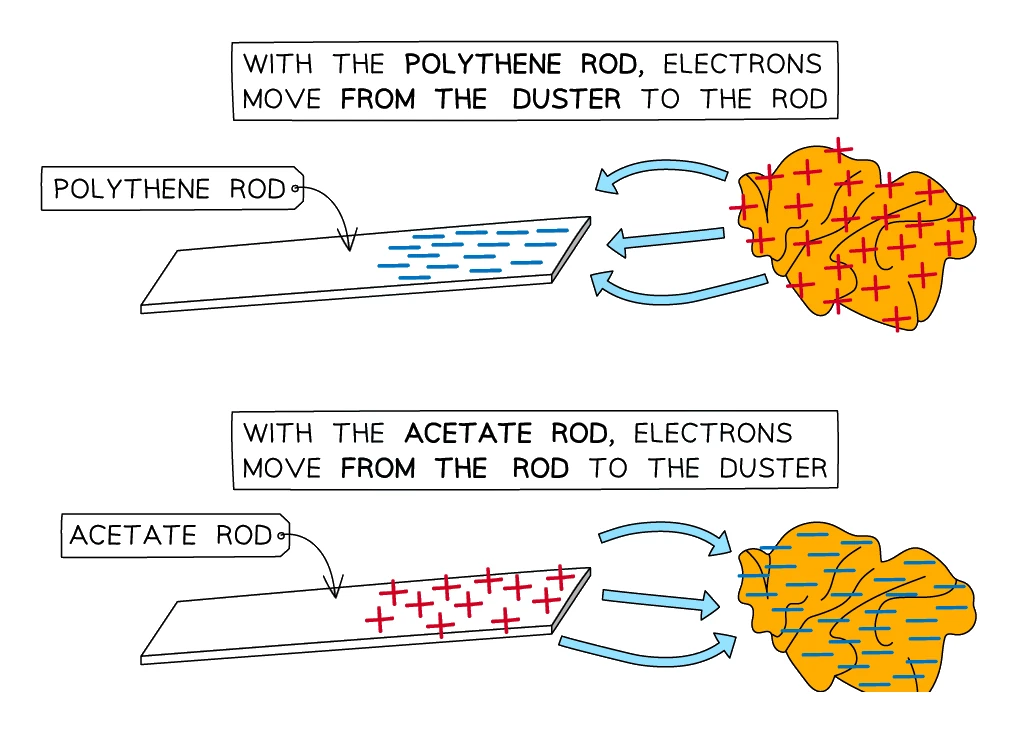
- Grip a polythene rod in the middle so your fingers cannot leak charge from the ends, and stroke both ends firmly with the chosen cloth. Polythene gains electrons from the cloth, so it ends up
- Hang the rod horizontally inside the nylon cradle from the wooden stand. Do not touch the charged ends, because your skin would let charge leak away
- Take one of the test rods and rub it with a fresh cloth in the same way
- Without making physical contact, bring one charged end of the test rod close to one end of the suspended polythene rod
- Observe whether the polythene rod rotates towards the test rod (attraction) or rotates away from it (repulsion)
- Record the observation, then repeat steps 3–5 with the other test rods
Analysis
- Charging is by . Atoms cannot lose their protons by rubbing, so when an insulator becomes charged it must be because electrons have moved from one surface to the other:
- The material that gains electrons becomes negatively charged
- The material that loses electrons becomes positively charged
- The total charge before and after rubbing is the same (charge is conserved), and the two surfaces simply end up with equal and opposite amounts of it
- Reading the results:
- If the suspended rod repels the test rod, the two rods carry the same sign of charge
- If the suspended rod attracts the test rod, the two rods carry opposite signs of charge
- Typical school-lab outcomes:
- Polythene rubbed with a duster → gains electrons, charges negative
- Acetate (or perspex) rubbed with a duster → loses electrons, charges positive
- Two polythene rods rubbed the same way repel each other; a polythene rod and a freshly rubbed acetate rod attract each other
Exam tip
Why charge builds up on plastic but not on earthed metal
A pad rubbed over a car becomes charged on the plastic panels but not on the earthed metal ones, and the explanation is three marks from four ideas: plastic is an insulator (or metal is a conductor); rubbing transfers electrons between the surfaces; the electrons stay on the plastic, which has no free electrons to carry them away; on the metal they flow through it to earth. Tie each of the last two points to its material by name. A sentence about charge staying put or flowing away that names no surface does not earn that mark.
Sources of error and improvements
- Random errors:
- Draughts in the room can swing the suspended rod by themselves; close doors and windows and let the rod settle before each test
- If the rotation is hard to see, rub the rod for longer to deposit more charge and produce a clearer deflection
- Improvement, making the experiment quantitative. Instead of just reading attract/repel, count the number of small paper discs each freshly rubbed rod can pick up from a tray; a graph or bar chart of the results then shows which rod has gained the most charge
Common exam question
Variables, anomalies and charts in a charging investigation
Question: In an investigation of how materials charge, state the independent, dependent and control variables, deal with an anomalous reading, or choose the type of graph for the results (1–2 marks each).
Set in 2 of the 24 papers. The independent variable is the material; the dependent variable is what is measured, such as the force needed to pull charged squares apart (newtonmeter or spring balance; "forcemeter" earns nothing). Control variables are everything else kept the same: rubbing or rotation time and speed, the number, size and thickness of the pieces, the temperature.
An anomalous reading sits far from the other repeats: circle it, say it should be repeated or checked, and leave it out of the mean. A mean that includes it is capped at one mark; dropping the minus sign from a negative charge costs another. Results listed by material are categoric, so name a bar chart, with that reason as the second mark; "histogram" is ignored.
3. Electric charge
Three states of charge
- A particle (or an object) can be:
- positively charged: has fewer electrons than protons
- negatively charged: has more electrons than protons
- neutral (uncharged): has the same number of electrons and protons, so the charges exactly cancel
- An ordinary atom is neutral because the number of orbiting electrons matches the number of protons in its nucleus; the equal-but-opposite charges add to zero overall
How an object becomes charged
- The only charges that can move at room temperature are electrons, since protons are locked inside the nucleus
- Two consequences follow:
- Gaining electrons leaves an object with a net negative charge
- Losing electrons leaves an object with a net positive charge
- The shortcut to remember this is the maths: subtracting a negative from zero leaves a positive
0 − (−1) = +1
Common exam question
Explaining how an object has become charged
Question: Explain how a cloth, rod or metal grid has become positively or negatively charged, or describe the difference between a neutral particle and a positively charged one (1–2 marks).
Asked in 5 of the 24 papers; the answer is always about electrons. Say that electrons are transferred and that the object which is now positive has lost electrons, while one that is negative has gained them. Saying simply that the cloth has lost electrons, or that the rod took electrons from it, earns both marks, but the electrons must have left the object that is now positive, not another part of the apparatus. A neutral particle has equal numbers of protons and electrons; a positive one has more protons than electrons because it lost some, and "it has no charge" on its own earns nothing.
Protons never move. "Gains protons" and "positive electrons" are both rejected, and the force doing the transferring is friction.
Forces between charges
- Two charged objects placed near one another exert an electric force on one another without touching, which is a non-contact force
- The direction of the force depends on the signs:
- Like charges repel (both positive, or both negative → they push apart)
- Opposite charges attract (one positive, one negative → they pull together)
- The size of the force grows as the charges are brought closer together and shrinks as they are moved apart
| Charge of object 1 | Charge of object 2 | Force is… |
|---|---|---|
| positive | positive | repulsive |
| negative | negative | repulsive |
| positive | negative | attractive |
| negative | positive | attractive |

Common exam question
Explaining why charged objects attract or repel
Question: Explain why a stream of electrons spreads out, why a charged particle accelerates between charged plates, or how two rubbed materials end up stuck together (2–3 marks).
Asked in 4 of the 24 papers. Name each object's charge, then apply the rule. Electrons are all negative, so like charges repel and the stream spreads, one mark each ("similar charge" is tolerated, "positive electrons" is not). A positive particle is attracted to the negative plate and repelled by the positive one, so a resultant force acts on it; quoting "unlike charges attract" or "like charges repel" correctly earns the first mark.
Rubbed materials that stick together take three marks from five ideas: friction; electrons transferred between them (moving protons are ignored); so they are oppositely charged; the one that gained electrons is negative; and opposite charges attract. A negatively charged film sticks to a neutral plate because it repels electrons in the plate, leaving the touching surface oppositely charged.
Why a charged object attracts a neutral one
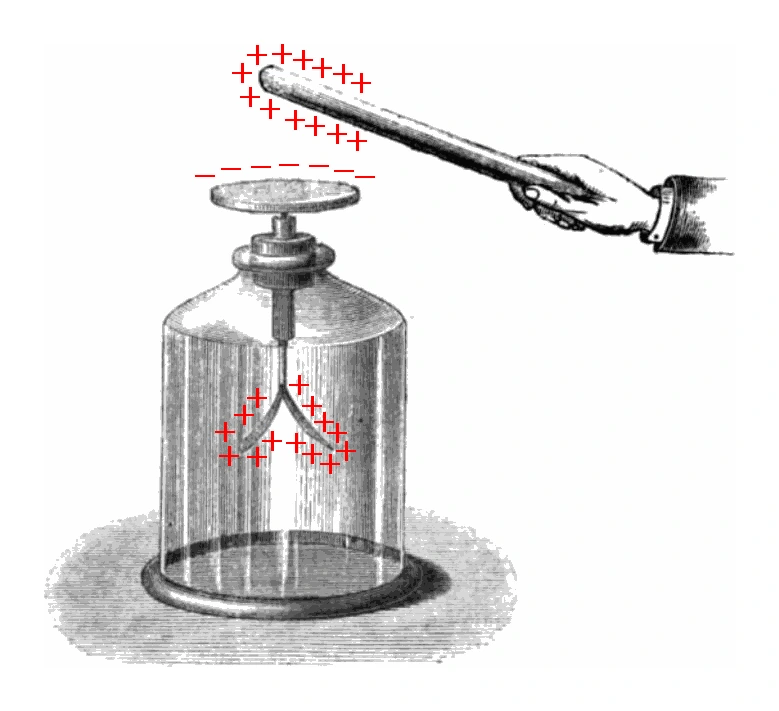
- A charged object also exerts a force on an apparently uncharged object; for example, a rubbed comb picks up small pieces of paper
- The mechanism is induced charge separation:
- Inside the neutral object, the electrons are free to shift a little, even if the object as a whole has no net charge
- When a positively charged comb is brought near, the loose electrons in the paper drift towards the comb, leaving the far side of the paper slightly positive
- The negative near-side is now closer to the comb than the positive far-side, so the attractive force on the near-side wins out and the paper is pulled in
- The same trick explains how charged balloons stick to walls, why dust clings to a television screen, and why a rubbed plastic ruler bends a thin stream of water from a tap
Common exam question
Demonstrating that an object is charged
Question: Describe an experiment that shows an object is charged, or how rubbed rods could show that there are two different types of charge (2–3 marks).
Asked in 2 of the 24 papers. For two marks, bring the object near a light, uncharged insulator (small pieces of paper, hair, a thin water stream, a balloon, a suspended rod) and say that it attracts it: attraction is the evidence. Repulsion on its own is rejected unless you use a gold-leaf electroscope, where the leaf deflecting is accepted.
Showing two types of charge takes three marks: suitable apparatus (the same objects, an electroscope or a coulombmeter); a charged rod exerting a force on it; and evidence of both behaviours, such as two charged rods moving apart while a different pair move together, or an electroscope leaf that swings one way for a positive object and the other way for a negative one. An answer that mentions magnets is rejected.
4. Uses and dangers of static electricity
Useful applications
-
Photocopiers: rely on static charge on a rotating drum to pick up powdered ink (toner) only where it is needed:
- The drum (or copying plate) is given a uniform positive charge across its whole surface
- An optical image of the page is projected onto the drum. Where the original page is white, light hits the drum and the positive charge on those areas leaks away. Where the original page is dark (text or graphics), the drum stays positively charged
- Negatively charged toner powder is dusted onto the drum; it sticks only to the areas that are still positive, copying the dark pattern of the original page
- A blank sheet of paper is rolled over the drum and the toner transfers to the paper
- The paper is briefly heated so the toner melts and bonds to the fibres, which is why photocopies come out warm
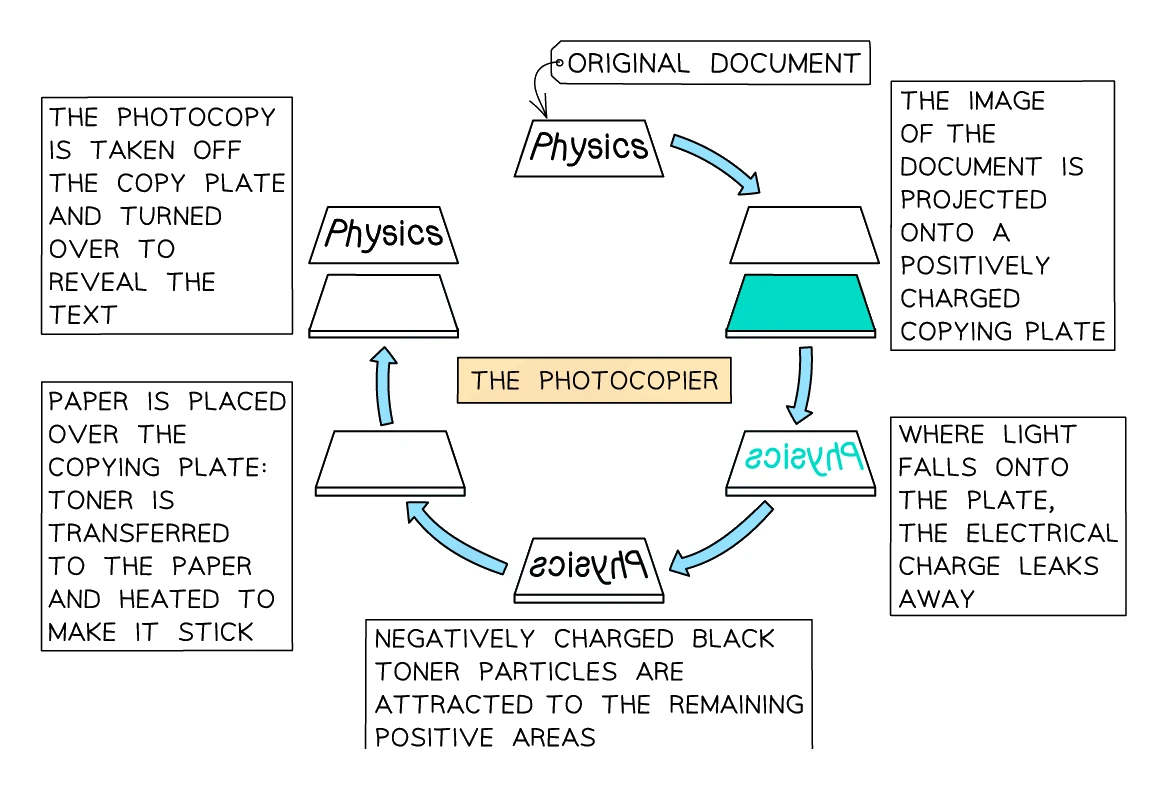
Source: Static electricity by Save My Exams -
Inkjet printers: the same idea, but each droplet of coloured ink is given a charge as it leaves the nozzle, and electrostatic deflection plates steer the droplet to the right spot on the page
-
Electrostatic insecticide sprayers: each fine droplet of insecticide is charged as it leaves the nozzle:
- all droplets carry the same sign of charge, so they repel each other and spread out into a fine even mist instead of clumping into big drops
- the droplets are also attracted to the opposite charge induced on the leaves of the crop, so they coat the underside of leaves as well as the top, wasting less of the chemical
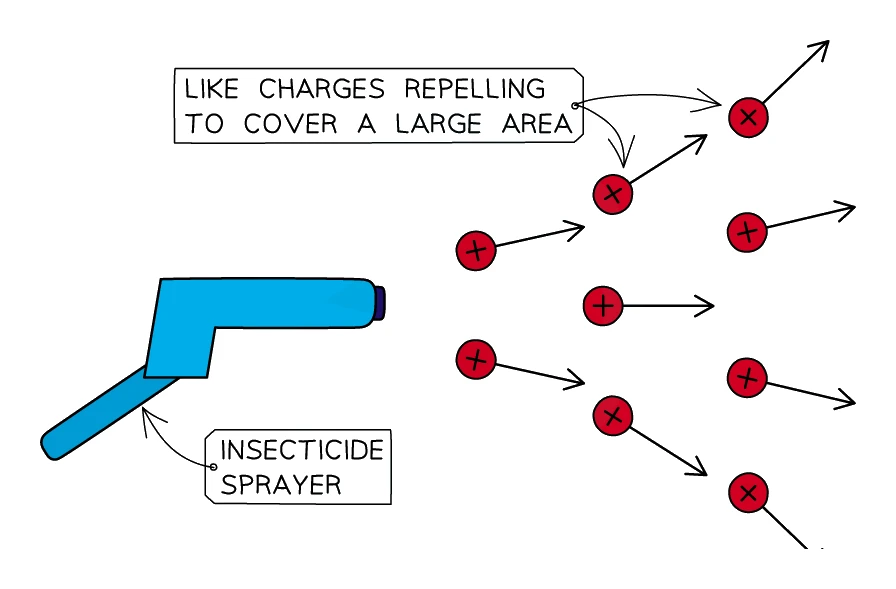
Source: Static electricity by Save My Exams -
Electrostatic spray painting of cars: the same trick applies, where paint droplets carry one sign of charge, the car body is grounded so it carries the opposite, and the paint coats every recess evenly
Sparking, a dangerous consequence
- A spark is what you see when so much charge has built up on one object that the potential difference between it and a nearby object becomes large enough to ionise the air between them. The ionised air becomes briefly conducting, the charge rushes across, and you see (and hear) a small lightning bolt
- Sparking can:
- Give an electric shock to anyone touching the charged surface (uncomfortable from a clothes-dryer; lethal in extreme cases such as a lightning strike)
- Ignite flammable vapour, since a single spark in petrol vapour, hydrogen, or fine dust can start a fire or explosion
Refuelling vehicles and the bonding wire
- Fuel running quickly through the metal pipe of a tanker rubs against the inside of the pipe; the friction transfers electrons between the fuel and the pipe and so charges the fuel
- A petrol-station fuel pump nozzle, an aeroplane refuelling tanker, or a chemical-works pipe is therefore at risk of a spark just as the fuel hits the tank, and that spark is sitting next to flammable vapour
- Two safety practices prevent this:
- The aircraft/lorry chassis is bonded to the tanker (and both to ground) with a thick copper wire called a bonding line before the fuel valves are opened. Any charge that builds up on either body now flows down this low-resistance wire to earth rather than jumping the air gap as a spark
- The fuel nozzle and pipe are made from a slightly conducting plastic or coated metal so that charge does not accumulate at the spout
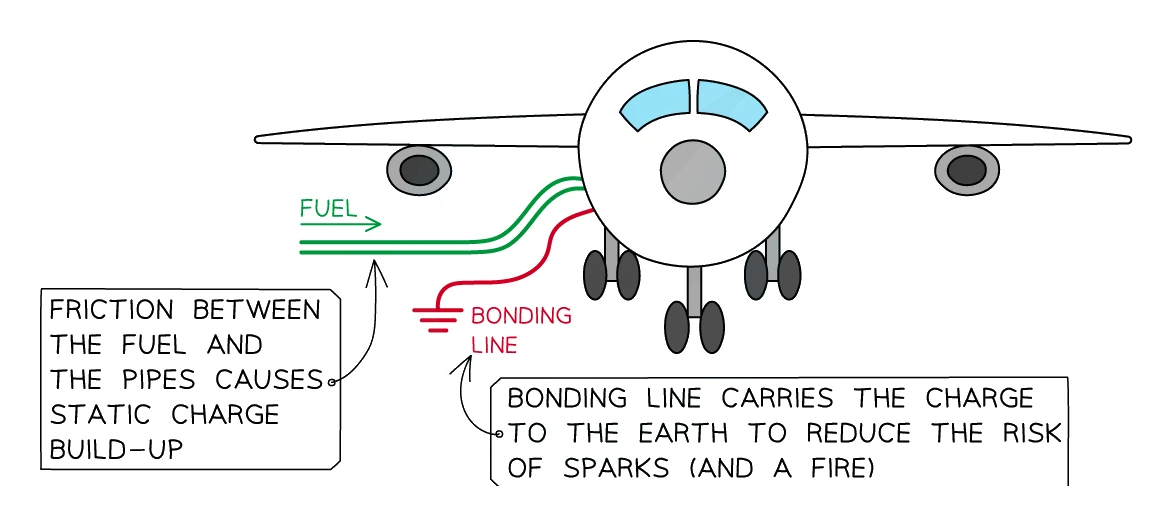
Earthing as a general safety principle
- The general rule for managing dangerous static: connect any conductor that might pick up charge to a thick, low-resistance wire that leads to earth (the ground, treated as an effectively infinite reservoir of charge)
- Examples of earthing in action:
- The earth pin in a three-pin mains plug (topic 07) discharges a faulty appliance's metal casing
- Anti-static wrist straps worn by computer technicians have a thin earth wire that lets any charge build-up on the wearer leak harmlessly to ground before it can damage delicate chips
- Lightning on tall buildings are thick copper or aluminium strips bolted from the top of the building down to a buried earth plate; if lightning strikes the building, the charge flows through the strip rather than through the building's walls
Exam tip
Why the current stops when a charged rod is earthed
When a negatively charged rod touches a metal object that is connected to the ground through an ammeter, the meter shows a current briefly and then reads zero. The two marks are: electrons flow through the metal towards earth ("charges" is accepted in place of "electrons"), and the flow then stops because the rod has lost its excess electrons, which you can put as the rod having been discharged or neutralised. Stating only that electrons or charge flow is the first mark; the second is for saying that the flow then stops, or that the rod has been discharged.