1. Atomic structure
What an atom is
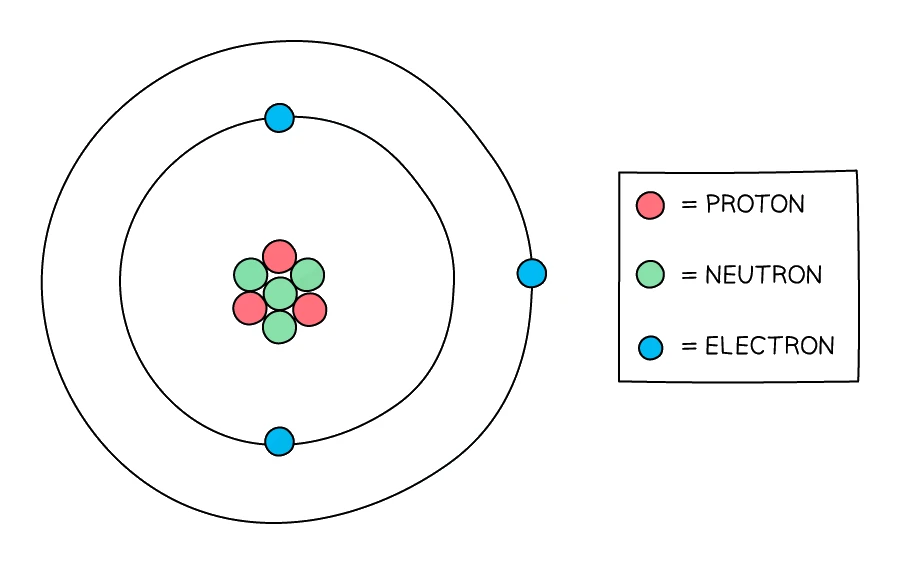
- An atom is the basic building block of all matter. Atoms are tiny (about 1 × 10⁻¹⁰ m in radius), so around 100 million atoms could sit side by side across a thumbnail
- Every atom has two parts:
- a tiny dense at the centre
- a cloud of orbiting the nucleus
- The nucleus is about 10 000 times smaller than the whole atom but contains almost all of the mass. If the atom were scaled up so the nucleus was a marble in the middle of a football stadium, the electrons would be orbiting the seats in the back row
The three sub-atomic particles
| Particle | Location | Relative charge | Relative mass |
|---|---|---|---|
| Proton | In the nucleus | +1 | 1 |
| Neutron | In the nucleus | 0 | 1 |
| Electron | Orbiting the nucleus | −1 | 1/2000 (effectively zero) |
- Together protons and neutrons make up the nucleus and are called
- In a neutral atom, the number of electrons equals the number of protons, so the positive nuclear charge is exactly cancelled by the negative electron charge
- If an atom loses or gains electrons, the charges no longer balance and the atom becomes an ion: positive if electrons have been lost, negative if extra electrons have been gained
Atomic and mass numbers
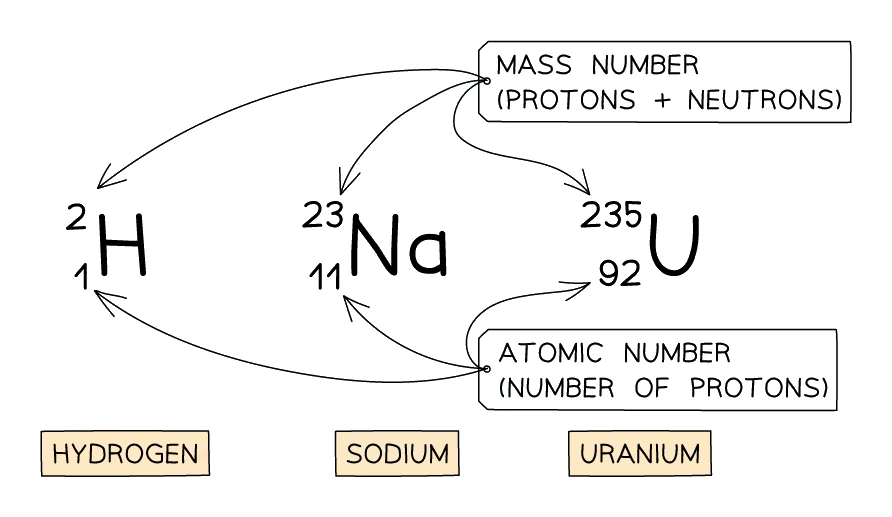
- Atomic number (Z) = the number of in the nucleus. This single number defines which element an atom is:
- Hydrogen: Z = 1
- Carbon: Z = 6
- Sodium: Z = 11
- Uranium: Z = 92
- Mass number (A) = the total number of nucleons (protons + neutrons) in the nucleus
- The number of in an atom can therefore be found by subtraction:
number of neutrons = mass number − atomic number = A − Z
Nuclear notation
- A nucleus is described by writing its element symbol together with its mass number and atomic number:
ᴬ_Z X
- where:
- A = mass number (top, total nucleons)
- Z = atomic number (bottom, protons)
- X = the element's chemical symbol
- Some examples:
- ¹₁H is hydrogen (1 proton, 0 neutrons, 1 electron)
- ²³₁₁Na is sodium (11 protons, 12 neutrons, 11 electrons)
- ²³⁸₉₂U is uranium-238 (92 protons, 146 neutrons, 92 electrons)
Common exam question
Counting neutrons from a nuclear symbol
Question: Given the symbol of a nucleus, with its mass number above and its atomic number below, how many neutrons does the nucleus contain? (1 mark, multiple choice)
Asked in 3 of the 24 papers. Subtract the bottom number from the top one: the mass number counts protons and neutrons together and the atomic number counts the protons, so cobalt-60 (atomic number 27) has 60 − 27 = 33 neutrons. The three wrong options are built from the expected slips: the atomic number on its own, the mass number on its own, and the two added together. Electron counts are asked the same way: a neutral atom has as many electrons as protons, a positive ion has fewer because it has lost electrons, and a negative ion has gained electrons. Saying that a positive ion has gained protons is rejected.
2. Isotopes
Definition
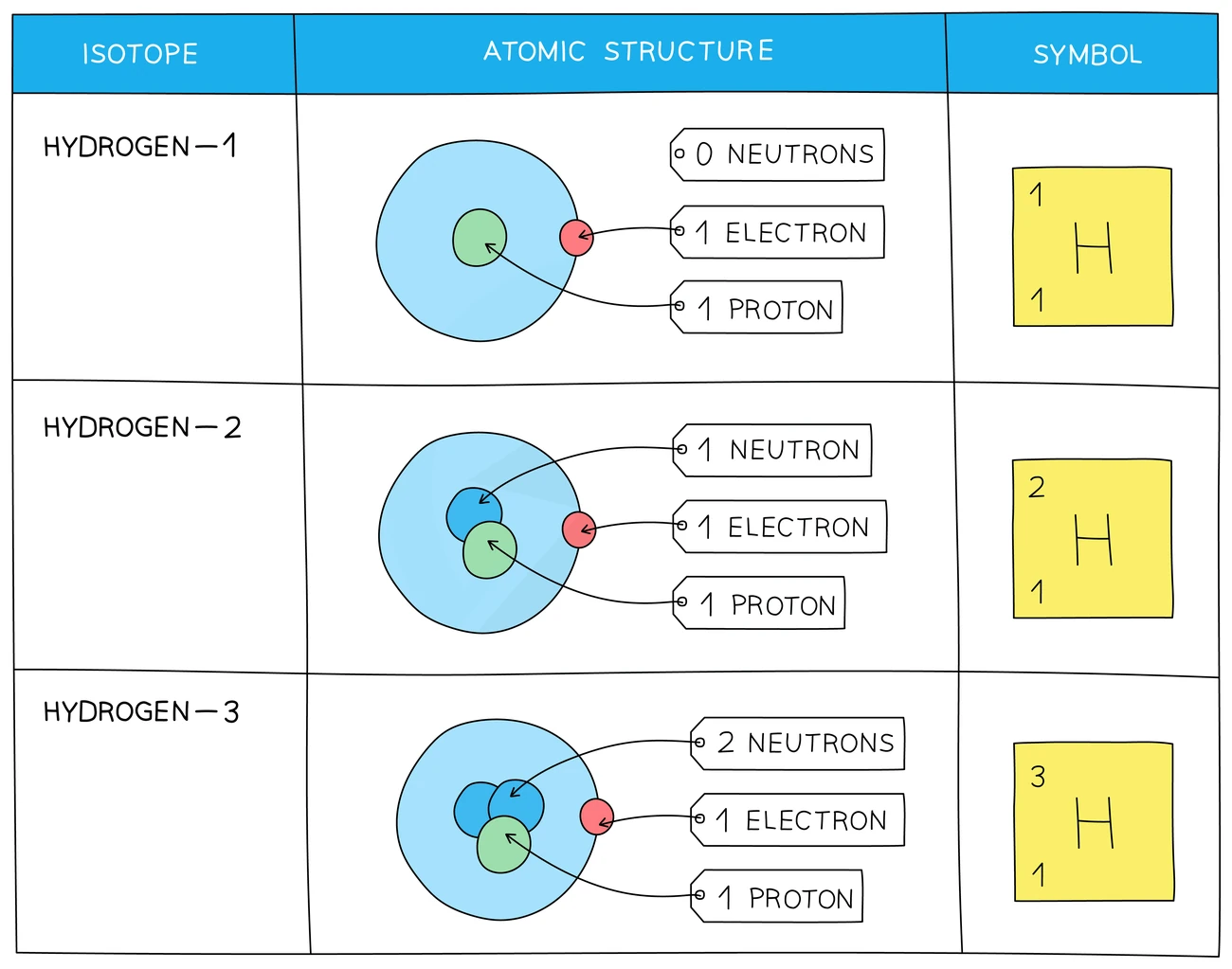
- An isotope is a form of an element whose atoms have the same number of but a different number of
- Because the atomic number is unchanged, isotopes of an element are chemically identical. They sit in the same place on the periodic table and form the same compounds. The difference shows up in their mass and in their nuclear stability
- Most elements have several naturally occurring isotopes:
- Hydrogen has three: ¹₁H (protium, no neutrons), ²₁H (deuterium, 1 neutron) and ³₁H (tritium, 2 neutrons). Of these, only tritium is radioactive
- Carbon has three common isotopes: ¹²₆C, ¹³₆C, and the radioactive ¹⁴₆C used in radiocarbon dating
- Uranium has two common isotopes: ²³⁵₉₂U (used in nuclear fuel) and ²³⁸₉₂U (the more abundant one)
Common exam question
Defining or recognising an isotope
Question: Describe what is meant by the term isotope, or pick out the nucleus in a table that is a different isotope of a given element (1–2 marks).
Asked in 3 of the 24 papers. The written definition carries two separate marks: nuclei with the same number of protons (the same atomic number is accepted) and a different number of neutrons (a different mass number is accepted). Give both halves. In the table version, keep the proton number fixed and change only the neutron number: a row with a different number of protons is a different element, and a row identical to the given nucleus is the same isotope, not a different one. The multiple-choice definition reads the same way (equal proton numbers, unequal neutron numbers), and the options that swap in electrons or keep the neutron number fixed are wrong.
Why some isotopes are stable and others aren't
- The nucleus is held together by the strong nuclear force, which acts only over very short distances. Protons repel each other electrically, so a stable nucleus needs the right ratio of neutrons to protons to balance these effects
- Stable isotopes have a nucleon balance the nuclear forces can hold together indefinitely
- Unstable isotopes have too many neutrons (or in some cases, too few) and the nucleus will eventually emit a particle or a burst of energy to settle into a more stable arrangement. We call this
- A few examples:
- ¹²₆C is stable. ¹⁴₆C is unstable (it has two extra neutrons) and decays by beta emission
- Heavy nuclei like ²³⁸₉₂U are unstable simply because they are large. They shed mass and charge in a chain of alpha and beta decays until they reach lead
3. Types of radiation
Why radiation is emitted
- An unstable nucleus can become more stable by emitting radiation: a high-energy particle or wave that carries away mass, charge or energy from the nucleus
- This process is called radioactive decay. It happens spontaneously and at a random moment for any given nucleus: you can predict the average behaviour of a large sample, but you can never say when one particular nucleus will decay
The three main types of radiation
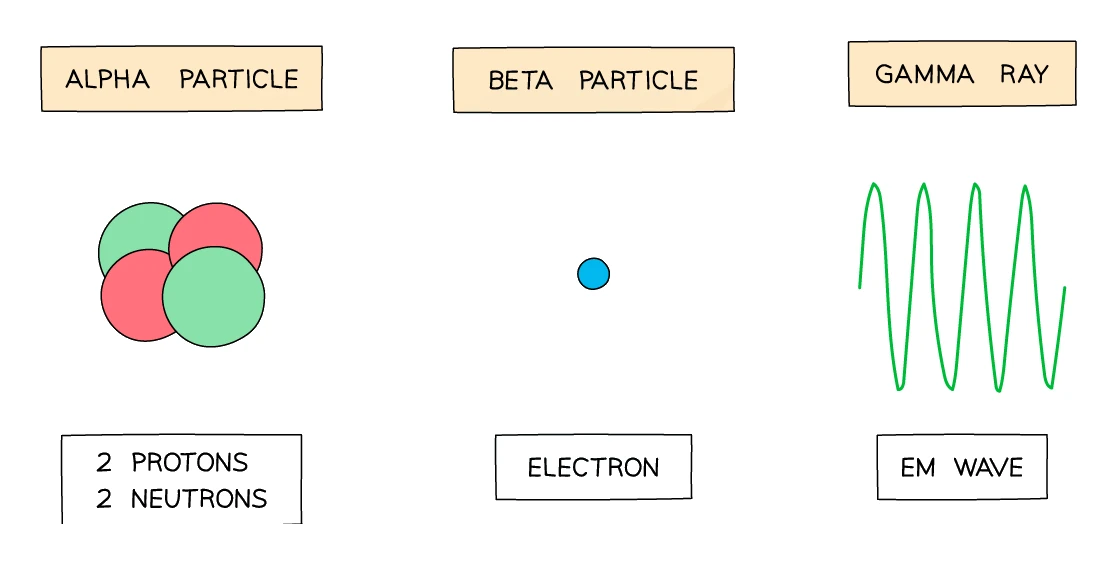
- Alpha (α) particles are emitted from very large unstable nuclei
- Beta (β⁻) particles are emitted when a neutron in the nucleus converts into a proton and an electron
- Gamma (γ) rays are emitted as a high-energy electromagnetic wave when a nucleus needs to shed surplus energy without changing its composition
- A fourth, less common process is neutron emission: a single neutron is ejected without any change in proton number
What each one is made of
| Radiation | Symbol | Nature | Charge | Relative mass |
|---|---|---|---|---|
| Alpha | α (⁴₂He) | Two protons + two neutrons (a helium nucleus) | +2 | 4 |
| Beta | β⁻ (⁰₋₁e) | A high-speed electron ejected from the nucleus | −1 | 1/2000 (negligible) |
| Gamma | γ | A high-energy electromagnetic wave (photon) | 0 | 0 |
Common exam question
Identifying a radiation from its description
Question: Which type of radiation is a high-energy electron, which option best describes gamma radiation, or which particle is the same as an alpha or a beta particle? (1 mark, multiple choice)
Asked in 3 of the 24 papers. Match each name to its nature: an alpha particle is a helium nucleus (two protons and two neutrons), a beta particle is a high-energy electron and gamma is a high-frequency electromagnetic wave. The fourth option is usually a neutron, named outright or described as a particle with mass but no charge. A neutron or a proton on its own is only one constituent of an alpha particle, and a beta particle is not an electromagnetic wave: one scheme rules out wrong options on exactly those grounds, so learn the three descriptions as a set.
Penetrating power
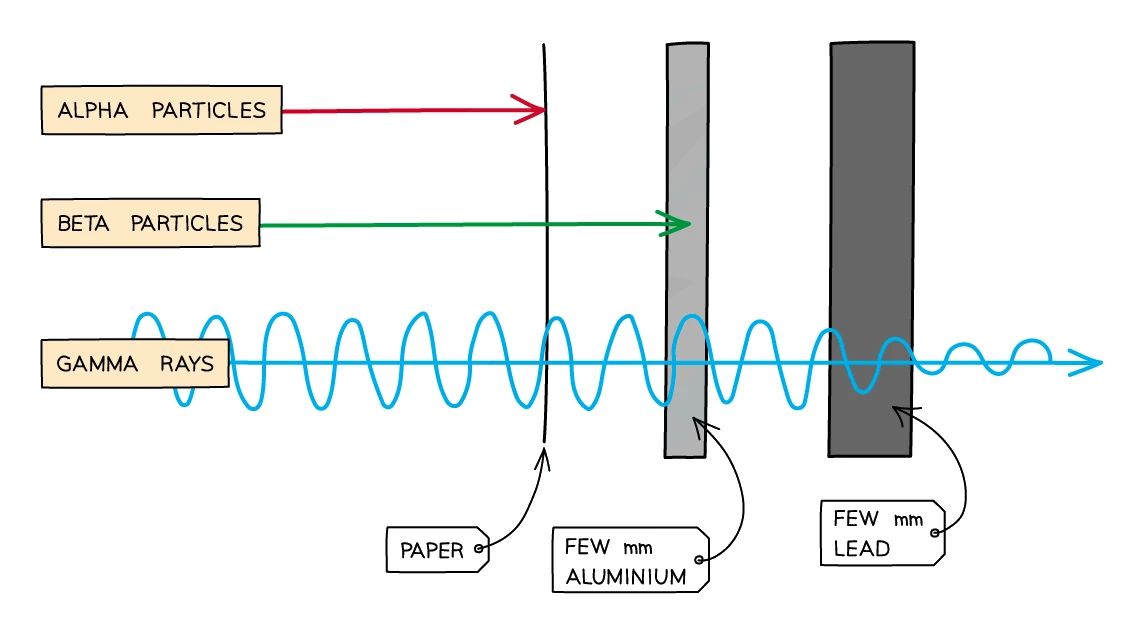
- Alpha is the most massive and most highly charged, so it interacts strongly with matter. It ionises everything it meets very effectively but is stopped after only a few centimetres of air or by a single sheet of paper
- Beta is light and singly charged. It penetrates several tens of centimetres of air and is stopped by a few millimetres of aluminium foil. Its ionising effect is moderate
- Gamma has no charge and no mass, just energy. It penetrates the furthest (effectively infinite range in air; only reduced, never fully blocked, by even a few centimetres of lead). Its ionising effect on a given molecule is the weakest of the three because it interacts least
Common exam question
Working out which radiation a source emits
Question: From counts taken through air, paper, aluminium or lead, state or explain which radiation a source emits, or mark in a table which radiation each absorber stops (1–3 marks).
Asked in 4 of the 24 papers. Argue from what stops the radiation. Alpha is stopped by paper or a few centimetres of air, so a count that dies away within a few centimetres, or drops to background behind paper, means alpha. Beta passes paper but not a few millimetres of aluminium. Gamma alone gets through lead, so a count still detected through lead must be gamma: any alpha or beta would have been absorbed, which is also why gamma, not beta, is detected outside a patient's body. With data, say that paper cut the count sharply and that aluminium and lead made no further difference, then name alpha; the middle mark needs both aluminium and lead mentioned. In the table version each correct row earns a mark.
Ionising power (the flip side)
- The same property that makes alpha stop quickly is what makes it ionise heavily: a charged particle that loses its energy in a short path knocks lots of electrons off molecules on its way
- A useful summary:
- alpha: short range, strongly ionising
- beta: medium range, moderately ionising
- gamma: very long range, weakly ionising
- Inside the body, the dangers run in the opposite order: alpha is most dangerous inside the body (because it ionises heavily over a short range and damages nearby cells) but harmless outside (the skin stops it). Gamma is most dangerous outside the body because it can reach internal organs
Common exam question
Stating differences between alpha and beta
Question: State two differences between alpha radiation and beta radiation, or explain why alpha particles leave shorter, thicker tracks than beta particles in a cloud chamber (2 marks).
Asked in 2 of the 24 papers. Any two comparisons earn the marks: alpha has more mass and more charge, and it is positive where beta is negative; alpha has a shorter range in air, is slower and is less penetrating (stopped by paper, where beta needs aluminium); alpha is more ionising; alpha is a helium nucleus while beta is an electron. The reverse argument, stated about beta, is accepted. For the cloud-chamber tracks, two points from: alpha does not penetrate as far, it is more ionising, it is more likely to collide with the material, and it has more mass or moves more slowly, so its energy is spent along a short, dense track.
4. Core practical: investigating radiation
Aim
- Use a Geiger–Müller (GM) tube to investigate the penetrating power of alpha, beta and gamma radiation by placing different absorbers (paper, aluminium, lead) between a sealed source and the detector
Variables
- Independent variable: the absorbing material (and its thickness for aluminium)
- Dependent variable: the count rate registered by the GM tube, measured in counts per minute (cpm) or counts per second (cps)
- Control variables: the same source, fixed distance between source and tube, same location (so background level is the same), same measurement time per reading
Common exam question
Naming the variables in the penetration investigation
Question: For a method that counts the radiation getting through different absorbers, or more and more sheets of one, tick whether each listed quantity is the independent, dependent or control variable, or pick the dependent variable from a list (1–3 marks).
Asked in 2 of the 24 papers. The independent variable is what the experimenter changes: the absorbing material, or the number of sheets of lead. The dependent variable is the count measured by the detector. The control variables are the distance between the source and the detector and the time over which each count is taken. In the tick-table version, all four rows right earns the three marks, two or three rows earns two and one row earns one, and more than one tick in a row loses that row's mark, so commit to a single column each time.
Apparatus
| Equipment | Purpose |
|---|---|
| Sealed radioactive sources (one α, one β, one γ) in a school-approved holder | The sources to be tested |
| Long-handled tongs | Allow safe handling of the sources without bringing them close to the body |
| GM tube and digital counter | Detects ionising radiation and counts the pulses |
| Selection of absorbers: sheet of paper, several aluminium sheets at 0.5 mm thickness intervals, several lead sheets | Placed between source and detector to test penetration |
| Lead-lined storage box for the sources | Reduces stray exposure when sources are not in use |
| Ruler and clamp stand | Fixes the source-to-tube distance |
| Stopwatch | Times each measurement |
Method
- With no source present, take three one-minute readings of the background count and find the mean. Subtract this from every later reading so the measured value is the count due to the source alone
- Set up the GM tube and source 3 cm apart on the bench, with the tube pointing at the source
- Without any absorber in place, record the count for one minute. This is the unblocked count for that source
- Place a single sheet of paper between the source and tube and record the count for one minute
- Replace the paper with 0.5 mm of aluminium foil, then 1.0 mm, then 1.5 mm, recording the count at each thickness
- Replace the aluminium with several thicknesses of lead in turn and record the count for each
- Repeat the whole sequence for the other two sources
Interpreting the results
- The unblocked count tells you the total emission from the source. Compare each absorber's count to it:
- If paper drops the count near to the background level, the source is emitting alpha
- If paper has no effect but a few mm of aluminium drops the count to near background, the source is emitting beta
- If even thick lead only partially reduces the count, the source is emitting gamma
- Many sources emit more than one type of radiation. A source that drops with paper and again with aluminium is emitting both alpha and beta, for example
Safety
- Never directly handle radioactive sources; use tongs at arm's length
- Keep the unboxed source pointing away from yourself and others
- Spend as little time as possible with the source out of its lead box
- Return the source to its lead-lined container immediately after each measurement
5. Decay equations
Alpha decay
- In alpha decay, the nucleus emits an alpha particle (a helium-4 nucleus)
- Effects on the parent nucleus:
- decreases by 4
- decreases by 2
- A new element is formed (since Z has changed)
- General equation:
ᴬ_Z X → ᴬ⁻⁴_Z₋₂ Y + ⁴₂α
Beta decay
- In beta decay, a neutron inside the nucleus transforms into a proton plus an electron. The electron is ejected as the beta particle; the proton stays in the nucleus
- Effects on the parent nucleus:
- Mass number stays the same (a neutron has become a proton, but the total nucleon count is unchanged)
- Atomic number increases by 1 (one more proton)
- A new element is formed
- General equation:
ᴬ_Z X → ᴬ_Z₊₁ Y + ⁰₋₁β
Gamma decay
- In gamma decay, the nucleus emits a burst of high-energy electromagnetic radiation (a gamma photon)
- Effects on the parent nucleus:
- Mass number stays the same
- Atomic number stays the same
- No new element is formed; the nucleus has simply lost some energy
- Gamma emission often happens immediately after another decay (alpha or beta) leaves the daughter nucleus in an excited state. The excited nucleus then sheds the excess energy as a gamma photon
- General equation:
ᴬ_Z X → ᴬ_Z X + ⁰₀γ
Neutron emission
- A handful of very neutron-rich isotopes can decay by ejecting a single directly
- Effects on the parent nucleus:
- Mass number decreases by 1 (one nucleon has gone)
- Atomic number stays the same (no protons lost)
- The result is a different of the same element
- General equation:
ᴬ_Z X → ᴬ⁻¹_Z X + ¹₀n
Balancing nuclear equations
- Two simple rules let you check or complete any decay equation:
- The sum of mass numbers on the left must equal the sum on the right
- The sum of atomic numbers on the left must equal the sum on the right
- A balanced equation conserves both mass and charge across the reaction
Common exam question
Decay equations and changes in the nucleus
Question: Complete an alpha or beta decay equation, count the alphas and betas in a decay sequence, or match a decay to its effect on the nucleus (1–3 marks).
Set in 7 of the 24 papers. Balance mass and atomic numbers separately: an alpha particle is 4 over 2 and a beta particle is 0 over −1. Each missing number, on either side, is usually a mark. With several alphas, multiply by how many there are; a wrong alpha atomic number is carried through. For a mixed sequence, divide the mass-number drop by 4 for the alphas, then balance atomic numbers (each alpha removes 2, each beta adds 1); that attempt alone earns the first mark.
Asked what beta decay does, say the protons go up by one and the neutrons down by one, one mark each; statements about atomic or mass number were ignored. If only the mass number falls, by 1, it is neutron emission.
Worked example
Completing an alpha decay equation
A nucleus of radon-220 (atomic number 86) undergoes alpha decay to form a polonium nucleus. Complete the nuclear equation by finding the missing mass number and atomic number of the daughter nucleus and the alpha particle.
Solution:
- An alpha particle has mass number 4 and atomic number 2, written ⁴₂α.
- Mass number check: 220 = daughter mass number + 4, so daughter mass number = 216.
- Atomic number check: 86 = daughter atomic number + 2, so daughter atomic number = 84.
- Element with Z = 84 is polonium (Po).
- Completed equation: ²²⁰₈₆Rn → ²¹⁶₈₄Po + ⁴₂α
Worked example
Counting the alpha and beta particles in a decay series
Uranium-238 (atomic number 92) decays through a series of alpha and beta emissions and ends as the stable nucleus lead-206 (atomic number 82). Find how many alpha particles and how many beta particles are emitted over the whole series.
Solution:
- Only alpha particles change the mass number, by 4 each: 238 − 206 = 32, so 32 ÷ 4 = 8 alpha particles.
- Eight alpha particles remove 8 × 2 = 16 from the atomic number: 92 − 16 = 76.
- The final atomic number is 82, so beta decays must add 82 − 76 = 6, one each: 6 beta particles.
- Check: mass numbers 206 + (8 × 4) + (6 × 0) = 238; atomic numbers 82 + (8 × 2) + (6 × −1) = 82 + 16 − 6 = 92. Both balance.
6. Detecting radiation
Photographic film
- Photographic film darkens when ionising radiation hits it, just as it darkens when visible light hits it
- The more radiation absorbed, the darker the film when developed
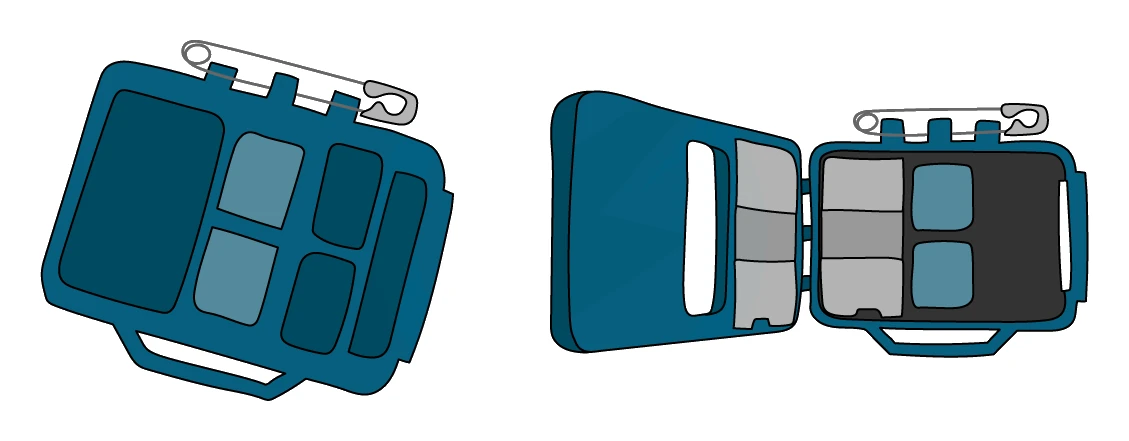
- Radiation workers (radiographers, nuclear-medicine staff, lab technicians) wear film badges with several layers of absorber inside them:
- paper to filter out alpha
- aluminium to slow beta
- lead and copper windows to gauge how much gamma got through
- The patchwork of darkening on the developed film tells the health-and-safety team how much of each kind of radiation the wearer was exposed to over the badge's wearing period
Geiger–Müller tube (GM tube / Geiger counter)
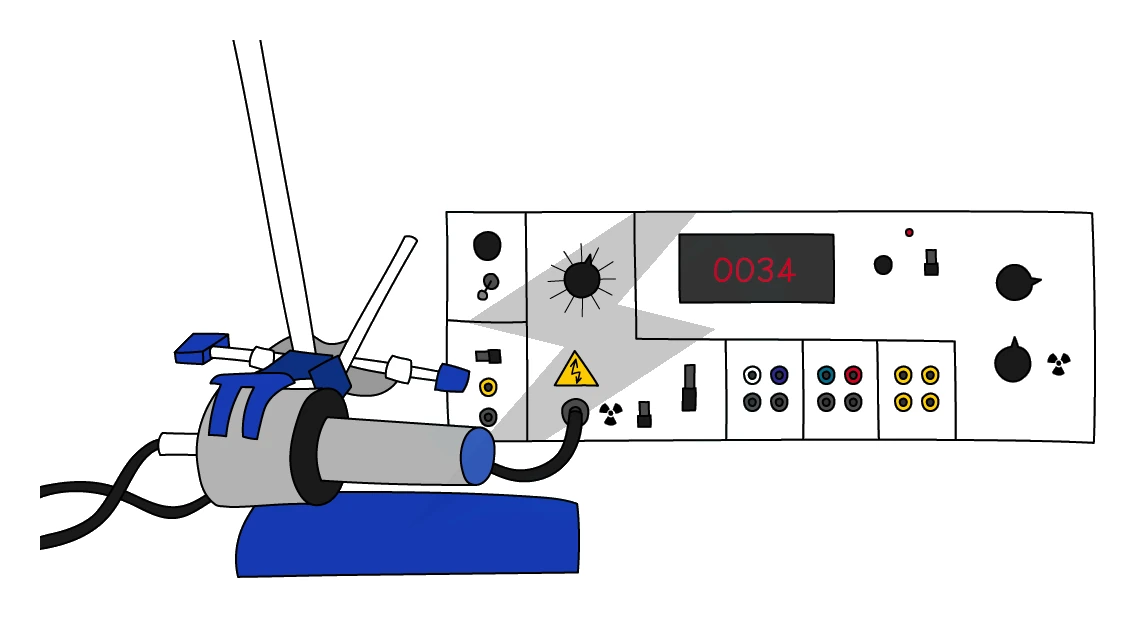
- A Geiger–Müller tube is a sealed glass tube filled with low-pressure gas. A thin mica window at one end lets in alpha, beta and gamma (alpha only if the window is thin enough)
- Whenever a radioactive particle enters the tube, it ionises the gas inside, producing a short electrical pulse that the connected counter records as a single "count"
- The counter either makes an audible click for every pulse or shows a digital count rate display
- Count rate is just counts divided by time. Convert to counts per second (cps, or Hz) by dividing the per-minute total by 60
Common exam question
Naming a detector of ionising radiation
Question: Name a piece of apparatus that can detect ionising radiation, or fill the gap in "the count rate is measured with a ... and a counter" (1 mark).
Asked in 4 of the 24 papers. Give Geiger–Müller tube (GM tube is accepted) or photographic film; one scheme also allowed a scintillator, another a spark counter, and "Geiger counter" was condoned. Name the instrument: in one paper the vague answer "radiation detector", which only restates the question, was ignored. When the gap is followed by "and a counter", the word wanted is the GM tube itself.
Background radiation
- Some level of radioactivity is always present in the surroundings, even with no laboratory sources nearby. This is called background radiation and it has to be subtracted from any measurement to find the true contribution of the source
- The biggest sources of natural background radiation:
- Radon gas seeping from rocks and building materials. Radon is an alpha emitter; it accumulates in basements and poorly ventilated buildings and is the single largest contributor in most homes
- Cosmic rays from the Sun and from beyond the Solar System, which strike the upper atmosphere and produce showers of high-energy particles that reach the ground
- Foods like bananas (potassium-40), Brazil nuts, and root vegetables naturally contain trace radioactive isotopes
- Carbon-14 present in all living tissue
- Artificial (human-made) sources are smaller in everyday life but include:
- Medical procedures (X-rays, CT scans, radioactive tracers, radiotherapy)
- Nuclear waste from power stations and weapons programmes
- Fallout from past nuclear-weapons testing or accidents (Chernobyl, Fukushima)
- Background level varies with location (higher at altitude because of more cosmic rays; higher in areas of granite-rich rock because of more radon) and with time (small spikes during severe space weather)
Common exam question
Sources and meaning of background radiation
Question: State one source of background radiation, give another naturally occurring source, or describe what is meant by the term background radiation (1–2 marks).
Asked in 4 of the 24 papers. For a source, any one of: the Sun or cosmic rays, rocks or soil, radon gas, food, medical equipment, weapons testing or a named nuclear accident; a named radioactive isotope such as carbon-14 is also accepted when a natural source is wanted. Give one answer, not a list: a list containing a wrong item is rejected. "Space" on its own is ignored, and the cosmic microwave background is rejected because it is a different phenomenon from the ionising radiation meant here. For the two-mark description, say that background radiation is always present, all around us, that it comes from sources in the environment rather than from the sample being measured, and name one of those sources: each scheme credited two of these three ideas.
Subtracting background from a measurement
- The correct workflow for a radiation experiment:
- With no source present, take a long background count (several minutes)
- Calculate the background count rate
- With the source in place, take the apparent count
- The corrected count rate is the apparent rate minus the background rate
Common exam question
Correcting a count rate for background
Question: Describe how to measure the count rate from a source and correct it for background radiation, or state how a method should be changed to allow for background (1–4 marks).
Asked in 3 of the 24 papers. The four-mark version has four separate points: use a GM tube with a counter and a timer; take a reading with the source removed from the room, or before it is brought in; measure that background count several times and take a mean; then subtract the background count from every reading taken with the source. The shorter versions credit the same idea in fewer steps: get the source out of the way (point it away, return it to its box, or move it far off), count for a minute, and subtract. When the question only asks how to correct a reading, "subtract the background count rate" is the whole mark.
Improving the accuracy
- Background levels fluctuate randomly, so a one-minute reading is noisy. To get a more reliable corrected rate:
- Take readings over a long period: counting for 10 minutes and dividing gives a more stable rate than counting for 30 s
- Repeat the experiment and average the results
- Use a strong source so the source's contribution dominates the background fluctuation