1. Kinetic theory of gases
Random motion of gas molecules
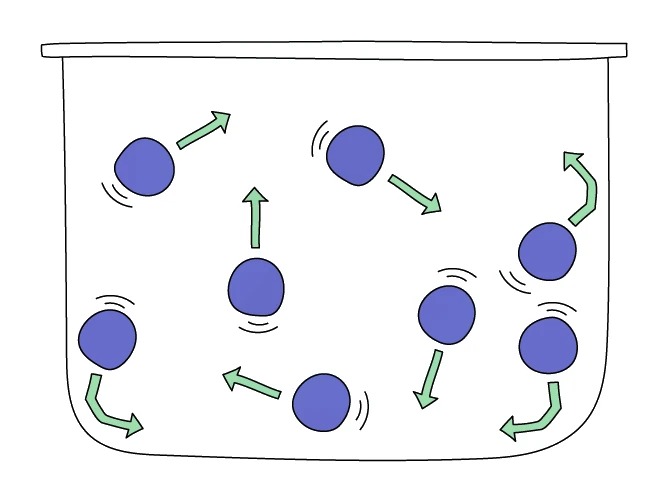
- Gas molecules never sit still; they fly about ceaselessly in random directions at high speed
- "Random" means no preferred direction: every molecule is constantly changing direction as it bounces off other molecules and off the walls of the container
- A typical air molecule at room temperature moves at hundreds of metres per second between collisions
How collisions produce pressure
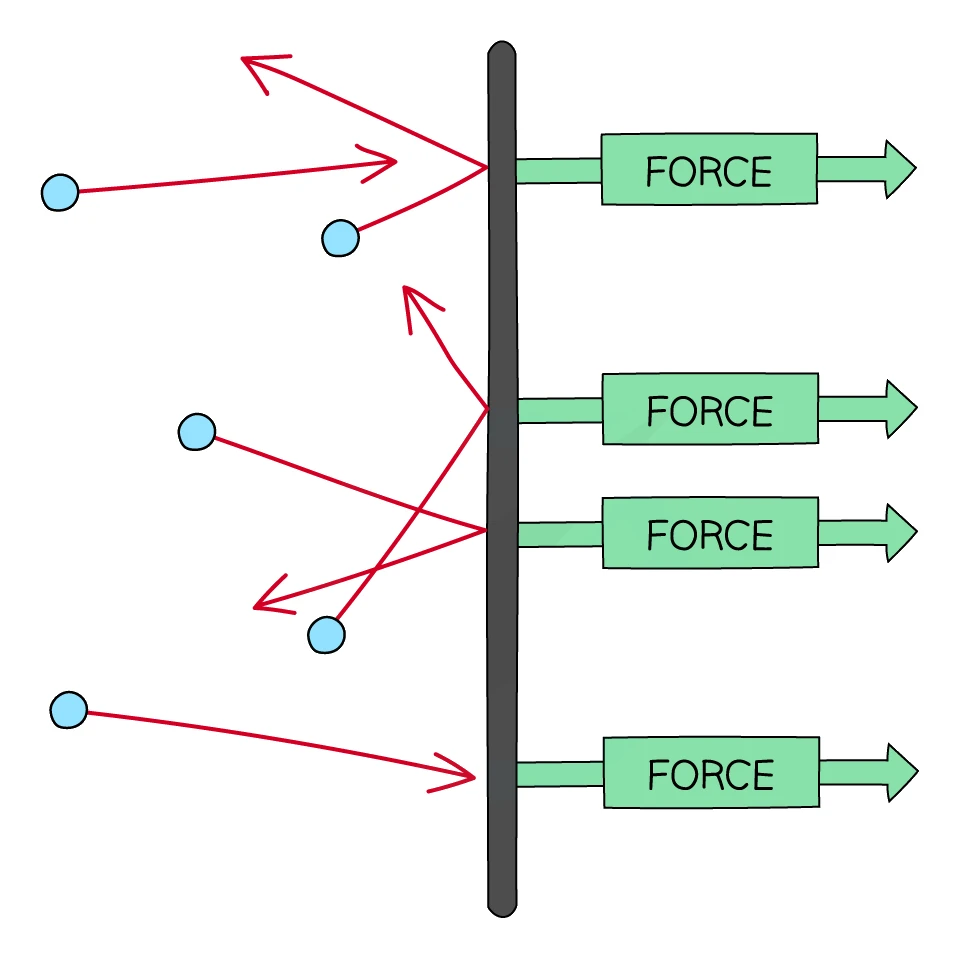
- Each time a gas molecule strikes the wall of its container, it bounces back. By Newton's third law, the wall pushes the molecule back, and the molecule pushes the wall
- Over countless collisions, the millions of tiny pushes add up to a net force on every wall, acting at right angles to the surface
- Pressure is force per unit area:
P = F / A
- Two things control how big the pressure is:
- How often the molecules hit the wall each second (more collisions per second means more force per second)
- How hard each collision is (faster molecules mean a harder impact)
- Anything that changes either factor (heating the gas, compressing it, adding more molecules) changes the pressure
Common exam question
Explaining how a gas exerts pressure on its container
Question: Explain, or describe, how the molecules of a gas produce a pressure on the inside of their container (3 marks).
Asked in 4 of the 24 papers, always for three marks, one per idea: the molecules collide with the walls (or the surface) of the container; each collision exerts a force on the wall; and pressure is force per unit area, so the total force over the wall area is the pressure. p = F/A is accepted for the third point, but one scheme says the formula alone is not enough, so say it in words too.
Name the walls: "the molecules collide with each other" is ignored and earns nothing. Random motion is also credited in one scheme, and when a question asks why the pressure is the same on every wall, the two marks are for that random motion and for an equal rate of collisions in every direction.
2. Absolute zero and the Kelvin scale
Why temperatures have a lower limit
- As a gas is cooled, its molecules slow down and collide with the walls less often and less hard. The pressure drops
- If you could keep cooling, you would eventually reach a temperature at which the molecules have stopped moving completely. There would be no collisions, no pressure, and no kinetic energy at all
- This temperature is called . It is the lowest theoretically possible, because you cannot remove any more energy from a system that already has zero kinetic energy
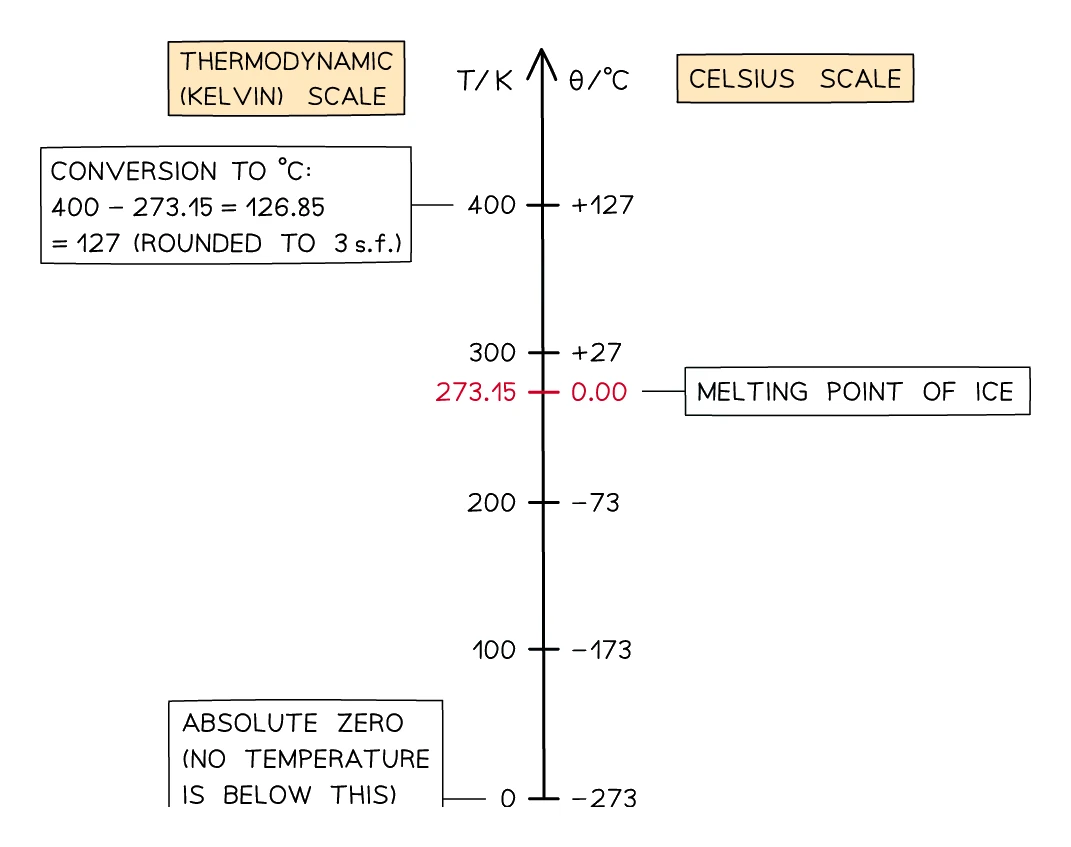
- Absolute zero is exactly 0 K, or −273 °C (more precisely −273.15 °C, but the syllabus uses −273 °C)
Common exam question
Finding and explaining absolute zero
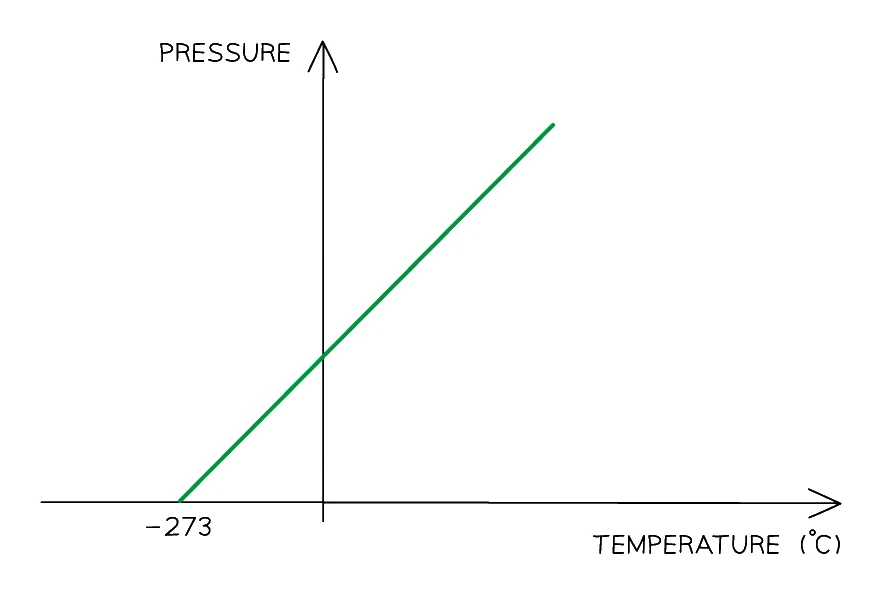
Question: Use a graph of pressure against temperature in °C to find absolute zero, or explain why a temperature cannot go below −273 °C (2 marks).
Set in 2 of the 24 papers. On the graph, extend the straight line back with a ruler until it meets the temperature axis, where the pressure would be zero: one mark is for showing that extrapolation on the graph, the other for the value you read off it. Read that value from the line, not from memory: on the exam graph, the extended line met the axis near −300 °C, the accepted range was −280 °C to −320 °C, and −273 °C lies outside it.
For the explanation, any two of: this temperature is absolute zero; the particles would have no kinetic energy, so no speed and no pressure (saying a negative value of these is impossible also counts); and no lower temperature is possible. Give it as −273 °C or 0 K.
The Kelvin scale
- The Kelvin scale (K) is the absolute temperature scale used throughout physics. It starts at absolute zero
- Two essential facts:
- 0 K = −273 °C (the bottom of the scale, the same temperature, just labelled differently)
- A change of 1 K is the same as a change of 1 °C; the scales are stretched out at the same rate; only the zero point is different
- To convert between the two scales:
T (K) = θ (°C) + 273
θ (°C) = T (K) − 273
- Because the Kelvin scale starts at the lowest possible temperature, a Kelvin is never negative
Common exam question
Converting a Celsius temperature to kelvin
Question: Calculate the temperature of a substance in kelvin, given its temperature in °C (1 mark).
Set as a one-mark question in 3 of the 24 papers. Add 273: 20 °C becomes 293 K and 100 °C becomes 373 K. Adding 273.15 is accepted too, so 293.15 K also scores. Write the unit as K with no degree sign, and remember that a kelvin temperature is never negative. The same conversion earns a mark in a pressure-law calculation whenever its temperatures are given in °C, so make it a reflex before you substitute into any gas equation.
3. Temperature and kinetic energy
What "temperature" really measures
- Temperature is a measure of the average kinetic energy of the particles in a substance
- Hotter substance means particles moving on average faster, which means higher average kinetic energy
- The link is proportional when temperature is measured in kelvin:
T (in K) ∝ average kinetic energy of particles
- This is why Kelvin is the right scale for gas laws: doubling the Kelvin temperature genuinely doubles the average kinetic energy of the molecules. Doubling the Celsius temperature does not: going from 1 °C to 2 °C is only 0.36 % more average kinetic energy
Exam tip
Proportional only when the temperature is in kelvin
At constant volume, pressure and average kinetic energy are proportional to the kelvin temperature, not the Celsius one. A graph of pressure against temperature in °C is a straight line that misses the origin, so call that relationship linear, not proportional: one scheme gives one mark for the straight line and one for saying it misses the origin; another credits "proportional" only when the answer ties it to kelvin. Asked to sketch kinetic energy against temperature in K, draw a straight line with a positive gradient from the origin; each of those two features is a mark.
Why all states show this behaviour
- The temperature–KE link applies to every state of matter:
- in a gas, almost all the internal energy sits in the kinetic store (molecules barely interact), so KE and temperature are tightly linked
- in a solid, most of the kinetic energy is vibrational rather than translational, but the rule still holds, so hotter solids vibrate harder
- in a liquid, similarly, particles slide past each other faster as the temperature climbs
Evaporation cools the liquid that's left behind
- When a liquid evaporates, only the most energetic surface molecules can overcome the forces of attraction from their neighbours and escape as vapour
- The molecules left behind have a lower average kinetic energy than before
- Lower average KE means lower , so the remaining liquid cools
- This is the physics behind sweating, why a wet swimsuit feels cold in a breeze, and why fridges and air conditioners use an evaporating refrigerant to extract heat
4. The gas laws qualitatively
Pressure and volume at constant temperature
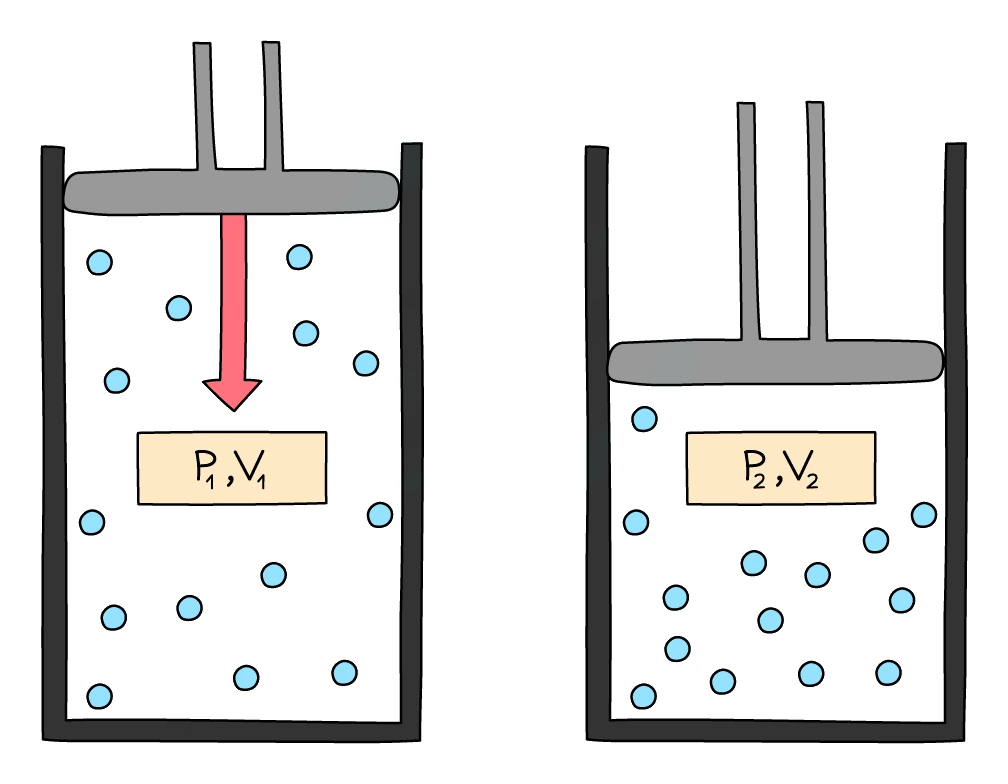
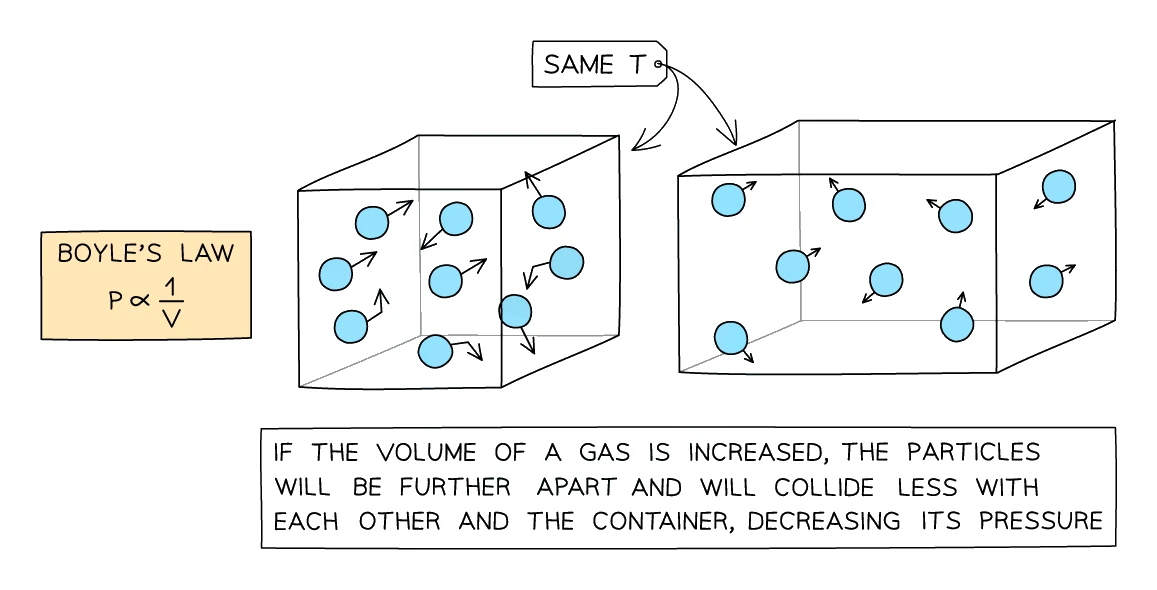
- Squeezing a fixed amount of gas into a smaller box (at the same temperature) makes the pressure rise:
- the molecules still move at the same average speed
- but they have less distance to travel between collisions with the wall
- so they hit the walls more often per second, and more frequent collisions mean higher pressure
- Letting the gas expand makes the pressure fall by the reverse logic
Pressure and temperature at constant volume
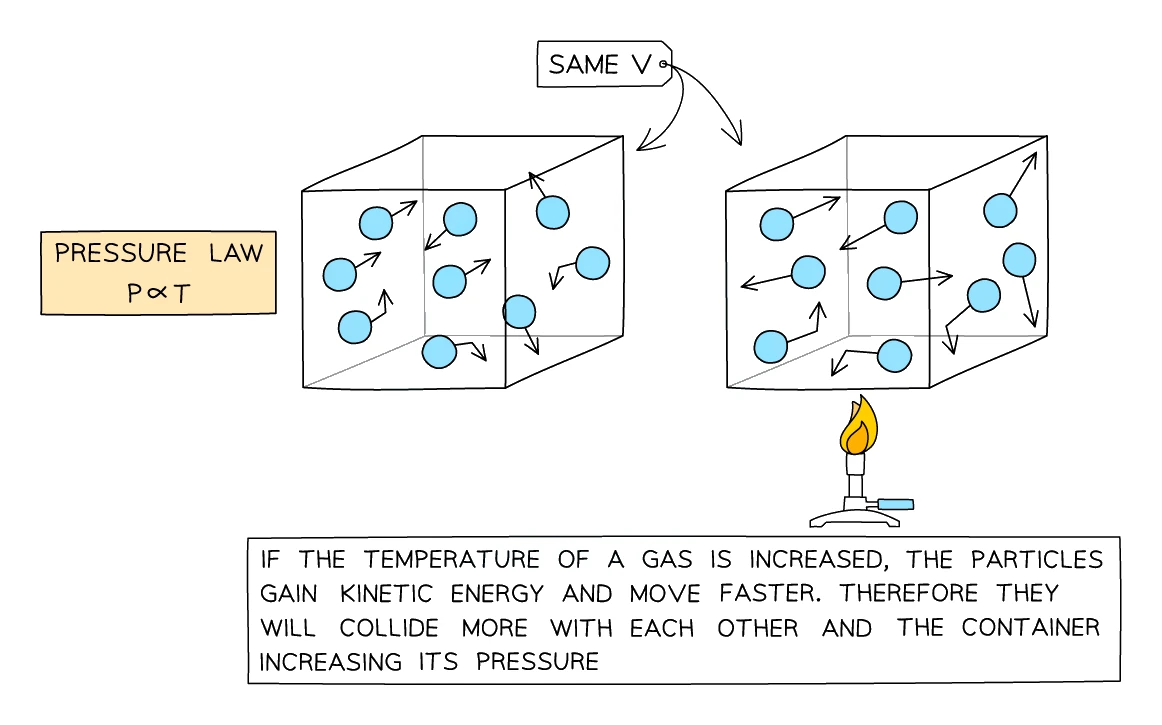
- Heating a sealed container of gas (volume fixed) makes the pressure rise:
- the molecules gain kinetic energy and move faster
- they hit the walls more often and each impact carries more force
- both effects raise the pressure
- Cooling the gas reverses the effect, giving slower molecules, fewer and softer collisions, lower pressure
Common exam question
Explaining why gas pressure changes with temperature
Question: Using ideas about particles, explain why the pressure of a gas kept at constant volume rises when it is heated, or falls when it cools (2–3 marks).
Asked in 6 of the 24 papers, as often for cooling (a tyre in winter, a chilled balloon) as for heating. The three marks are linked steps: the particles move faster (more kinetic energy); they collide with the walls more often; and each collision is harder, so the force on the walls, and so the pressure, increases. For cooling, reverse each step.
The walls must appear at least once; without them the two collision marks are ignored. "The particles gain more energy" alone earns nothing: say faster or more kinetic energy, and for a cold gas say less kinetic energy, never none. One paper set the same reasoning in a question about a sealed can collapsing as it cools, with a further mark for the outside pressure being greater than the inside.
Volume and temperature at constant pressure
- Heating a gas in a container that can change shape (a balloon, a piston that can slide) makes the volume rise:
- the molecules push harder on every wall
- if a wall is free to move, it moves outward until the pressure rebalances against whatever is pushing back from outside
- The volume of a gas is proportional to its Kelvin temperature at fixed pressure
5. The pressure law (constant volume)
Statement
- At constant volume and for a fixed amount of an ideal gas:
P ∝ T (in kelvin)
- Equivalently, if subscript 1 marks the initial state and subscript 2 marks a later state:
p₁ / T₁ = p₂ / T₂
- where:
- p₁, p₂ = pressures in Pa (any consistent unit, as long as both are the same)
- T₁, T₂ = absolute temperatures in kelvin (always, never °C)
Using the equation
- Convert any Celsius readings to kelvin first by adding 273. Forgetting to do this is one of the most common exam mistakes
- Rearranging for p₂: p₂ = p₁ × (T₂ / T₁)
- Rearranging for T₂: T₂ = T₁ × (p₂ / p₁)
Common exam question
Calculating a pressure or temperature at constant volume
Question: Calculate the new pressure (or temperature) of a fixed volume of gas after its temperature changes, sometimes to decide whether a limit is reached (3–4 marks).
Set in 5 of the 24 papers. The four marks are: convert both temperatures to kelvin, substitute into p₁/T₁ = p₂/T₂, rearrange, evaluate. Substituting the Celsius values forfeits the conversion mark, so that answer is capped at 3 of the 4 marks in three schemes and at 2 in a fourth. A wrong conversion is carried forward, working out the constant p/T first and multiplying is accepted, and when the temperatures are already in kelvin the question is worth 3 marks.
If asked whether a warning light comes on or a limit is passed, the last mark is for a conclusion that matches your value, so write it down. A one-mark follow-up may ask what else must stay constant for the calculation to hold: the mass, or number of molecules, of gas.
Worked example
Pressure law calculation
A gas in a sealed container has a pressure of 80 kPa at a temperature of 27 °C. The container is heated until the temperature reaches 127 °C. Calculate the new pressure. (Volume stays constant.)
Solution:
- Convert both temperatures to kelvin: T₁ = 27 + 273 = 300 K, T₂ = 127 + 273 = 400 K
- Substitute into p₁/T₁ = p₂/T₂: 80/300 = p₂/400
- Rearrange: p₂ = 80 × 400/300
- p₂ = 107 kPa (to 3 s.f.)
6. Boyle's law (constant temperature)
Statement
- At constant and for a fixed amount of an ideal gas:
P × V = constant
- Equivalently, between two states:
p₁ × V₁ = p₂ × V₂
- where:
- p₁, p₂ = pressures in Pa
- V₁, V₂ = volumes in m³ (or any consistent unit, as long as both match)
- p and V are inversely proportional: doubling the pressure halves the volume; halving the pressure doubles the volume
Common exam question
Calculating a volume or pressure at constant temperature
Question: Calculate the new volume, or the new pressure, of a fixed mass of gas when it is compressed or allowed to expand at constant temperature (2–4 marks).
Set in 5 of the 24 papers. Substitute into p₁V₁ = p₂V₂, rearrange and evaluate, one mark each (the substitution and rearrangement can come in either order, and two versions merge them into one mark). Any consistent units work, so leave cm³ as cm³, but keep the powers of ten straight: a power-of-ten slip costs a mark. Extra marks are added for the setting: expressing the answer in standard form when asked, or first working out the new volume from the container's dimensions. For a bubble or balloon under water, p is the total pressure, atmospheric plus the water's; a wrong pressure carried from an earlier part still earns the method marks.
A one-mark follow-up may ask for the assumption made: the temperature, or the mass (amount) of gas, stays constant.
Why it works microscopically
- At constant temperature the molecules have the same average kinetic energy, so each individual collision with the wall carries the same average force
- Shrink the container to half its volume and the molecules have to travel only half as far between wall collisions
- They therefore hit each wall twice as often per second, and the pressure doubles
- The same number of molecules, moving at the same average speed, in half the space, gives twice the pressure
Checking the answer makes sense
- A useful sanity check after any gas-law calculation:
- if the volume has shrunk (compression), expect the new pressure to be larger than the original
- if the gas has been heated at fixed volume, the new pressure should be larger than before
- if you get the opposite trend, you've probably substituted the temperatures the wrong way round, or forgotten to convert °C to K
Worked example
Boyle's law calculation
A gas is compressed from a volume of 0.60 m³ at a pressure of 100 kPa to a new volume of 0.40 m³. The temperature does not change. Calculate the new pressure.
Solution:
- Identify the known values: p₁ = 100 kPa, V₁ = 0.60 m³, V₂ = 0.40 m³
- Substitute into p₁V₁ = p₂V₂: 100 × 0.60 = p₂ × 0.40
- Rearrange: p₂ = (100 × 0.60) / 0.40
- p₂ = 150 kPa
- Sanity check: the volume shrank, so the pressure should be larger, and 150 kPa > 100 kPa. ✓