1. Types of forces
What a force is
- A force is a push or a pull that one object exerts on another whenever the two objects interact
- The SI unit of force is the newton (N)
- Force is a vector quantity: it has both a magnitude and a direction (see section 2)
The named forces in the syllabus
- Weight (gravitational force): the pull of a planet on every object that has mass. A bigger mass feels a bigger weight when placed in the same gravitational field
- Reaction force (normal contact force): the push a surface exerts on an object that rests on it. It acts perpendicular to the surface
- Friction: a force that opposes the motion of an object as it slides over another surface. Friction arises because no two surfaces are perfectly smooth at the molecular scale; tiny irregularities catch against one another
- Drag force: friction in a fluid (a liquid or a gas). The fluid's particles bump into the moving object and slow it down
- Air resistance: a special case of drag where the fluid is air. The force grows as the object moves faster, because more air particles hit it per second
- Thrust: a forward driving force produced by an engine, jet or rocket
- Upthrust: the upward push that a fluid exerts on any object floating in or submerged in it
- Electrostatic force: the attraction between opposite charges and repulsion between like charges
- Magnetic force: the attraction between unlike poles and repulsion between like poles
- Tension: the pull that runs along a stretched rope, wire, cable or spring when something is pulling on each end
Three things forces can do
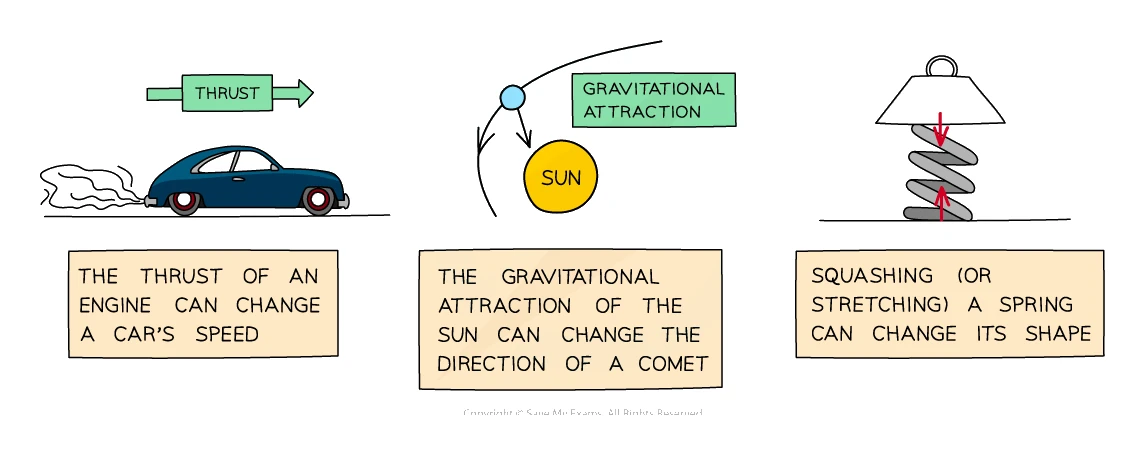
- A force acting on an object can:
- change its speed (cause it to accelerate or decelerate along the same direction)
- change its direction of motion
- change its shape (stretch, squash, bend or twist it)
Vocabulary cautions
- Refer to the gravitational pull on an object as its in exam answers, because the word "gravity" can ambiguously mean either the force or the field strength, and mark schemes often reject it
- For the upward push that a falling object feels, use (or drag). "Wind resistance" is not a physics term, and "air pressure" is a different concept altogether
2. Scalar and vector quantities
Definitions
- A has a magnitude only, so it is described fully by a number with a unit
- A has both a magnitude and a direction, so it is only described fully when both are stated
Distance and displacement
- Distance is how far an object has actually travelled along its path, ignoring direction; distance is therefore a scalar
- Displacement is the straight-line gap between the start point and the end point of the motion, together with the direction from start to end; displacement is therefore a vector
- On a route with bends, distance and displacement give different numerical answers, because the distance grows with every twist while the displacement only depends on where you end up
Speed and velocity
- Speed is the rate at which distance is covered, so it is a scalar
- Velocity is the rate at which displacement is covered, and includes a direction, so it is a vector
- An object moving at a steady speed around a circle has a continually changing velocity (because the direction keeps changing) even though the speed stays the same
Common pairs
| Scalar | Vector |
|---|---|
| distance | displacement |
| speed | velocity |
| mass | weight |
| energy | force |
| temperature | acceleration |
| volume | momentum |
| density | — |
| power | — |
Common exam question
Defining a vector and sorting scalars from vectors
Question: State what is meant by a vector quantity, give a similarity and a difference between scalars and vectors, or circle the scalars in a list of quantities (1–3 marks).
Asked in 3 of the 24 papers. A vector has magnitude and direction; a scalar has magnitude only. "Size" or "amount" is accepted for magnitude, but "scale" is ignored, so it cannot stand in for the word. For a similarity and a difference, the similarity is that both have a magnitude and the difference is that only a vector has a direction.
When you circle the scalars, circle only what you are sure of: with three scalars in a list of seven, circling four caps you at two marks, five or six caps you at one, and circling everything scores nothing. Charge, power, temperature, speed, distance, mass, time and energy are scalars; acceleration, force, velocity and weight are vectors, and any correct scalar is credited as an example.
Representing forces with arrows
- Forces are drawn as arrows on a free-body diagram:
- the length of each arrow scales with the size of the force it represents (a 6 N arrow comes out twice as long as a 3 N arrow on the same diagram)
- the direction the arrow points shows the line of action of the force
- each arrow is labelled with the name of the force or with its size in newtons (e.g. W for weight, or "75 N pull")
- Forces that point neither straight up nor straight along the ground are described by stating the angle from the horizontal or from the vertical (e.g. "a 60 N force acting at 30° above the horizontal")
Common exam question
Drawing and naming the forces on an object
Question: Draw labelled arrows on a diagram to show the forces acting on an object (falling, floating or being lifted), or name the force that acts alongside one you are given (1–4 marks).
Asked in 9 of the 24 papers. A label earns credit only when labelled arrows are asked for; the other marks go on direction, length and where the arrow starts. Weight points vertically down and is labelled weight (W or mg): "gravitational force" is accepted, "gravity" alone is ignored, and showing a gravity force as well as a weight force is rejected. Air resistance or drag points opposite to the velocity; "friction" is accepted, "wind resistance" condoned in one scheme and ignored in another. Upthrust points vertically up. Asked to name the other force, write "weight", not "gravity".
Lengths are judged by eye: equal arrows for an object at rest or at constant speed, the arrow for the winning force longer when the object is accelerating. Start the arrows on the object (at the centre of gravity when one is marked) and draw only the arrows asked for: an extra arrow can cost a mark.
3. Resultant forces
What the resultant force is
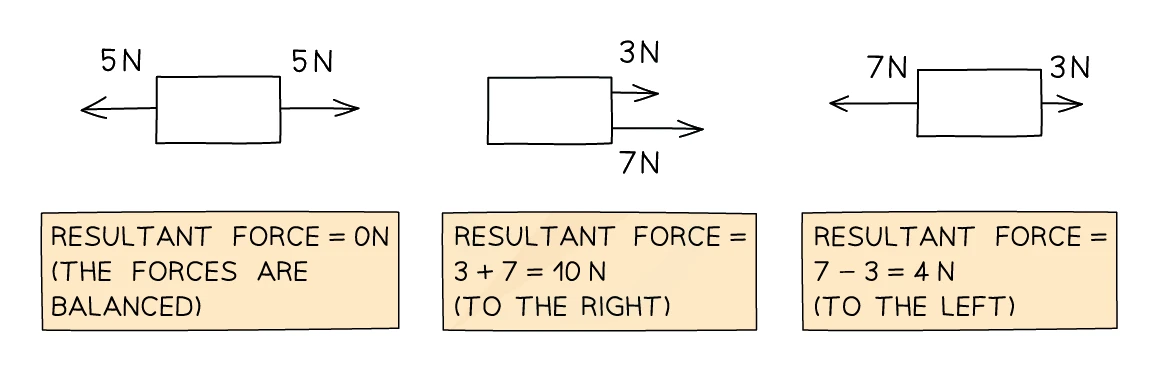
- The on an object is the single force that has the same effect as all the individual forces added together, direction included
- It determines:
- the direction the object will move (or accelerate) in
- the magnitude of the net push or pull the object actually experiences
- The resultant alone matters for the motion; once you have it, you can ignore the individual forces
Adding forces along a line
- Forces along the same straight line combine by simple addition, taking sign into account:
- Forces pointing the same way are added together
- Forces pointing in opposite directions are subtracted
- A final answer is only complete when both magnitude and direction are stated, in newtons and as a compass-style direction or left/right/up/down
Common exam question
Finding the resultant of forces along a line
Question: Calculate the magnitude and direction of the resultant force from a diagram of forces acting along one line, or state the resultant force on an object that is at rest (1–2 marks).
Asked in 5 of the 24 papers. Add the forces that point the same way, subtract the opposing total and give the direction as a word (up, left) or as "the same direction as the larger force": the sign of your number is ignored, "west" for left is only condoned and an unqualified "north" is ignored. An object at rest, or floating, has a resultant of 0 N, a one-mark answer in its own right. The resultant often feeds the next part, and a wrong value is carried forward through a correct F = ma method. In one paper the resultant and the larger force were given and the weight had to be found by subtracting one from the other before the mass could be calculated.
Friction inside the resultant
- Friction is the force that opposes motion of an object across or through another material
- On a free-body diagram, a friction arrow points opposite to whichever way the object is sliding
- Drag and air resistance are both special cases of friction: drag inside any fluid, air resistance inside air specifically
4. Balanced and unbalanced forces
Balanced forces
- The forces on an object are balanced when they add up to a zero resultant
- A balanced object either stays still or carries on at a constant in a straight line, because its motion does not change at all
- Example: a book at rest on a desk feels a downward weight and an equal upward reaction force from the desk. The two cancel out
Unbalanced forces and Newton's second law
- The forces are unbalanced when they do not add to zero, so there is a non-zero resultant
- A non-zero resultant force makes the object accelerate: it can speed up, slow down, or change direction
- The size of the acceleration is given by Newton's second law of motion:
F = m × a
- where:
- F = resultant force (N)
- m = mass (kg)
- a = acceleration (m/s²)
- Rearranges to a = F / m and m = F / a
Example A — a delivery lorry of mass 1200 kg accelerates uniformly from rest to 18 m/s in 6.0 s. Calculate (i) the acceleration and (ii) the resultant force driving the lorry forward.
- (i) a = (v − u) / t = (18 − 0) / 6.0 = 3.0 m/s²
- (ii) F = m × a = 1200 × 3.0 = 3600 N
Example B — a cyclist plus bicycle have a combined mass of 85 kg. They brake from 12 m/s to a halt in 4.0 s. Calculate the size of the braking force.
- a = (v − u) / t = (0 − 12) / 4.0 = −3.0 m/s²
- F = m × a = 85 × (−3.0) = −255 N
- The negative sign tells you the resultant force points opposite to the motion, i.e. it is the brakes pushing backwards against the cyclist's forward travel
Common exam question
Calculating acceleration or force with F = ma
Question: State the formula linking force, mass and acceleration, then calculate the acceleration from a resultant force and a mass, or the force from a mass and an acceleration (1–4 marks).
Asked in 7 of the 24 papers. The one-mark formula part takes F = m × a in symbols or words and in any rearrangement. The calculation marks are often one for substituting into the formula, one for rearranging and one for evaluating, so write the substituted line (1500 = 600 × a) before the division. A slip in an earlier part is carried forward through a correct method, and where the recall mark sits inside the calculation rather than in a part of its own, a valid substitution implies it. The mass must be in kilograms, so convert a mass given in grams first: a power-of-ten error costs one mark. The sign of a deceleration is ignored, and when the question asks for a set number of significant figures that rounding is an independent mark.
Worked example
F = ma with a unit-conversion step
A resultant force of 6 N acts on a mass of 200 g. Calculate the acceleration.
Solution:
- Convert the mass to kilograms first: 200 g = 200 ÷ 1000 = 0.20 kg
- Rearrange F = m × a to make a the subject: a = F ÷ m
- Substitute and evaluate: a = 6 ÷ 0.20 = 30 m/s²
Convert grams to kilograms before substituting: leaving the mass as 200 g gives 0.03 m/s², a power-of-ten error that costs a mark. Write the substituted formula rather than F = m × a on its own, because the substitution is where the first calculation mark sits.
5. Weight
Definition
- Weight is the pull that a gravitational field exerts on any object that has mass
- Because weight is a force, it carries a direction (always towards the centre of the planet), making weight a ; weight is measured in newtons (N)
- Mass is the amount of matter in an object, a measured in kilograms (kg)
- Mass and weight are not the same physical quantity even though everyday language often confuses them
The equation
W = m × g
- where:
- W = weight (N)
- m = mass (kg)
- g = (N/kg)
- g on Earth is 10 N/kg (also equal to the acceleration of free fall, 10 m/s², because these two numerical values match when they describe the same physical effect from two different angles)
- g varies between planets and moons: a stronger gravitational field gives a larger weight for the same mass
- Mass and weight are directly proportional to one another in a given gravitational field, so doubling the mass doubles the weight
Worked example
Calculating weight and the unit mark
A satellite component has a mass of 35 kg. Calculate its weight on Earth, where g = 10 N/kg. Give the unit.
Solution:
- Identify the equation: W = m × g
- Substitute: W = 35 × 10
- Evaluate: W = 350
- State the unit: N (newtons)
When a question says "give the unit", the unit is marked on its own, so 350 with no unit loses that mark even though the number is right. Check that the mass is in kilograms before you multiply: a mass given in grams has to be divided by 1000 first, and a power-of-ten slip costs a mark.
6. Stopping distance
Definition and breakdown
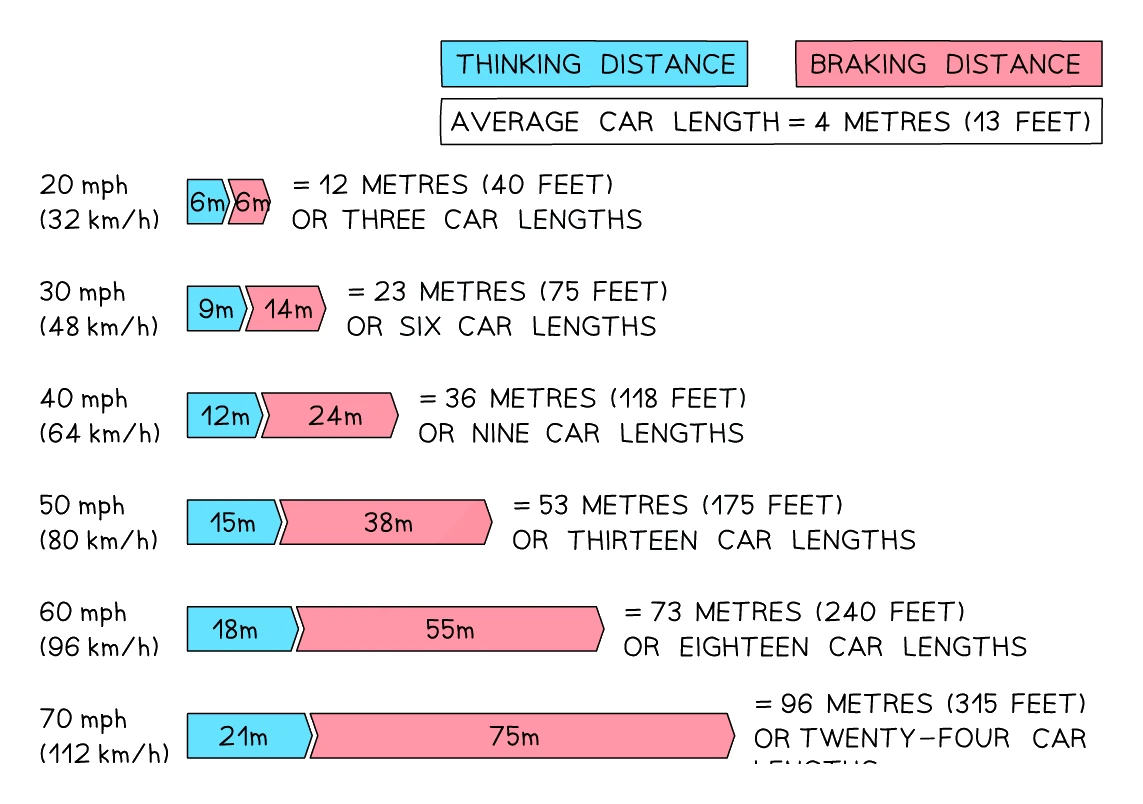
- Stopping distance is the total distance a vehicle travels from the instant the driver spots a hazard to the instant the vehicle finally comes to rest
- It splits into two stages:
stopping distance = thinking distance + braking distance
- Thinking distance = the distance the vehicle covers during the driver's reaction time, before the brakes are even pressed
- Braking distance = the distance the vehicle covers while it is decelerating under the braking force, from the moment the brakes are first applied to the moment it stops
Common exam question
Calculating a braking or stopping distance
Question: Work out the thinking distance, the braking distance or the total stopping distance of a vehicle, from a graph or from the speed, reaction time, mass and braking force (2–4 marks per part).
Set in 3 of the 24 papers, each by a different route. From a graph of thinking and braking distance against speed, read both distances at the given speed and add them: stating stopping distance = thinking distance + braking distance is a mark on its own, and readings are accepted within a small tolerance. From a velocity-time graph, the braking distance is the area under the braking section only. From numbers, chain three steps, each with a substitution mark and an evaluation mark: thinking distance = speed × reaction time, a = F ÷ m, then v² = u² + 2as with v = 0 for the braking distance, a wrong acceleration being carried forward. The s in v² = u² + 2as is the braking distance only: in one scheme, using the stopping distance or the thinking distance instead scored 3 of the 4 marks.
Reaction time and thinking distance
- Reaction time is the time gap between a driver noticing a hazard and starting to act on it
- A typical adult driver's reaction time is about 0.7 s (roughly two-thirds of a second) when alert and undistracted. This is the value the UK Highway Code uses for its stopping-distance tables
- Thinking distance grows with reaction time and with vehicle speed:
- longer reaction time → more time before the brakes are pressed
- higher speed → more metres covered during that reaction time
- Reaction time is lengthened by:
- tiredness
- distractions such as using a phone, eating, or fiddling with controls
- alcohol or drugs
Braking distance
- The braking distance counts every metre the vehicle still rolls forward from the moment the brakes first bite until it finally comes to rest
- For a given braking force, braking distance grows with:
- vehicle speed, because a faster vehicle has more kinetic energy that the brakes must remove
- vehicle , because heavier vehicles need more work done by the brakes to decelerate
- road conditions, because wet, icy or oily roads reduce the friction between tyre and road, lengthening the braking distance
- brake and tyre condition, because worn brakes or bald tyres also lengthen braking distance
Speed dominates
| Speed / mph | Speed / m/s | Approximate stopping distance / m |
|---|---|---|
| 20 | 9 | 12 |
| 30 | 13 | 23 |
| 40 | 18 | 36 |
| 50 | 22 | 53 |
| 60 | 27 | 73 |
- Doubling the speed roughly quadruples the braking distance because braking distance depends on the square of the speed (consistent with v² = u² + 2as)
Common exam question
Effect of a factor on thinking and braking distance
Question: Explain the effect, if any, of a change in the driver (tiredness, alcohol) or in the car and road (ice, tyre grip, brake condition) on the thinking distance and on the braking distance (1–4 marks).
Asked in 2 of the 24 papers, once as two multiple-choice items and once as a four-mark explanation. Deal with the two distances separately. Thinking distance depends on the driver: tiredness, alcohol and distraction lengthen the reaction time, so the thinking distance increases, and that is two marks (the effect, then the reason). Braking distance does not depend on the driver: the credited answer is that there is no effect, because the braking force, and so the braking time, is unchanged, and the idea that human factors do not affect braking distance is accepted as the reason. Ice on the road, worn tyres or weaker brakes lengthen the braking distance, and both distances grow with speed. Writing that tiredness increases the braking distance cannot earn either braking-distance mark.
7. Terminal velocity
What terminal velocity is
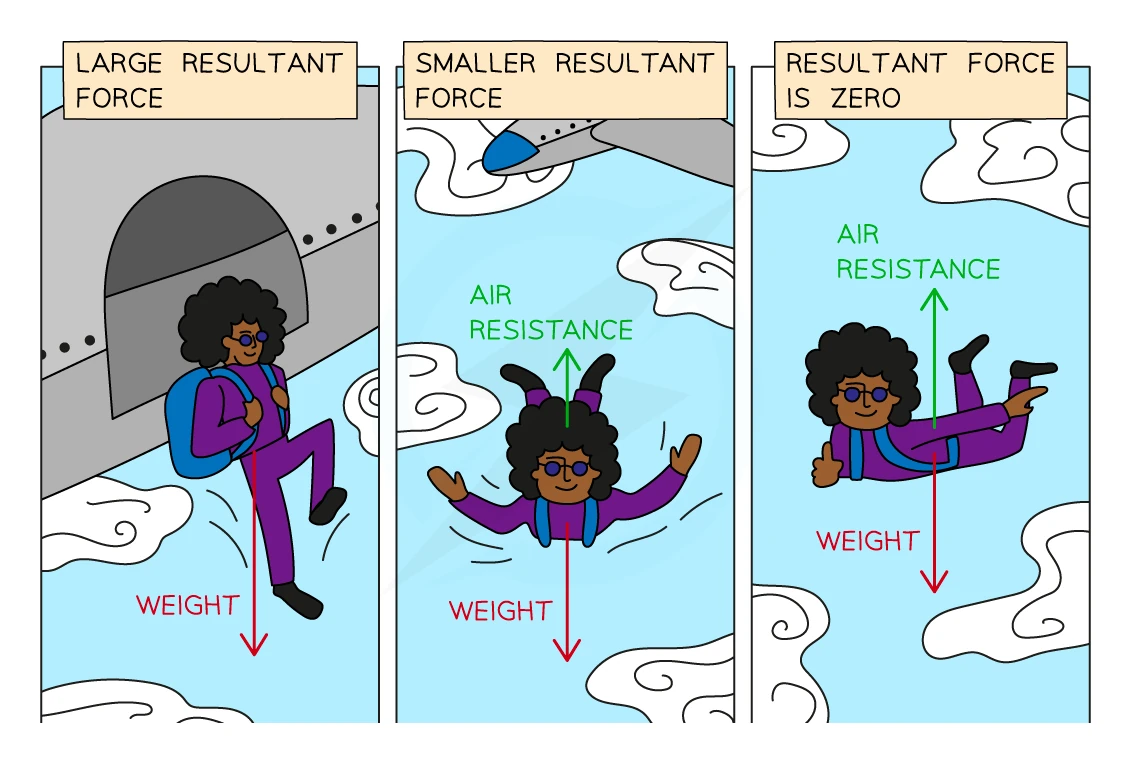
- Terminal velocity is the largest steady speed a falling object reaches once the air pushing up on it has grown enough to balance its weight
- At terminal velocity:
- the upward push from matches the downward pull of exactly in size
- the resultant force is zero
- the object stops accelerating and falls at a constant
The four stages of a falling object
- Stage 1, the moment of release. Only weight acts (air resistance is zero because there is no relative motion through the air). The resultant force is the full weight pulling downwards, so the object accelerates downwards at the acceleration of free fall, g
- Stage 2, early fall. The object now has a small downward speed, so air particles begin to collide with it and a small upward air resistance appears. Weight still wins, so the object continues to accelerate downwards, but at a slightly reduced rate
- Stage 3, as the speed climbs, air resistance climbs with it (more air particles hit per second, and harder). The resultant force shrinks, so the acceleration shrinks. The object is still gaining speed, but more slowly
- Stage 4, the speed reaches the point where air resistance equals weight. Resultant force is now zero, acceleration is now zero, and the object falls at a constant
Common exam question
Explaining the motion of a falling object using forces
Question: Explain how a falling object reaches terminal velocity, or why a parachutist slows when the parachute opens, using ideas about forces (3–5 marks).
Asked in 4 of the 24 papers, each marked from a list of points, so tell the whole story in order. Name weight and drag (air or water resistance): "gravity" on its own is ignored, and so is upthrust. At first weight is larger than drag, so there is a resultant force downwards and the object accelerates. As the speed rises drag rises, so the resultant force and the acceleration decrease. At terminal velocity drag equals weight, the resultant force is zero and the velocity is constant: in one scheme that final point is compulsory. F = ma on its own did not earn the resultant-force point in one scheme, so link it to the unbalanced forces.
When a parachute opens the sequence reverses: air resistance is now larger than weight, so the resultant force and the acceleration are upwards, and the parachutist slows until drag again equals weight. "Decelerates" or "slows down" is ignored where "the acceleration is upwards" is wanted.
8. Core practical: investigating force and extension
Aim
- Measure the of a spring (or a rubber band, or a length of metal wire) as the stretching on it is increased, and decide whether the two are directly proportional
Variables
- Independent variable: stretching force, F (N), set by hanging known masses
- Dependent variable: extension, e (cm or mm), read off a fixed ruler
- Control variables: the same spring (or rubber band, or wire) used throughout; the same starting attachment point; the same ruler with the same zero alignment
Apparatus
| Equipment | Purpose | Resolution |
|---|---|---|
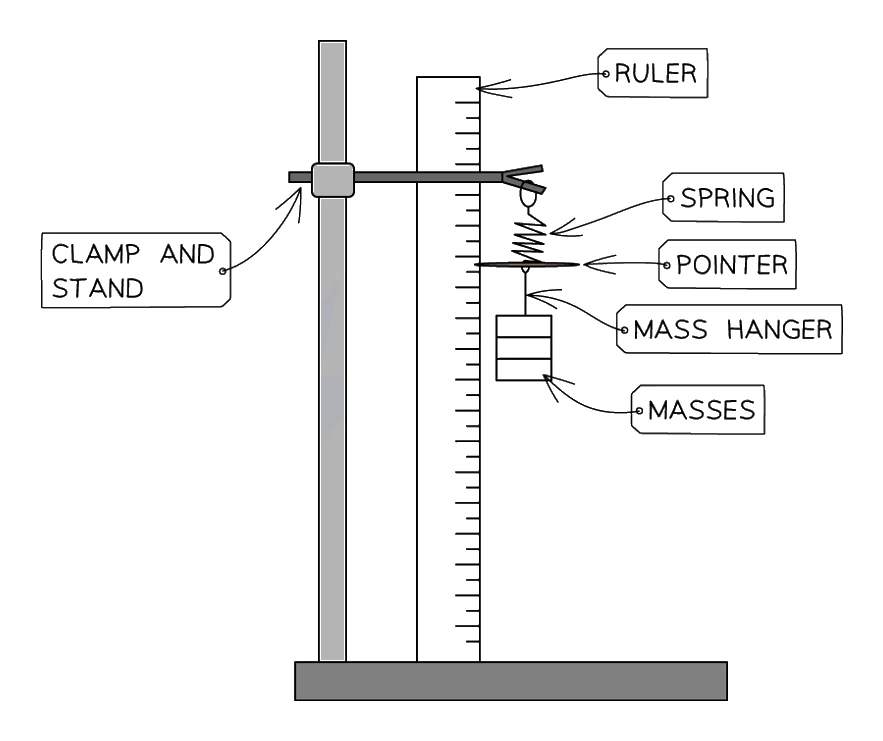
| Retort stand, clamp and boss, G-clamp | Holds the spring vertically and prevents the stand from toppling as masses are added | — |
| Spring (or rubber band, or thin metal wire) | The object whose extension is being measured | — |
| 100 g slotted masses with a 100 g hanger | Provides the known stretching forces in 1 N steps (since W = 0.1 × 10 = 1 N per mass) | — |
| Vertical ruler clamped beside the spring | Measures the position of a pointer attached to the bottom of the spring | 1 mm |
| Small horizontal pointer (or piece of tape acting as a fiducial marker) | Lets you read the bottom of the spring against the ruler accurately | — |
| For a metal wire: a bench pulley and a wooden block clamped over the wire | Allows the wire to be stretched horizontally with the masses hanging vertically off the bench edge | — |
Method
- Hang the spring (or rubber band, or metal wire) from the clamp without any mass attached. Read and record its original length L₀ using the pointer and the clamped ruler
- Place the 100 g mass hanger on the spring. Give the spring a couple of seconds to come to rest, then read the new pointer position L₁ and record it together with the mass
- Add one further 100 g mass to the hanger. Allow it to come to rest, then read and record the new length
- Continue adding masses in 100 g steps until all five are loaded
- Carefully remove the masses one at a time and check that the spring returns to its original length. If it does not, it has been stretched beyond its and the run must be repeated with a fresh spring
- Repeat the whole sequence three times and take the mean of the three readings at each load
- For the metal wire variant: clamp the wire horizontally across the bench, run it over a bench pulley, attach the hanger to the dangling end, and stick a small piece of tape on the wire as a fiducial marker for the ruler
Exam tip
Extension is the new length minus the original length
One five-mark method question on this practical was marked from a list: measure the original length, measure the new length for a range of masses, work out extension as new length minus original length, read a clamped vertical ruler with a pointer at eye level to avoid parallax, always measure to the same point on the spring, and repeat and average. Use "extension" only for the difference and "length" for what the ruler shows: a question that gives a loaded length and an extension and asks for the original length wants the subtraction. For a bending strip the same marks appear as a rule fixed vertically with a plumb line or set square, its zero at the unloaded height.
Analysis
- Convert each loaded mass m (in kg) to a stretching force F with F = m × g, taking g = 10 N/kg (so each 100 g step adds 1.0 N)
- Calculate the e at every load:
e = mean loaded length − original length
- Plot (y-axis) against extension (x-axis), or extension against force, but force-vs-extension is the conventional Hooke's law plot
- A straight line through the origin shows that force and extension are directly proportional, i.e. the material is obeying Hooke's law throughout the tested range
- A region where the line curves away from a straight line shows the material has passed its (see section 9)
Sources of error and safety
- Systematic error, parallax. Always read the pointer against the ruler with your eye exactly level with the pointer
- Random error, equipment movement. A wobble of the stand between readings shifts the apparent zero; the G-clamp removes this
- Random error, slow settling. Let the spring fully stop oscillating before taking each reading; a length read mid-bounce will be off by the amplitude of the wobble
- Safety: wear safety goggles in case the spring or wire snaps and whips back, keep feet clear of the hanging masses, and place a soft mat or tray beneath the masses to catch them if they drop
9. Hooke's law
The law
- states that, up to the limit of proportionality, the extension of an elastic object (such as a spring) is directly proportional to the force stretching it
- Directly proportional means:
- doubling the stretching force doubles the extension
- halving the stretching force halves the extension
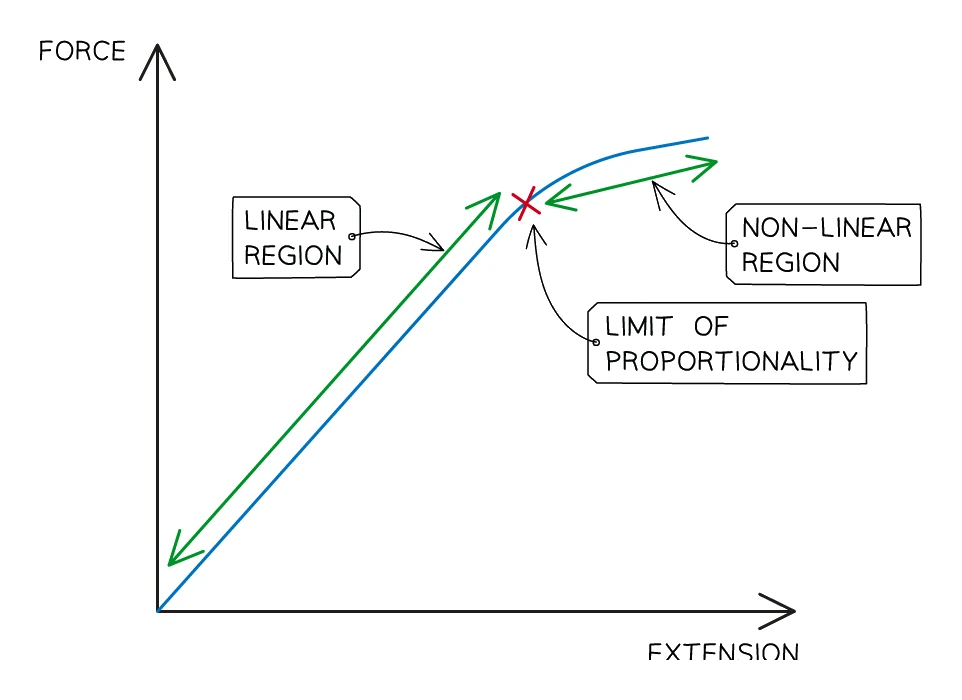
- a plot of force against extension is a straight line through the origin within the proportional region
Common exam question
Showing Hooke's law on a force-extension graph
Question: Sketch a graph to show that a spring obeys Hooke's law, labelling both axes, or explain from a plotted graph whether it does (1–3 marks).
Asked in 5 of the 24 papers. For the sketch the three marks are: axes labelled force (load or weight) and extension, units ignored and either way round; a straight line with a positive gradient throughout; and the line passing through the origin. A curve at the end is condoned only if you mark where Hooke's law stops, such as the limit of proportionality; one scheme ignored "elastic limit", so the curve then cost the straight-line mark.
For a plotted or printed graph, say the same things in words: force is proportional to extension, the line is straight and it passes through the origin, with no sign that the elastic limit has been passed. A rubber band disobeys it because its line is curved (differing loading and unloading lines also count); "not proportional" alone is ignored. "Extension increases with force" earns one mark, adding that it is linear earns the second, and Hooke's law named with nothing else is worth a single mark.
Limit of proportionality
- Every elastic material has a , a stretching force beyond which extension no longer keeps step with the force
- Past this limit, the force-extension graph bends away from its straight section: each extra newton produces a larger extra extension than before
- The exact value of the limit depends on the material and on its dimensions
Elastic and inelastic deformation
- Deformation is any change in an object's original shape produced by a force
- Two outcomes are possible when the force is removed:
- , where the object returns to its original shape and size. Examples: a steel spring, a rubber band, most fabrics, a tennis ball after a bounce
- (also called plastic deformation), where the object stays permanently changed even after the force is removed. Examples: a clay tile that has been moulded, a paperclip that has been bent past straightening, a metal drinks can that has been crushed
- Hooke's law is a statement about the elastic region of a material; once a material has been pushed into inelastic deformation, it does not spring back to the origin of the force-extension graph
Common exam question
Elastic behaviour and exceeding the elastic limit
Question: Describe what is meant by elastic behaviour, explain how a loading-unloading graph shows that a material is elastic, or explain what happens to a spring stretched by too large a force (1–2 marks).
Asked in 4 of the 24 papers. Elastic behaviour is two marks, so give both halves: the material returns to its original length or shape, and it does so when the force is removed ("load", "mass" or "weight" are all taken for the force). On a loading-unloading graph the two marks are that the unloading line returns to the origin (no extension) and that it does so once the force is removed; the shape of the loop is ignored. For a force that is too large, the two marks are that the spring passes its elastic limit (limit of proportionality is accepted) and is permanently deformed, no longer returning to its original length; "it breaks" and "it loses its elasticity" are ignored. A spring that has lost its elastic behaviour settles longer than it started, and any value above the original length up to the loaded length is credited.