1. Electrical power and fuses
What electrical power is
- Power is the rate at which energy is transferred, i.e. the amount of energy moved each second
- Power is measured in watts (W); 1 watt is the same as 1 joule per second (1 W = 1 J/s)
- For an electrical device, the power depends on two things:
- the voltage (potential difference) across the device
- the current flowing through the device
The power equation
P = I × V
- where:
- P = power transferred by the device (W)
- I = current through the device (A)
- V = voltage across the device (V)
- Rearrangements:
- I = P / V (a high-power device at fixed voltage draws a large current)
- V = P / I
Common exam question
Calculating power or current with P = IV
Question: Give the formula that links power, current and voltage, then calculate an appliance's power from its current and the mains voltage, or its current from its power rating (2–3 marks, plus 1 for the formula).
Set in 7 of the 24 papers. The formula mark takes power = current × voltage in words or standard symbols, or any rearrangement. Then one mark is for the substitution and one for the evaluation; "give the unit" adds a third mark of its own, so write W (or J/s) even if your number is wrong.
Conversions carry marks: divide a current in mA by 1000 before substituting (a credited step), and for an answer in kW there is one mark for the value in W and a second for the kW. Given power and voltage, rearrange to current = power ÷ voltage; the rearrangement, or the substitution, is the first mark.
Worked example
Calculating power from current and voltage
A toaster is connected to a 230 V mains supply and draws a current of 4 A. Calculate the power of the toaster.
Solution:
- Write the equation: P = I × V
- Substitute: P = 4 × 230
- P = 920 W
Fuses
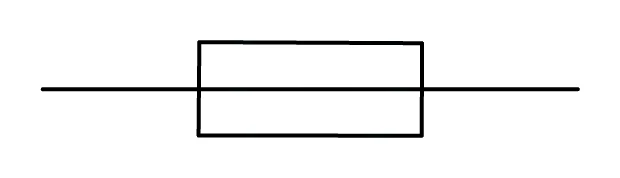
- A fuse is a safety component placed in the of an appliance; it cuts the supply if the current grows dangerously large
- A fuse looks like a small glass or ceramic cartridge with a fine metal wire running through it; if the current passes the rated value, the wire heats up and melts ("blows"), breaking the circuit
- Once a fuse has blown it must be replaced, because it cannot reset itself
- Without a fuse, an internal short circuit could deliver enough current to overheat the cable, set fire to nearby material, or electrify the appliance's metal casing
Choosing the right fuse rating
- Common UK fuse ratings are 3 A, 5 A and 13 A
- The right fuse for an appliance is the smallest one that is still above the appliance's normal operating current:
- Use I = P / V to find the appliance's working current from its rated power
- Pick the next standard fuse rating up from that figure
- If the fuse is rated too low, it will blow during normal operation and the appliance will keep cutting out
- If the fuse is rated too high, a fault current can pass right through it before the wire melts, leaving the appliance vulnerable to overheating
Common exam question
Explaining how a fuse protects an appliance
Question: Explain how a fuse protects an appliance, or how it works to protect it when there is a fault (3 marks).
Asked in 2 of the 24 papers, three marks each time, one per step. The current becomes too high: it exceeds the fuse rating. The fuse wire melts ("blows" and "breaks" are credited too, but "burns" is ignored and earns nothing). The circuit is broken, so the appliance is isolated from the supply ("stops the current" is accepted).
Say the current exceeds the rating or becomes too high, not simply that it increases: one mark scheme ignores "the current increases", because a rise that stays under the rating does nothing. A linked two-mark part asked why a fuse rated far above the normal current is a poor choice: a fault current still flows without melting it, so the lead or appliance can overheat or catch fire.
2. Calculating energy transfers
Energy from power and time
E = P × t
- where:
- E = energy transferred (J)
- P = power of the device (W)
- t = time the device runs for (s)
- Substituting P = I × V gives a second form that uses circuit quantities directly:
E = I × V × t
- The two equations are equivalent, so pick whichever set of quantities the question hands you
Common exam question
Calculating energy transferred from power and time
Question: Calculate the energy transferred to or by an appliance from its power, or from its current and voltage, and the time it is switched on (3–4 marks).
Set in 6 of the 24 papers. Use E = P × t, or E = I × V × t when you are given the current and voltage; the mark schemes accept either route, with one mark each for the substitution, any rearrangement needed and the evaluation.
The time is the trap. In five of those six questions it came in hours or minutes, and converting it to seconds is a mark of its own (or costs a mark when missed), so write the conversion down, for example 3 hours = 10 800 s, before you substitute. For an appliance made of identical parts, such as bulbs in series, use the total voltage across all of them, not the voltage across one.
Worked example
Calculating energy transferred (E = P × t)
A lamp has a power of 60 W and is left on for 5 minutes. Calculate the energy transferred.
Solution:
- Convert time to seconds: 5 min = 300 s
- Write the equation: E = P × t
- Substitute: E = 60 × 300
- E = 18 000 J
Energy and work
- The work done by the charge flowing through a component is exactly the energy transferred to that component
- In a complete circuit, the total energy delivered by the battery equals the total energy transferred to every component on the loop, which is conservation of energy
3. Electrical safety
Why mains electricity is dangerous
- UK mains electricity runs at 230 V, and even a brief contact can drive a current through the body that disrupts the heart's rhythm
- A potential difference as small as about 50 V is already enough to cause a serious electric shock if the path through the body is right
- Wet or sweaty skin lowers the body's resistance dramatically, raising the current for a given voltage; this is why mains tools and bathroom appliances need extra protection
Common hazards in domestic wiring
- Damaged insulation: a frayed cable can expose the live wire, electrocuting anyone who touches it
- Overheating cables: running too much current through a cable that is too thin (or letting a heater cable sit tightly coiled) heats the wire enough to melt the surrounding insulation, exposing live metal and risking a fire
- Damp conditions: water on or near live wiring can complete an unintended path through the user's body, both giving a shock and short-circuiting the appliance
Safety features in everyday appliances
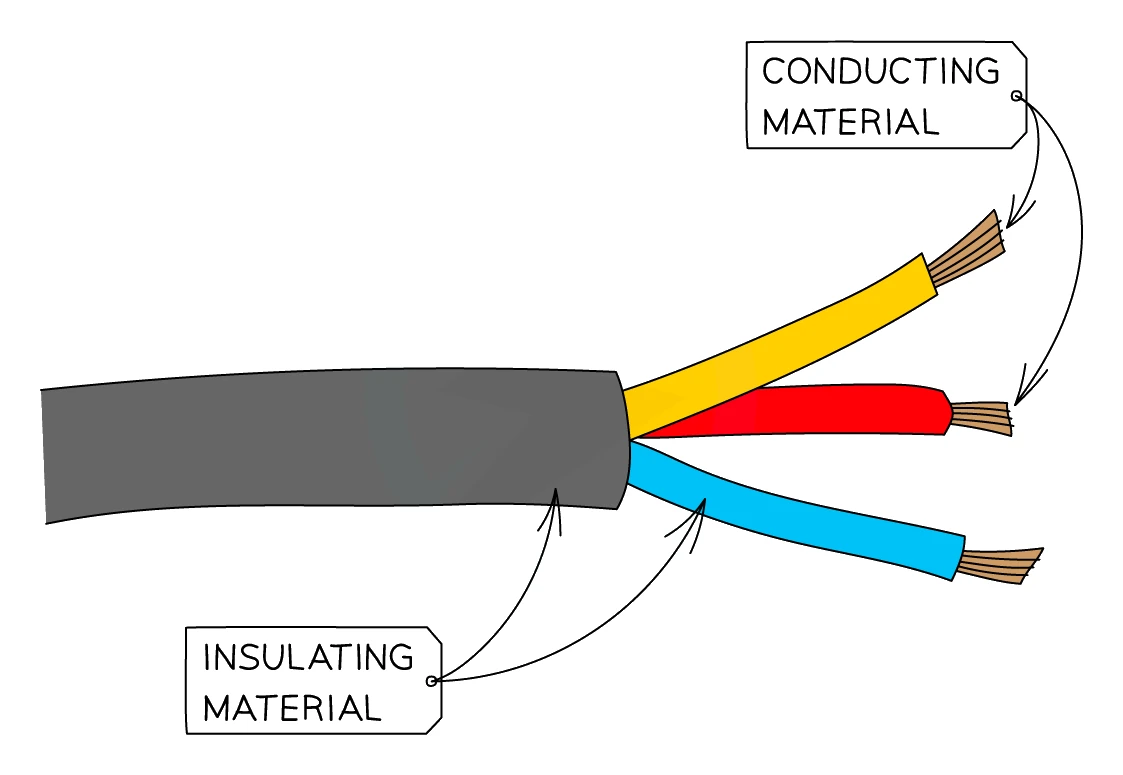
- Insulation: every conducting wire is wrapped in a non-conducting plastic or rubber sleeve so that touching the outside of the cable does not expose the user to the live conductor inside
- Double insulation: appliances with plastic (non-metallic) cases (e.g. modern kettles, hair dryers, vacuum cleaners) have two separate insulating layers (the insulation around the wires and the casing itself). They do not need an because there is no metal exterior to electrify in a fault. The double-square symbol (☐ inside ☐) on the appliance shows it is double insulated
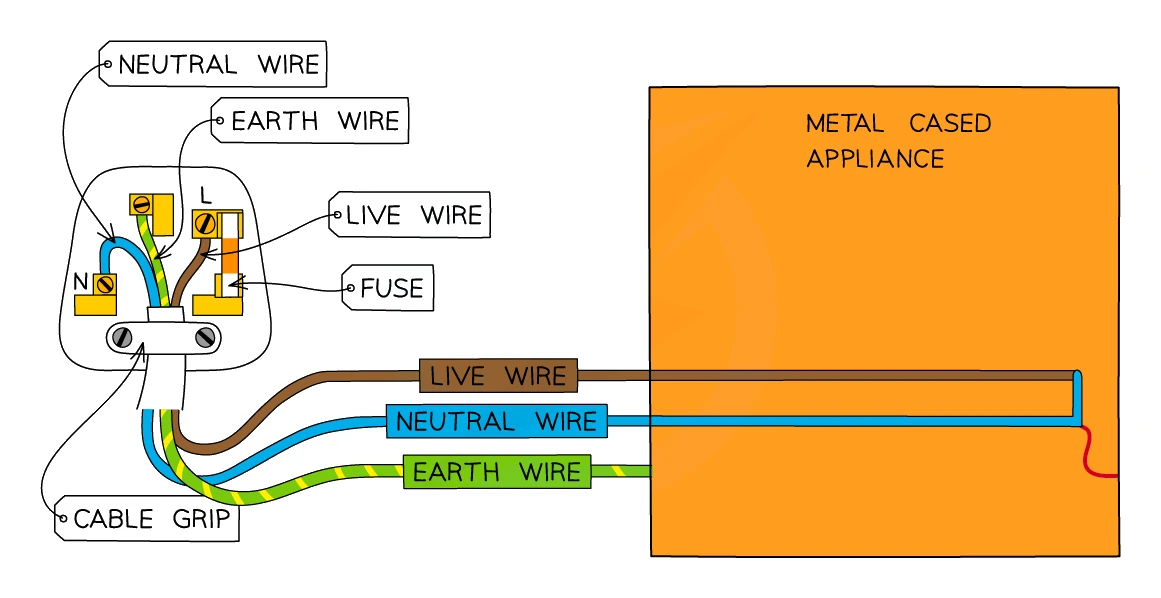
- Earthing: appliances with metal cases carry a third wire (the earth wire) bolted to the casing. If the live wire breaks free internally and touches the casing, the earth wire offers a very low-resistance path to ground, sparing the user from a shock and causing a sudden current surge through the fuse so it blows quickly
- Fuses: covered in section 1; they sit in the live wire and melt to break the circuit if the current exceeds the fuse rating
- Circuit breakers: modern alternatives to fuses (covered below)
Common exam question
Safety features of a mains appliance
Question: State which wire the fuse is connected in, name other electrical safety features of a mains appliance, or explain why a power supply is covered in plastic (1–2 marks).
Set in 2 of the 24 papers. The fuse goes in the live wire (the brown one). For other safety features, the earth wire, a circuit breaker (an RCD or trip switch counts), double insulation and insulated cables each earn a mark.
Explaining a plastic case or cover is two marks: plastic is an electrical insulator and does not conduct, so it prevents an electric shock. Naming double insulation is accepted for the first mark. Make the shock the second point: a remark about current leaking to the surroundings is ignored.
How earthing protects a user step by step
- Imagine an iron with a live wire that has worked loose and is now touching the inside of its metal case
- Without an earth wire:
- The casing becomes electrified at 230 V
- Anyone who touches the casing completes a path through their body to ground
- A shock current flows through them
- With an earth wire connected to the casing:
- The casing is bonded by a thick low-resistance wire to the ground
- A huge current surges through the the moment the casing becomes live
- The same surge passes through the in the live wire
- The fuse wire heats up and melts, breaking the live wire and cutting the supply
- The user is never exposed to the fault voltage
Circuit breakers vs fuses
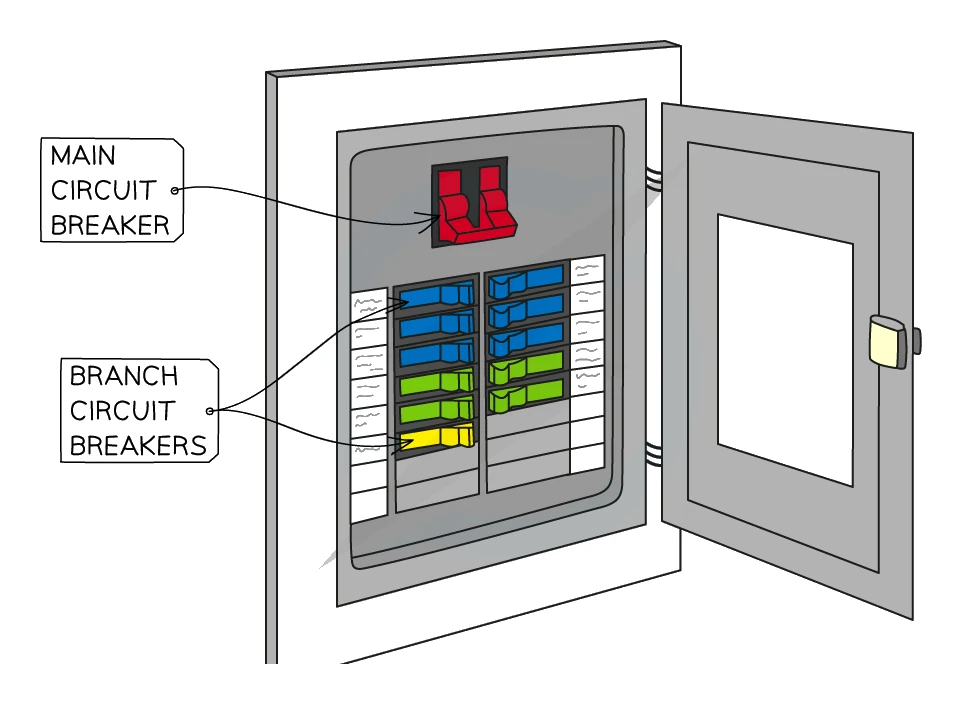
- A circuit breaker is an automatic, electrically operated switch that trips open when the current exceeds a set value, breaking the circuit
- Its main internal mechanism is a small electromagnet: when the current grows large, the magnetic field is strong enough to pull a spring-loaded contact apart
- Advantages over a fuse:
- Reset, don't replace: once the fault is fixed, a circuit breaker can simply be flicked back to the on position; a blown fuse has to be thrown away and a new one fitted
- Trips much faster: the electromagnet reacts in milliseconds, while a fuse wire takes longer to heat up to its melting point
- In a modern house, the consumer unit (sometimes still called a "fuse box" out of habit) contains a row of circuit breakers, each one protecting a different circuit (sockets, lighting, kitchen, shower, etc.). A larger main breaker can disconnect the whole house at once
Common exam question
Advantages of a circuit breaker over a fuse
Question: Give one advantage, or explain the advantages, of a circuit breaker compared with a fuse (1–2 marks).
Asked in 2 of the 24 papers. Two ideas are credited, one mark each: a circuit breaker can be reset, so it does not have to be replaced like a blown fuse and can be used again and again; and it is faster, switching the circuit off more quickly (being more sensitive to the fault current is accepted). The one-mark version takes either idea; for two marks give both.
A follow-up asked why a heater on a 16 A breaker might switch off before drawing its normal current: other appliances sharing the same circuit, the heater's own lower-rated fuse, or its thermal cut-out or thermostat operating are the credited suggestions, while blaming an electrical fault in the heater is ignored.
4. The heating effect of an electric current
Why current heats wires
- When current flows through a metal wire, the drifting electrons repeatedly collide with the vibrating positive ions in the lattice
- Each collision transfers some of the electron's kinetic energy to the ion, making the ion vibrate more vigorously
- That extra vibration shows up as a rise in temperature of the wire, because kinetic energy in the electrons has been transferred to internal (thermal) energy in the metal
- Some of this thermal energy is then dissipated to the surroundings by heating (and at higher temperatures by infrared radiation as well)
Exam tip
Explaining why a wire heats up when current flows
When a question asks why a coil, element or wire gets hot while current flows through it, make three separate points, because the mark scheme gives one mark for each: the wire has resistance; the electrons lose energy to it as they pass along it; and they lose it because they collide with the ions of the metal lattice ("atoms" or "particles" is accepted for ions). "It has resistance, so it gets hot" earns only the first of the three: the electrons' energy loss and their collisions with the ions are the other two marks.
Useful applications of the heating effect
- The heating effect is the basis of every domestic appliance that turns electricity into warmth:
- electric kettle: current through a high-resistance heating element brings the water to the boil
- toaster: a coil of resistance wire glows red-hot under each slice of bread
- electric oven and grill: a hidden resistive element heats the oven cavity
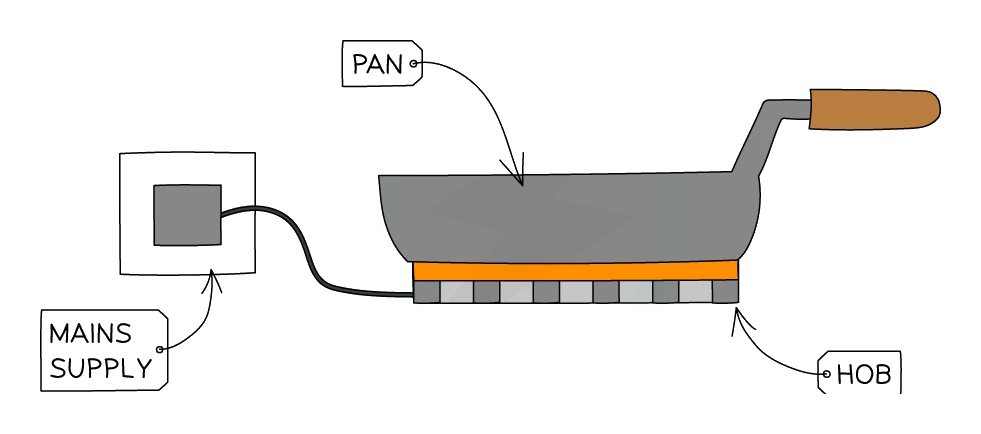
- electric hob: a resistive element under the ceramic surface heats the cookware
- bar heater / electric radiator: a long coil of resistance wire heats the room air
- filament lamp: heats the metal filament until it glows white-hot, producing light (along with a lot of waste heat)
- In wiring that is not meant to heat up, such as extension leads, mains cables, and transformer windings, the heating effect is a waste of energy, and good design uses thick, low-resistance copper conductors to minimise it
5. Alternating and direct current
Direct current (d.c.)
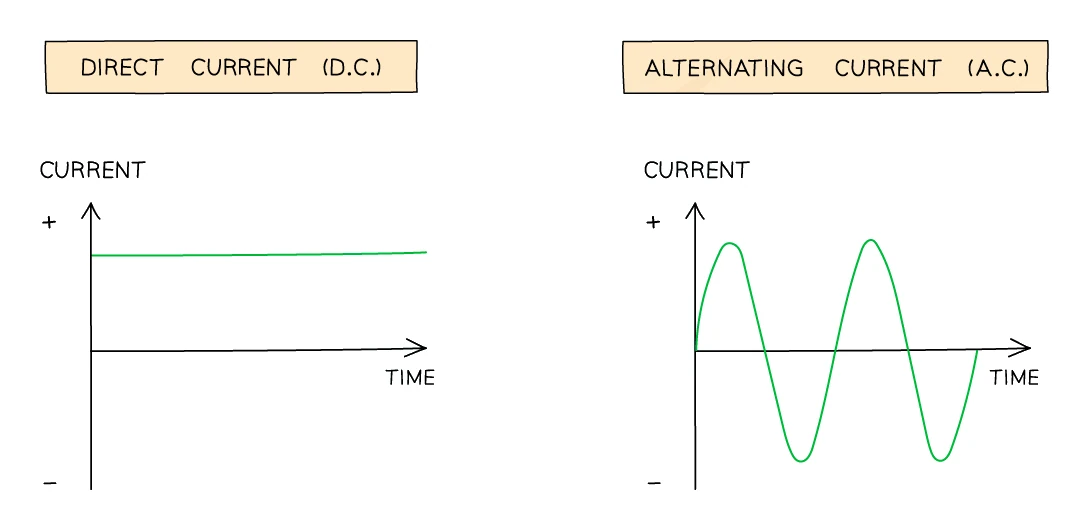
- A direct current (d.c.) is a current that keeps flowing in just one direction around a circuit, starting at the source's positive end and arriving back at its negative end
- The two terminals of a d.c. source keep their roles unchanged: one stays at the higher potential (the positive end) and the other stays at the lower potential (the negative end) for the whole time the source is connected
- Sources of d.c. include cells, batteries, solar panels and d.c. packs used in school labs
Alternating current (a.c.)
- An alternating current (a.c.) is a current whose direction continually reverses, flowing one way, then the opposite way, then back again, many times every second
- The supply's two terminals swap polarity in step with the current; neither terminal is permanently positive
- The frequency of an a.c. supply is the number of complete cycles per second, measured in hertz (Hz)
- In the United Kingdom, the mains supply is a.c. at a frequency of 50 Hz and a voltage of about 230 V
- Sources of a.c. include power-station generators and the sockets in any home
Common exam question
How direct current differs from alternating current
Question: Describe how direct current (d.c.) differs from alternating current (a.c.) (2 marks).
Asked in 2 of the 24 papers, two marks each time: one for each kind of current. Direct current flows in one direction only. Alternating current continuously changes direction; "keeps changing direction" or "changes direction constantly" is accepted. The credited idea for a.c. is the direction, so a current that just "changes" or "goes up and down" has not earned that mark. Mains electricity is a.c.; a cell or battery supplies d.c.
Comparison of d.c. and a.c. at a glance
| Feature | Direct current (d.c.) | Alternating current (a.c.) |
|---|---|---|
| Direction of flow | One fixed direction | Continually reversing |
| Source terminals | One fixed positive, one fixed negative | Two identical terminals that swap polarity |
| Current-vs-time graph | Flat horizontal line above the zero axis | Sine wave above and below the zero axis |
| Typical sources | Cells, batteries, solar panels, lab power packs | Power-station generators, household mains |
| Typical UK example | 1.5 V AA cell, 12 V car battery | 230 V / 50 Hz mains socket |