1. Density
Definition
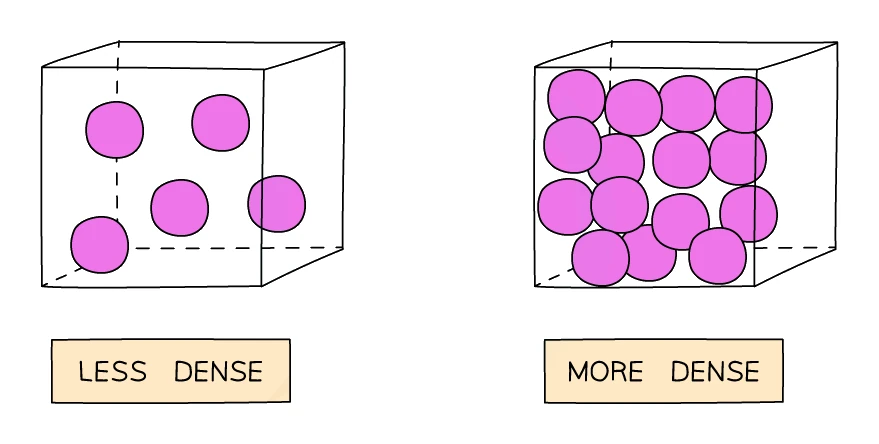
- Density (ρ) is the mass per unit volume of a material
- It tells you how tightly the matter in a substance is packed together. Two objects of identical size made from different materials can have very different masses; the denser one feels heavier
The density equation
ρ = m / V
- where:
- ρ = density (kg/m³ in SI units; sometimes quoted in g/cm³)
- m = mass (kg or g)
- V = volume (m³ or cm³)
- Useful rearrangements:
- m = ρ × V (how much a fixed volume of a known material weighs)
- V = m / ρ (the volume occupied by a known mass of a known material)
Common exam question
Calculating a density from mass and volume readings
Question: Use the recorded masses and volumes to calculate the density of a liquid, the air in a balloon, a bone or several rocks (3–4 marks).
Asked in 5 of the 24 papers. When the readings are a container empty and then full, subtract to get the mass of the sample alone first (one mark). Then density = mass ÷ volume, substituted and evaluated; one scheme credits the formula when the working implies it. A unit asked for is marked separately and must match the numbers used, so grams and cm³ give g/cm³. "To 2 significant figures" carries a mark, so an answer left at four figures loses it. A power-of-ten slip costs one mark.
A table of masses and volumes for several rocks asks you to justify that one is a different material: calculate every density, then conclude from the values, since different materials have different densities. Follow-through is allowed if your conclusion fits your own numbers.
Comparing states of matter
- For the same substance, density generally falls as you go from solid → liquid → gas:
- Solid: particles packed tightly in a fixed lattice. Highest density of the three states
- Liquid: particles still touching but free to slide past each other. Slightly less dense than the solid (water is the famous exception: ice floats on water because solid water is less dense than liquid water)
- Gas: particles spread far apart with mostly empty space between them. Density is typically about a thousand times smaller than the liquid or solid forms
Units conversions
- SI density is kg/m³, but g/cm³ is also very common. The conversion:
- 1 g/cm³ = 1000 kg/m³ (water has a density of 1.0 g/cm³ = 1000 kg/m³)
- Useful reference densities:
- air at sea level ≈ 1.2 kg/m³
- water ≈ 1000 kg/m³
- aluminium ≈ 2700 kg/m³
- iron ≈ 7900 kg/m³
- lead ≈ 11 300 kg/m³
Worked example
Calculate the density of a material
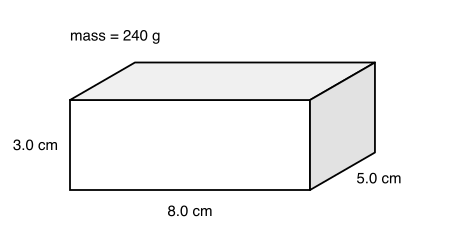
A rectangular block has a mass of 240 g and dimensions 8.0 cm × 5.0 cm × 3.0 cm. Calculate its density in g/cm³.
Solution:
- Volume = 8.0 × 5.0 × 3.0 = 120 cm³
- ρ = m / V = 240 / 120 = 2.0 g/cm³
2. Core practical: determining density
Aim
- Measure the density of three different kinds of sample: a regularly shaped solid, an irregularly shaped solid, and a liquid, using the most suitable technique for each
Apparatus
| Equipment | Purpose | Resolution |
|---|---|---|
| Digital balance | Measures the mass of every sample | 0.01 g |
| 30 cm ruler | Measures lengths of regular solids (≥ a few cm) | 1 mm |
| Vernier calipers | Measures smaller solid samples accurately | 0.01 mm |
| Micrometer screw gauge | Measures the smallest samples (wires, thin discs) | 0.001 mm |
| Eureka (displacement) can with spout | Catches the water displaced by an irregular solid | — |
| Measuring cylinder | Reads the displaced water and the volume of any liquid sample | 1 ml |
| Beaker / sample container | Holds liquid being weighed | — |
Experiment A: density of a regularly shaped solid (a metal cube, a cylinder, a sphere)
- Independent variable: the dimensions you measure (length, breadth, height, radius)
- Dependent variable: derived density value
- Control variables: the same balance and measuring instrument used throughout; samples at room temperature
Method:
- Place the solid on the digital balance and record the mass m in kg
- Choose the right instrument for the size of the sample:
- centimetre ruler for objects bigger than a few centimetres
- Vernier calipers for samples a few millimetres to a few centimetres across
- micrometer for very small or thin samples
- Measure each dimension three times at different points, and take the mean of the three readings for each dimension
- Calculate the volume from the appropriate geometric formula:
- cuboid: V = length × breadth × height
- cylinder: V = π × r² × h
- sphere: V = (4/3) × π × r³
- Calculate the density from ρ = m / V
Experiment B: density of an irregular solid (a stone, a key, a small metal casting)
- Independent variable: the sample being tested
- Dependent variable: the volume of water displaced
- Control variables: the same eureka can, the same measuring cylinder, the same starting water level
Method:
- Find the mass of the sample on the digital balance
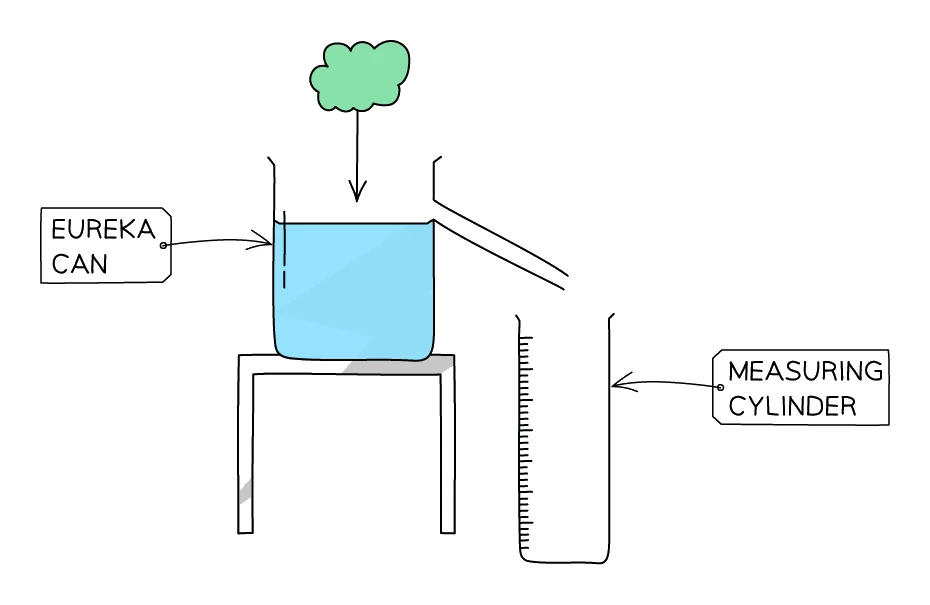
- Top the can up with water so that the level reaches the spout and a few drops trickle out; wait until dripping has stopped completely before continuing
- Place an empty, dry measuring cylinder directly beneath the spout
- Lower the sample carefully into the eureka can on a thin thread (or slide it gently down the inside) so it sinks fully below the water without splashing
- The water that has been pushed out runs through the spout into the measuring cylinder. Read off the volume of water collected; this equals the volume of the sample
- Calculate the density from ρ = m / V
Experiment C: density of a liquid
- Independent variable: the volume of liquid added (or the type of liquid)
- Dependent variable: the mass of the liquid
Method:
- Place an empty, dry measuring cylinder on the digital balance and record its mass m₁
- Without removing the cylinder from the balance, pour in a measured volume of liquid (read the volume V off the cylinder's own scale, with your eye level with the meniscus)
- Record the new mass m₂ (cylinder + liquid)
- The mass of the liquid alone is m = m₂ − m₁
- Calculate the density from ρ = m / V
Common exam question
Describing how to find the density of an irregular object
Question: Describe a method to find the mass and volume, or the density, of an irregular object such as a rock or a hailstone (3–5 marks).
Asked in 4 of the 24 papers. Two points come first: find the mass on a balance, and find the volume by displacement. Read the water level in a measuring cylinder before and after the object goes in, then subtract; or fill a displacement can to its spout and catch what the object pushes out. Then density = mass ÷ volume. For a hailstone, measure its diameter with callipers and use the volume of a sphere.
Accuracy details earn the rest, one mark each: object fully submerged, no splashing or spilling, cylinder read at eye level at the bottom of the meniscus, balance zeroed on a level surface, object dry when weighed, repeats averaged. Write "balance": three schemes reject "scale" (allowing "scales"), the fourth credits neither, and one ignores an unqualified "avoid parallax".
Sources of error and safety
- Systematic, un-zeroed balance. Always tare the balance to zero before placing each sample on it
- Systematic, parallax on the measuring cylinder. Read the meniscus at eye level so the volume isn't over- or under-read
- Random, irregular sample dropped instead of lowered. Slamming the sample into the eureka can causes water to splash out, throwing off the volume reading. Lower it gently on a thread instead
- Safety. Eureka cans are typically glass or thin metal, so handle with care; mop up spills immediately to avoid slips and short circuits near the electric balance
3. Pressure
Definition
- Pressure is the force per unit area acting normal (at right angles) to a surface
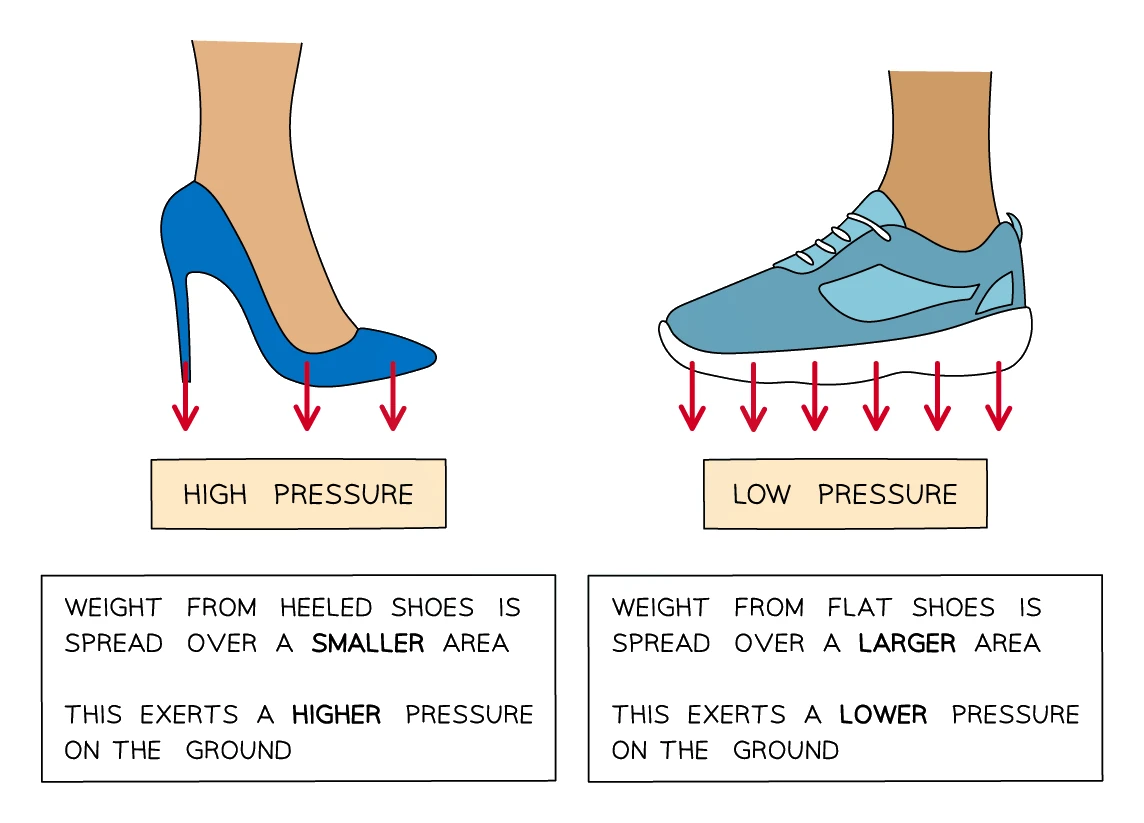
- The same force concentrated into a smaller area produces a higher pressure. That's why a sharp knife slices and a blunt one doesn't, and why a sleeping bag is more comfortable on a wide foam mat than on a single rope
The pressure equation
P = F / A
- where:
- P = pressure (pascals, Pa, where 1 Pa = 1 N/m²)
- F = force acting perpendicular to the surface (N)
- A = area over which the force is applied (m²)
- Rearrangements:
- F = P × A (the total force a fluid pressure exerts on a surface of known area)
- A = F / P
Worked example
Calculate pressure from force and area
A person weighing 600 N stands on a flat tile with a total contact area of 0.030 m².
Solution:
- P = F / A = 600 / 0.030 = 20 000 Pa (20 kPa)
Common exam question
Calculating with pressure = force ÷ area
Question: Calculate the pressure a weight exerts on the ground, the force a pressure produces on a piston or a surface, or the area it acts on, sometimes with a unit (2–4 marks).
Asked in 4 of the 24 papers. One mark is for substituting into p = F ÷ A (the formula alone earns nothing), one for the evaluation; longer versions add one for rearranging to find F or A. The force must be a weight in newtons: given a mass, convert it with W = m × g first, because dividing the mass by the area is capped at two of the three marks. Keep the units consistent: pascals go with m², and an area in cm² gives a pressure in N/cm². A unit asked for is marked separately and must match your numbers: with the pressure left in kPa, writing m² kept three of the four marks and cm² only two. Follow-through is allowed between linked parts.
Everyday consequences
- Small area + ordinary force = high pressure:
- Drawing pins taper to a tiny tip on the wall side. A modest push from a fingertip becomes a huge pressure at the point, driving it into the wood
- Nails and needles work the same way
- Sharp knives cut better than blunt ones because the cutting edge is a much smaller area
- Stiletto heels focus the wearer's weight onto a few square millimetres and can dent wooden floors
- Large area + ordinary force = low pressure:
- Tractor tyres are very wide. The same vehicle weight spread over more rubber gives a lower ground pressure, so the tractor doesn't sink into wet soil
- Caterpillar tracks on tanks and bulldozers do the same thing, distributing the weight over a long track footprint
- Snow shoes and skis stop a person sinking into soft snow by spreading their weight across a much larger area than a pair of boots would
- A camel's foot broadens when it pushes down, spreading the camel's weight on sand
4. Pressure in a liquid
What changes with depth
- A fluid is anything that can flow: both liquids and gases qualify
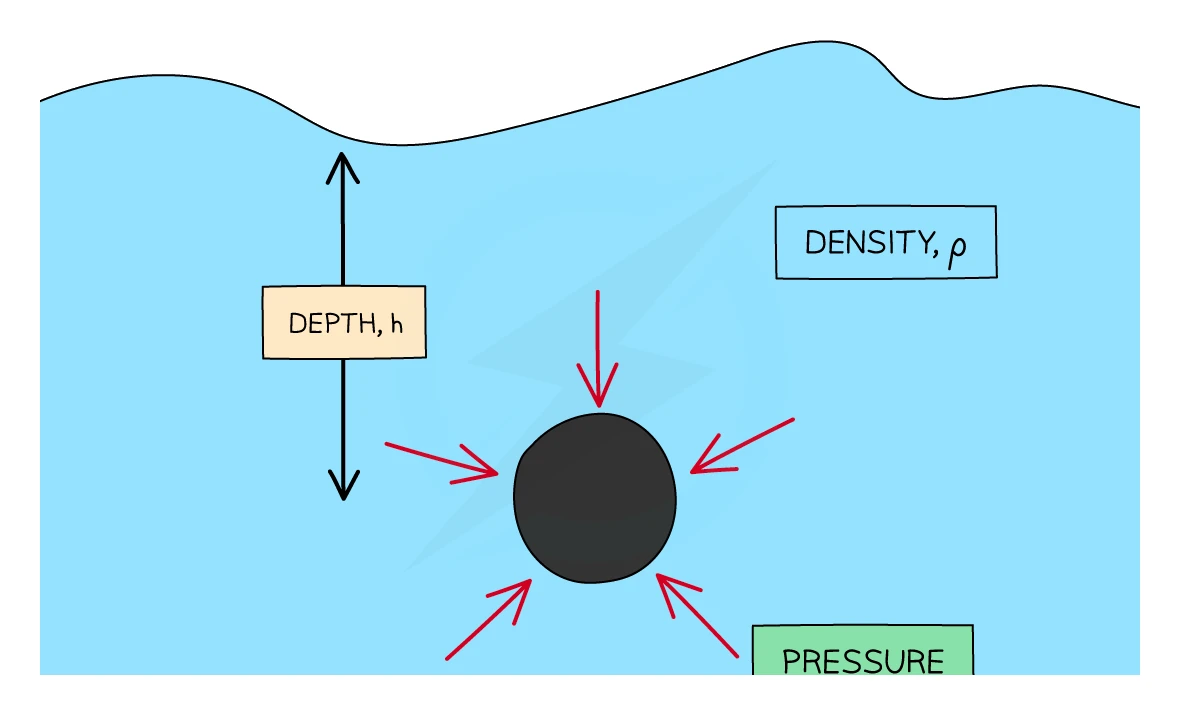
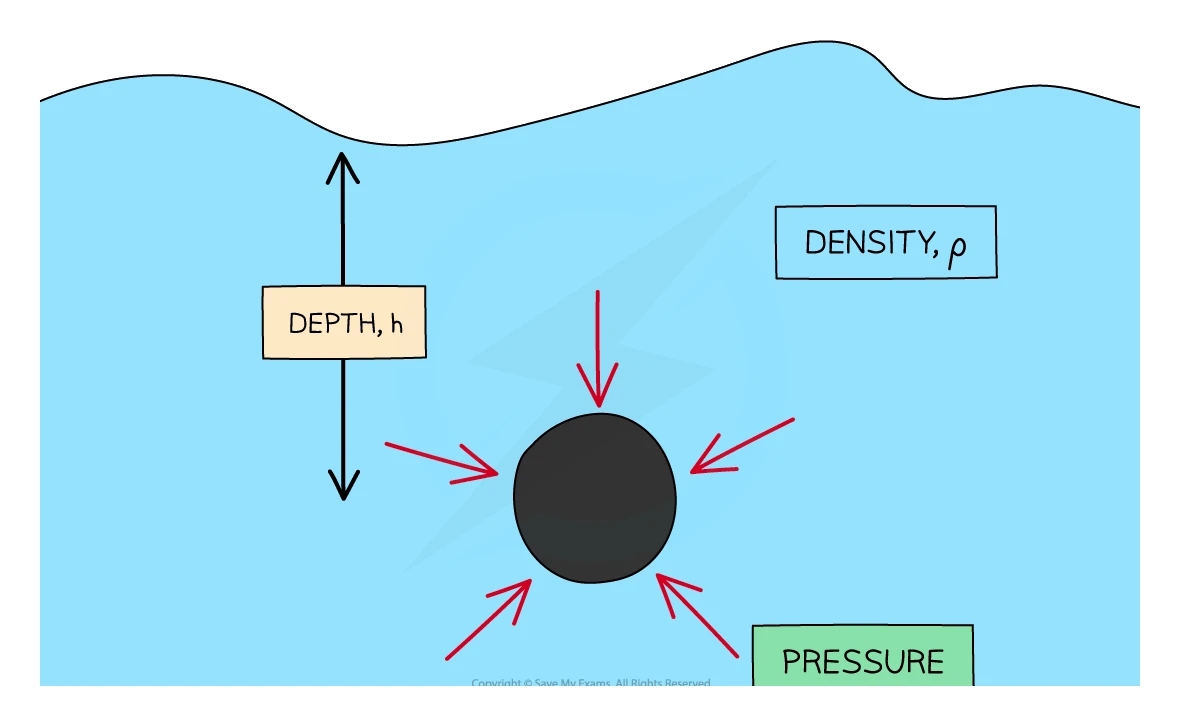
- A stationary fluid exerts pressure on any surface inside it:
- The pressure acts at right angles to the surface, no matter which way the surface is facing
- The pressure increases with depth below the surface of the fluid. The deeper you go, the more fluid is piled above and pressing down
- The pressure is the same at the same depth, regardless of direction or position in the fluid
Common exam question
Explaining effects of pressure increasing with depth
Any question that asks you to explain a design or an observation in terms of pressure changing with depth: how a dam must change to hold sea water, or why a jet from a hole near the top of a bottle lands closer than one from lower down. Set in 2 of the 24 papers. State the pressure comparison first, because it is a mark in both schemes: the pressure at the bottom is greater for the denser water, or the pressure at the higher hole is lower. Then give the consequence: a wider base or stronger material for the dam ("taller" is ignored); a smaller force on the water at the higher hole, so it leaves more slowly. Two holes at the same depth give identical paths because the pressure there is the same, and the pressure acts equally in all directions.
Why depth raises pressure
- Imagine a column of liquid sitting on top of a small horizontal patch of area at some depth h
- The weight of that column is m × g = (ρ × V) × g = ρ × A × h × g
- That weight presses on the patch, contributing a pressure of:
P = (force) / (area) = (ρ × A × h × g) / A = ρ × g × h
- The area cancels out, so the pressure depends only on the depth, the of the and the gravitational field strength
The depth-pressure equation
P = h × ρ × g
- where:
- P = pressure at depth h below the surface (Pa)
- h = depth below the surface (m)
- ρ = density of the fluid (kg/m³)
- g = gravitational field strength (10 N/kg on Earth)
- This is the extra pressure caused by the fluid above. Outside the fluid, atmospheric pressure is also present (about 101 000 Pa at sea level), so the total pressure on something deep underwater is atmospheric + the hydrostatic term above. Most exam questions only ask for the hydrostatic term
Common exam question
Stating the formula for pressure difference
Question: State the formula that links pressure difference to height, density and gravitational field strength, g (1 mark).
Asked in 7 of the 24 papers, always as the lead-in to a calculation with it; two of those papers also ask for the formula linking pressure, force and area in the same way. Words or standard symbols both score: pressure difference = height × density × gravitational field strength, or p = h × ρ × g, and any correct rearrangement is accepted. Choose your symbols carefully. "Depth" for height is accepted; four of the seven schemes let d stand for density but one rejects it, so write ρ. Writing "gravity" for g is rejected by three schemes and ignored by two more, so it never earns the mark; g is the gravitational field strength.
Common exam question
Calculating a pressure, depth or height with p = hρg
Question: Calculate the pressure difference at a stated depth, or the depth of liquid that produces a given pressure difference (2–4 marks).
Asked in 9 of the 24 papers. One mark is for substituting into p = h × ρ × g and one for the evaluation; rearranging to find h earns a third, and one scheme gives a mark for converting cm to m. When the answer line says kPa or cm, the evaluation mark is for the value in that unit. A power-of-ten slip costs one mark, but only when g was used: leaving g out is a physics error, not a slip. g = 9.8 is accepted.
For the total pressure, add atmospheric pressure (about 100 kPa) to the liquid's pressure difference: three of these papers give a mark for that addition, with follow-through from your own value. A barometer question runs backwards: subtract the trapped gas pressure from the total, then rearrange for the liquid's height.
Worked example
Calculate pressure at depth in a liquid
A diver descends to a depth of 25 m in seawater with a density of 1 020 kg/m³ (g = 10 N/kg).
Solution:
- State the formula: P = h × ρ × g
- Substitute: P = 25 × 1 020 × 10
- P = 255 000 Pa (255 kPa)
Note: this is the pressure due to the liquid alone. The total pressure at that depth also includes atmospheric pressure (~100 000 Pa) added on top.
Why dams are built thicker at the base
- The water inside a reservoir exerts a hydrostatic pressure on the dam wall, and that pressure rises linearly with depth
- The pressure on the wall is therefore small near the surface and largest near the bottom
- Engineers make the dam wall much thicker at the base than at the top so that the thicker section can resist the much larger force from the deeper water. The wall's cross-section is roughly triangular, with the wide end at the bottom and the narrow end at the surface
- The same logic explains why submarines have a maximum operating depth: at some depth, the hydrostatic pressure exceeds the design strength of the hull