1. The Big Bang theory
The origin of the Universe
- The currently accepted scientific model for how the Universe began is the Big Bang theory:
Around 14 billion years ago, all matter and energy in the Universe was concentrated in a single very small, extremely hot and dense point. From this point the Universe began to expand rapidly in every direction at once. As it expanded, it cooled and matter eventually clumped together under gravity to form the stars, galaxies and planets we see today
- The "Big Bang" was not an explosion of matter into empty space. It was an expansion of space itself, because there was no space outside the early Universe to explode into. Every point that exists today was inside that hot, dense beginning
- The Universe has been expanding ever since, and is still expanding today
- "The Big Bang" gives a starting point for the Universe but does not say what (if anything) caused it, or what was "before" it. Those questions sit outside what physics can currently answer
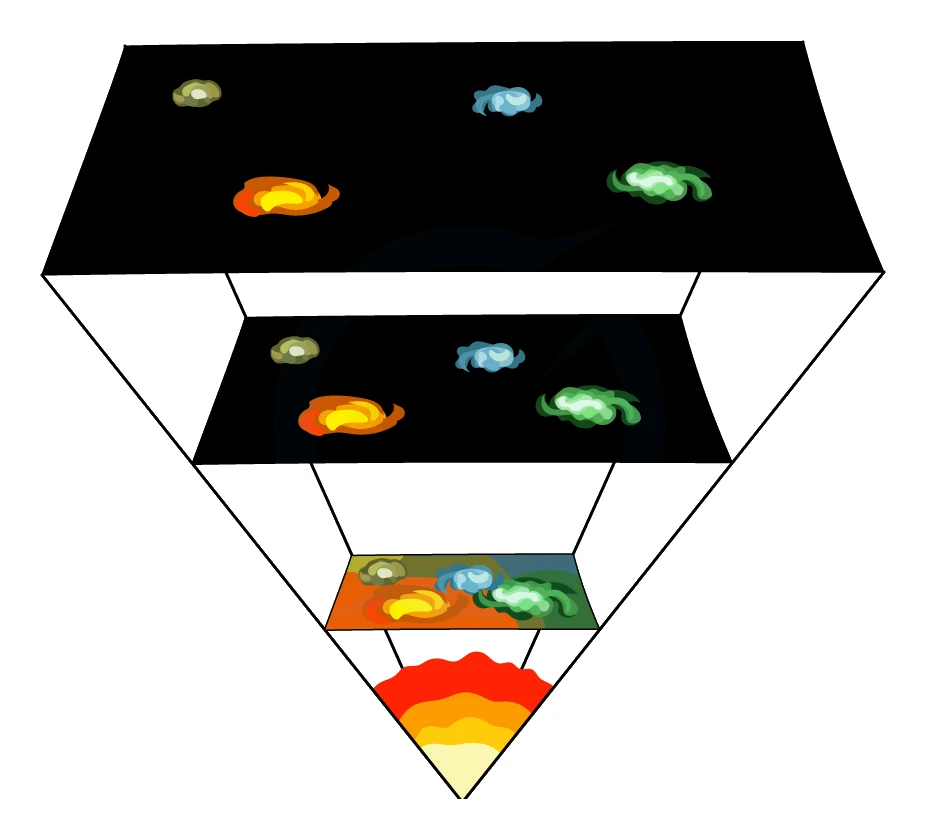
The expansion is observed today
- When astronomers look at the light from distant galaxies, they find that:
- Every galaxy is moving away from every other galaxy
- The further away a galaxy is, the faster it is moving away from us
- This is exactly what you would expect if the entire Universe had been expanding from a hot, dense early state. Tracing the expansion backwards in time leads to a single starting point, the Big Bang
The balloon analogy
- Imagine drawing dots on a deflated balloon. Each dot represents a galaxy. The rubber of the balloon represents the space between galaxies
- Now blow the balloon up:
- Every dot moves further from every other dot
- The dots are not moving across the rubber, because the rubber itself is stretching
- There is no centre of the expansion on the surface of the balloon. From any dot, all other dots look as if they are moving away
- This is what is happening in the real Universe. Space itself is stretching, carrying galaxies further apart. There is no special centre of the expansion; every galaxy sees every other galaxy receding
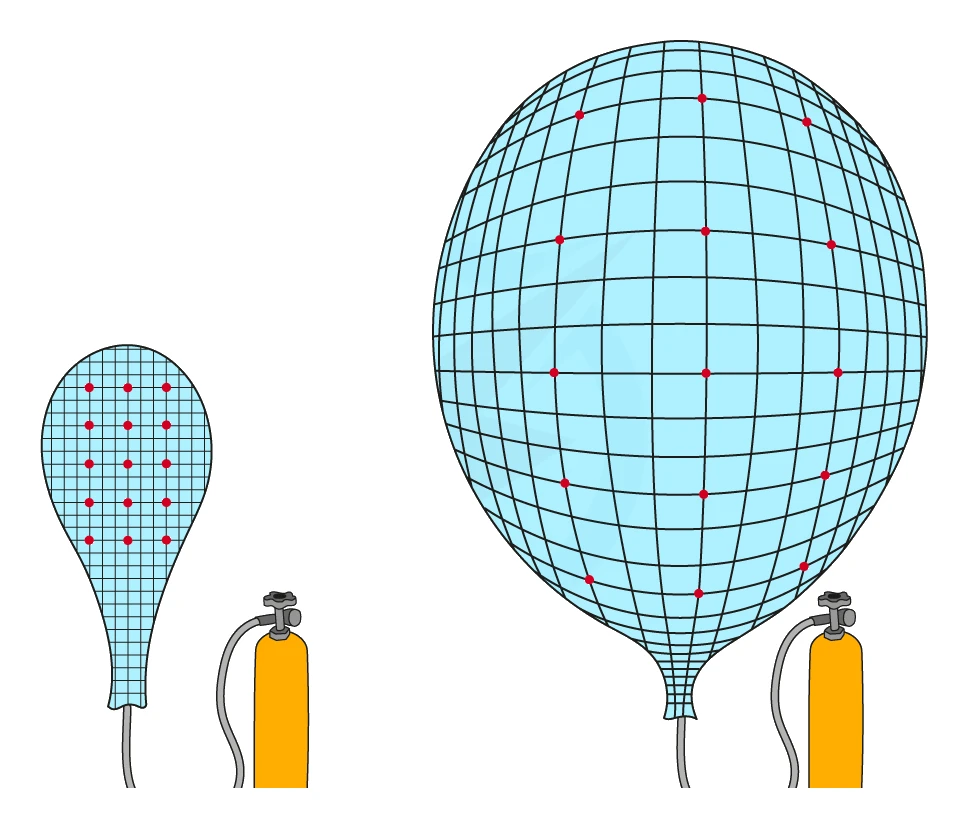
- A direct consequence: galaxies become more thinly spread with time, since the same number of galaxies occupy an ever-larger volume of space, so the average galaxies-per-cubic-megaparsec number is dropping
The Universe was very different early on
- Right after the Big Bang, the Universe was a fireball of pure energy and elementary particles at billions of degrees
- As space expanded, it cooled enough for protons and neutrons to form, then for hydrogen and helium atoms to form (a few hundred thousand years later)
- Gravity slowly pulled the gas together into clumps. The denser clumps collapsed into the first stars and galaxies
- The Universe is now far cooler (the average temperature of space is about 2.7 K) and far less dense than it was, but it is still continuing to spread out
2. Evidence for the Big Bang
There are two main pieces of evidence that astronomers point to. Both fit the Big Bang theory and neither is well explained by any alternative theory (such as the older Steady State theory, which proposed that the Universe always existed in roughly the same state).
Evidence 1 — Galactic redshift
- Light from distant galaxies is observed to be redshifted, with its wavelength stretched towards the red end of the visible spectrum
- The redshift means the galaxies are moving away from us
- The amount of redshift increases with distance, so distant galaxies are receding faster than nearby ones
- This is exactly what an expanding Universe should look like (covered in detail in sections 4 and 5)
Evidence 2 — Cosmic Microwave Background radiation
- In 1964, two American radio engineers (Penzias and Wilson) discovered a faint signal coming from every direction in the sky at exactly the same intensity
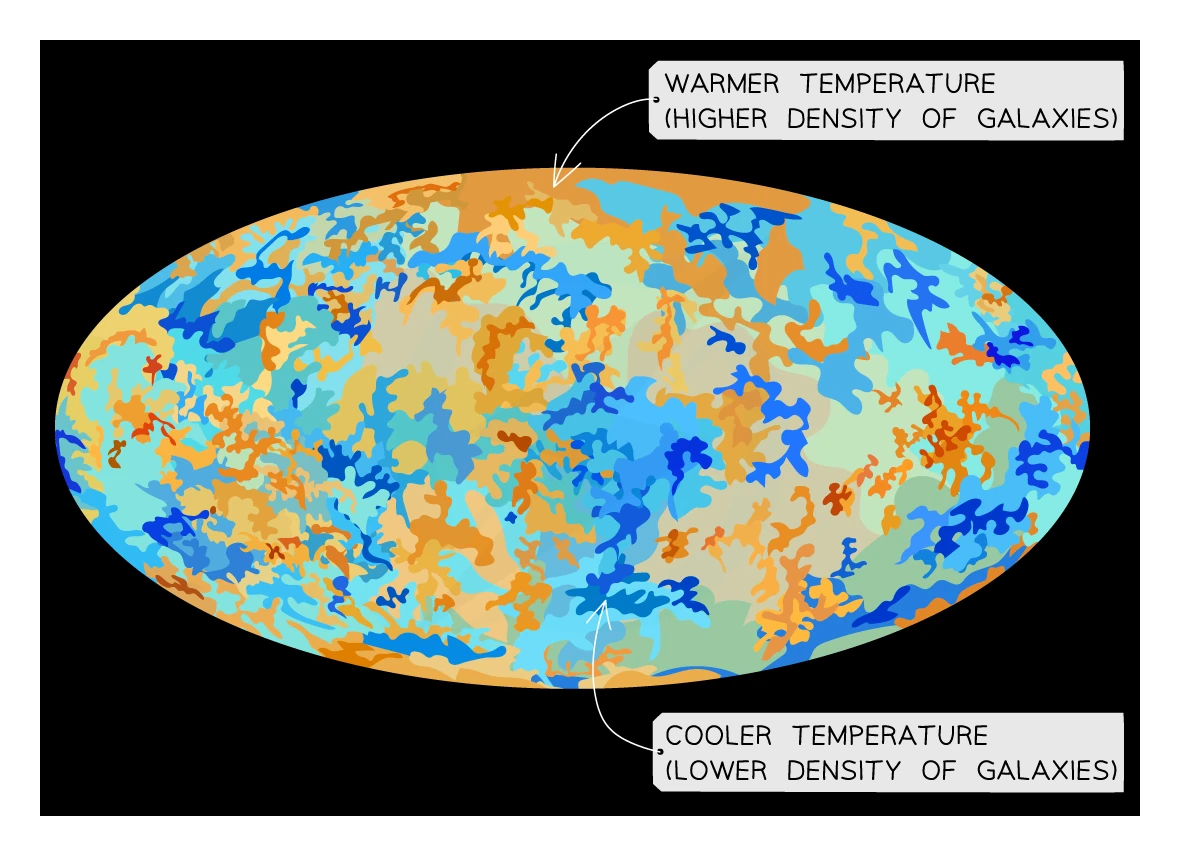
- The signal turned out to be microwave radiation with a temperature of about 2.7 K, the (CMB) radiation:
the CMB is electromagnetic radiation, in the microwave part of the spectrum, coming from every direction in space at almost exactly the same intensity and temperature (≈ 2.7 K)
Why the CMB supports the Big Bang
- According to the Big Bang theory, the very early Universe was extremely hot, and any hot body emits thermal radiation. So a hot early Universe should have produced enormous amounts of high-energy radiation
- As the Universe expanded, that radiation was stretched out along with the expansion of space. Its wavelength has grown over the last 14 billion years, from short, high-energy gamma rays at the beginning, to long, low-energy microwaves today
- The wavelength of the CMB peaks at around 1 mm, squarely in the microwave region, and its overall spectral shape matches the prediction for a once-hot Universe that has been expanding (and therefore stretching its radiation) for ~14 billion years
- The fact that the CMB:
- Fills the entire sky uniformly
- Has exactly the wavelength and spectrum predicted by the Big Bang model
- Is observed to be the same in every direction
...makes it the single most convincing piece of evidence for the Big Bang. Other theories (such as Steady State) cannot account for it
Exam tip
Turning the CMB into an argument for the Big Bang
The one paper to ask for two pieces of evidence (6 marks) capped each at four, so red-shift alone cannot carry it. For the CMB half: name it, say it comes from every direction and is the same in all of them, so all parts of the universe were once in contact (a single point is accepted); the universe was hotter long ago, and the radiation's wavelength has increased as the universe expanded (a fall in frequency also counts). Its two-mark opener, how the universe's size and temperature have changed, wants two ideas: expanded and cooled.
Why the CMB was discovered so late
- The atmosphere absorbs microwaves, so the CMB cannot easily be measured from the ground
- The discovery only became possible once radio astronomy had developed and once space telescopes could be placed above the atmosphere
- Detailed maps of the CMB (from satellites like COBE, WMAP and Planck) show that it is extremely uniform, but with tiny temperature ripples of about 1 part in 100 000. These ripples are the seeds of the structures (galaxies, clusters) that grew under gravity into the Universe we see today
3. The Doppler effect
To understand galactic redshift, you first need the Doppler effect, which is the apparent change in the wavelength (and frequency) of a wave when its source is moving relative to the observer.
What the Doppler effect is
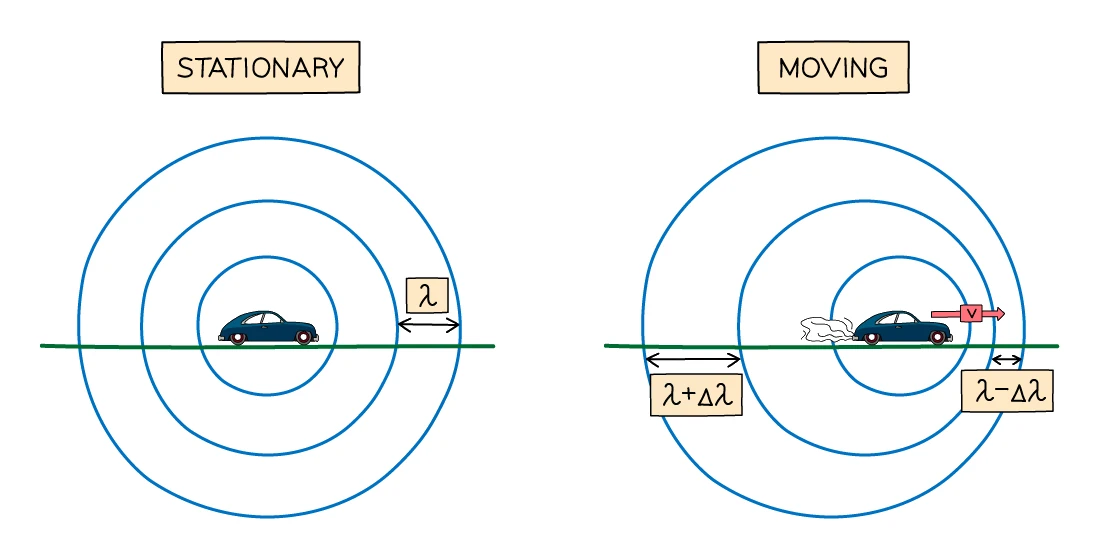
- Imagine a stationary source emitting waves. The waves spread out in a series of evenly spaced spherical wavefronts in every direction
- Now make the source move. The wavefronts are still produced at the same rate, but the source is catching up with the wavefronts ahead of it and moving away from the wavefronts behind it
- In front of the moving source:
- The wavefronts are bunched closer together
- The wavelength is shorter (λ − Δλ)
- The frequency is higher
- Behind the moving source:
- The wavefronts are stretched apart
- The wavelength is longer (λ + Δλ)
- The frequency is lower
An everyday example: ambulance sirens
- An ambulance siren has a higher pitch when the ambulance is coming towards you (wavelengths bunched up in front, higher frequency, higher pitch)
- The pitch then suddenly drops as the ambulance passes and starts moving away (wavelengths stretched behind, lower frequency, lower pitch)
- The change in pitch is obvious to the ear. Light waves do exactly the same thing, but the change is invisible to your eyes; you need a spectrometer to detect it
The Doppler equation for light
- The fractional change in wavelength is equal to the speed of the source divided by the speed of light:
Δλ / λ₀ = v / c
- Where:
- λ₀ = the reference wavelength, the wavelength the source would emit if it were not moving (often measured in a laboratory on Earth)
- λ = the observed wavelength, what arrives at your detector
- Δλ = λ − λ₀, the change in wavelength
- v = the speed of the source away from (or towards) the observer (m/s). Positive for moving away (redshift), negative for moving towards (blueshift)
- c = the speed of light = 3 × 10⁸ m/s
- Both sides of the equation are dimensionless, since it is wavelength divided by wavelength, speed divided by speed. So the Doppler shift itself has no units
- Rearranging for v:
v = c × (λ − λ₀) / λ₀
Common exam question
Calculating a galaxy's speed from its red-shift
Question: Calculate the speed of a galaxy from its emitted and observed wavelengths, given the speed of light (3–4 marks).
Set in 4 of the 24 papers. Usually one mark each for the change in wavelength, the substitution into Δλ/λ₀ = v/c, the rearrangement and the evaluation; one scheme fully credited a correct answer with no working, and a wrong Δλ carried through correctly still earns the later marks when your working shows it.
The λ₀ you divide by is the reference (laboratory) wavelength, never the observed one: using the observed value cost a mark in two papers and left only one mark in a third. A power-of-ten slip costs one mark. The wavelengths can stay in nm, but the answer takes the units of the speed of light you are given: one paper gave c in km/s, made you read Δλ off a line of best fit on a graph against distance, and wanted the velocity in km/s.
Worked example
Recession speed from a Doppler-shifted spectral line
A particular spectral line is emitted at a rest wavelength of 500 nm in a laboratory on Earth. The same line observed in a distant galaxy has a wavelength of 512 nm. Calculate the recession speed of the galaxy.
Solution:
- Δλ = 512 − 500 = 12 nm
- λ₀ = 500 nm, the reference wavelength (not the observed 512 nm)
- Δλ / λ₀ = v / c, so v = c × Δλ / λ₀
- Both wavelengths are in nm, so the ratio is simply 12 / 500 = 0.024
- v = 3.0 × 10⁸ × 0.024 = 7.2 × 10⁶ m/s
4. Galactic redshift and blueshift
Definition of redshift
- The Doppler effect applies to all waves, including light from stars and galaxies
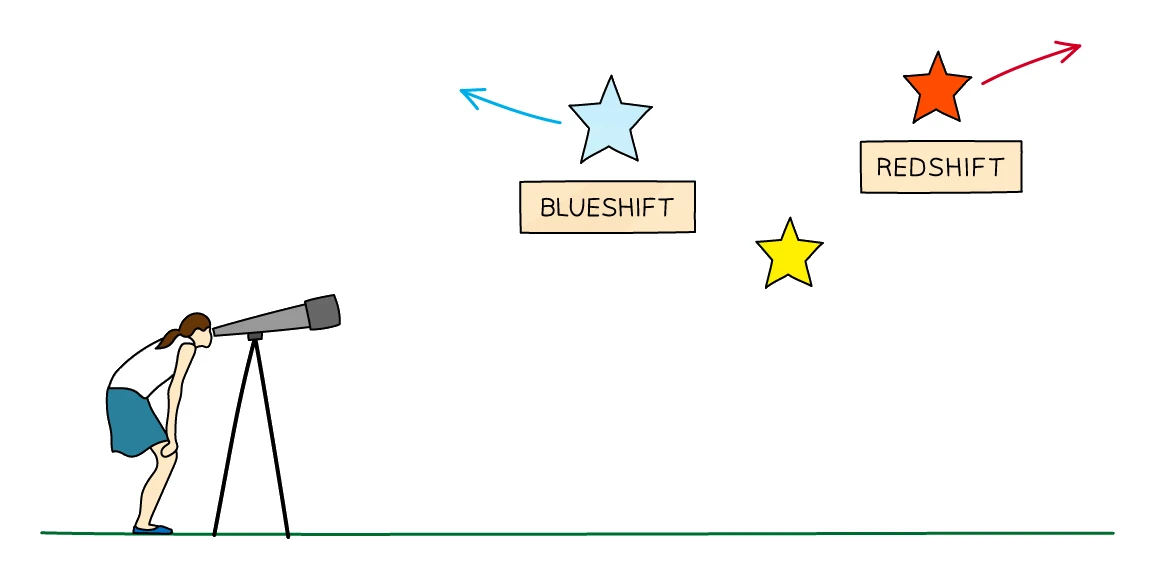
- When a galaxy is moving away from us, the light we receive from it has its wavelength stretched, pulled towards the red end of the visible spectrum:
redshift is the apparent increase in wavelength of light when the source is moving away from the observer
- All distant galaxies show redshift in their spectra; every one of them is moving away from the Earth
Definition of blueshift
- The opposite happens when a source is moving towards us:
blueshift is the apparent decrease in wavelength of light when the source is moving towards the observer
- Light from an approaching source is pushed towards the blue end of the spectrum
- Most galaxies show redshift, but a few nearby galaxies (most famously the Andromeda galaxy) are actually moving towards us, and their light is blueshifted. These local motions are caused by the galaxies' own gravitational attraction to each other, on top of the overall expansion
How to spot redshift in a spectrum
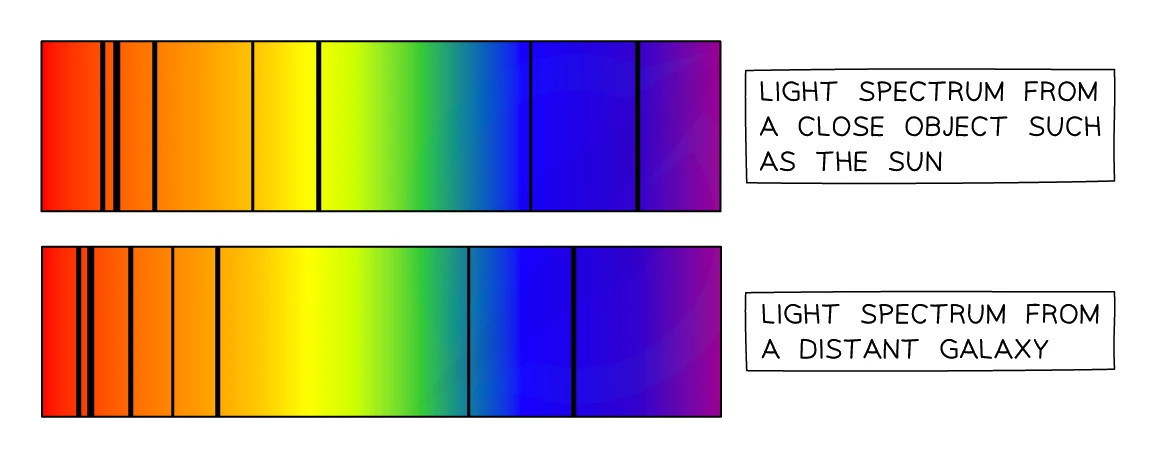
- Every chemical element produces a unique pattern of spectral lines, which are narrow bright lines in an emission spectrum, or narrow dark lines in an absorption spectrum
- The pattern of lines is fixed by the physics of the atom; the position of each line on the wavelength axis can shift if the source is moving
- When astronomers compare the spectrum of a distant galaxy with the same element's spectrum measured in a laboratory:
- The pattern is the same: same number of lines, same spacing
- The whole pattern is shifted towards longer wavelengths for a receding galaxy (redshift)
- The whole pattern is shifted towards shorter wavelengths for an approaching one (blueshift)
Remembering which way is which
- Red light has the longest wavelength and lowest frequency in the visible spectrum
- Blue light has the shorter wavelength and higher frequency
- So moving towards longer wavelength = moving towards the red end = redshift = source moving away
- And moving towards shorter wavelength = moving towards the blue end = blueshift = source moving towards you
- Or use the sound analogy: a motorbike speeding away from you sounds lower-pitched (longer wavelength) than when it is standing still. Same with light from a galaxy moving away: the wavelength is longer, hence redshifted
Exam tip
Defining red-shift and where it is greatest
When asked what red-shift means (2 marks), give both halves: the light's wavelength has increased (a fall in frequency, or a stretched wavelength, also counts) because the source is moving away from the observer (or the observer moving away from the source). The mark is for the wavelength change itself, not for the colour. Red-shift comes from motion along the line of sight, so a star in orbit is most red-shifted at the one point where it moves directly away from Earth: when a paper asked for that position, the cross had to be within a star's radius of it.
5. Galactic redshift as evidence for an expanding Universe
What galactic redshift tells us
- Two key observations from looking at galaxies all across the sky:
Every distant galaxy is redshifted; they are all moving away from the Earth
The further away a galaxy is, the greater the redshift, so the faster it is moving away
- This relationship, distance proportional to recession speed, is known as Hubble's law
- It tells us that the Universe is expanding uniformly. Each galaxy sees every other galaxy receding, just like dots on the surface of an inflating balloon
Why this is evidence for the Big Bang
The logic chain runs as follows:
- Distant galaxies show redshift → they are moving away from us
- The further away a galaxy, the bigger its redshift → distant galaxies are moving away faster
- If you rewind time, all galaxies must once have been very close together
- Rewind enough, and the entire Universe was concentrated in a single small region
- That fits the Big Bang picture: a hot dense beginning, followed by 14 billion years of expansion
The galactic redshift observations were one of the first major pieces of evidence for the Big Bang, first measured by Edwin Hubble in the 1920s, and refined ever since with better telescopes and supernova observations. The discovery of the CMB in 1964 then provided the second, independent piece of evidence.
What galactic redshift does NOT mean
- The galaxies are not moving through space away from a centre. Instead, space itself is expanding between them, carrying them apart (the balloon analogy)
- There is no single point in space that the Universe is expanding from; every point is moving away from every other point
- The Earth is not at the centre of the Universe. Any observer in any galaxy would see all the other galaxies redshifted by the same amount, just as every dot on the inflating balloon sees all the other dots receding
Common exam question
Explaining why red-shift is evidence for the Big Bang
Question: Explain how the red-shift of galaxies, or more red-shift for more distant galaxies, is evidence for the Big Bang or an expanding universe (2–4 marks).
Asked in 5 of the 24 papers, every time on Paper 2. Each link of the chain can score: light from the galaxies is red-shifted, so they are moving away from us; the further a galaxy is, the greater its red-shift, so the faster it recedes (quoting Hubble's law is accepted); so all the galaxies are moving apart: the universe is expanding; so it must once have been at a single point. Two schemes marked "expanding" and "single point" separately.
Stick to the observation given: one scheme ignored any mention of the CMB; another ignored the single point, the expansion and the Big Bang itself, giving its two marks for double red-shift meaning double speed, then larger speed meaning larger distance (or galaxies moving apart). Two schemes condoned "stars" for galaxies; one rejected "planets".