1. What a vector is
Size and direction
- Two things describe a vector: how big it is and which way it points. A scalar is just a number, with no direction attached
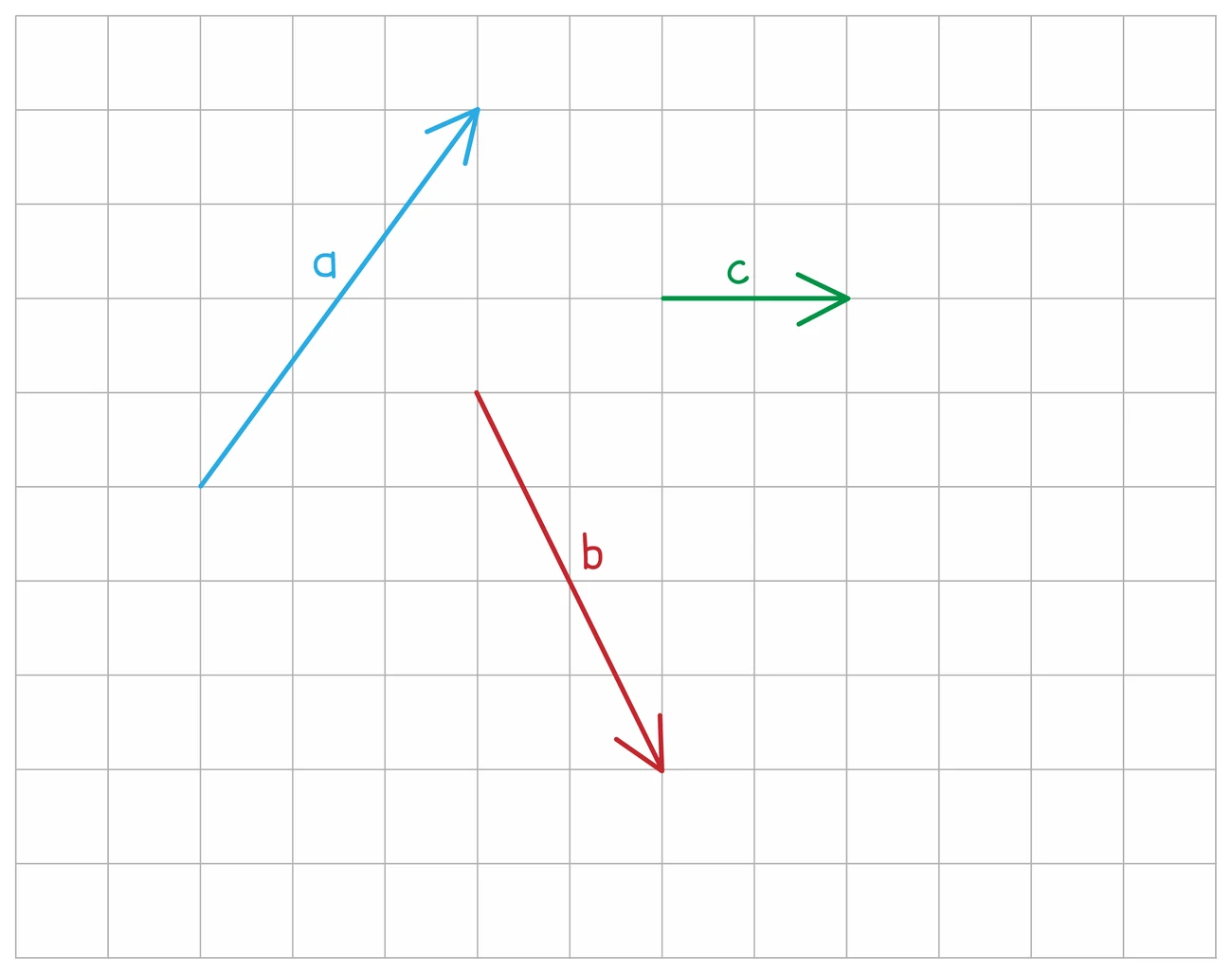
- On a grid a vector is drawn as a line of the right length with an arrow showing which way it points
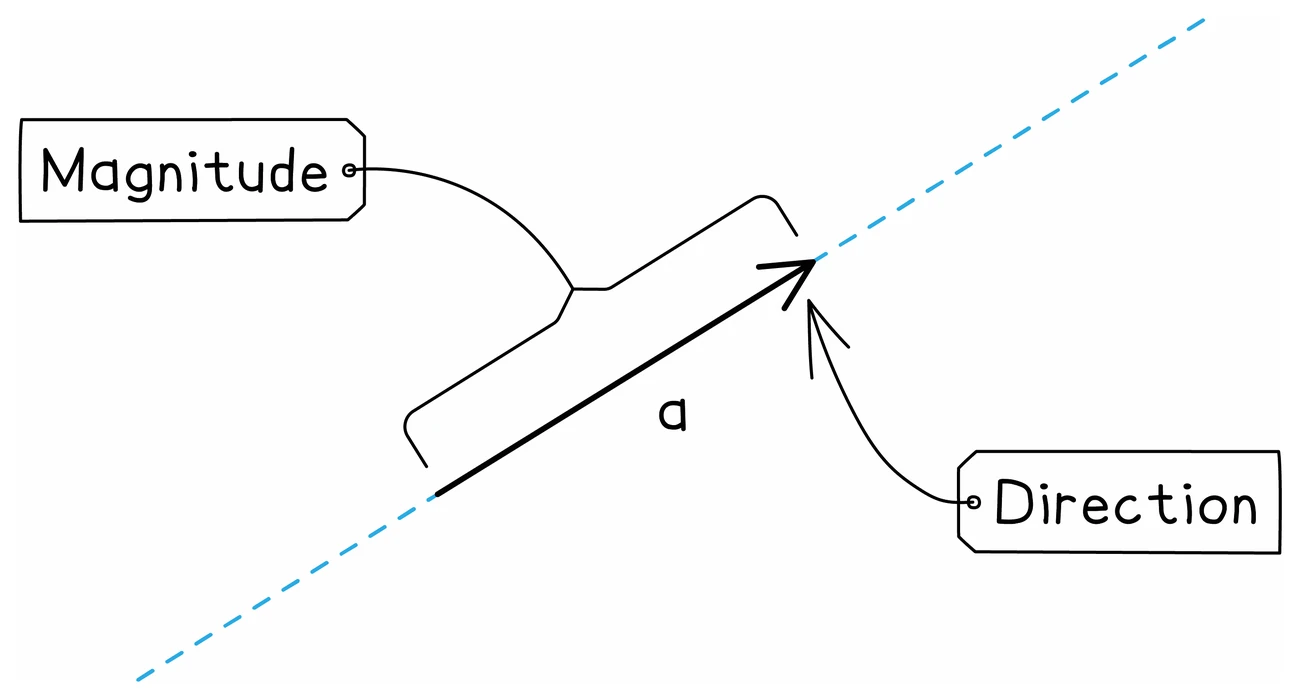
- The same vector can be drawn anywhere on the grid: only its length and direction matter, not where it starts
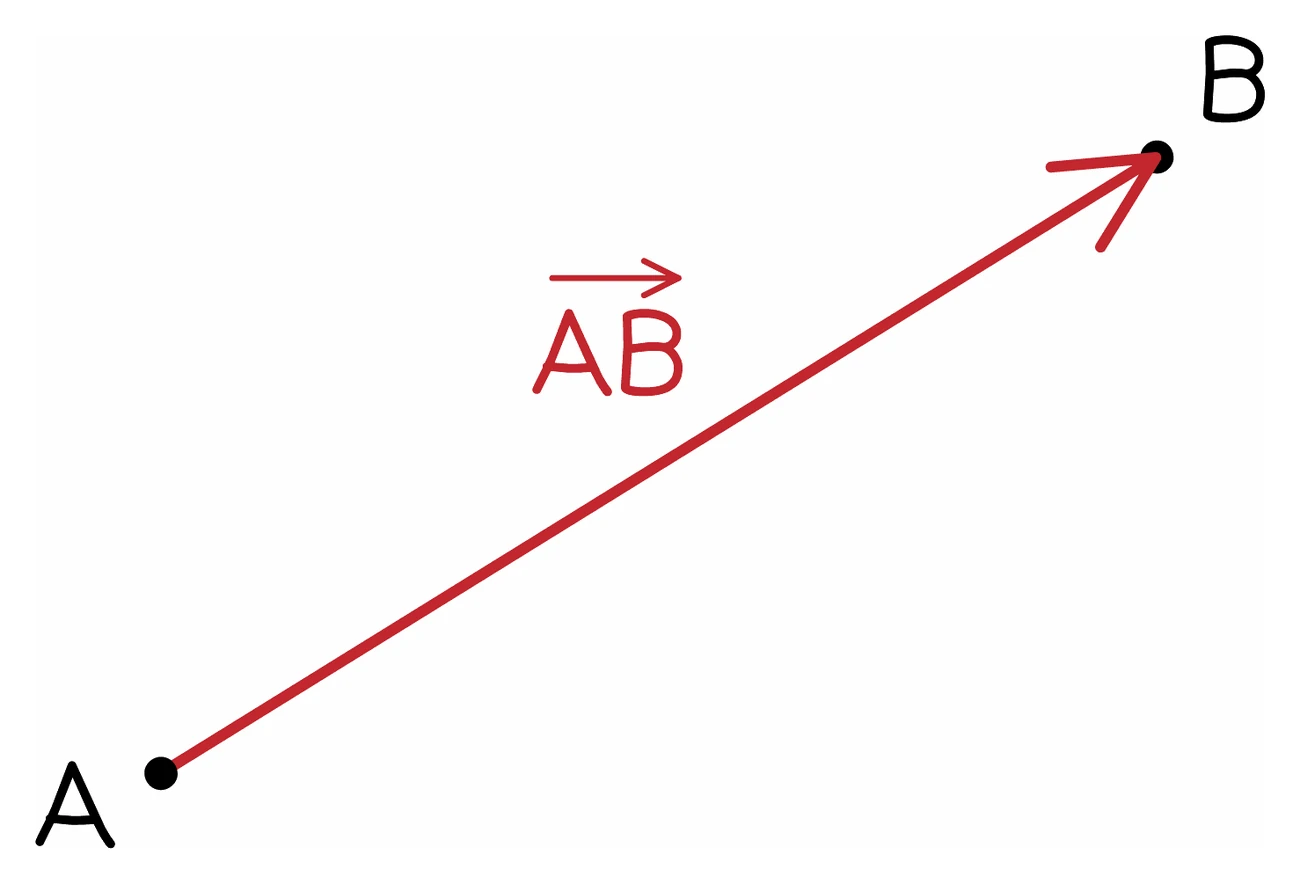
- Starting at A and finishing at B gives the vector written AB with an arrow above it; going back the other way gives BA, the same length reversed, so BA = −AB
- Printed vectors are bold, and handwritten ones are underlined, though mark schemes do not penalise a missing underline
Column vectors
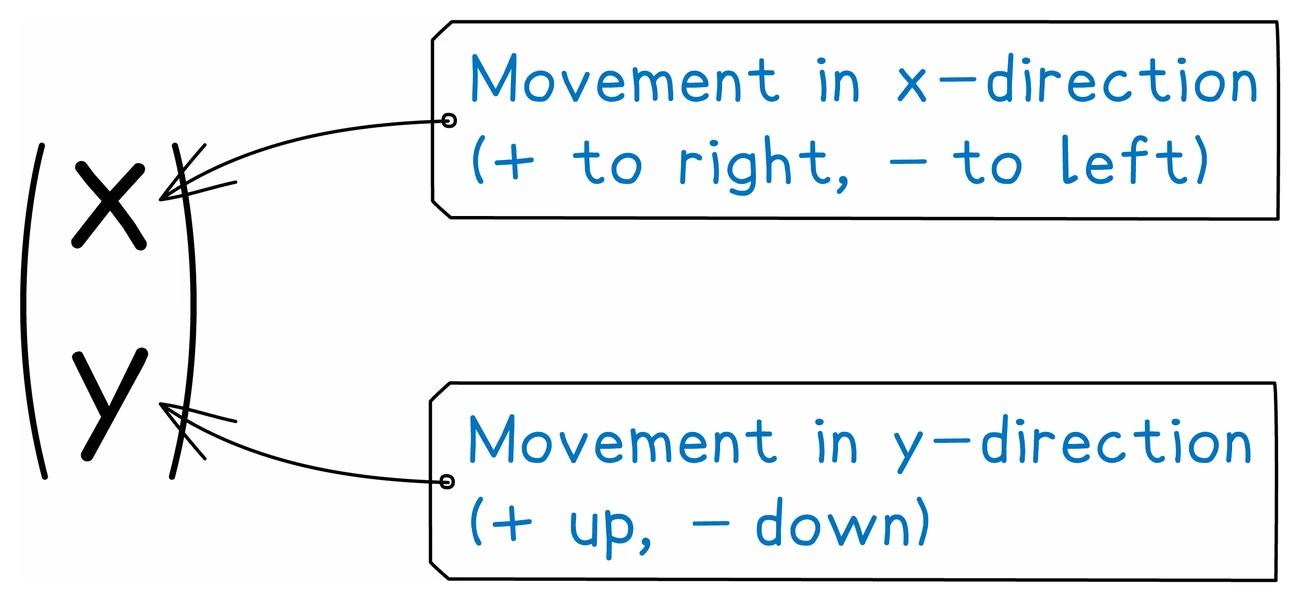
- A column vector stacks the horizontal movement above the vertical one
- The top number is positive for right and negative for left; the bottom number is positive for up and negative for down
- Add or subtract two column vectors by working on the top numbers and the bottom numbers separately
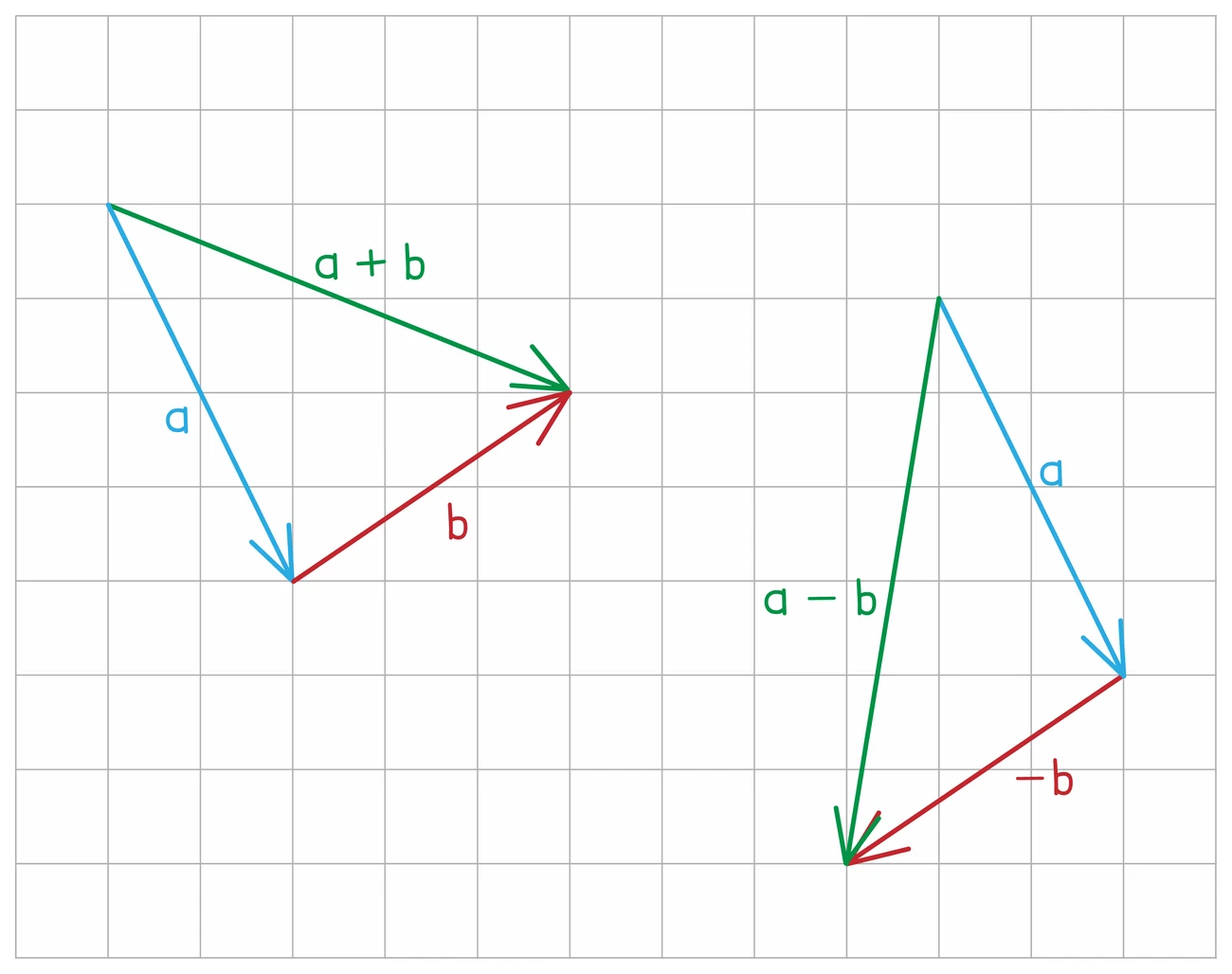
- Multiplying by a scalar multiplies both numbers
- With a = (3, −2) and b = (−1, 5) written as columns, a + b = (2, 3) and a − b = (4, −7)
- 3a = (9, −6), and 2a + 3b = (6, −4) + (−3, 15) = (3, 11)
- Follow the order of operations: multiply each vector by its scalar first, then add or subtract
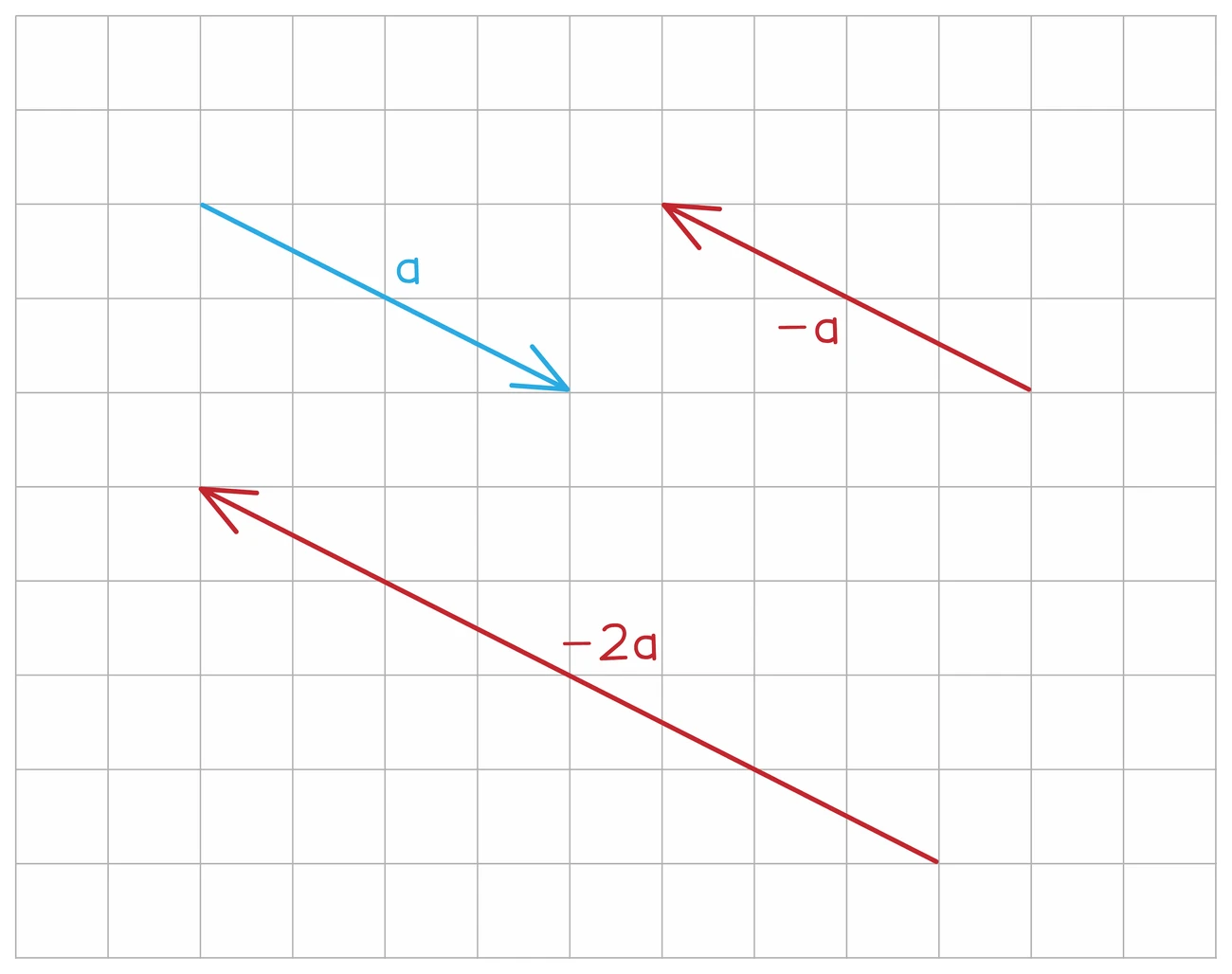
- Multiplying by a positive scalar keeps the direction and changes the length; a negative scalar reverses the direction as well
Worked example
Adding and scaling column vectors
a = (3, −1) and b = (−2, 4), both written as column vectors. Work out a + b and 2a − b.
Solution:
- Add or subtract the top numbers together and the bottom numbers together, separately
- a + b: top 3 + (−2) = 1, bottom −1 + 4 = 3
- a + b = (1, 3)
- For 2a, multiply both parts of a by 2: top 6, bottom −2
- Then subtract b from that: top 6 − (−2) = 8, bottom −2 − 4 = −6
- 2a − b = (8, −6)
- A scalar multiplies every part: doubling only the top number would give 2a = (6, −1), which is wrong
2. Magnitude
The length of a vector
- The magnitude is the length of the vector, written with modulus bars as |a| or |AB|
- It is always positive, because a length cannot be negative, and the direction plays no part
- The two components form the short sides of a right-angled triangle with the vector as the hypotenuse, so Pythagoras gives the length
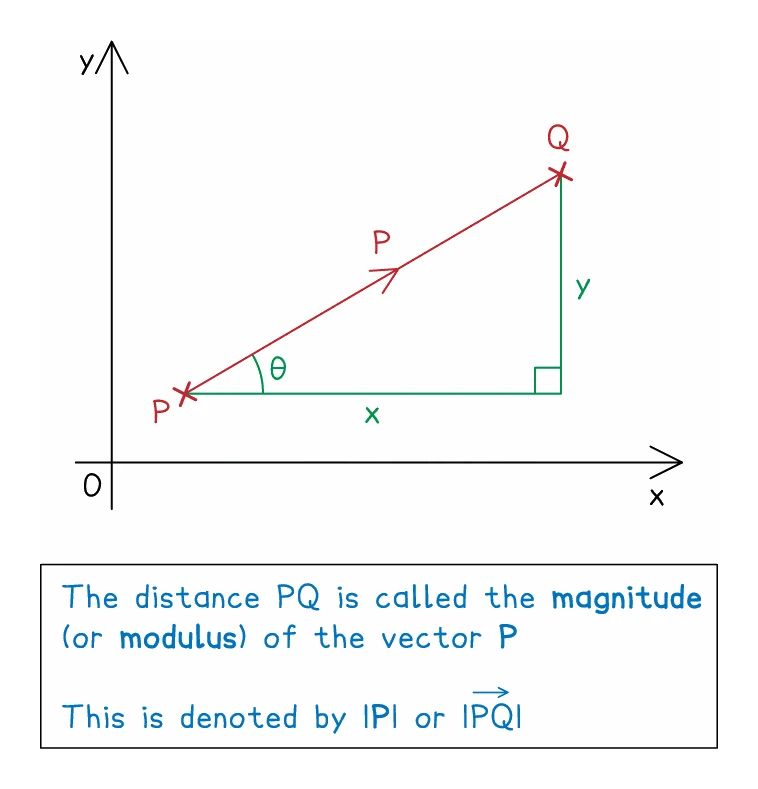
- For a column vector with components x and y, the magnitude is √(x² + y²)
- The magnitude of (8, −6) is √(64 + 36) = √100 = 10
- The magnitude of (5, 12) is √(25 + 144) = √169 = 13
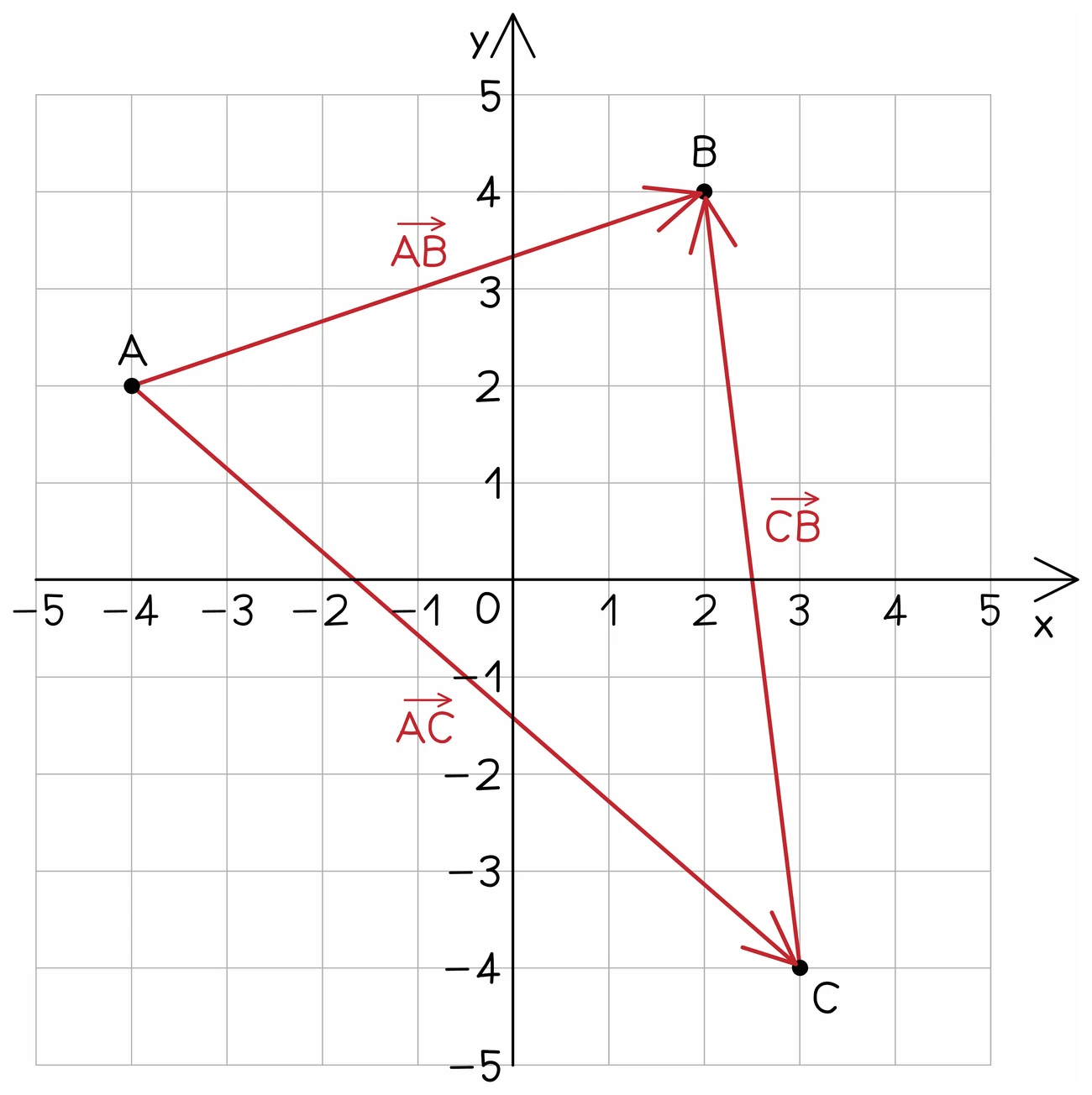
- Reading the components off a diagram works the same way: the vector AB below runs 10 across and 4 down, so |AB| = √(10² + 4²) = √116 = 2√29, which is 10.8 to 3 significant figures
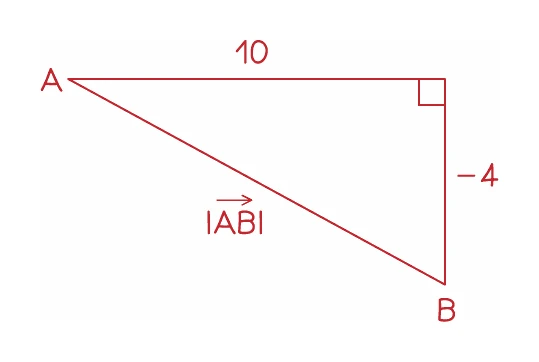
- Leave the answer as a simplified surd on the non-calculator paper, and wherever an exact value is asked for
Worked example
Column vectors and a magnitude
a = (3, −2) and b = (−1, 5), written as column vectors. Find 2a + 3b as a single column vector, and find the magnitude of a − b.
Solution:
- Deal with the scalars first: 2a = (6, −4) and 3b = (−3, 15)
- Add the tops and the bottoms separately: 6 + (−3) = 3 and −4 + 15 = 11
- So 2a + 3b = (3, 11)
- For the magnitude, first find a − b: 3 − (−1) = 4 and −2 − 5 = −7
- So a − b = (4, −7)
- The magnitude is √(4² + (−7)²) = √(16 + 49) = √65
- 65 = 5 × 13 has no square factor, so |a − b| = √65 is the exact answer: leave it like that on the non-calculator paper (it is 8.06 to 3 significant figures)
Worked example
A missing coordinate from a magnitude
P is the point (2, −1) and Q is the point (k, 5). The magnitude |PQ| is 3√5. Find the two possible values of k.
Solution:
- PQ = Q − P: top k − 2, bottom 5 − (−1) = 6, so PQ = (k − 2, 6) as a column vector
- Square the magnitude to remove the root: (3√5)² = 3² × 5 = 45
- Pythagoras on the components: (k − 2)² + 6² = 45
- So (k − 2)² = 45 − 36 = 9
- 9 has two square roots, 3 and −3, so k − 2 = 3 or k − 2 = −3
- k = 5 or k = −1
- Check: k = 5 gives (3, 6) and k = −1 gives (−3, 6), and both have magnitude √(9 + 36) = √45 = 3√5
3. Position vectors and vector paths
Position vectors
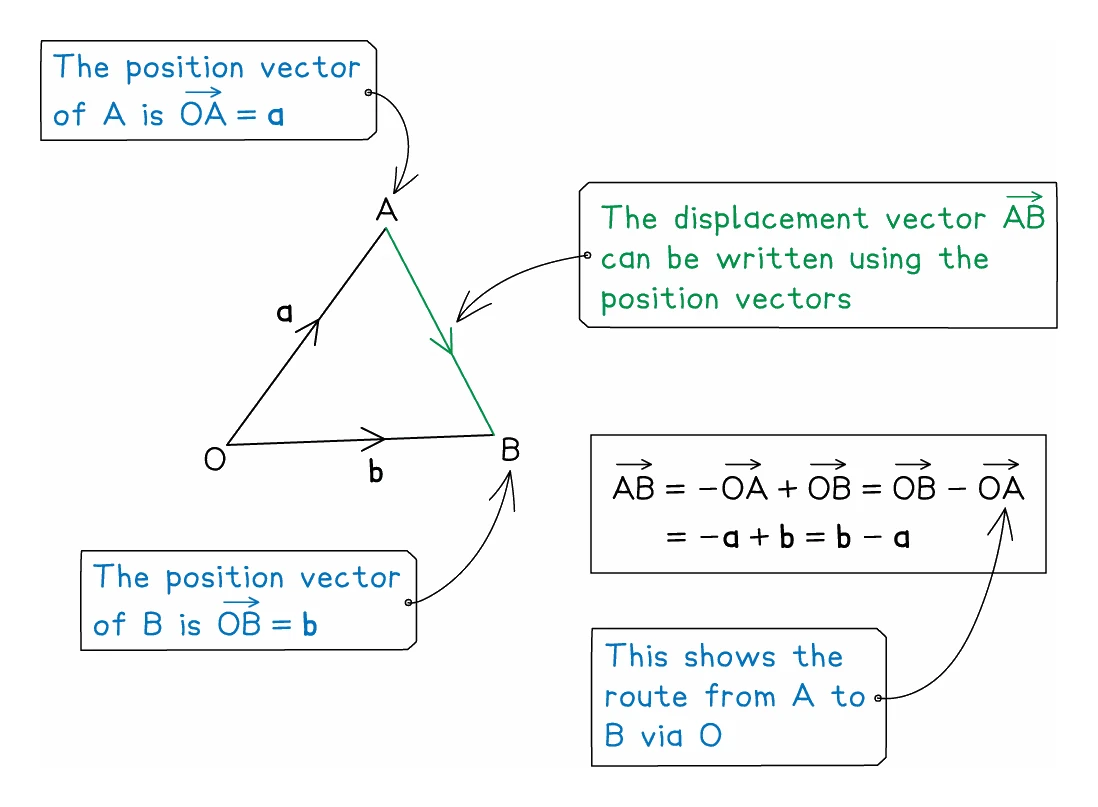
- A position vector gives the location of a point relative to the origin, so the position vector of A is OA
- A question asking for "the position vector of P" wants OP, so your route must start at O
- The vector between two points is found by going backwards to the origin and forwards again: AB = OB − OA
- Reading that as "end minus start" is the quickest way to remember it
Worked example
From coordinates to a column vector and back
A is the point (−3, 4) and B is the point (2, −1). Find the vector BA. Then find the coordinates of C, where BC = (−7, 3) written as a column vector.
Solution:
- BA goes from B to A, so take B's coordinates away from A's: end minus start
- Top: −3 − 2 = −5
- Bottom: 4 − (−1) = 5
- So BA = (−5, 5) as a column vector, 5 left and 5 up
- For C, start at B and add the movement BC
- x: 2 + (−7) = −5, and y: −1 + 3 = 2
- So C is the point (−5, 2), written as coordinates because the question asks for coordinates
Exam tip
The vector BA starts at B
A vector written the wrong way round, such as AB given when BA was asked for, has both signs flipped, and the schemes give it only one of the two marks, no more than an answer with just one number right. When a question names A and then B but asks for BA, sketch the move from B to A before you subtract, and check that your signs match it.
Finding a path
- Any vector across a diagram can be built by travelling along vectors you already know, in any route that works
- Travelling with an arrow adds that vector; travelling against it subtracts
- Different routes give different-looking expressions that simplify to the same thing, and mark schemes accept any correct path
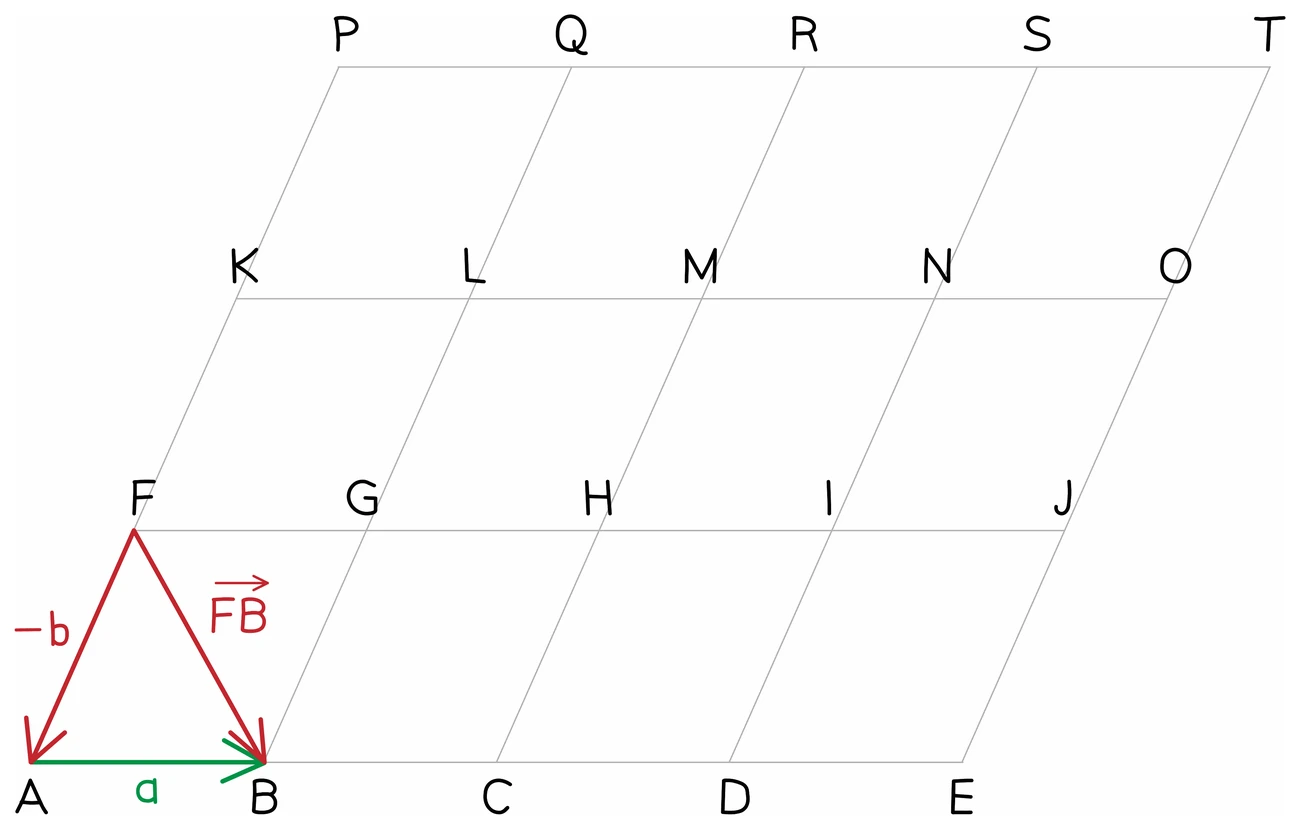
- Collect like terms at the end, because "give your answer in its simplest form" appears on almost every one of these questions
Exam tip
Write the route before you simplify
Questions asking for a vector in terms of two given vectors are set in 11 of the 21 papers. Write the route in letters first, such as OM = OA + AM: the schemes give a mark for a correct route along the lines of the diagram even if nothing else is right. A correct but unsimplified answer usually earns every mark except the last, which needs the like terms collected.
Worked example
A point dividing a line in a ratio
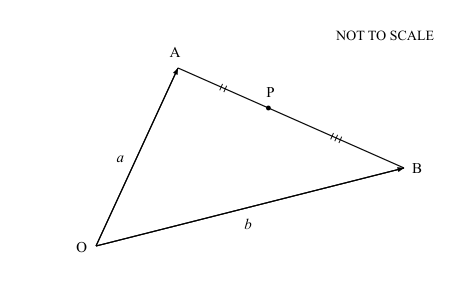
In triangle OAB, OA = a and OB = b. The point P lies on AB so that AP : PB = 2 : 3. Find OP in terms of a and b, simplified as far as possible.
Solution:
- Travel from O to P by going along OA and then part of AB
- First find the whole of AB: AB = OB − OA = b − a
- The ratio 2 : 3 splits AB into 5 equal parts, and P is 2 of them along from A
- So AP = ⅖(b − a)
- Now OP = OA + AP = a + ⅖(b − a)
- Expand: OP = a + ⅖b − ⅖a
- Collect the a terms: OP = ⅗a + ⅖b
- So OP = ⅗a + ⅖b
- Check: at the far end, O to B would give a + 1(b − a) = b, as it should
4. Proving things with vectors
Parallel vectors
- Two vectors are parallel exactly when one is a scalar multiple of the other, so b = ka for some number k
- To prove it for two expressions, factorise both and show the same bracket falls out of each
- 6a + 4b factorises to 2(3a + 2b), and 9a + 6b factorises to 3(3a + 2b)
- So 9a + 6b = 1.5(6a + 4b), which makes them parallel
- A negative k means parallel but pointing the opposite way
- Say explicitly that one is a multiple of the other, since that statement is what earns the mark
Collinear points
- Three points are collinear when they all lie on one straight line
- Show it by finding two vectors joining the points, showing they are parallel, and noting that they share a common point
- The shared point is essential: parallel alone only means the lines have the same direction, not that they are the same line
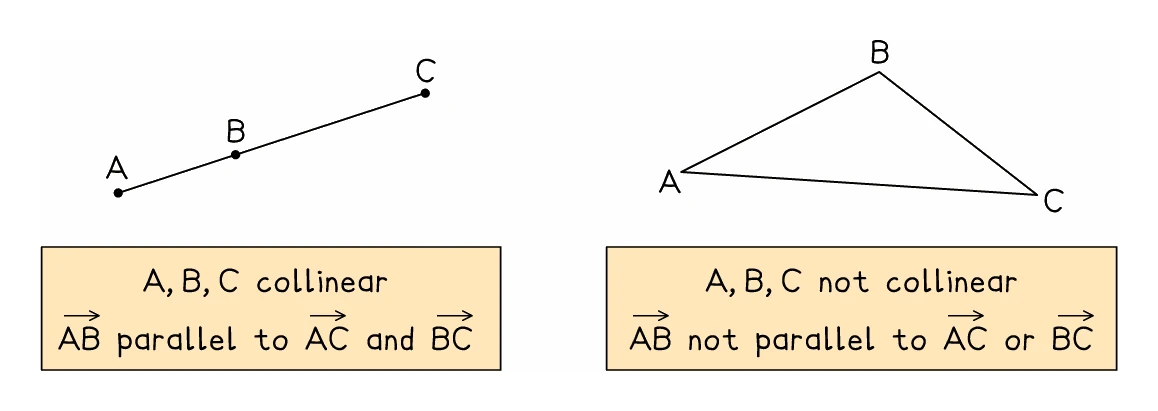
- The syllabus names showing vectors parallel, showing three points collinear, and ratio and similarity problems as the things to be able to do
Worked example
Showing two vectors are parallel
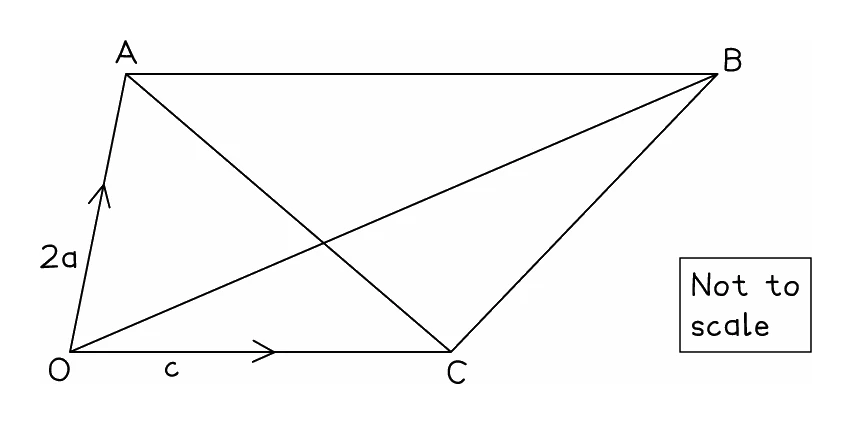
In a diagram, AB = 2a + 3b and CD = 4a + 6b. Show that AB and CD are parallel.
Solution:
- Two vectors are parallel exactly when one is a scalar multiple of the other
- Look for a common factor in CD
- 4a + 6b = 2(2a + 3b)
- The bracket is AB, so CD = 2 × AB
- CD is a scalar multiple of AB, therefore AB and CD are parallel
- Saying only that "the letters are the same" is not a proof: the statement that must appear is that one vector is a multiple of the other
- If the two also shared a point, that same working would prove the points collinear: parallel plus a common point is what collinear needs
Worked example
Where two lines meet, from a parallel side
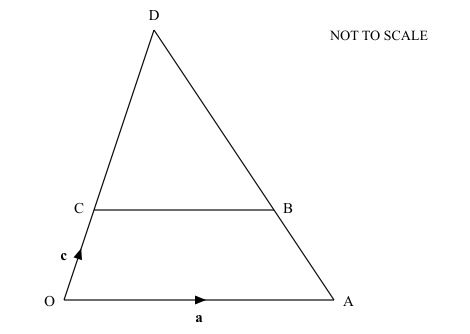
O is the origin, OA = a and OC = c. B is the point with CB = ⅔a, so CB is parallel to OA. The lines OC and AB are extended to meet at D. Find the position vector of D, and the vector BD, in terms of a and c.
Solution:
- CB is parallel to OA, so triangles DCB and DOA are similar: they share the angle at D, and the parallel sides make their other angles equal
- The scale factor from triangle DOA to triangle DCB is CB ÷ OA = ⅔, so DC is ⅔ of DO
- That leaves OC as ⅓ of OD, so OD = 3 × OC
- The position vector of D is 3c
- Reach B from O through C: OB = OC + CB = c + ⅔a
- BD = OD − OB = 3c − (c + ⅔a)
- So BD = 2c − ⅔a
- Check: DB is ⅔ of DA, so BD should be ⅔ of AD; AD = 3c − a, and ⅔(3c − a) = 2c − ⅔a, which matches