Sine Rule, Cosine Rule and Area of Triangles
Mathematics revision notes · Cambridge (CIE) · 0580
1. Labelling and choosing a rule
The labelling convention
- These three rules work in any triangle, not just right-angled ones, which is what makes them different from Pythagoras and SOHCAHTOA
- All three are printed in the List of formulas, so none has to be memorised, but each must be labelled correctly before it can be used
- Capital letters mark the angles and the matching small letter marks the side opposite that angle
- Side a lies opposite angle A, side b opposite angle B, and side c opposite angle C
- Relabel the triangle in the question to match, rather than trying to fit the formula to whatever letters the diagram already uses
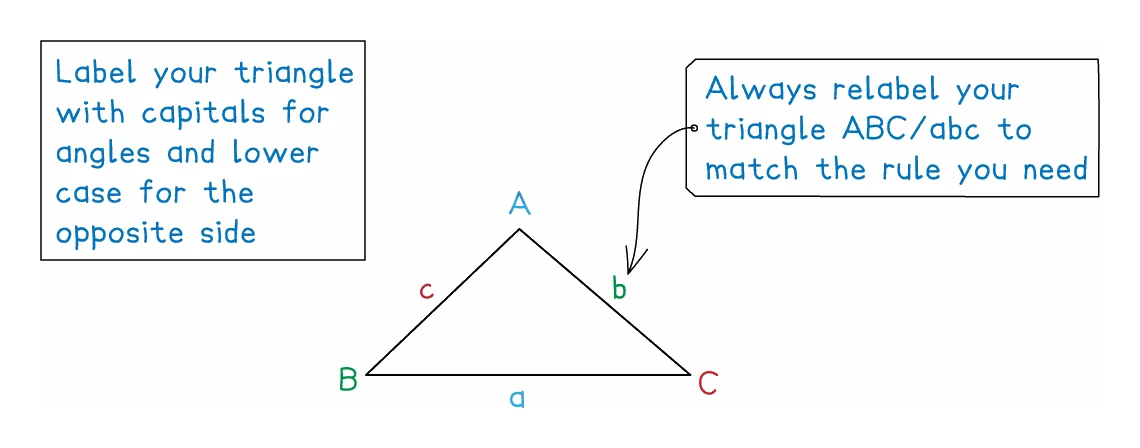
- Getting a side paired with the wrong angle is the commonest cause of a wrong answer here
Which rule
- Choose the rule from what you already know and what you are being asked for
| Rule | Use it when |
|---|---|
| Sine rule | a side and the angle facing it are both known, and you want the partner of another such pair |
| Cosine rule | two sides and their included angle are known, and the third side is wanted |
| Cosine rule | all three sides are known, and any angle is wanted |
| Area formula | two sides and their included angle are known, and the area is wanted |
-
The included angle means the one wedged between the two sides, at the corner where they meet
-
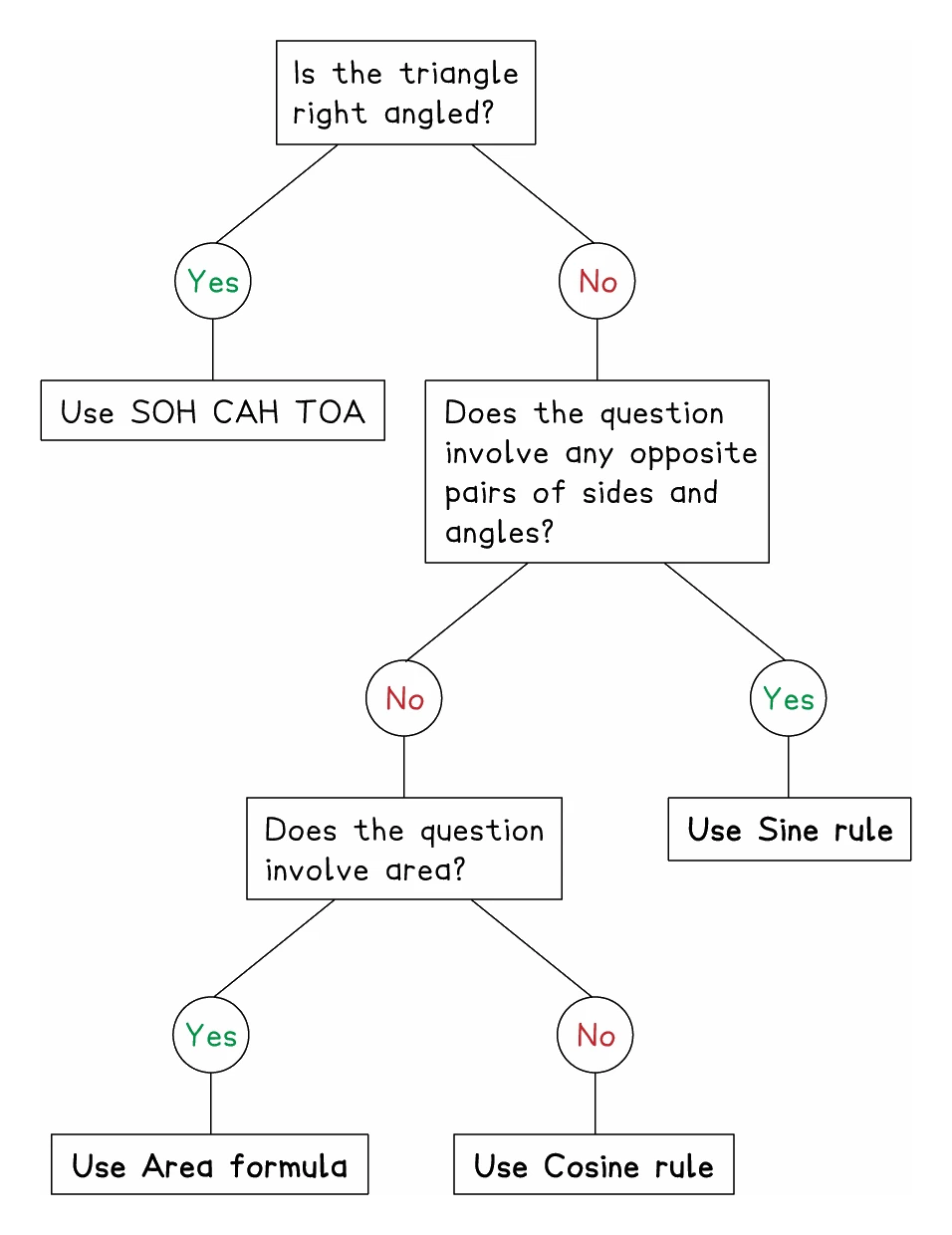
Quick test: spot a side sitting opposite a known angle and the sine rule applies; without such a pair, it is the cosine rule
-
A question worth many marks usually needs two rules in succession, often the cosine rule then the sine rule
-
Angles in a triangle add to 180°, which frequently supplies the missing angle without any rule at all
-
Papers never name the rules in the question, so recognising which applies is part of what is being tested
Worked example
Deciding which rule fits
For each triangle, say which rule you would use. (a) Angle A = 40°, side a = 9 cm, angle B = 65°. (b) Sides b = 7 cm and c = 10 cm with angle A = 55° between them. (c) All three sides known, angle B wanted.
Solution:
- The deciding question is always the same: is a side known together with the angle opposite it?
- (a) Side a and angle A are a matching pair, and angle B is known, so the sine rule finds side b
- (b) The angle given lies between the two known sides, so no side has its opposite angle known
- That is the cosine rule, finding side a from b, c and angle A
- (c) Three sides and no angles, so again no matching pair: the cosine rule rearranged for cos B
- If (b) had asked for the area rather than a side, two sides and the angle between them is exactly ½ab sin C
- The papers never print the words "sine rule" or "cosine rule", so this choice is always yours to make
2. The sine rule
Finding a side
- The printed form is a ÷ sin A = b ÷ sin B = c ÷ sin C
- Only two of the three parts are needed, so pick the pair that contains your unknown and the pair you know completely
- Substitute, then multiply across to make the unknown side the subject
Worked example
A side by the sine rule
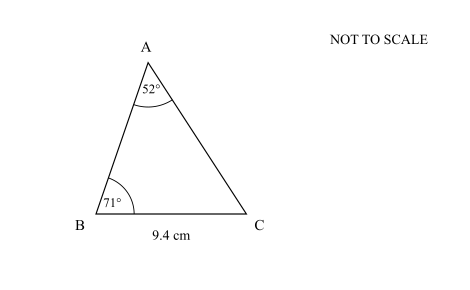
In triangle ABC, angle A = 52°, angle B = 71° and side a = 9.4 cm. Find side b, correct to 3 significant figures.
Solution:
- Side a and angle A are an opposite pair, and side b faces angle B, so use the sine rule
- b ÷ sin 71° = 9.4 ÷ sin 52°
- Multiply both sides by sin 71°: b = 9.4 × sin 71° ÷ sin 52°
- b = 11.27887…
- So b = 11.3 cm to 3 significant figures
- Check: b faces the larger angle, so it should be the longer side, and it is
Finding an angle
- Inverting all three fractions moves the angles into the numerators, giving sin A ÷ a = sin B ÷ b = sin C ÷ c
- That flipped version is not printed, but it follows from the printed one, so either form can be written down
- Substitute, make the sine of the unknown angle the subject, then apply the inverse sine
- Give angles correct to one decimal place, as the syllabus requires
The ambiguous case
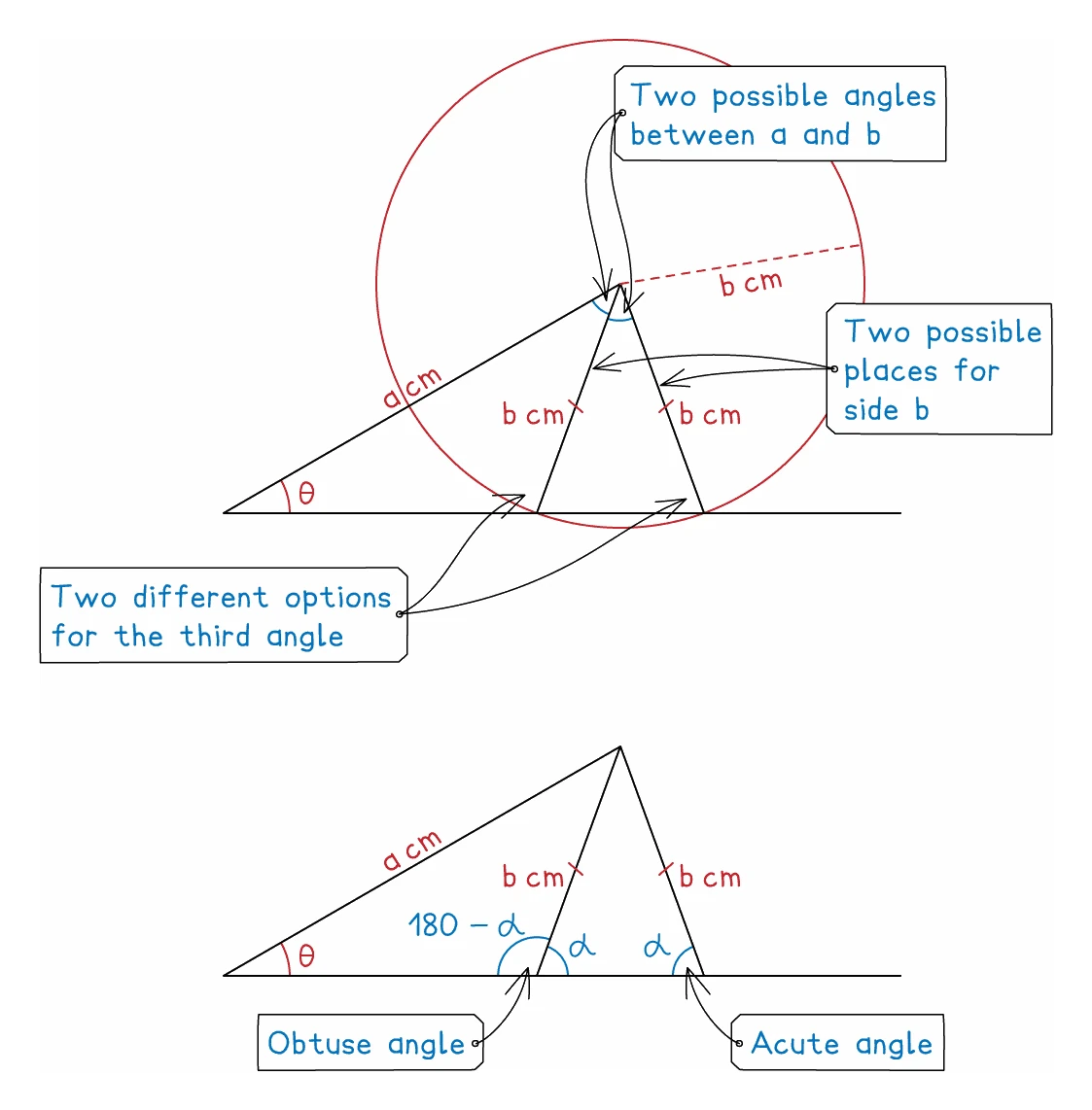
- Inverse sine on a calculator only ever returns the acute answer, but an obtuse angle can have the same sine
- Whenever the sine rule is used to find an angle, there is a second candidate: 180° minus the acute answer
- The syllabus names this the ambiguous case and includes it explicitly, along with obtuse angles generally
- The obtuse candidate is possible only if it and the angle you already know add up to less than 180°; when both are possible, the diagram or the wording decides
- This never happens with the cosine rule, which returns the obtuse angle directly
Worked example
An angle, with the ambiguous case
In triangle ABC, side a = 7.6 cm, side b = 5.2 cm and angle B = 34°. Find angle A.
Solution:
- Side b and angle B are an opposite pair, and angle A faces side a, so the sine rule applies, inverted to put the angles in the numerators
- sin A ÷ 7.6 = sin 34° ÷ 5.2
- Multiply both sides by 7.6: sin A = 7.6 × sin 34° ÷ 5.2
- sin A = 0.8172…
- The calculator gives A = sin⁻¹(0.8172…) = 54.8136…, so A = 54.8° to 1 decimal place
- The obtuse alternative is 180 − 54.8136… = 125.2°, and both are consistent with the given information: the third angle C would be 91.2° or 20.8°
- Either can be correct here, so a real question settles it, with its diagram or by saying that the angle is obtuse
3. The cosine rule
Finding a side
- The printed form is a² = b² + c² − 2bc cos A
- Angle A must be the one between sides b and c, and side a must be the one facing it
- Substitute, work out the right-hand side, then square root
- Keep the subtraction intact: the whole 2bc cos A is subtracted, and where A is obtuse its cosine is negative, so the term is added in effect
Worked example
A side by the cosine rule
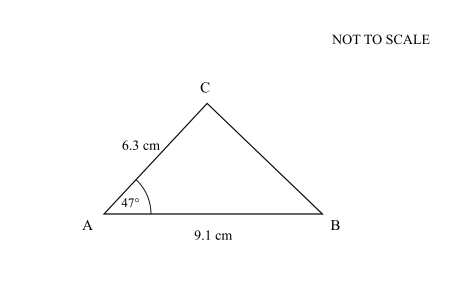
In triangle ABC, b = 6.3 cm, c = 9.1 cm and their included angle is A = 47°. Find side a, correct to 3 significant figures.
Solution:
- Two sides with their included angle, and the third side wanted, so the cosine rule applies
- a² = 6.3² + 9.1² − 2 × 6.3 × 9.1 × cos 47°
- a² = 39.69 + 82.81 − 114.66 × cos 47°
- a² = 122.5 − 78.1979… = 44.3020…
- a = √44.3020… = 6.6559…
- So a = 6.66 cm to 3 significant figures
Finding an angle
- With all three sides known, rearrange to cos A = (b² + c² − a²) ÷ 2bc
- That rearrangement is not printed, so either derive it or substitute into the printed form and solve
- Apply the inverse cosine at the end
- A negative value for cos A simply means the angle is obtuse, and the calculator returns it directly with no ambiguity
Worked example
An obtuse angle from three sides
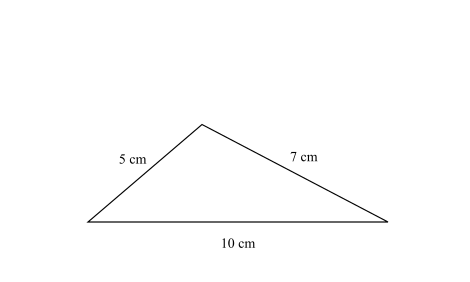
A triangle has sides 6 cm, 8 cm and 12 cm. Find the angle opposite the 12 cm side, correct to 1 decimal place.
Solution:
- All three sides are known, so use the cosine rule for an angle, with a = 12 as the side facing the unknown angle
- cos A = (6² + 8² − 12²) ÷ (2 × 6 × 8)
- cos A = (36 + 64 − 144) ÷ 96 = −44 ÷ 96 = −0.4583…
- The cosine is negative, so the angle is obtuse
- A = cos⁻¹(−0.4583…) = 117.2796…
- So A = 117.3° to 1 decimal place
4. Area of a triangle
Two sides and their included angle
- The printed formula is Area = ½ab sin C
- Angle C must sit between the two sides a and b, and any pair of sides with their included angle will do
- Where that angle is not given, find it first with the sine or cosine rule
- If C happens to be 90°, sin 90° = 1 and the formula collapses to the familiar half base times height
- Convert all the lengths to the same unit before substituting, and give the area in the unit the question asks for
Worked example
Area from two sides and the included angle
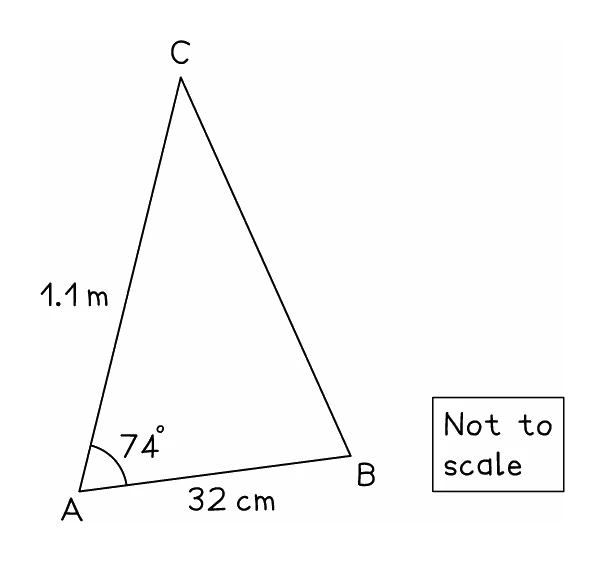
A triangle has sides of 8.5 cm and 6.2 cm with an angle of 63° between them. Find its area, correct to 3 significant figures.
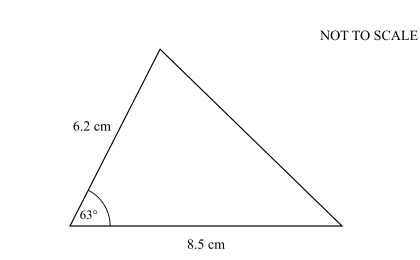
Solution:
- The angle lies between the two given sides, so the area formula applies directly
- Area = ½ × 8.5 × 6.2 × sin 63°
- Area = 26.35 × sin 63°
- Area = 23.4780…
- The area is 23.5 cm² to 3 significant figures
- On the non-calculator paper the angle has an exact sine instead: with 30° in place of 63°, sin 30° = ½ and the area is ½ × 8.5 × 6.2 × ½ = 13.175 cm²
Exam tip
Carry your earlier answers into the next part
Long questions on these rules often chain their parts: a length or angle you calculate in one part is needed in a later one, for another rule or for an area. The method marks that use it are given for your own answer, even a wrong one, so substitute it and keep going rather than leave the part blank.
Worked example
The area of a quadrilateral in two triangles
In quadrilateral PQRS the diagonal PR is drawn. PQ = 7.8 cm, QR = 5.4 cm, PS = 11.6 cm, angle PQR = 118° and angle RPS = 49°. Find the length of PR and the area of PQRS, each correct to 3 significant figures.
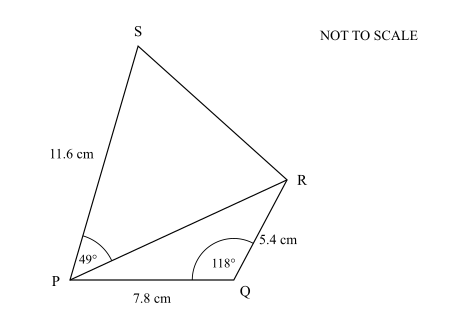
Solution:
- The diagonal splits PQRS into two triangles, PQR and PRS
- In triangle PQR the angle Q lies between PQ and QR, so the cosine rule gives PR
- PR² = 7.8² + 5.4² − 2 × 7.8 × 5.4 × cos 118°
- PR² = 60.84 + 29.16 − 84.24 × cos 118° = 90 + 39.5482… = 129.5482…
- The angle is obtuse, so cos 118° is negative and subtracting 84.24 × cos 118° adds 39.5482…
- PR = √129.5482… = 11.3819…, so PR = 11.4 cm to 3 significant figures
- Triangle PQR: area = ½ × 7.8 × 5.4 × sin 118° = 18.5948… cm²
- Triangle PRS: angle RPS lies between PR and PS, so area = ½ × 11.3819… × 11.6 × sin 49° = 49.8222… cm²
- Area of PQRS = 18.5948… + 49.8222… = 68.4171…, so the area is 68.4 cm² to 3 significant figures
- Use the unrounded PR in the second triangle: with 11.4 the total comes to 68.496…, which rounds to 68.5 instead