1. Pythagoras' theorem
The relationship
- Pythagoras' theorem links the three sides of a right-angled triangle, and it works in no other triangle
- The longest side is the hypotenuse, and it is always the one opposite the right angle
- The theorem states a² + b² = c², in which c stands for the hypotenuse while a and b stand for the other two sides
- Whichever of those two you call a and whichever you call b makes no difference to the result
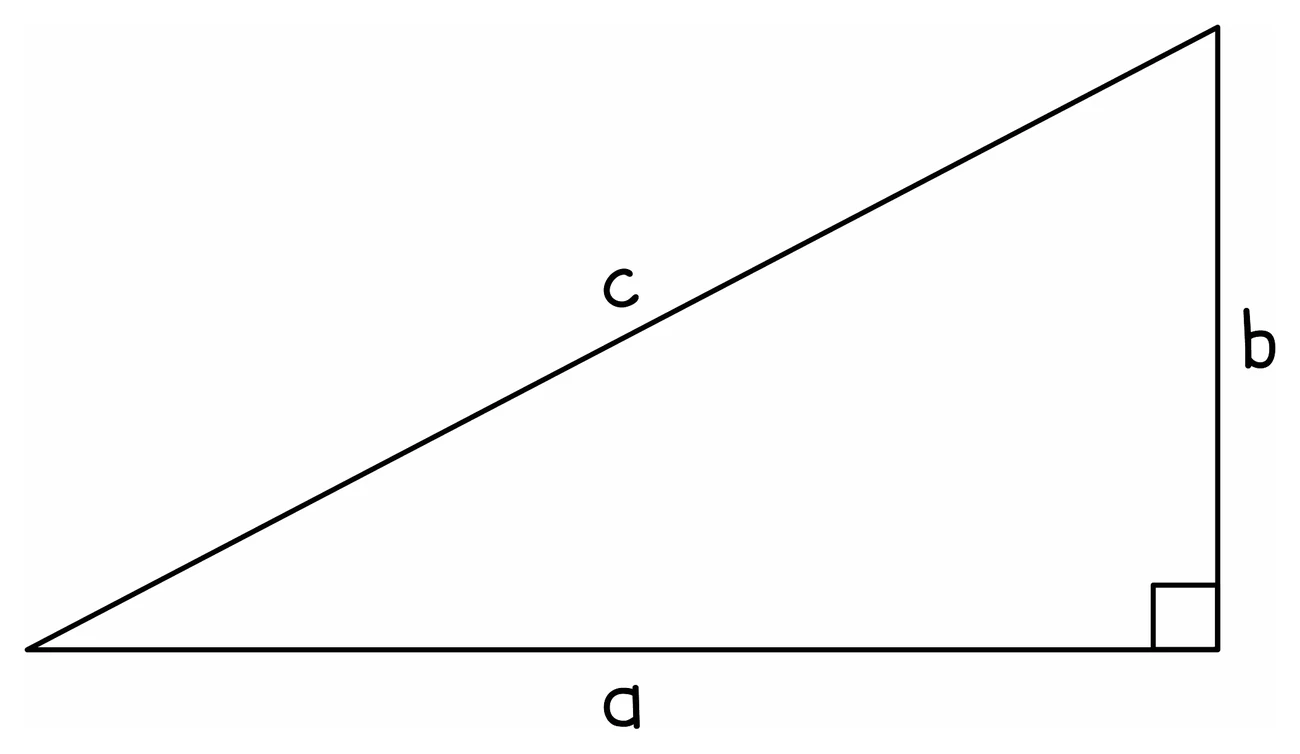
- Papers do not use the words "Pythagoras" or "hypotenuse" in the question: they simply give a right-angled triangle with two sides marked
Using it both ways
- To find the hypotenuse, square both shorter sides, add, then take the square root
- To find a shorter side, square the hypotenuse and the known shorter side, subtract, then take the square root
- Adding when you should subtract is the standard error, and the check is simple: the hypotenuse must come out as the longest side
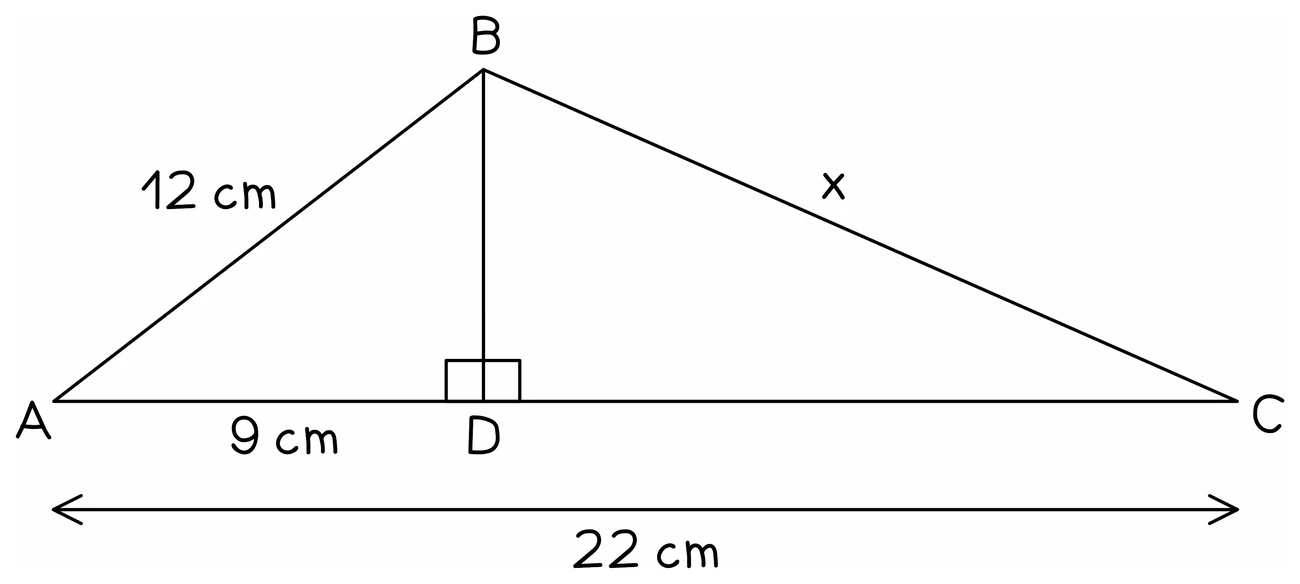
- Where an answer does not work out exactly, leave it as a surd if the question asks for an exact value, and otherwise round as instructed
- Cut a bigger figure into right-angled pieces and the theorem applies again, so dropping a perpendicular inside an isosceles triangle or a trapezium opens it up
Worked example
Both directions in one triangle
A right-angled triangle has shorter sides 9 cm and 12 cm. Find the hypotenuse. A second right-angled triangle has hypotenuse 25 cm and one shorter side 7 cm. Find the other shorter side.
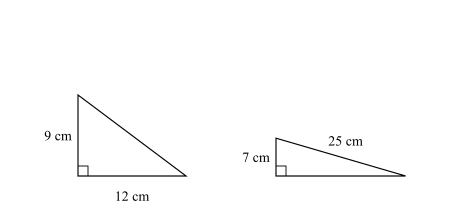
Solution:
- For the first, the unknown is the hypotenuse, so add
- c² = 9² + 12² = 81 + 144 = 225
- c = √225 = 15 cm
- For the second, the unknown is a shorter side, so subtract
- a² = 25² − 7² = 625 − 49 = 576
- a = √576 = 24 cm
- Check both: 15 is longer than 9 and 12, and 24 is shorter than 25
2. Sine, cosine and tangent
Labelling the triangle
- The three ratios connect an angle to two of the sides, and which sides they are depends on the angle chosen
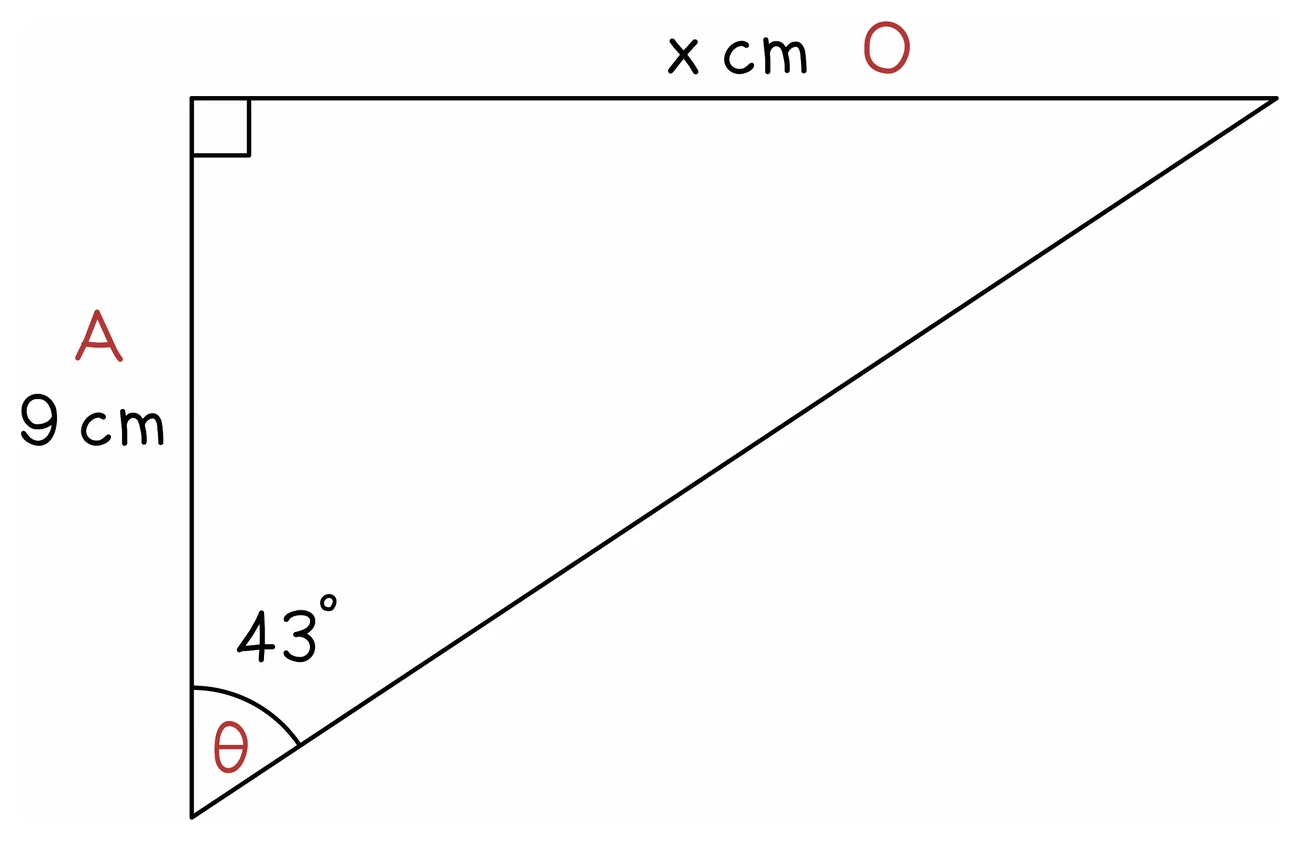
- Pick the angle in question, call it θ, then label the sides from its point of view
- H, the hypotenuse, opposite the right angle and always the longest
- O, the side opposite θ
- A, the side next to θ
- H never moves, but O and A swap over if a different angle is chosen, so relabel whenever the angle changes
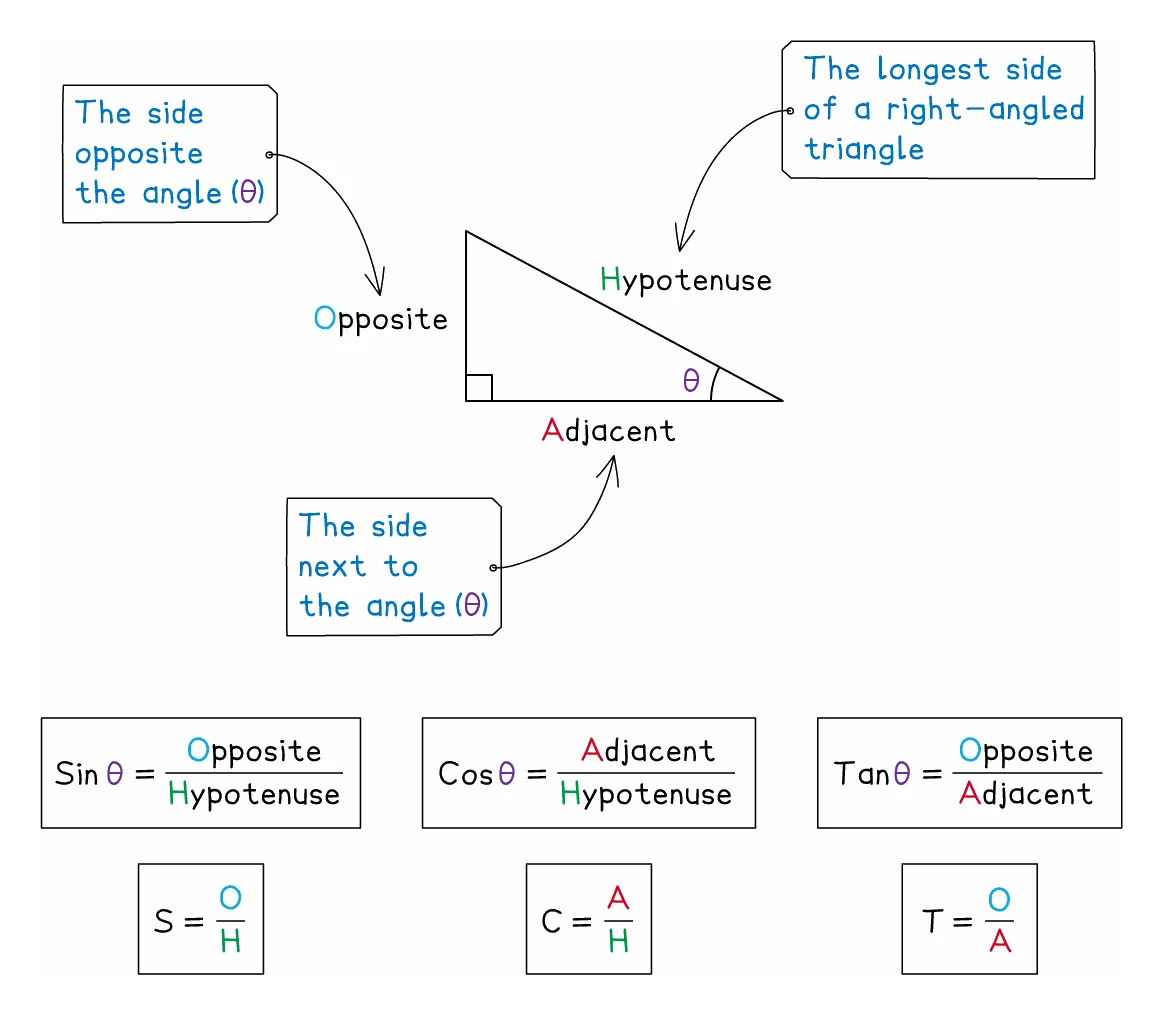
- SOHCAHTOA records the three ratios
- sin θ = O ÷ H
- cos θ = A ÷ H
- tan θ = O ÷ A
- Like Pythagoras, these work only in right-angled triangles
Finding a side
- Label the triangle, then note which letter belongs to the side you have and which to the side you are after
- Those two letters pick the ratio: A and H means cosine, O and A means tangent, and O and H means sine
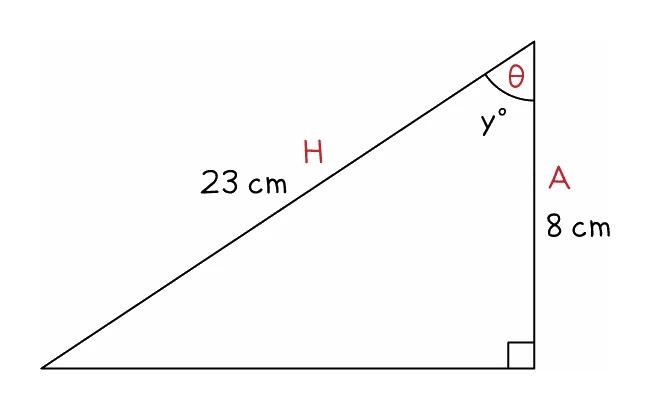
- Substitute, then rearrange to make the unknown the subject
- Round to three significant figures unless the question says otherwise
Worked example
Finding a side
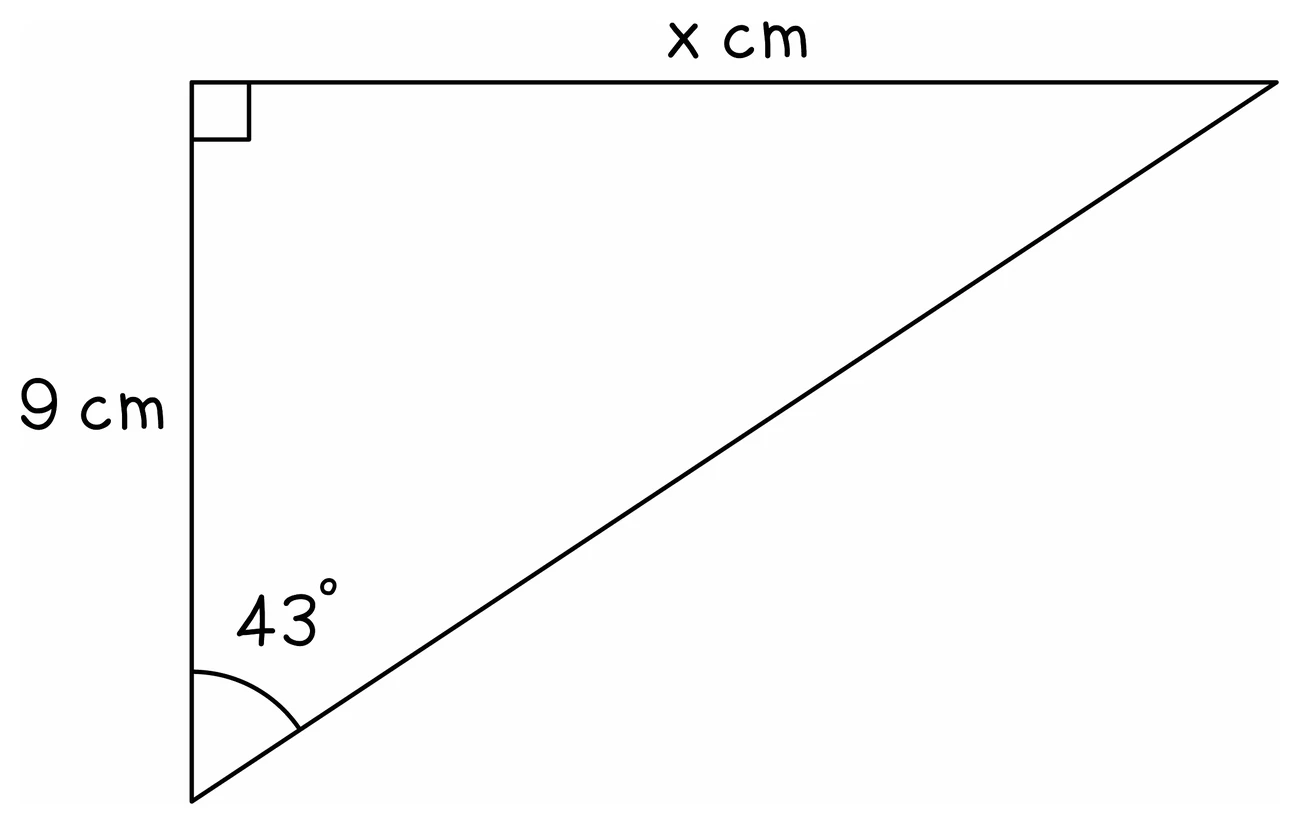
Find the length x in the triangle below, correct to 3 significant figures.
Solution:
- Label the sides from the 43° angle, not from the right angle
- The 9 cm side runs from the 43° angle to the right angle, so it is the adjacent
- x is across the triangle from the 43° angle, so it is the opposite
- Opposite and adjacent together means tangent
- tan 43° = x ÷ 9
- Multiply both sides by 9: x = 9 × tan 43°
- x = 8.3926… = 8.39 cm to 3 significant figures
- Write the substituted line, x = 9 tan 43°, before evaluating: that is the method mark
- The hypotenuse is not involved at all here, so it needs no label
Finding an angle
- Label the triangle and identify which two sides are known
- Write the ratio, which leaves the angle as the unknown
- Apply the inverse function, written sin⁻¹, cos⁻¹ or tan⁻¹, usually reached with the shift key
- The syllabus states that angle answers should be given correct to one decimal place, so use that unless told otherwise
- Check the calculator is in degrees before starting, since a wrong mode makes every answer wrong
Worked example
Finding an angle
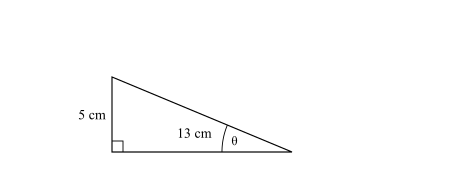
A right-angled triangle has hypotenuse 13 cm and the side opposite angle θ is 5 cm. Find θ, correct to 1 decimal place.
Solution:
- The known sides are O and H, which is SOH, so use sine
- sin θ = 5 ÷ 13
- Apply the inverse: θ = sin⁻¹(5 ÷ 13)
- θ = 22.61986…
- So θ = 22.6° to 1 decimal place
- Check: the third side is 12 by Pythagoras, and the smallest angle faces the shortest side
3. Applying it in context
Elevation and depression
- An angle of elevation is measured up from the horizontal to the line of sight, and an angle of depression is measured down from it
- Both are measured from the horizontal, never from the vertical, which is the usual misreading
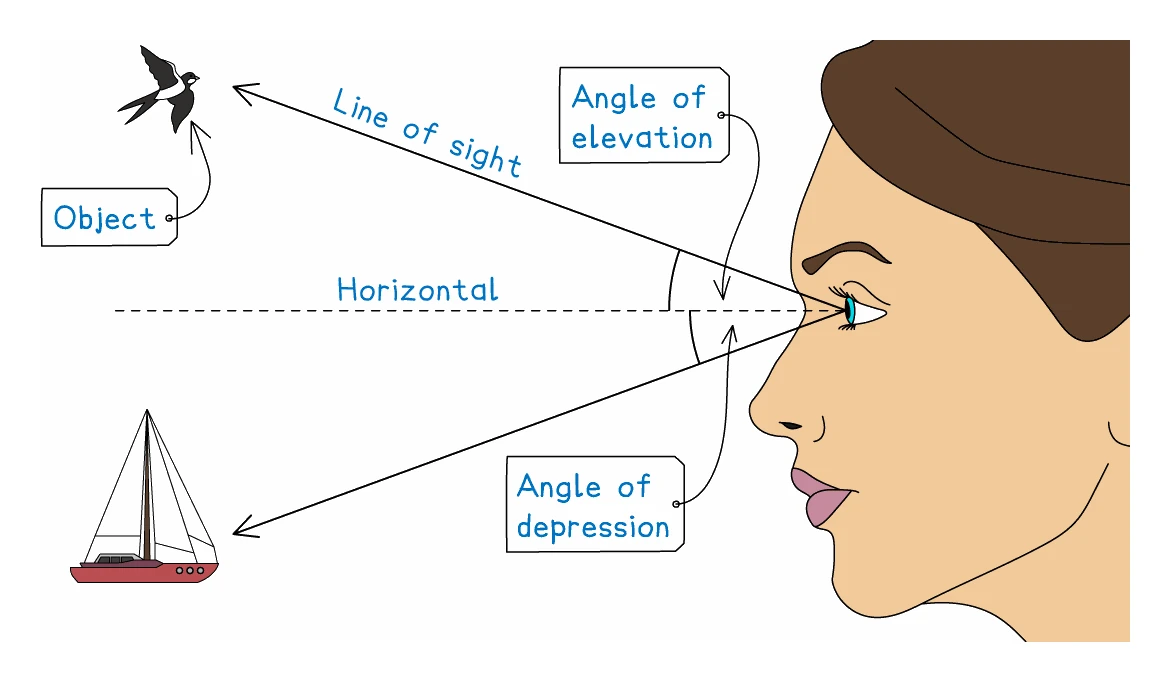
- Sketch the situation with the horizontal drawn in and the right angle marked, then apply SOHCAHTOA
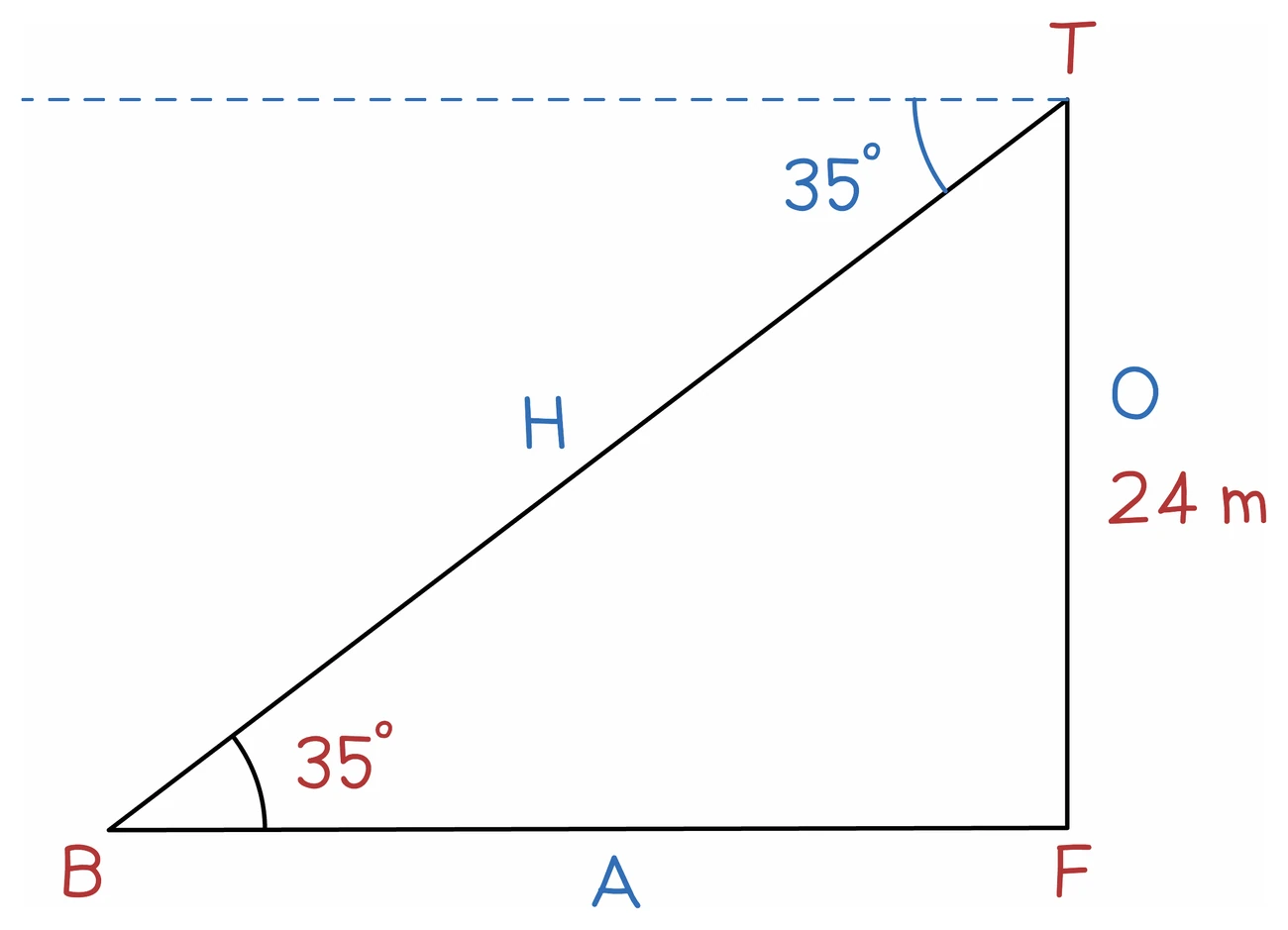
- Tangent appears most often, because these questions usually pair a height with a horizontal distance
Worked example
An angle of elevation
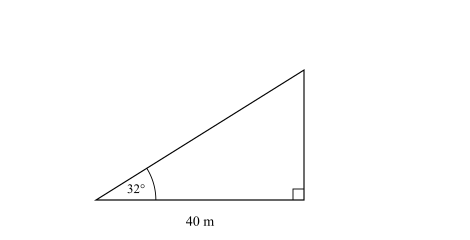
From a point 40 m from the base of a tower, the angle of elevation of the top is 32°. Find the height of the tower, correct to 1 decimal place.
Solution:
- The horizontal distance is adjacent to the 32° angle and the height is opposite it
- O and A means tangent
- tan 32° = height ÷ 40
- height = 40 × tan 32°
- height = 24.9947…
- The tower is 25.0 m tall to 1 decimal place
Worked example
An angle of depression between two masts
Two vertical masts stand on horizontal ground. Mast AB has its foot at B and is 37.5 m tall, and mast CD has its foot at D and is 9.5 m tall. B and D are 48 m apart. Find the angle of depression of C, the top of the shorter mast, from A, correct to 1 decimal place.
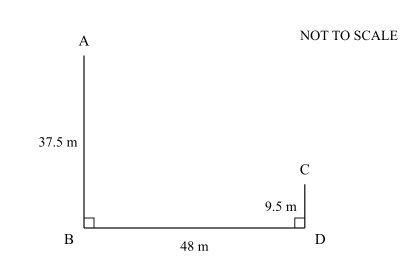
Solution:
- Draw a horizontal line from C across to AB, meeting it at E, so angle AEC = 90°
- EC is the gap between the masts, 48 m, and E is 9.5 m above the ground
- So AE is the difference in heights: 37.5 − 9.5 = 28 m
- The angle of depression of C from A equals angle ACE, the angle of elevation of A from C, because the horizontals through A and C are parallel
- From angle ACE, AE is opposite and EC is adjacent, so use tangent
- tan(ACE) = 28 ÷ 48
- Angle ACE = tan⁻¹(28 ÷ 48) = 30.256…
- The angle of depression is 30.3° to 1 decimal place
- Using the full height, tan⁻¹(37.5 ÷ 48) = 38.0°, gives the angle of depression of D, the foot of the shorter mast, instead
Shortest distance to a line
- The shortest distance from a point to a line is the perpendicular distance, measured at a right angle to the line
- The syllabus names this directly, and these papers ask for a "shortest distance" in 6 of the 21
- Drawing that perpendicular creates a right-angled triangle, which Pythagoras or SOHCAHTOA then solves
- The syllabus adds that knowledge of bearings may be required in two-dimensional problems like these, so a north line can appear on the same diagram
Exam tip
Draw the perpendicular before you calculate
Draw the perpendicular from the point to the line, and mark its right angle, before any calculation. The schemes give a method mark just for recognising that the shortest distance is this perpendicular, so it can score even if the working after it goes wrong. Where that recognition is shown only on the diagram, some schemes count it only if the right angle is marked.
Worked example
Shortest distance from a point to a line
In triangle FGH, FG = 14 cm, FH = 20 cm and angle GFH = 41°. Find the shortest distance from G to the line FH, correct to 3 significant figures.
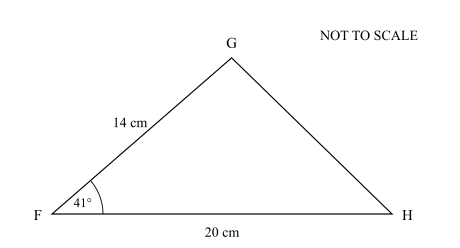
Solution:
- The shortest distance is the perpendicular from G to FH: call its foot N, so angle GNF = 90°
- In the right-angled triangle GNF, FG is the hypotenuse and GN is opposite the 41° angle
- O and H means sine: sin 41° = GN ÷ 14
- GN = 14 × sin 41° = 9.1848…
- The shortest distance is 9.18 cm to 3 significant figures
- FH = 20 cm is not needed for this route, but it gives a check through the area: ½ × 14 × 20 × sin 41° = 91.848… cm², and that area is also ½ × 20 × GN, so GN = 2 × 91.848… ÷ 20 = 9.18 cm
- When the area is what you know, rearranging area = ½ × base × distance in the same way finds the distance directly
4. Exact trigonometric values
The values to know
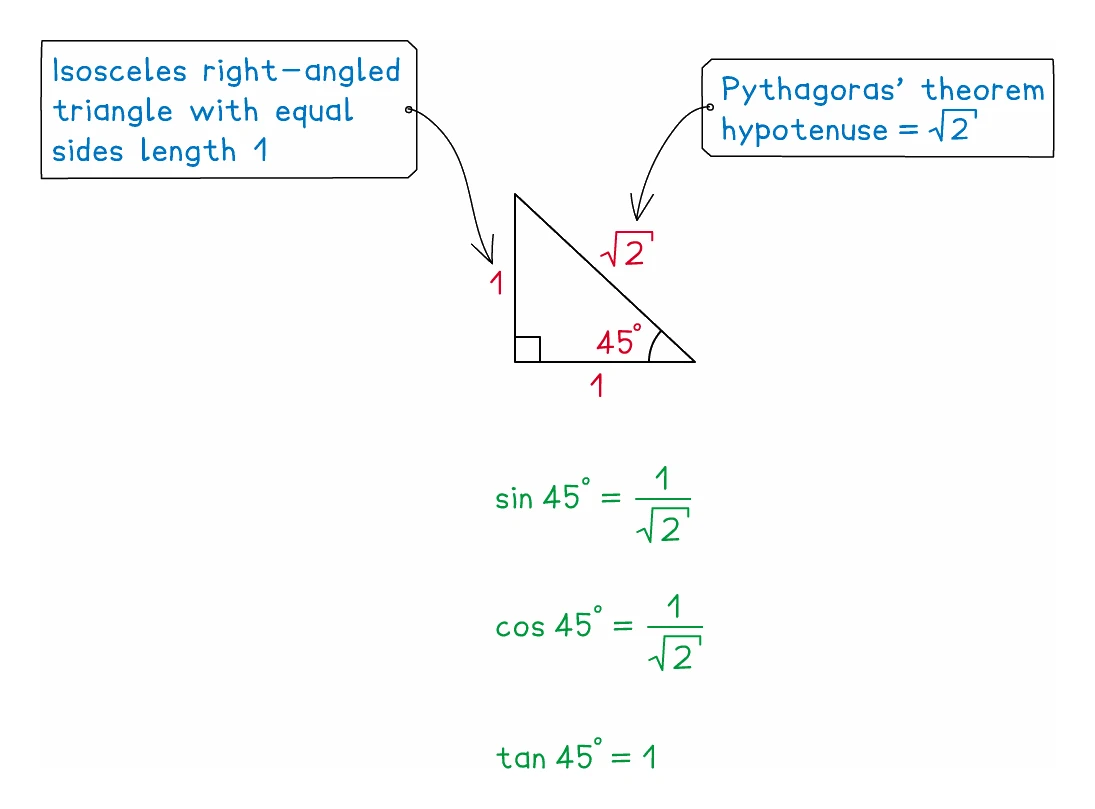
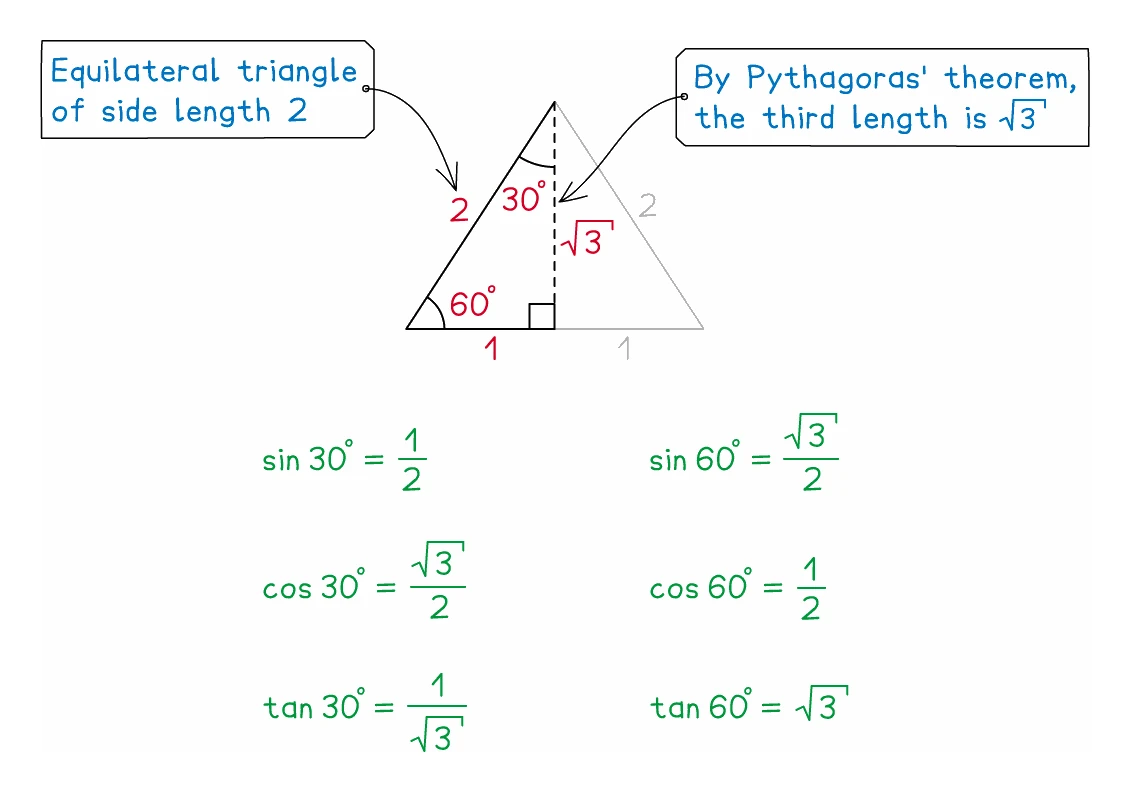
- For a handful of angles the ratios can be written exactly, as a fraction or a surd rather than a rounded decimal
| θ | 0° | 30° | 45° | 60° | 90° |
|---|---|---|---|---|---|
| sin θ | 0 | ½ | √2 ÷ 2 | √3 ÷ 2 | 1 |
| cos θ | 1 | √3 ÷ 2 | √2 ÷ 2 | ½ | 0 |
| tan θ | 0 | √3 ÷ 3 | 1 | √3 | — |
- The syllabus requires sine and cosine at 0°, 30°, 45°, 60° and 90°, and tangent at 0°, 30°, 45° and 60° only
- Tangent has no value at 90°, which is why the syllabus stops short of it there
- The sine row read forwards matches the cosine row read backwards, which halves what there is to remember
- √2 ÷ 2 is the same as 1 ÷ √2, and √3 ÷ 3 is the same as 1 ÷ √3, so either form is correct
- These come up whenever a question asks for an exact value, which rules out a rounded decimal
Worked example
Using the exact values
Without a calculator, find the exact value of sin 60° × cos 30°, and of tan 45° + sin 30°.
Solution:
- These come from the two triangles worth memorising, so no calculator is needed
- sin 60° = √3/2 and cos 30° = √3/2
- Multiplying: (√3/2) × (√3/2) = (√3 × √3) / (2 × 2)
- √3 × √3 = 3, so the answer is 3/4
- tan 45° = 1 and sin 30° = 1/2
- Adding: 1 + 1/2 = 3/2, or 1.5
- 3/4 = 0.75 and 3/2 = 1.5 exactly, so either form is exact here; a surd such as √3/2 has no exact decimal, so it has to stay as a surd
Exam tip
Write down the exact value you use
On the non-calculator paper, write the exact value you need on its own line, such as tan 30° = 1/√3, before you substitute it. The schemes give a mark for that correct value by itself, even when the rearranging that follows goes wrong. Write the one you use: some schemes refuse to credit a value that appears only in a table of them all, written out from memory.
Worked example
An exact length from an exact trig value
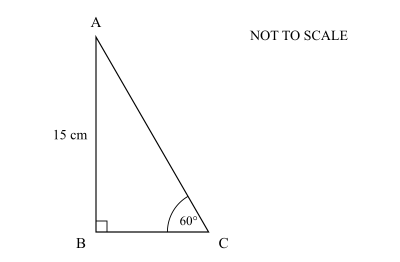
Triangle ABC has a right angle at B. Angle ACB = 60° and AB = 15 cm. Without a calculator, find the exact lengths of BC and AC, each in the form a√b.
Solution:
- From the 60° angle at C, AB is the opposite side, BC is the adjacent side and AC is the hypotenuse
- For BC, O and A means tangent, and tan 60° = √3
- √3 = 15 ÷ BC, so BC = 15 ÷ √3
- Multiply the top and the bottom by √3: BC = 15√3 ÷ 3 = 5√3 cm
- For AC, O and H means sine, and sin 60° = √3/2
- √3/2 = 15 ÷ AC, so AC = 15 ÷ (√3/2) = 30 ÷ √3
- Multiply the top and the bottom by √3: AC = 30√3 ÷ 3 = 10√3 cm
- Check with Pythagoras: (5√3)² + 15² = 75 + 225 = 300, and (10√3)² = 100 × 3 = 300