1. The gradient function
What differentiating produces
- A straight line has one gradient, but a curve is steeper in some places than others, so its gradient depends on where you are
- Differentiating turns the equation of a curve into a second equation that gives the gradient at any point
- That second equation is the gradient function, also called the derivative, and it is written dy/dx
- Substituting an x value into dy/dx returns the gradient of the curve there, and the y value is never needed
- Drawing a tangent and measuring it estimates the same number; differentiating gives it exactly
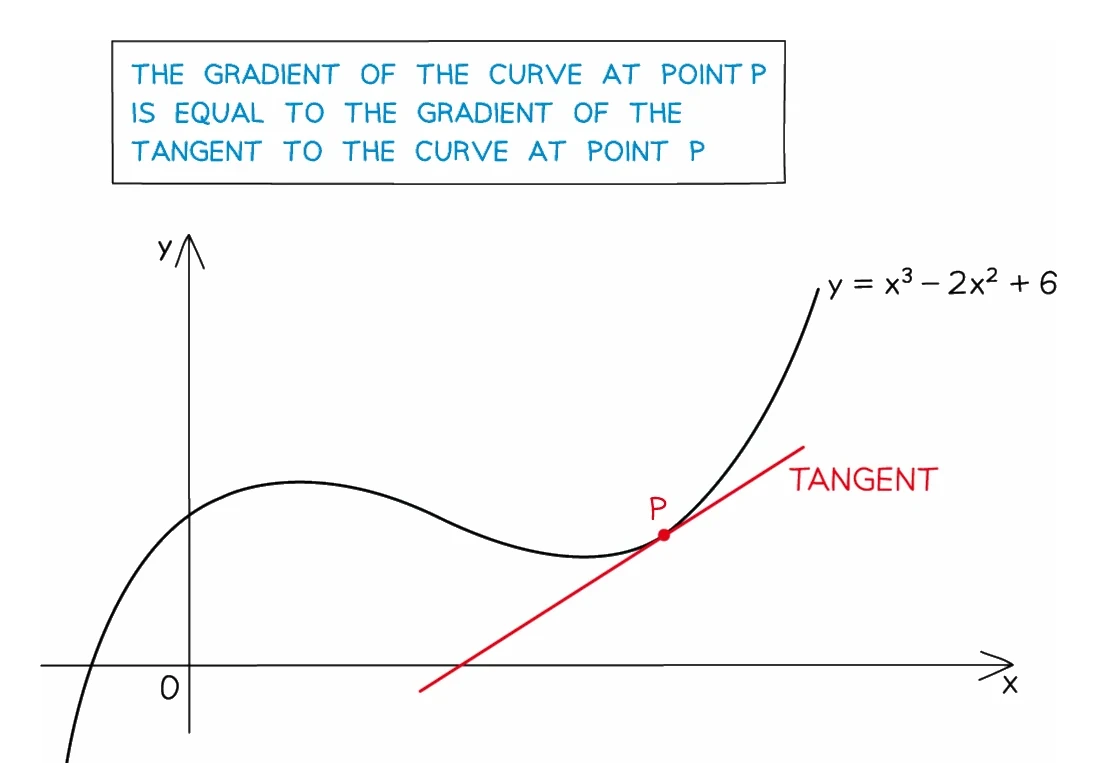
- Write "y =" in front of the curve and "dy/dx =" in front of the derivative every time, so the two never get confused
The rule
- Differentiating a power of x means multiplying by that power, then knocking one off it
- x⁶ differentiates to 6x⁵
- 3x⁴ differentiates to 12x³
- In general, kxⁿ differentiates to knxⁿ⁻¹
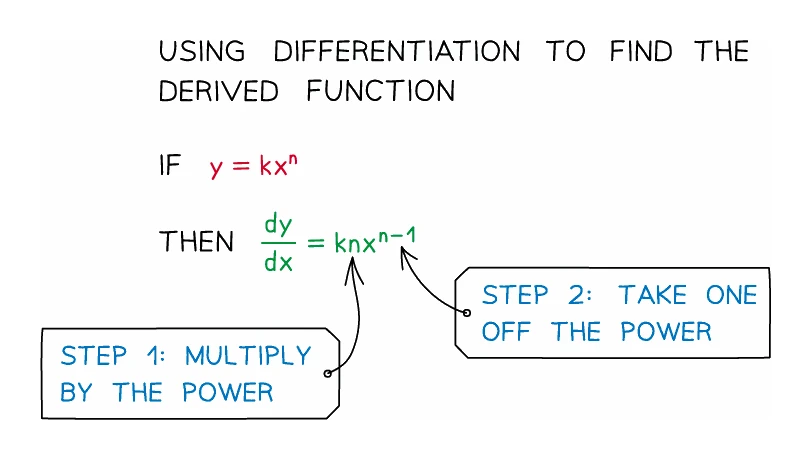
- Two cases look different but follow the same rule
- A term in x alone loses its x: 7x differentiates to 7, which matches the gradient of the line y = 7x
- A number on its own differentiates to 0, which matches the gradient of a horizontal line
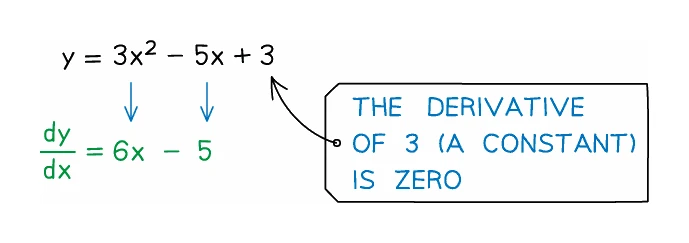
- Differentiate a sum term by term, taking each one separately and keeping the signs between them
- This specification only asks for powers of x that are positive whole numbers or zero, and for sums of at most three such terms
Worked example
Differentiating and using the result
A curve has equation y = 4x³ + 7x − 2. Find dy/dx, and hence the gradient of the curve where x = 2.
Solution:
- Differentiating turns the equation of a curve into its gradient function, which gives the gradient at any point rather than one fixed number
- The rule is to multiply by the power and then reduce the power by one, applied to each term separately
- 4x³: multiply by 3 and drop the power to 2, giving 12x²
- 7x is 7x¹: multiply by 1 and drop the power to 0, and x⁰ = 1, so it gives 7
- −2 is a constant with no x at all, so it differentiates to 0: a constant shifts the curve up or down without changing its steepness
- So dy/dx = 12x² + 7
- The gradient at a point comes from substituting that x into the derivative, not into the curve
- At x = 2: 12 × 2² + 7 = 48 + 7 = 55
Worked example
Finding unknown powers and coefficients
A curve has equation y = axⁿ + 4x³ − 9, and its gradient function is dy/dx = 35x⁶ + bx². Find the values of a, n and b.
Solution:
- Differentiate the curve term by term, keeping the letters: axⁿ gives naxⁿ⁻¹, 4x³ gives 12x², and −9 gives 0
- So dy/dx = naxⁿ⁻¹ + 12x², which must match 35x⁶ + bx² term by term
- Find the power first, because the number in front is a × n and cannot be split until n is known
- Powers: n − 1 = 6, so n = 7
- Numbers in front: na = 35, so 7a = 35 and a = 5
- The x² terms: b = 12
- a = 5, n = 7 and b = 12
- Check: y = 5x⁷ + 4x³ − 9 differentiates to 35x⁶ + 12x², as given
Working backwards from a gradient
- A question may give a gradient and ask where the curve has it
- Set dy/dx equal to that number and solve the equation, which is usually a quadratic
- Each solution is an x value, so put it back into the curve's own equation to obtain the matching y
- Take care to read which side the number sits on: making the derivative equal 5 is a different instruction from replacing x by 5
2. Turning points
Where the gradient is zero
- At the very top or the very bottom of a curve the tangent is horizontal, so the gradient there is zero
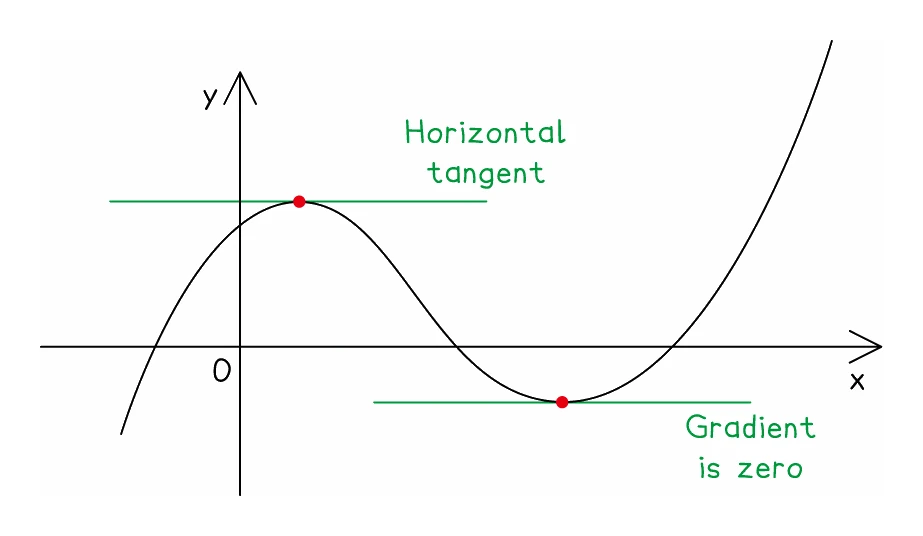
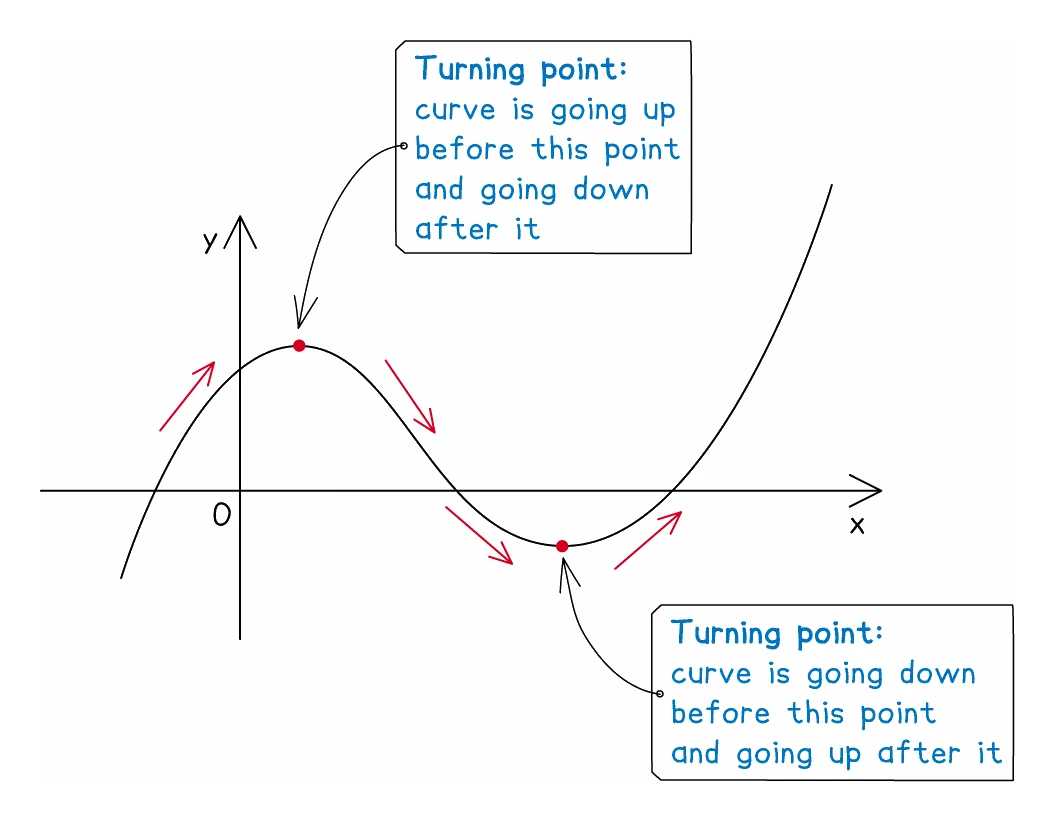
- Such a point is a turning point, also called a stationary point
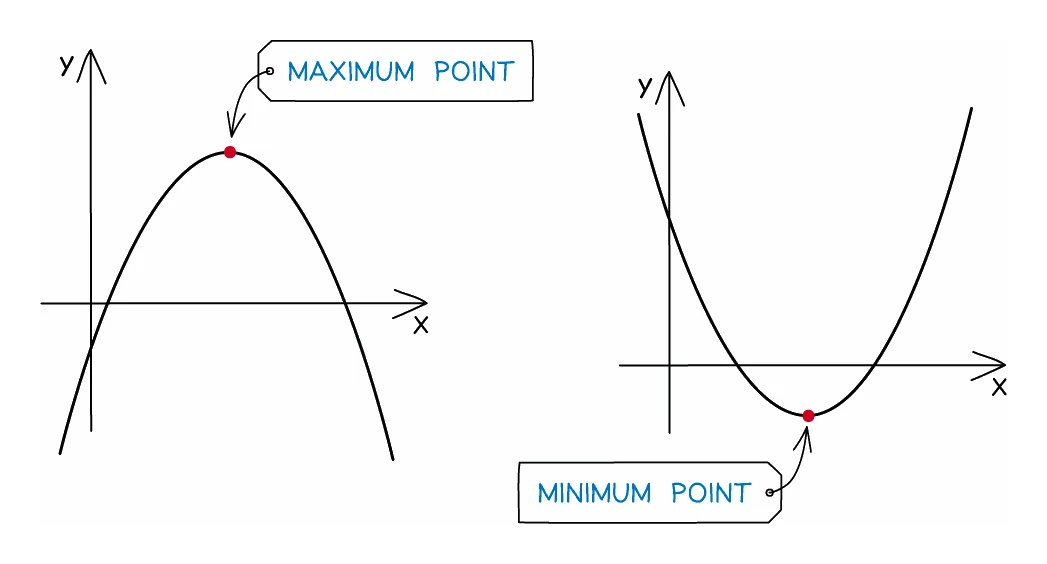
- A maximum is a peak and a minimum is a trough, and both are found the same way
- The method is always the same three steps
- Differentiate the equation of the curve
- Put the derivative equal to zero, then solve that equation
- Take each x found and substitute it into the curve, not the derivative, for the matching y
- A cubic normally has two turning points, so expect two answers and give both as coordinates
- Writing the line "dy/dx = 0" is itself worth a mark, so put it down before solving
Worked example
Finding both turning points of a cubic
The curve y = x³ − 27x + 4 has two turning points. Find their coordinates.
Solution:
- A turning point is where the curve stops rising and starts falling, or the reverse, so the gradient there is zero
- Differentiate first: dy/dx = 3x² − 27
- Then set the derivative to zero: writing the line dy/dx = 0 earns a mark by itself
- 3x² − 27 = 0
- Divide through by 3: x² − 9 = 0, so x² = 9
- Taking the square root gives two answers, x = 3 and x = −3, and forgetting the negative root loses a whole turning point
- Those are only the x coordinates; the y coordinates come from substituting back into the equation of the curve, never into the derivative
- At x = 3: 3³ − 27 × 3 + 4 = 27 − 81 + 4 = −50
- At x = −3: (−3)³ − 27 × (−3) + 4 = −27 + 81 + 4 = 58
- The turning points are (3, −50) and (−3, 58)
Exam tip
Keep going after a slip in the derivative
If your derivative has a slip, carry on with it. The schemes usually give one method mark for setting your own derivative equal to zero and another for a correct method of solving your own quadratic, so both are still there to earn. Write each solving step down, as the example above does, whether by square roots, factorising or the formula: from a wrong derivative, the x values alone cannot show that method.
3. Deciding maximum or minimum
Three accepted methods
- The syllabus accepts any method and lists these three, so use whichever is quickest unless the question says which one to use
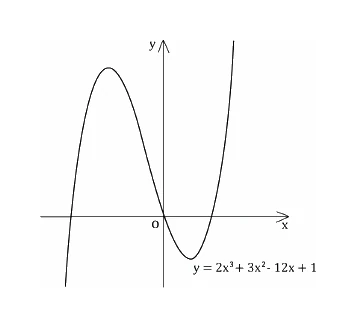
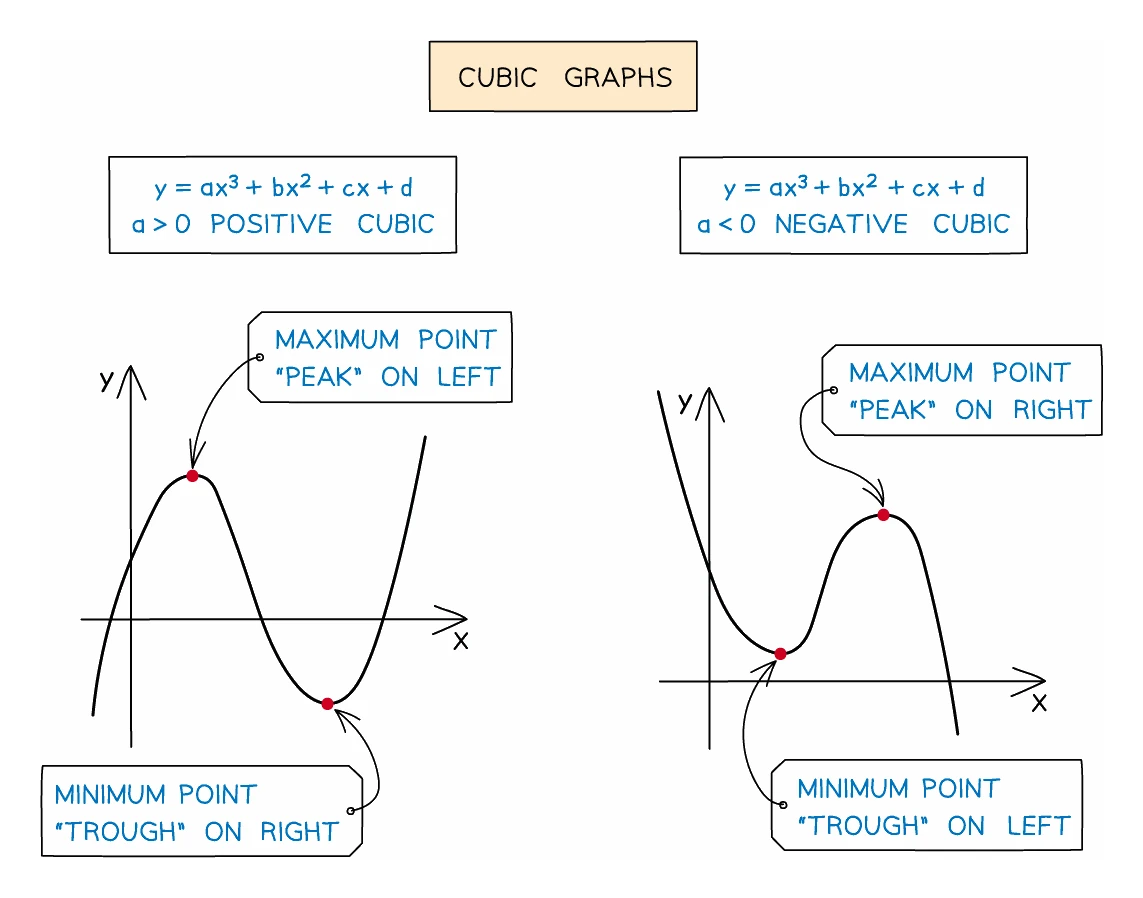
- A sketch. Use the shape you already know: a positive cubic rises overall, so its maximum comes first and its minimum second, and a negative cubic is the other way round. A positive quadratic has only a minimum, a negative quadratic only a maximum
- The gradient either side. Substitute an x just below and just above the turning point into dy/dx. Positive then negative means a maximum; negative then positive means a minimum
- The second derivative. Differentiating a second time produces d²y/dx², into which the turning point's x value is substituted
- A negative result means a maximum, which is the opposite of what most people expect
- A positive result means a minimum
- A result of zero settles nothing, so fall back on one of the other two methods
- You are not expected to identify points of inflection on this specification
Worked example
Classifying with the second derivative
The curve y = x³ − 27x + 4 has turning points at (3, −50) and (−3, 58). Determine which is a maximum and which is a minimum.
Solution:
- The second derivative measures how the gradient itself is changing, which is what separates a maximum from a minimum
- Start from the first derivative: dy/dx = 3x² − 27
- Differentiate it again, term by term: 3x² gives 6x, and −27 is a constant so it gives 0
- d²y/dx² = 6x
- Substitute each turning point's x value
- At x = 3: 6 × 3 = 18, which is positive, so the gradient is increasing through that point and (3, −50) is a minimum
- At x = −3: 6 × (−3) = −18, which is negative, so the gradient is decreasing there and (−3, 58) is a maximum
- Positive means minimum and negative means maximum, which is the way round most often misremembered
- The result matches the shape of a positive cubic, which rises to a maximum, falls, then rises again, so the maximum lies to the left of the minimum, exactly as −3 lies left of 3
Exam tip
Decide maximum or minimum with a labelled sketch
The schemes credit a sketch every time you decide whether a turning point is a maximum or minimum, and when the question asks for a sketch, nothing else scores: draw one even if you have also used the second derivative. Draw the cubic the right way up (for a positive x³ term: up to the maximum, down to the minimum, up again), place each turning point where its coordinates put it, and label each one maximum or minimum.
4. Using differentiation to optimise
Turning a problem into a curve
- A question may ask for the largest or smallest value a quantity can take, and the turning point gives it
- The quantity must first be written as an equation in one letter only
- Where two letters appear, the question always supplies a second fact linking them, so rearrange that and substitute
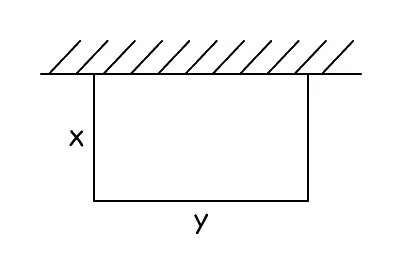
- Then differentiate, set the derivative to zero, and solve to find the value of the letter
- Substitute that value back into the original formula, because the question asks for the quantity, not for the letter
- Other letters work the same way, so a formula for A in terms of t differentiates to dA/dt
- To justify that the answer is a maximum, name the shape: a negative quadratic can only turn at a maximum
Worked example
The largest rectangle from a fixed length
A piece of wire 36 cm long is bent to form a rectangle. Find the greatest possible area.
Solution:
- Let one side be x cm, so the two sides of that length use 2x cm of wire
- The remaining wire is 36 − 2x cm, shared between the other two sides, so each is 18 − x cm
- Area A = x(18 − x), which expands to A = 18x − x²
- Differentiate: dA/dx = 18 − 2x
- Set it to zero: 18 − 2x = 0, so x = 9
- Substitute back into the formula for A: A = 18 × 9 − 81 = 162 − 81
- The greatest area is 81 cm²
- A = 18x − x² is a negative quadratic, so its only turning point is a maximum
- The rectangle turns out to be a 9 cm square, and its perimeter checks as 2(9 + 9) = 36