Angles in Polygons and Parallel Lines
Mathematics revision notes · Cambridge (CIE) · 0580
1. The basic angle facts
Four facts that start every question
- Angles meeting at a point add to 360°
- Angles on one side of a straight line add to 180°
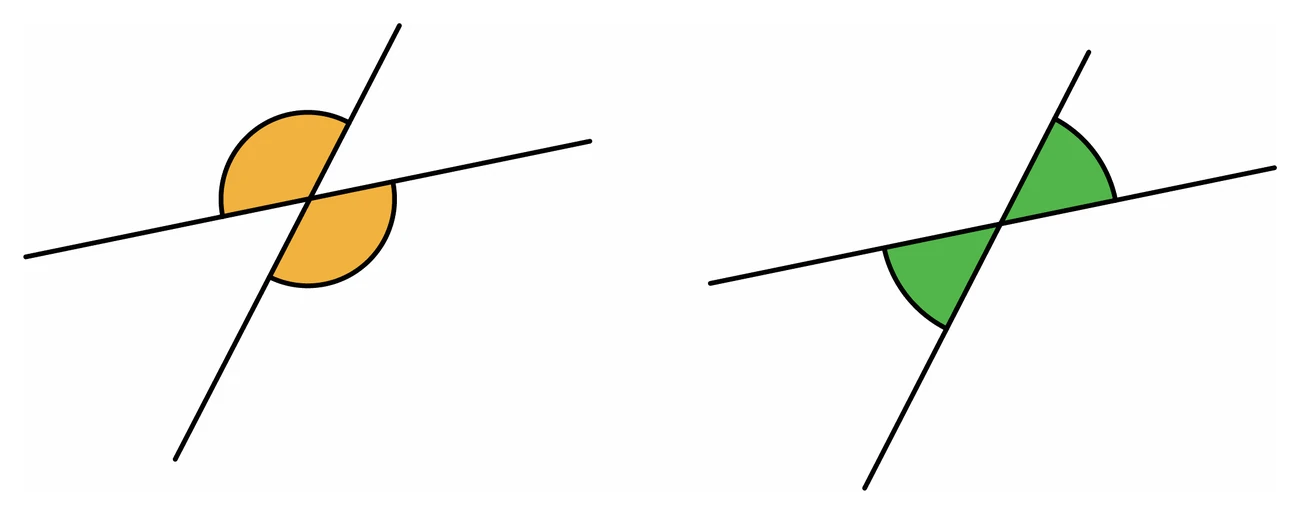
- Vertically opposite angles, formed where two straight lines cross, are equal
- The angles inside a triangle add to 180°, and the angles inside a quadrilateral add to 360°
- Naming uses three letters with the vertex in the middle, so angle ABC is the angle at B, and it means the angle smaller than 180° rather than the reflex one
- Diagrams are usually marked "NOT TO SCALE", so work from the numbers and the markings rather than from how the picture looks
Filling in what you can
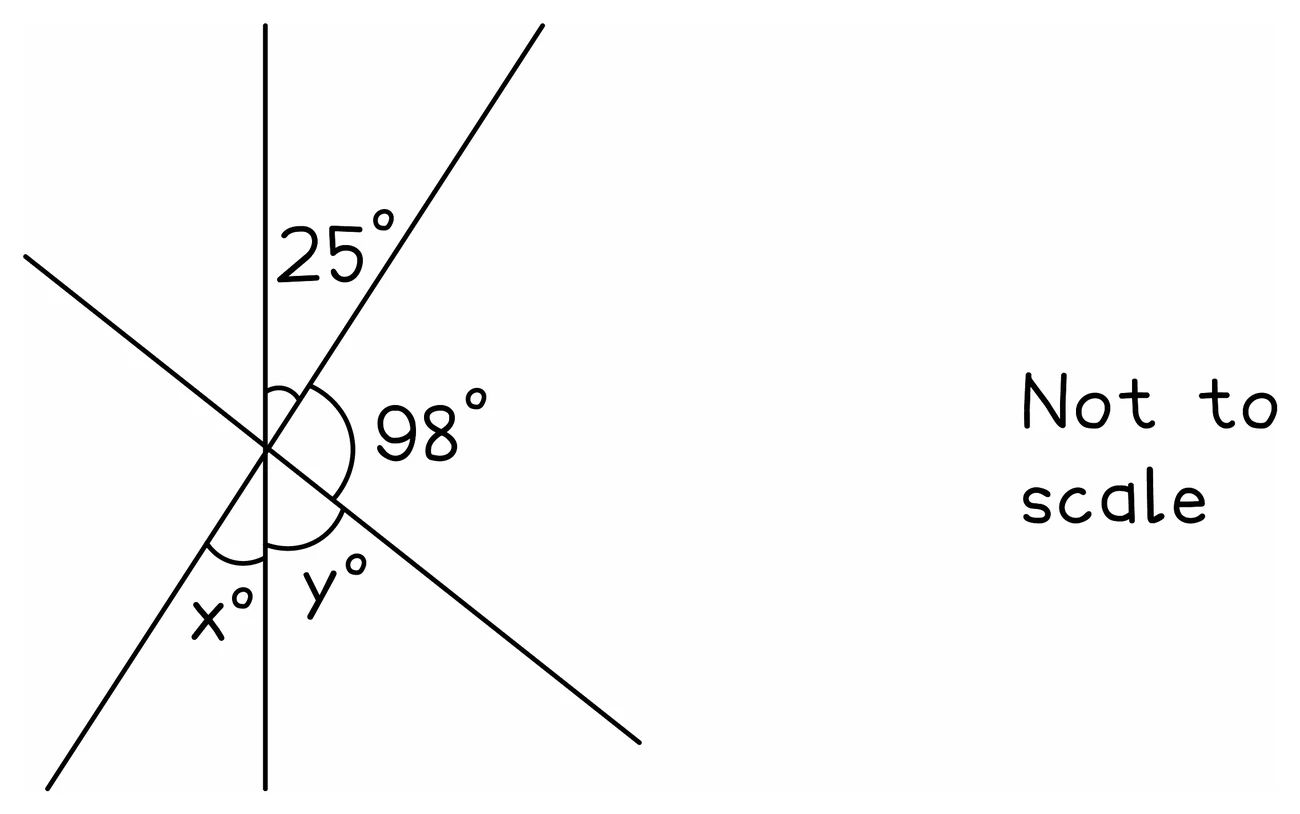
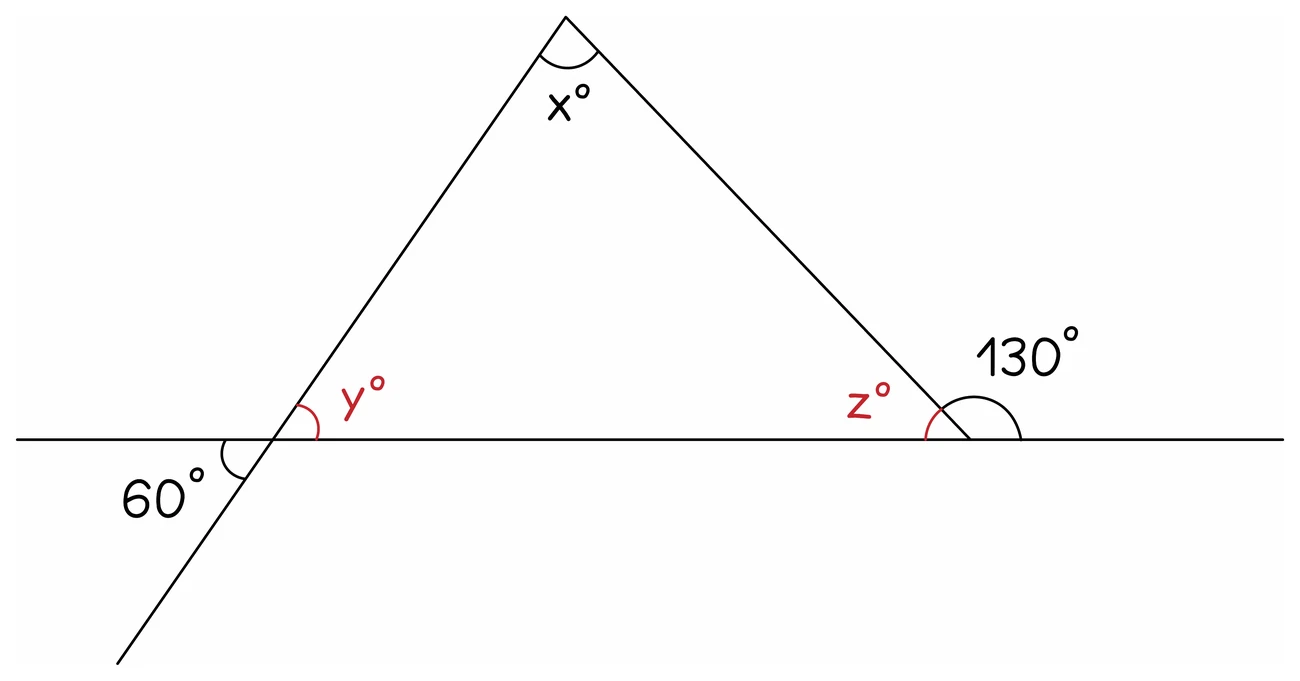
- Mark every angle you can work out on the diagram, even ones the question has not asked for
- One of them is almost always the step that unlocks the angle you actually want
- A question worth more than one mark expects the intermediate angles to appear in the working
Worked example
Crossing lines and a straight line
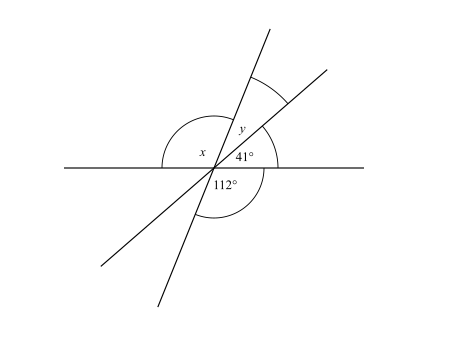
Three straight lines meet at a point. One angle is 112°, and x is vertically opposite it. On the straight line through that point sit x, y and an angle of 41°. Find x and y.
Solution:
- x is vertically opposite the 112° angle, and vertically opposite angles are equal
- So x = 112
- The three angles x, y and 41° lie on a straight line, so they add to 180°
- 112 + y + 41 = 180
- 153 + y = 180
- So y = 27
- Check: 112 + 27 + 41 = 180
Exam tip
Label every angle you work out
Many angle questions give a mark for a correct angle found on the way, even when the final answer is wrong, as long as it is clear which angle it is. So write each angle on the diagram in its exact position, or name it with three letters in your working (angle PQR = 47°). A number standing alone in the working does not show which angle it is.
2. Angles in triangles and quadrilaterals
Using the shape's own properties
- Any triangle's three angles total 180°, and knowing two gives the third by subtraction
- An isosceles triangle has two equal angles, and they are the ones opposite the two equal sides
- With an apex angle of 34°, the two base angles are (180 − 34) ÷ 2 = 73° each
- An equilateral triangle has three angles of 60°
- Any quadrilateral's four angles total 360°
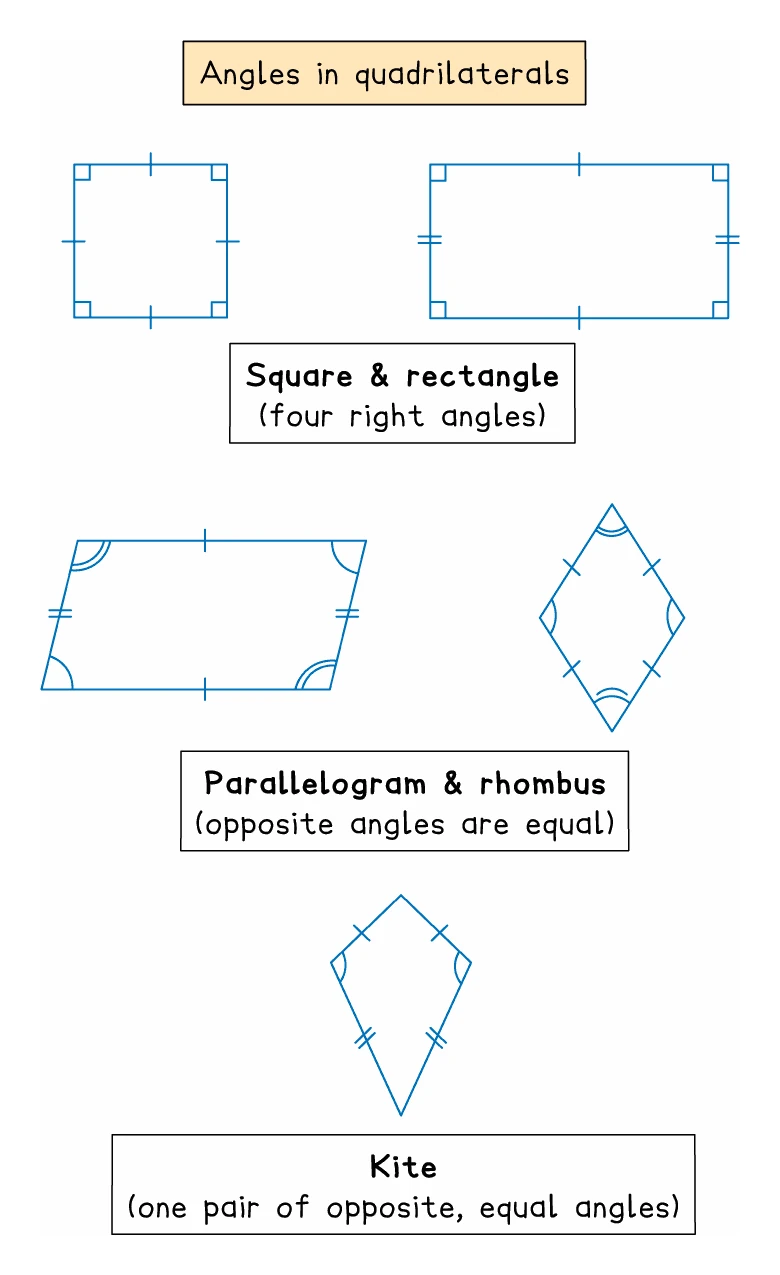
- Symmetry supplies extra equal angles: a parallelogram and a rhombus have equal opposite angles, and a kite has one pair of equal opposite angles
- A square or rectangle has four right angles
Worked example
The fourth angle of a quadrilateral
Three angles of a quadrilateral are 88°, 124° and 97°. Find the fourth angle.
Solution:
- The four angles of any quadrilateral add to 360°
- Add the three given: 88 + 124 + 97 = 309
- Subtract from 360: 360 − 309 = 51
- The fourth angle is 51°
3. Angles in parallel lines
The three relationships
- When a straight line crosses a pair of parallel lines, three named relationships appear
- Corresponding angles are equal. They sit in matching positions at the two crossings
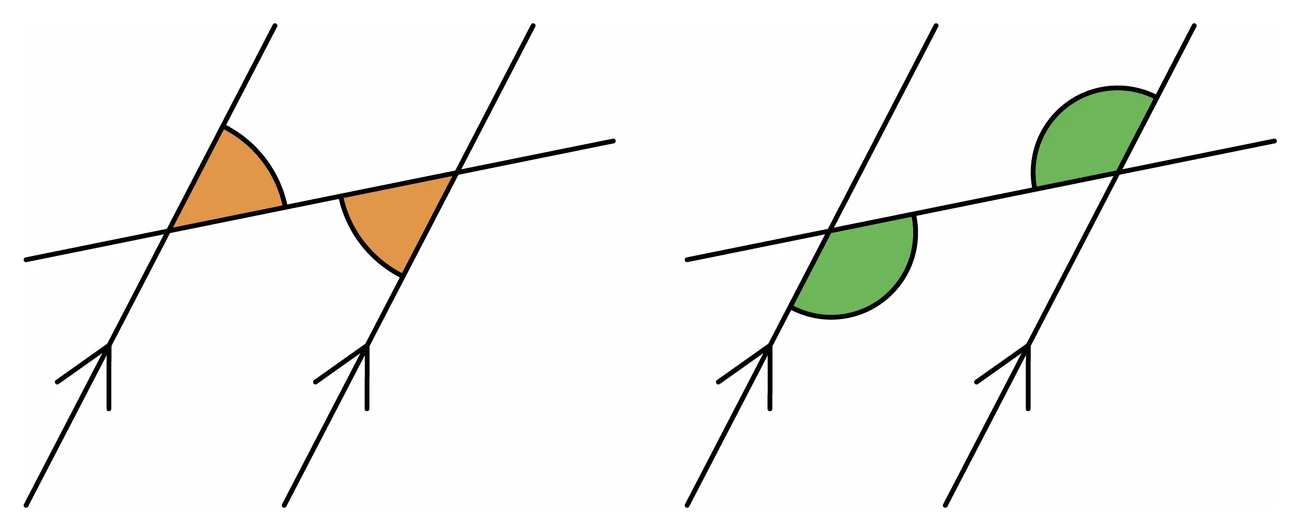
- Alternate angles are equal. They sit on opposite sides of the crossing line, between the parallel lines
- Co-interior angles add to 180°. They sit on the same side of the crossing line, between the parallel lines
- The syllabus also calls co-interior angles supplementary, which means they add to 180°
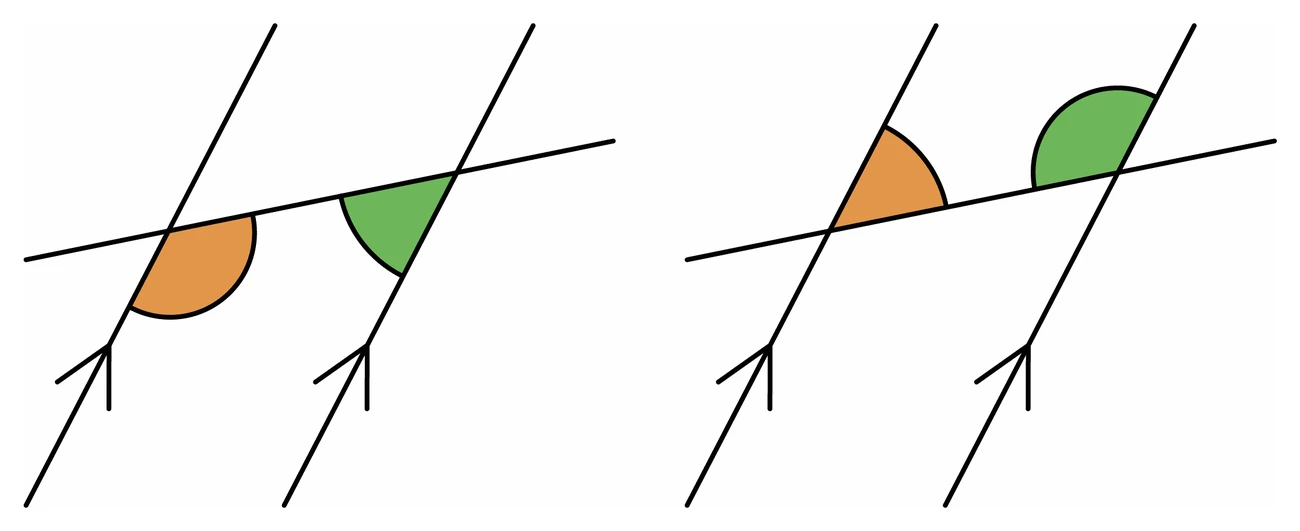
- Vertically opposite angles and angles on a straight line still apply, and combining them with the three above solves almost everything
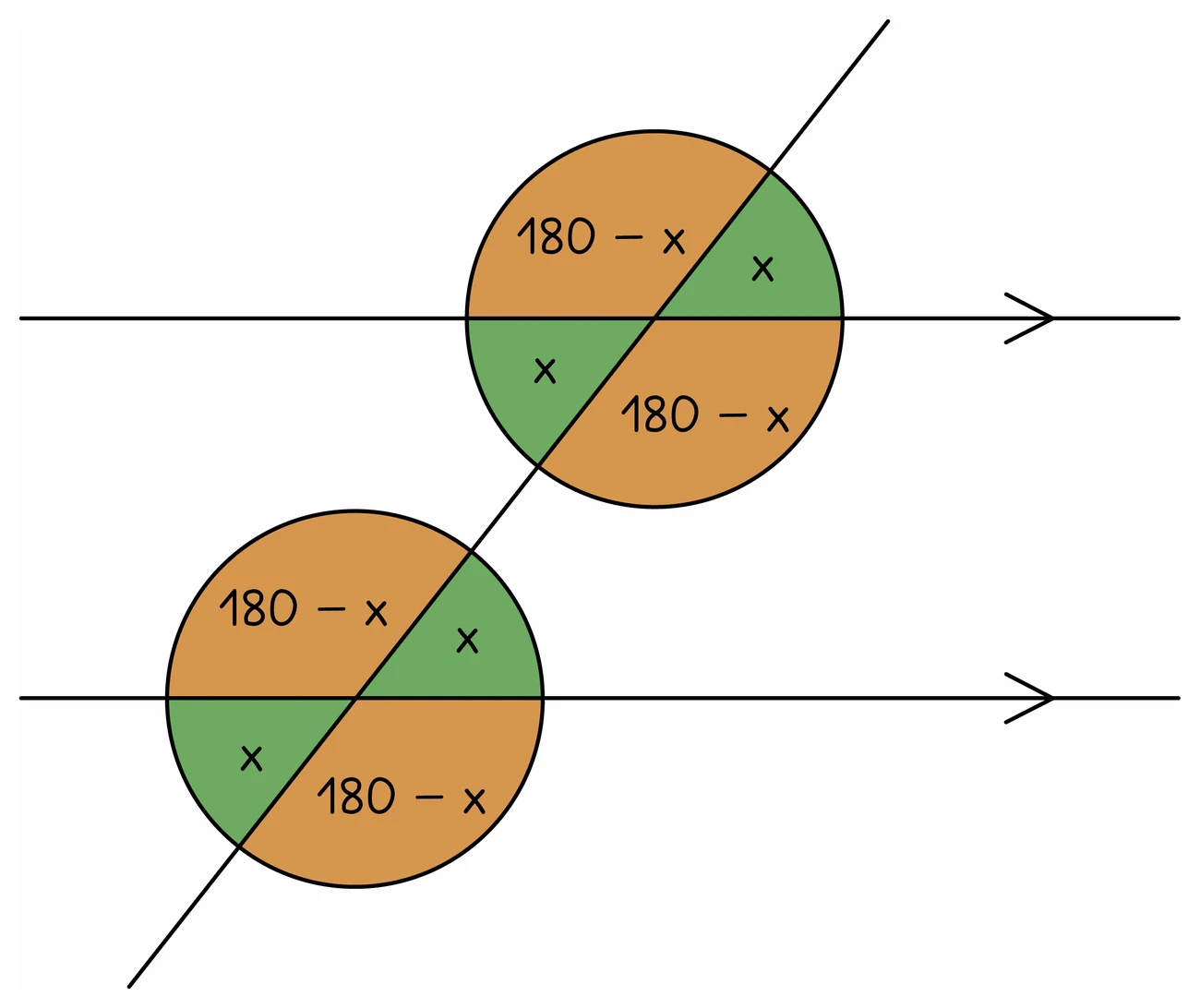
- Arrows on a diagram are what tell you the lines are parallel, so look for them before using any of these
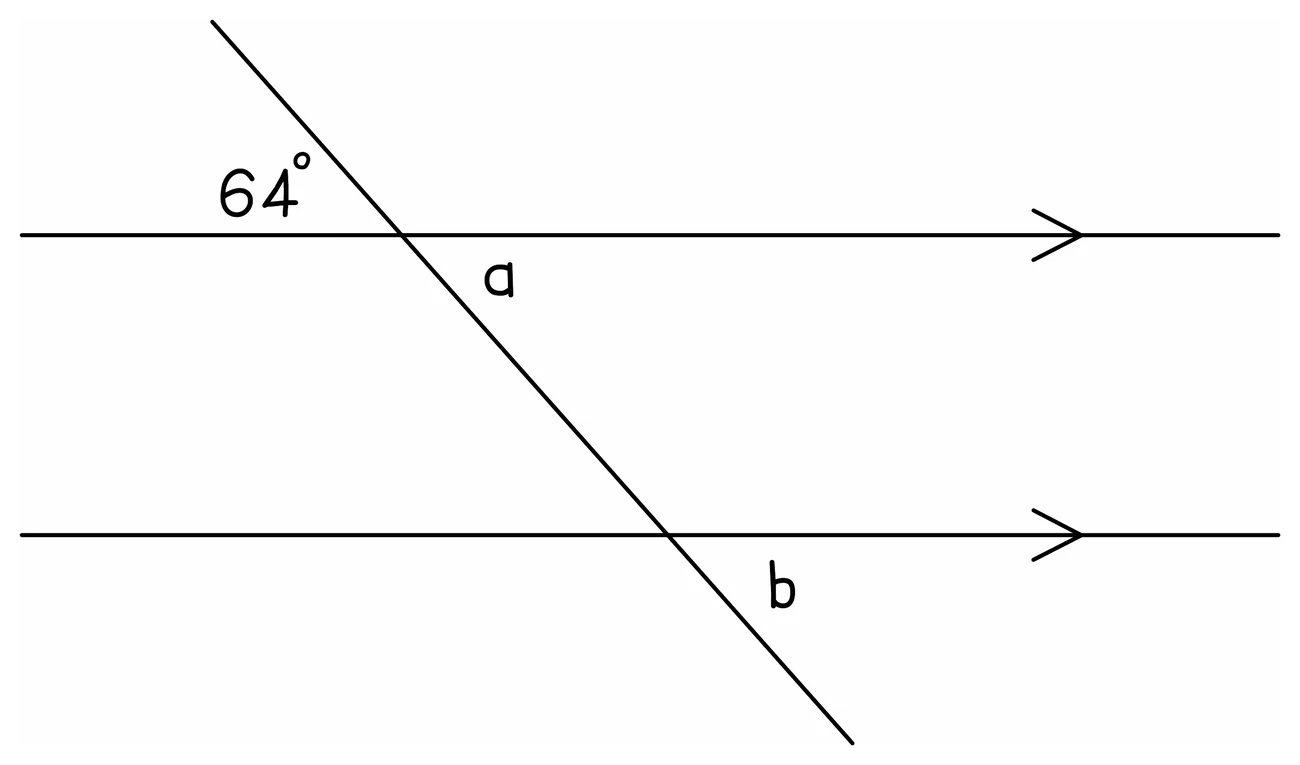
Naming the reason
- Questions ask for the angle and a geometrical reason, with a mark for each
- Give the full name: "alternate angles are equal", "corresponding angles are equal", "co-interior angles add to 180°"
- The F, Z and C shapes are useful for spotting the relationship but are not accepted as the reason on their own
- Abbreviating the name loses the mark, so write it out in full
Worked example
Two angles with reasons
A straight line crosses two parallel lines. One of the angles it makes is 118°. Find the angle corresponding to it, and the angle co-interior with that one, giving a reason for each.
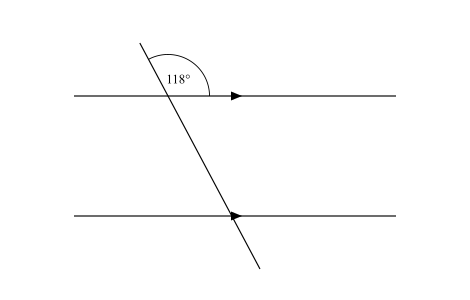
Solution:
- The corresponding angle sits in the matching position at the other crossing: above the lower line, to the right of the crossing line
- Corresponding angles are equal, so that angle is 118°
- It lies between the parallel lines, so it has a co-interior partner: the angle at the upper crossing on the same side of the crossing line, also between the parallel lines
- Co-interior angles add to 180°, so that angle is 180 − 118 = 62°
- Check: the 62° angle and the given 118° lie on a straight line at the upper crossing, and 118 + 62 = 180
4. Angles in polygons
Interior and exterior angles
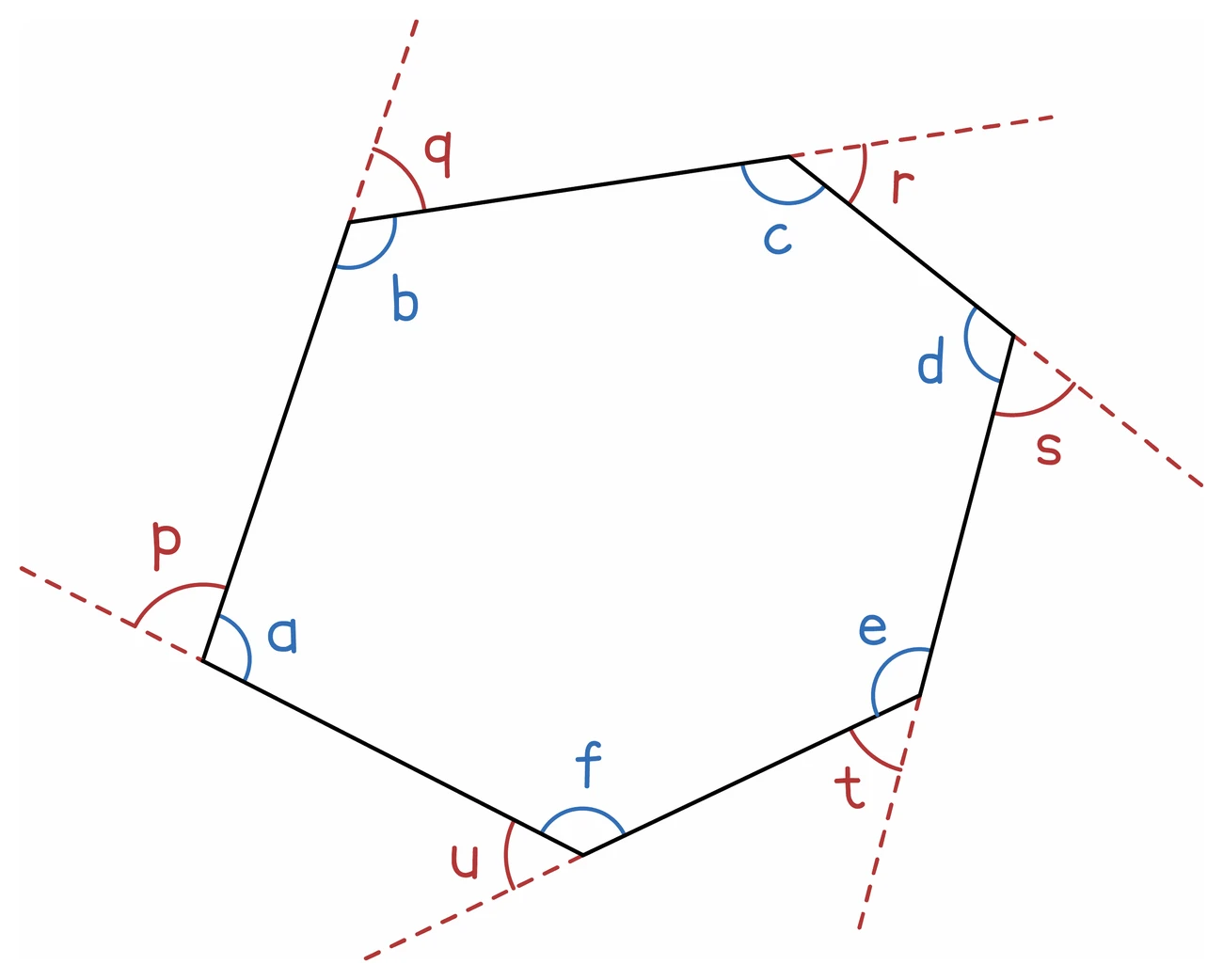
- An interior angle sits inside the polygon at a corner
- An exterior angle sits between one side and the extension of the next side
- At every corner the interior and exterior angles lie on a straight line, so they add to 180°
- Whatever the polygon and however many sides it has, its exterior angles total 360°
- For the inside angles the total depends on n: a polygon with n sides splits into n − 2 triangles, so they come to 180° × (n − 2)
- A triangle gives 180°, a quadrilateral 360°, a pentagon 540° and a hexagon 720°
Regular polygons
- A regular polygon has all sides equal and all angles equal, so its angles can be found by dividing
- Each exterior angle is 360° ÷ n, and this is usually the quicker route
- Each interior angle is then 180° minus that exterior angle
- The same result comes from 180(n − 2) ÷ n, so either method is acceptable
- Working backwards, n = 360° ÷ exterior angle; when a question gives the interior angle, take it from 180° first
| Regular polygon | Sides | Interior sum | Each interior | Each exterior |
|---|---|---|---|---|
| Equilateral triangle | 3 | 180° | 60° | 120° |
| Square | 4 | 360° | 90° | 90° |
| Pentagon | 5 | 540° | 108° | 72° |
| Hexagon | 6 | 720° | 120° | 60° |
| Octagon | 8 | 1080° | 135° | 45° |
| Decagon | 10 | 1440° | 144° | 36° |
Worked example
Finding the number of sides
Each exterior angle of a regular polygon is 24°. Work out the number of sides, and the size of each interior angle.
Solution:
- The exterior angles of any polygon add to 360°
- For a regular polygon they are all equal, so the number of sides is 360 ÷ 24
- The polygon has 15 sides
- The interior and exterior angles at each corner lie on a straight line
- Each interior angle is 180 − 24 = 156°
- Check with the other method: 180 × (15 − 2) = 2340, and 2340 ÷ 15 = 156
Worked example
Number of sides from an interior angle
Each interior angle of a regular polygon is 168°. Find the number of sides.
Solution:
- The interior and exterior angles at each corner lie on a straight line, so each exterior angle is 180 − 168 = 12°
- The exterior angles add to 360° and are all equal, so the number of sides is 360 ÷ 12
- The polygon has 30 sides
- Check with the other method: 180(n − 2) ÷ n = 168 gives 180n − 360 = 168n, so 12n = 360 and n = 30
Dividing 360 by the interior angle itself gives 360 ÷ 168, which is not a whole number: a sign that the step to the exterior angle was missed.
Irregular polygons
- The interior angle sum formula works for any polygon, so an irregular one with a missing angle is found by subtraction
- Add every angle you are given, then take the total from 180° × (n − 2)
- Five angles of a hexagon are 100°, 145°, 98°, 130° and 122°, which total 595°
- A hexagon's interior angles total 720°, so the missing angle is 720 − 595 = 125°
- The exterior angles still add to 360° whether the polygon is regular or not