Types of Markets: Competition & Monopoly
Economics revision notes · Cambridge (CIE) · 0455
1. Why the number of firms matters
Markets differ in how many firms compete in them, and that single feature shapes the price, the quality, the choice and the profit that consumers and producers end up with. The syllabus compares two ends of the range: a with many firms, and a monopoly with only one. You are not expected to draw diagrams or learn the formal theory of perfect and imperfect competition; the focus is on the practical effects of the number of firms.
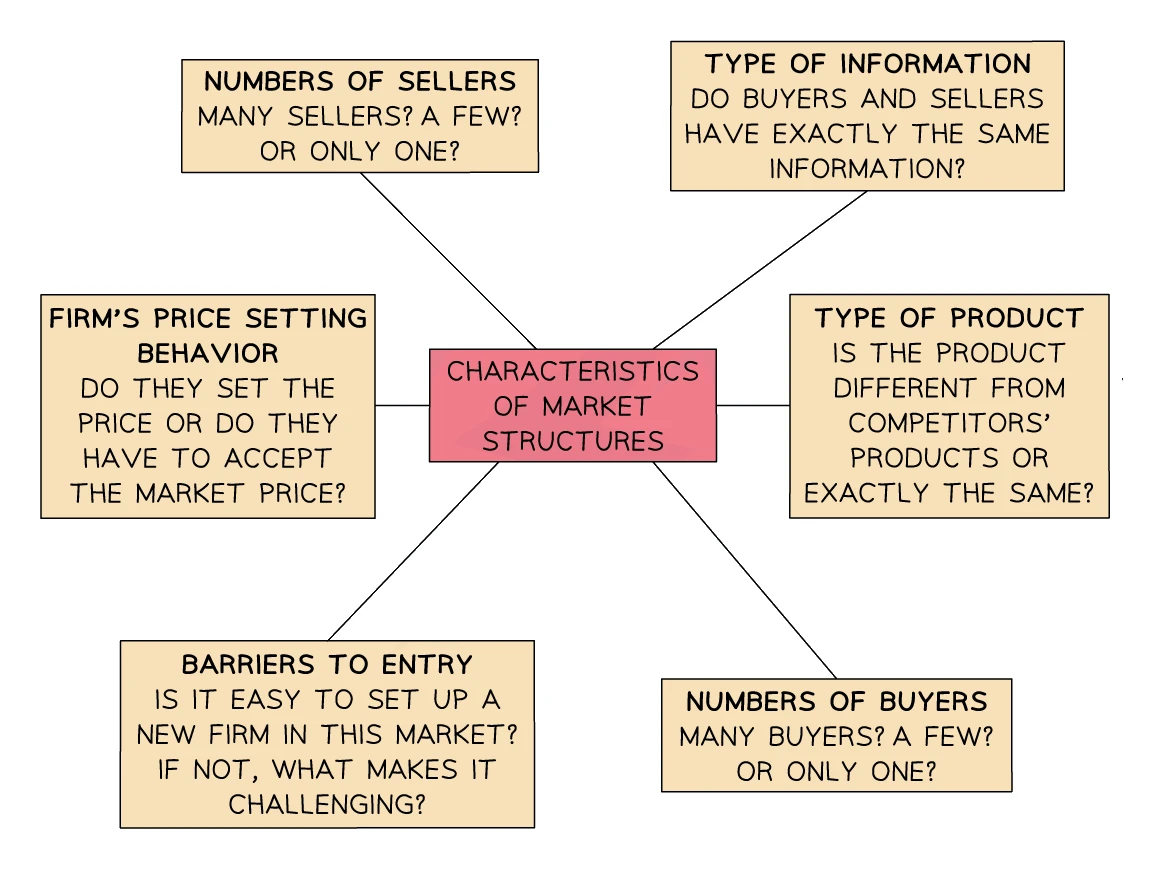
Several features are used to describe and compare market structures: how many sellers there are, whether the product is the same or different, how easy it is for new firms to enter, and whether a firm sets its own price or has to accept the market price.
2. Competitive markets
A competitive market is one in which many firms compete to sell a similar product, so no single firm can control the price. Each firm has to accept roughly the price set by the market as a whole.
Characteristics of a competitive market
- A large number of firms, each with a small share of the market.
- Similar products, so consumers can switch easily between sellers.
- Freedom of entry and exit — new firms can join the market when profits are attractive, and leave when they make losses.
- Price competition — because buyers can switch, no firm can charge much more than its rivals.
Effect of many firms on price, quality, choice and profit
| Feature | Effect in a competitive market |
|---|---|
| Price | Lower — firms compete on price, and consumers can switch to a cheaper rival, so prices are kept close to costs. |
| Quality | Higher — firms must keep improving to win customers from rivals. |
| Choice | Wider — many firms offer a range of products to suit different needs. |
| Profit | Lower per firm — competition limits how much each firm can charge above its costs. |
Advantages of competitive markets
- Lower prices for consumers, because firms undercut one another and consumers can switch between producers.
- Better quality and more innovation, because firms must improve to keep customers.
- More choice — a greater variety of products, and products that meet different needs (for example, cars designed for older drivers).
- Efficiency — the pressure to keep costs down forces firms to use resources well, and consumer power is high because buyers can influence the market by switching.
Disadvantages of competitive markets
- Small firms may miss out on economies of scale. With many firms each producing a small quantity, none may be large enough to enjoy the lower average costs that a big producer can reach. Average costs, and therefore prices, can end up higher than they would be with fewer, larger firms.
- Less funding for research. Small firms making low profits may have fewer funds to invest in improving quality or developing new technology.
- Wasteful duplication. Many firms doing similar things (advertising, distribution) can duplicate effort and resources.
Common exam question
How the number of firms affects consumers
Question: Analyse how consumers gain from competition or lose when firms close, or discuss whether more or fewer firms benefit them (6–8 marks).
Asked in 4 of the 11 structured papers (three as the 6-mark Analyse, one as the Discuss); the specimen mark scheme sets the Discuss. In the Analyse, each effect and each link explaining it earns a mark. Competition brings lower prices, as customers can switch; better quality and innovation, as firms must be efficient; more choice; and more consumer power, as firms respond to buyers. Fewer firms reverse each chain: more monopoly power, so higher prices, less innovation, lower quality and less choice. One scheme allows one mark in total for higher prices, so develop the others.
In the Discuss, fewer, larger firms gain economies of scale, cutting costs and prices, and can fund quality from profit, but risk diseconomies of scale. Level 3 needs both sides developed; a one-sided answer cannot rise above Level 2 (3–5).
3. Monopoly
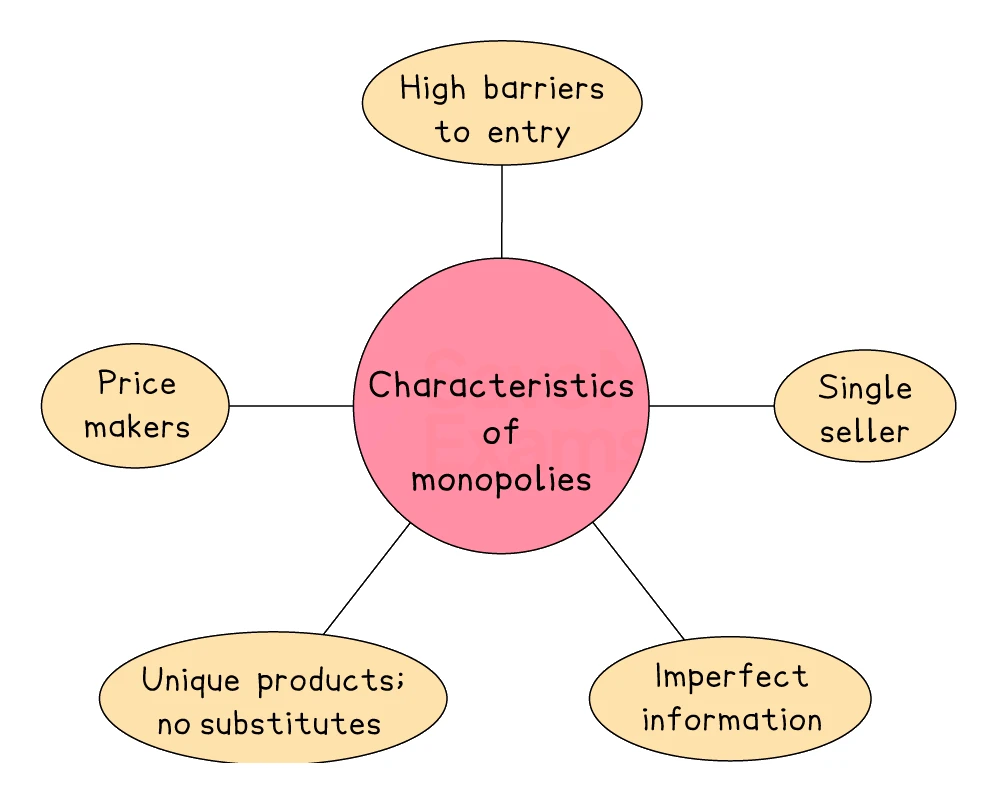
A monopoly is a market supplied by a single firm (or, more loosely, one firm with a dominant share). With no close competitor, the firm has the power to set its own price rather than accept a market price. Such a firm is sometimes called a price maker.
A monopoly often arises from that keep rivals out: control of an essential resource, very large set-up costs, patents, or legal protection.
Common exam question
Recognising a monopoly by its features
Question: Pick the features of a single dominant firm, or what keeps its profit high (1 mark, multiple choice).
Set in 4 of the 13 multiple-choice papers. A monopoly has high barriers to entry, is a price maker and makes high profit in the long run, not just the short run, since rivals cannot enter to compete it away. Keeping new firms out is the keyed cause of that profit, not government protection or low costs. Wrong options pair one firm with low barriers, many firms with high barriers, or a price taker. When a competitive market turns into a monopoly, barriers to entry, economies of scale and firm size all rise.
Asked in 1 of the 11 structured papers (4 marks): name and explain two characteristics, a mark for each step, such as the only firm (no real competition), high barriers (entry is hard) or a price maker (it sets the price).
Effect of one firm on price, quality, choice and profit
| Feature | Effect under monopoly |
|---|---|
| Price | Higher — with no competitor to undercut it, the firm can restrict supply and raise the price above the competitive level. |
| Quality | May be lower — with no competitive pressure, the firm has less incentive to improve. (It may also be high if the firm reinvests its profits.) |
| Choice | Narrower — a single supplier means consumers have little or no alternative. |
| Profit | Higher — protected from competition, the firm can earn large, lasting profits. |
Disadvantages of monopoly
- Higher prices and restricted supply. To maximise profit, the monopolist produces less and charges more than a competitive market would, so consumers are worse off and resources are misallocated.
- Less choice for consumers, who cannot switch to a rival.
- Weaker incentive to improve quality or cut costs, because no competitor threatens the firm's sales.
- Possible exploitation. The firm's market power can be used against the interests of consumers and, sometimes, of its suppliers.
Advantages of monopoly
A monopoly is not always harmful, and the syllabus expects you to see both sides.
- Economies of scale. A single large firm produces on a very large scale, so its average costs may be lower than those of many small firms — and some of that saving may be passed on as lower prices.
- Funds for research and innovation. High profits give the monopolist the money to invest in research, new technology and product development.
- Avoiding wasteful duplication. One firm avoids the duplicated networks and advertising of many competing firms — useful for a natural monopoly such as a water or rail network, where having one supplier of the infrastructure is the most efficient arrangement.
Common exam question
Price, profit and the case for a monopoly
Question: Compare price and profit with one firm and with many, or pick an advantage a monopoly can bring (1 mark, multiple choice).
Set in 3 of the 13 multiple-choice papers. Compared with a monopoly, a highly competitive market has lower prices and lower profits. A monopoly's advantages come from its size and its profit: economies of scale may cut its costs and so its prices, and high profits can pay for research and development, the keyed reason some governments let a monopoly exist. The wrong options are features of competition (wider choice, more output, prices set by market forces) or gains for the firm at consumers' expense (higher prices, maximum profit); drawing new firms in is the opposite of what a monopoly does.