1. What supply-side policy is
Supply-side policy is the use of government measures designed to increase the of the economy, so that it can produce more goods and services.
Fiscal policy and monetary policy work on aggregate demand: the total amount of spending in the economy. Supply-side policy works on the other side, on the economy's ability to produce. Instead of changing how much is being spent, it changes how much the economy is capable of making. On a production possibility curve, a successful supply-side policy shifts the whole curve outward, so the economy can produce more of both types of good.
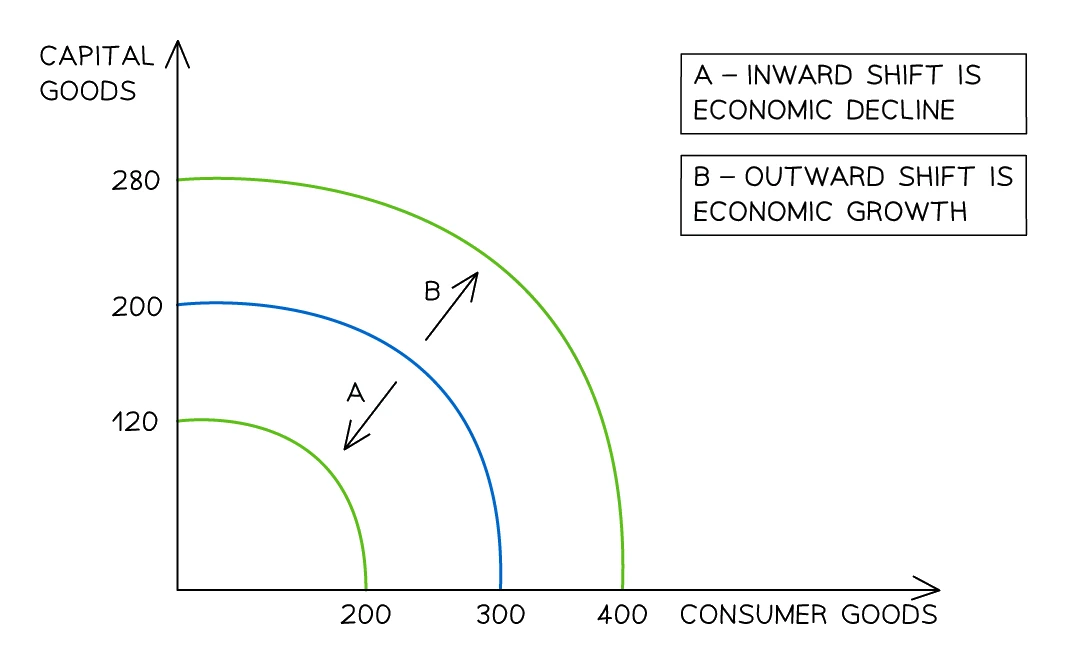
The attraction of supply-side policy is that it can raise output without the usual inflation problem. When a government pushes up demand too hard, prices rise. When it raises productive capacity instead, the economy can produce more at the same or lower cost, so growth comes with stable prices rather than higher ones. That is why supply-side measures are often described as the long-run route to the macroeconomic aims of topic 12.
The trade-off is time. Most supply-side measures take years to bear fruit, because they work by slowly changing the quantity and quality of resources, the skills of workers, and the efficiency of firms.
Common exam question
What supply-side policy aims to do
Question: Choose the definition, aim or most likely result of a supply-side policy from four options (1 mark, multiple choice).
Set in 6 of the 13 multiple-choice papers. The key is always about the economy's ability to produce: higher productive potential, potential GDP or productivity, or the economic growth that follows. The wrong options belong to other policies (more total demand, a change in the interest rate, the money supply or the exchange rate), reverse a supply-side measure (higher direct tax, stronger trade unions, a bigger public sector) or point the wrong way (more inflation, more structural unemployment, a worse current account).
Lower inflation and unemployment can follow from supply-side policy, but they do not define it: when a definition item offered a policy to cut inflation, one to cut unemployment and one to raise productivity, only productivity was right.
2. Supply-side policy measures
The syllabus names a set of supply-side measures. They fall into two broad groups: those that improve the quantity and quality of resources, and those that change the rules and incentives firms and workers face.
Education and training
Spending on education and training raises the skills, knowledge and productivity of the workforce.
Better-educated and better-trained workers produce more output per hour and can move more easily between jobs and industries (greater occupational mobility). This raises the quality of the labour force, lifts productivity, and helps reduce structural unemployment because workers' skills match the jobs available. The effect is slow: the children educated today only enter the workforce years later.
Infrastructure spending
Infrastructure spending is government investment in roads, railways, ports, airports, energy networks and broadband.
Good infrastructure lowers firms' costs of production: goods move faster and more cheaply, and workers can travel further to find work (greater geographical mobility). Better transport and communications connect firms to larger markets and make the whole economy more efficient, which raises capacity over time.
Improving incentives to work and invest
Measures that improve incentives make work and investment more rewarding, so people supply more labour and firms commit more capital.
Examples include widening the gap between wages and benefits so that working pays noticeably more than not working, and offering tax relief on investment so that firms keep more of the return. Stronger incentives draw more people into the labour force and encourage firms to expand their productive capacity.
Lower direct taxes
Lower direct taxes (such as income tax and corporation tax) leave workers and firms with more of what they earn.
Cutting income tax can encourage people to work more hours or to enter the workforce, because each extra hour is worth more after tax. Cutting corporation tax leaves firms with more profit to reinvest in new machinery, technology and capacity, and can attract foreign firms to set up in the country.
Labour market reforms
change the rules governing how workers are hired, paid and represented, to make the labour market work more flexibly.
These can include making it easier for firms to hire and dismiss workers, adjusting the role of trade unions, and reforming benefit rules. The aim is to help workers move into jobs faster and to make firms more willing to take on staff. These reforms can be controversial because greater flexibility for firms may mean less security for workers.
Deregulation
Deregulation is the removal or reduction of rules and red tape that restrict how firms operate.
Fewer regulations lower firms' compliance costs and make it easier for new firms to enter a market. More competition tends to push firms to cut costs and improve quality. The risk is that some regulation exists for good reason (safety, the environment, financial stability), so removing it can have harmful side-effects.
Privatisation
Privatisation is the sale or transfer of assets from the public sector to the private sector.
The argument is that private firms have a profit motive that pushes them to be more efficient than state-run organisations, so output rises and costs fall. Critics point out that a privatised firm may simply become a private monopoly, raising prices rather than improving service.
Common exam question
Spotting a supply-side policy measure
Question: Pick the option that is, or is not, a supply-side policy measure, or the measures that would meet a stated aim (1 mark, multiple choice).
Set in 3 of the 13 multiple-choice papers. Ask whether the option raises what the economy can produce, through better resources or through rules and incentives that help firms and workers. Skills training, privatisation and curbing trade union power all pass; higher indirect tax, a tariff on imports and a contractionary monetary policy do not. Removing barriers to entry counts as deregulation even when that word is missing.
Keep the two look-alikes apart: deregulation removes rules on how firms operate, while privatisation changes who owns them, moving assets from the public to the private sector. Read the aim in the stem too: asked which measures would make incomes more equal, the key took education and training and a cut in the basic rate of income tax, but not deregulation.
3. Effects of supply-side policy on macroeconomic aims
Because supply-side policy raises capacity, it can help with several aims at once.
- Economic growth. More and better resources mean the economy can produce more, raising real output over time.
- Low inflation. A larger productive capacity lets output grow without the shortages that cause demand-pull inflation, and lower firm costs ease cost-push inflation.
- Low unemployment. Education, training and better incentives improve workers' skills and willingness to work, cutting structural and frictional unemployment, while expanding firms hire more staff.
- Balance of payments stability. Lower costs and higher productivity make exports more price-competitive, which can improve the current account.
Common exam question
How supply-side measures help the macroeconomic aims
Question: Analyse how supply-side measures could reduce unemployment, or discuss whether better education helps a government reach its macroeconomic aims (6–8 marks).
Asked in 2 of the 11 structured papers. In the Analyse, naming the measure earns a mark, and so does each link: education and training raise skills and mobility, cutting structural unemployment; lower income tax or unemployment benefit strengthens the incentive to work, cutting frictional unemployment; privatisation or deregulation lowers firms' costs, so they can hire more. Higher productivity scores once, however many chains reach it.
The Discuss's top level needs both sides developed. For: a more productive workforce draws investment and growth, finds work more easily, cuts average costs and inflation, and exports more. Against: extra spending raises total demand and can push up inflation, skilled workers may emigrate, graduate jobs may be scarce, richer families may gain most, and gains take years.
The specimen mark scheme credits infrastructure spending (new for 2027) through geographical mobility.
The catch in every case is the time lag. Supply-side measures rarely change anything quickly, and some are expensive or politically difficult. A government usually combines them with fiscal and monetary policy rather than relying on them alone.