1. The basic economic problem
The basic economic problem is that resources are limited (finite) while human are unlimited (infinite). Society cannot produce everything everyone wants, so it must choose how to use the resources it does have.
This single idea sits underneath every other concept in the syllabus. Whenever an exam question asks about prices, government spending, exchange rates or trade, the underlying tension is the same: limited resources are being allocated between competing uses.
A useful way to phrase it for the exam: the economy must answer three questions.
- What to produce.
- How to produce it.
- For whom to produce it.
These are sometimes called the three fundamental economic questions. They appear because resources cannot stretch to cover every possible want, so an economy is constantly choosing on each.
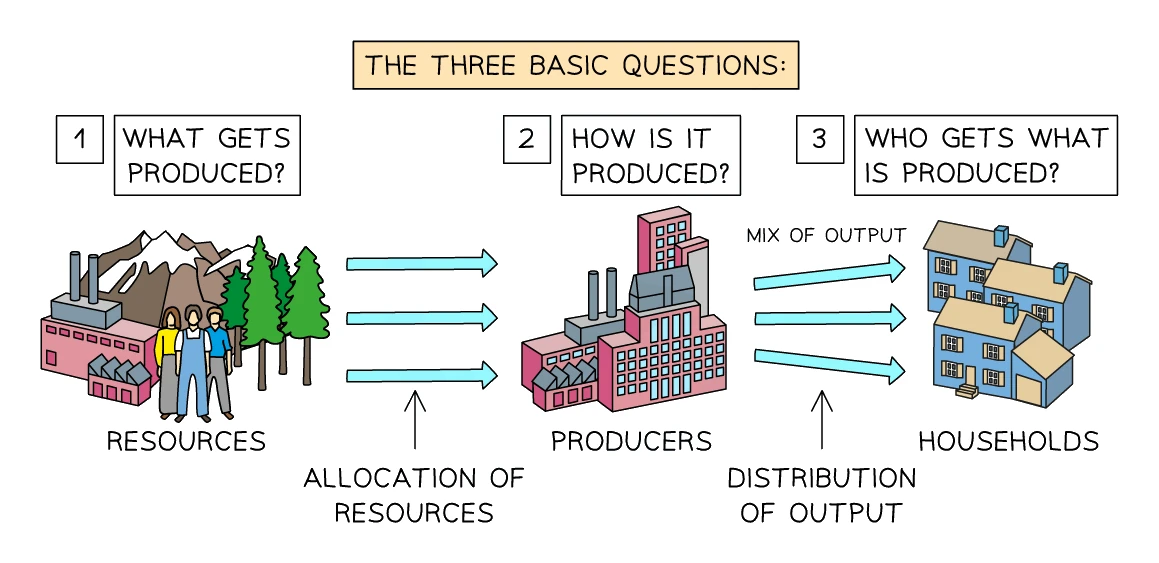
Common exam question
The three basic economic questions
Question: Choose the three questions that decide how resources are allocated, or the one question that scarcity does not force an economy to answer (1 mark, multiple choice).
Set in 2 of the 13 multiple-choice papers. The three are what to produce, how to produce it and for whom. Both items slip in a question that sounds just as sensible, "when" (and, in one of them, "where"), so check every word of an option against those three before you choose it.
2. Scarcity
Scarcity is the situation in which resources are limited while human are unlimited. Because wants exceed available resources, society cannot satisfy them all.
Scarcity is the foundation of the syllabus. Almost every other concept (price, demand, opportunity cost, market failure, trade) follows from it.
Wants vs needs
It helps to separate two kinds of human desire before going further.
- Needs are things essential for human life: food, water, shelter, basic clothing, basic healthcare.
- Wants are non-essential desires: a holiday, a games console, a designer bag, a faster car.
Needs are a limited set, but wants are unlimited: as soon as one is satisfied, another appears. Resources, by contrast, are finite, so wants always exceed what can be supplied. This is the wording the syllabus uses: finite resources and infinite wants.
Scarcity is not the same as a shortage
The two ideas are easy to confuse, so keep them apart.
| Scarcity | Shortage | |
|---|---|---|
| What it is | The fundamental economic problem: unlimited wants vs limited resources | A market situation: at a given price, quantity demanded exceeds quantity supplied |
| Time horizon | Permanent (a feature of the human condition) | Temporary (can be resolved by a price rise or extra supply) |
| Example | Oil is a scarce resource | A petrol station running out of fuel for an afternoon |
A definition of scarcity that just says "there is not enough" loses marks. Examiners want both halves: limited resources and unlimited wants.
Who faces the basic economic problem
Every economic agent has to make decisions because of scarcity.
| Agent | How scarcity affects their decisions |
|---|---|
| Consumers | Limited income forces them to choose which goods and services to buy. Higher prices for scarce items mean less can be bought. |
| Producers | Limited inputs (land, labour, capital) force them to choose what to make and how to make it. Scarcer inputs raise costs. |
| Workers | Time is limited, so workers choose which job to accept, how many hours to work, and how much training to invest in. |
| Government | A limited tax revenue forces a choice between spending on health, education, defence, transport, welfare and other priorities. |
Strong exam answers always tie the choice back to a specific group from this table, not "society in general".
Common exam question
What causes scarcity
Question: Choose the cause of scarcity or of the basic economic problem, or the reason a rich country or a shopper on a budget still faces it (1 mark, multiple choice).
Set in 9 of the 13 multiple-choice papers. The right option names one half of the problem, wants that are unlimited or resources that are finite, or the problem as a whole: wants exceed what can be produced, so choices have to be made. That is why a high-income country still faces it, and why a shopper whose money cannot cover both of two items has met the economic problem, not excess demand.
The wrong options turn a half round ("unlimited resources", "limited wants", an unlimited supply of the good), narrow resources to capital or swap them for income or wealth, put needs in place of wants, or name a different issue such as high costs, taxes, inflation or unequal incomes.
3. Economic goods vs free goods
A useful follow-up to scarcity is the distinction between and . This often appears in Paper 1 MCQs.
Economic goods
An economic good is a good that is scarce in relation to demand, so a sacrifice has to be made to obtain it. Economic goods have a price and an .
Anything with a price tag is an economic good. Oil, smartphones, university courses, bottled water, gold, a haircut, a streaming subscription. Producers supply these in order to make a profit.
Free goods
A free good is a good that is so abundant in supply that no sacrifice is needed to obtain it. Free goods have no price and no opportunity cost.
Classic examples: sunlight, the air we breathe in most places, sea water.
A good can move from being a free good to being an economic good if its supply becomes limited relative to demand. Clean drinking water was a free good for most of human history; today, with rising population and pollution, bottled drinking water in many places has a price and is therefore an economic good.
A common trap in MCQs: "free" can mean "given to me at no cost" (e.g. state-provided education) without being a free good. A good is "free" in the economic sense only if it is abundant, not just paid for by someone else.
Common exam question
Spotting a free good
Question: Pick the free good, the good that does have an opportunity cost or the true statement about free and economic goods, or identify two free goods (1 mark, multiple choice, or 2 marks).
Set in 3 of the 13 multiple-choice papers. Asked in 1 of the 11 structured papers. A free good is one that nobody has to give anything up to obtain, so it has no opportunity cost: the free goods in these items are air, sunlight and sea water, and food is the economic good set among them. The distractors cost the consumer nothing yet still used scarce resources, such as a free sample or health care provided by the state.
To identify two free goods, give air (or oxygen), sunlight, water or wind: those earned the marks. Wild fruit, wild flowers and trees were given the benefit of the doubt, but wood, fish and stone were not credited.
4. Opportunity cost
Scarcity forces choices; choices have a cost. That cost is .
Opportunity cost is the next best alternative forgone when a choice is made between competing uses of scarce resources.
Two parts of the definition matter equally:
- Next best alternative. Not just any other option, but the single best option that was given up. A choice between three sandwiches has one opportunity cost (the second-favourite), not two.
- Forgone because of a choice. The cost only arises because a decision had to be made. If a resource could do both jobs at once there would be no opportunity cost.
A definition that just says "the cost of a decision" without "next best alternative forgone" loses marks.
Common exam question
Defining and spotting an opportunity cost
Question: Choose the definition of opportunity cost, name the concept that a spending choice illustrates, or pick the opportunity cost in a short scenario (1 mark, multiple choice).
Set in 5 of the 13 multiple-choice papers. The definition is the next best alternative forgone when a decision is made; the wrong options describe scarcity, the allocation of resources or the cost of consuming a good. A government paying for healthcare or wind farms by giving up another use of the same money illustrates opportunity cost.
In a scenario, the answer is the alternative given up, in its own units, not the money the choice itself costs or earns. A hospital that has used up its budget for doctors gives up nurses to employ one more doctor, not the doctor's salary; a person who works longer for extra pay gives up hours of leisure, not dollars.
Opportunity cost is not always monetary
Opportunity cost can be measured in anything sacrificed: time, the satisfaction of an alternative product, lost income, the next best use of a piece of land. It is always the value of the next best alternative forgone, and that value may be expressed in money (the revenue or income of the option given up) or in non-money terms (time, output, satisfaction). The trap in numerical questions is picking the wrong money figure: it is not the amount spent on, or earned from, the option chosen, and not the two options added together. Total each option over the whole period. The cost is the full value of the next best option not taken, except where the option chosen still brings in an income but less than the alternative would: then only the income actually given up counts (the alternative's total minus the chosen option's).
| Choice made | Opportunity cost |
|---|---|
| Buy a new phone with £600 | The next best item that £600 could have bought (for example a holiday) |
| Spend an evening revising | The next best use of that evening (for example watching a film) |
| Government builds a hospital with tax revenue | The next best public project that tax revenue could have funded (for example a road) |
| Firm uses a field to grow wheat | The next best crop the field could have grown (for example barley) |
| Worker stays in the same job | The next best job they could have taken (with its own pay and conditions) |
| Farmer grows tomatoes earning $12,000 instead of onions earning $9,000 | $9,000, the onion revenue forgone |
Common exam question
Calculating an opportunity cost from money figures
Question: Work out the opportunity cost of a choice from the earnings, revenue or taxes each option would bring over several years (1 mark, multiple choice).
Set in 3 of the 13 multiple-choice papers. Every item ran over several years, so total each option over the whole period: one-year figures sat among the wrong options. When the option chosen brings in more (a firm choosing the better-earning of two products), the key was the other option's full total.
When the option chosen still brings in an income but less than the alternative, the keys counted only the income actually lost: the alternative's total minus the chosen option's. A trainee paid $9,000 a year for three years instead of taking a $15,000-a-year job loses $6,000 a year, so $18,000, not the job's full $45,000; pay expected after the training plays no part. A land-use item worked the same way, counting the government's lost tax as well as the lost income.
5. Opportunity cost for the four economic agents
The exam often tests opportunity cost by applying it to a specific economic agent. The structure is always the same.
Consumers
Consumers have a limited income. Spending on one good means giving up the next best alternative use of the same money.
Producers
Producers have limited inputs (workers, machines, raw materials, factory space). Using them to make product A means they cannot make the next best alternative product B.
Workers
Workers have limited time and limited skills. Taking job A means giving up the next best alternative use of that time.
Government
A government has a limited tax revenue. Spending on one programme means giving up the next best alternative use of those tax pounds.
Common exam question
Identifying the opportunity cost of a decision
Question: Identify the opportunity cost of a decision in the stimulus, such as households spending their income, firms exporting, or an economy producing primary products (2 marks).
Asked in 2 of the 11 structured papers. Each mark is for one specific alternative use of the same resource, tied to the decision named: income that is spent could have been saved; goods that are exported could have been sold or consumed at home; resources used for primary products could have made manufactured goods or services, or been left as wildlife habitat. When the question names two decisions, give one opportunity cost for each, matched to its own agent.
6. The three-step structure for applying opportunity cost
Most opportunity-cost questions in the exam are not "define" questions; they ask you to apply the idea to a particular decision: a 1-mark multiple-choice scenario or calculation, a 2-mark Identify question or a 4-mark Explain question. The three steps below give a structure that works for each of them.
The three-step structure.
Step 1: Identify the choice. Name the resource being allocated, the agent making the decision, and the competing uses.
Step 2: Name the next-best alternative forgone. State the specific alternative that is sacrificed. Use the context in the question; do not say "something else".
Step 3: Frame it as a . Explain that scarce resources used for one purpose cannot also be used for the other.
Common exam question
Explaining how scarcity forces a choice
Question: Explain how the economic problem makes consumers choose, or how opportunity cost affects a decision such as going to university (4 marks).
Asked in 1 of the 11 structured papers, and the specimen mark scheme for the 2027 papers sets the same type on opportunity cost. Each link in the chain earns a mark: wants are unlimited and resources finite, so there is scarcity; consumers have limited incomes, so they cannot buy everything they want; buying one product has an opportunity cost, and naming the product given up earns another.
The specimen allowed up to 2 marks for the definition (the next best alternative, given up) and up to 2 for applying it, or all 4 for a well-applied answer that only implies the definition. Its applied points: a school leaver gives up a full-time job's earnings now, weighs them against the higher pay a degree may bring later, and compares the satisfaction of studying with that of working.
7. Why opportunity cost matters
Two reasons it appears so often on the syllabus:
- It is the right way to evaluate decisions. A decision that "saves money" can still be a bad decision if the next-best alternative was worth even more. Cheaper flights save £60 if you can work that day, but they cost £130 of lost income if you cannot.
- It applies everywhere. Microeconomics (a consumer's spending, a firm's output choice), macroeconomics (a government's budget priorities) and international trade (which goods a country specialises in) all rest on the same idea.
Exam tip
Opportunity cost as a counter-argument
When a Discuss or Analyse question asks whether a government should spend on something, or whether producing or exporting more is good for an economy, opportunity cost is a ready-made point for the other side. The mark schemes of 9 of the 11 structured papers list it, on subsidies, pensions, housing, renewable energy and more. Where marks go point by point, naming the opportunity cost earns one and the specific alternative the money or resources could have funded (healthcare, education, other products) earns another, so always say what is given up.