Scarcity, Choice & Opportunity Cost
Basic Economic Problem · 3 question types
The Basic Economic Problem
The basic economic problem is that resources are limited (finite) while human are unlimited (infinite). Society cannot produce everything everyone wants, so it must choose how to use the resources it does have.
This single idea sits underneath every other concept in the syllabus. Whenever an exam question asks about prices, government spending, exchange rates or trade, the underlying tension is the same: limited resources are being allocated between competing uses.
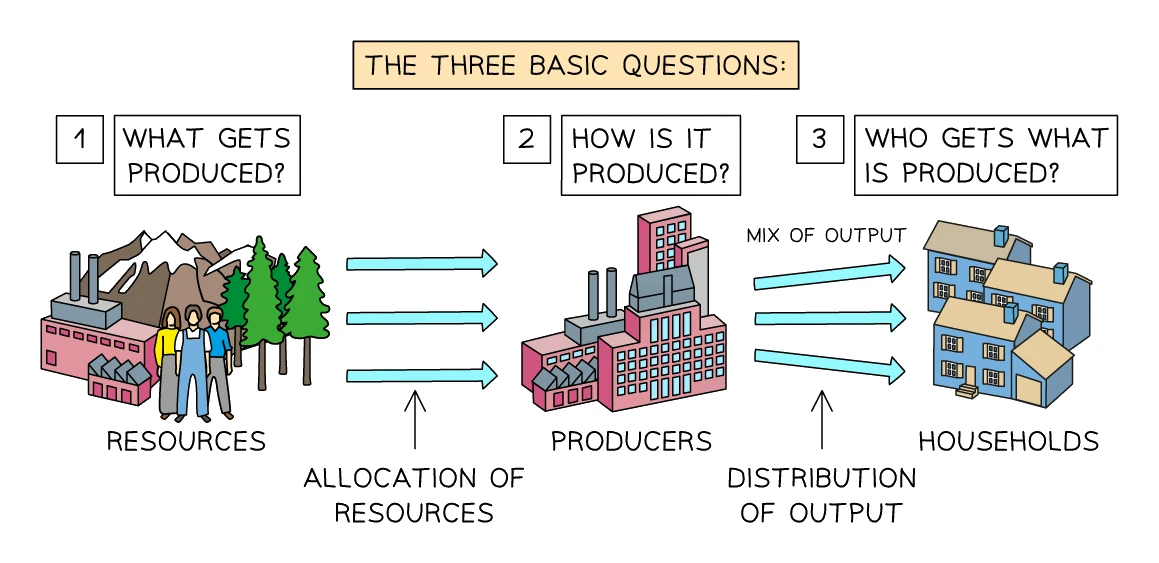
A useful way to phrase it for the exam: the economy must answer three questions.
- What to produce.
- How to produce it.
- For whom to produce it.
These are sometimes called the three fundamental economic questions. They appear because resources cannot stretch to cover every possible want, so an economy is constantly choosing on each.