1. What an exchange rate is
A foreign exchange rate is the value of one currency stated in units of another. It tells you how many units of one currency you get for one unit of another.
A few examples of typical quotations:
- £1 = $1.25 (one pound buys $1.25)
- €1 = £0.86 (one euro buys 86 pence)
- $1 = ¥150 (one US dollar buys 150 Japanese yen)
The exchange rate matters because it determines:
- how much foreign goods cost when imported,
- how competitive domestic goods are when exported,
- the value of foreign holidays, investments and remittances,
- the size of any foreign-currency debt a country owes.
Currencies are bought and sold on the foreign exchange (FX) market, where one currency is exchanged for another.
Exam tip
Defining the foreign exchange market
A 2-mark definition of the foreign exchange market is marked on separate ideas, one mark each up to two: a place or arrangement, currencies being bought, currencies being sold, and one currency being exchanged for another. So "a place where currencies are bought and sold" is enough on its own. A multiple-choice item has tested the floating rate the other way round, describing a currency whose price is set by demand and supply and asking what that describes: a floating exchange rate. Appreciation and depreciation are a rise and a fall in that market-set value.
2. Why people buy and sell foreign currencies
Before looking at how the rate is set, it helps to know who is buying and selling currency, because every reason to buy one currency is a reason to sell another. The syllabus lists six main reasons.
- Trade in goods and services. An importer must pay foreign firms in their currency, so it sells its own currency to buy theirs. Foreign buyers of a country's exports do the reverse, buying that country's currency to pay for the goods.
- Investment in capital goods between countries. A firm building a factory abroad (foreign direct investment) needs the host country's currency to pay for land, machinery and labour.
- Payment of profit, interest and dividends between countries. Profits earned by a firm operating abroad, and interest or dividends paid to foreign investors, have to be converted into the receiver's currency.
- . Migrant workers send part of their wages home, converting the currency they earn into the currency of their family's country.
- . Traders buy a currency they expect to rise and sell one they expect to fall, hoping to profit from the change in its value.
- Government intervention in currency markets. A central bank may buy or sell its own currency to influence the exchange rate.
3. How a floating exchange rate is determined
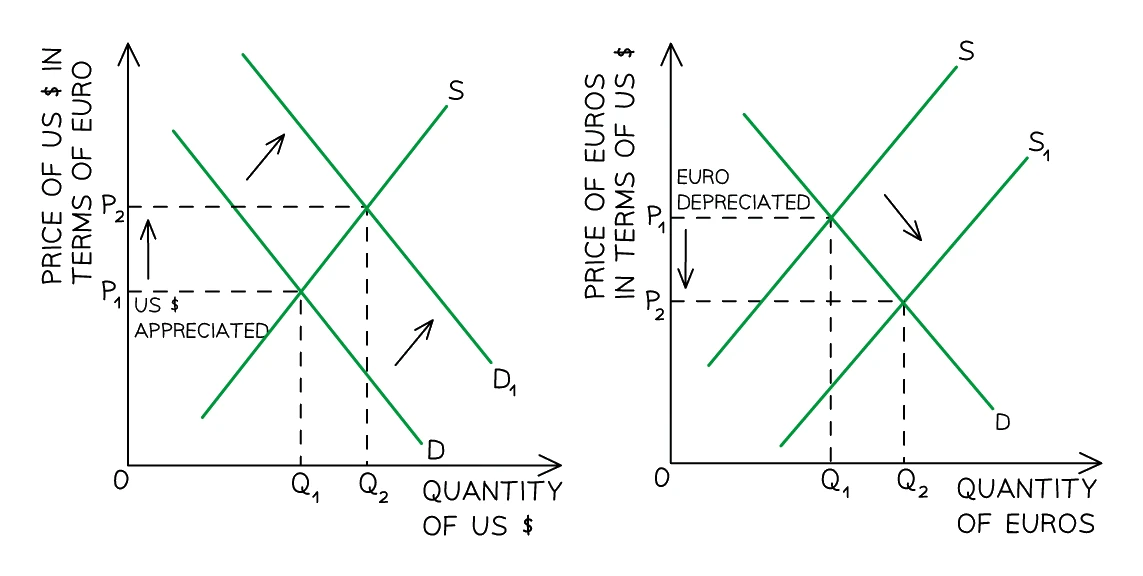
A floating exchange rate is determined by market forces: the demand for and the supply of the currency on the foreign exchange market. The government does not target a particular rate.
How the rate is set:
- Demand for the currency comes from foreigners who want to buy this country's exports, invest in it, or send money into it. To do any of these they must first buy the currency.
- Supply of the currency comes from domestic residents who want foreign currency, to pay for imports, to invest abroad, or to travel.
- The equilibrium exchange rate is the rate at which the demand for the currency equals the supply of it. If demand rises above supply, the rate is bid up; if supply exceeds demand, the rate falls, until the two are equal again.
Common exam question
Which change shifts a currency's demand or supply
Question: Pick the change that would shift the demand for, or the supply of, a country's currency, often shown on a diagram of its market (1 mark, multiple choice).
Set in 9 of the 13 multiple-choice papers, six times with a diagram. Name the currency being traded and ask who must buy or sell it. Demand rises when foreigners buy more of the country's exports (services count), invest more there or chase a higher interest rate; supply rises when its own residents buy more imports or invest abroad. So more imports shift the supply of the home currency right, lowering its price.
Wrong options reverse the cause or move the other curve. Check whose interest rate changed: lower US rates cut the demand for US dollars, while lower Chinese rates raise it. Cheaper oil cuts the demand for dollars too, because oil is paid for in dollars and its demand is price inelastic, so spending on it falls.
An appreciation is a rise in the value of a floating currency caused by market forces. A depreciation is a fall in its value caused by market forces.
Examples of floating currencies include the US dollar, the UK pound, the euro and the Japanese yen.
4. Causes of exchange-rate fluctuations
Anything that raises demand for the currency, or reduces its supply, causes an . Anything that reduces demand or raises supply causes a . The syllabus focuses on three causes.
1. Changes in demand for exports and imports
- Rising exports. Foreign buyers need the domestic currency to pay for the goods, so demand for the currency rises and it appreciates.
- Rising imports. Domestic residents sell their currency to obtain foreign currency, so the supply of the currency rises and it depreciates.
A country with strong exports tends to have a strong currency; a country buying far more imports than it sells exports tends to have a weakening one.
2. Changes in the interest rate
- A higher domestic interest rate attracts foreign investors looking for better returns. They buy the currency to hold deposits or bonds, so demand rises and the currency appreciates.
- A lower domestic interest rate pushes investors toward higher-yielding currencies abroad, so supply rises and the currency depreciates.
These short-term capital flows (sometimes called "hot money") can move very quickly, which is why central-bank interest-rate decisions have such an immediate effect on the exchange rate.
3. Speculation
- If many traders believe a currency will rise, they buy it now, and that buying itself pushes the rate up.
- If they believe it will fall, they sell it now, driving the rate down. Speculation can therefore be self-fulfilling in the short run.
Common exam question
Explaining why a floating exchange rate rises or falls
Question: Explain two causes of a rise in the value of a country's floating exchange rate, or analyse what could make it fall (4–6 marks).
Asked in 2 of the 11 structured papers. Each cause is a chain: the change in demand for, or supply of, the currency, then its source. A rise comes from higher demand (more exports, more inward investment, a higher interest rate attracting hot money, speculation that the currency will rise) or lower supply (fewer imports, the country's firms investing less abroad, lower interest rates abroad). The 4-mark scheme gives the higher-demand mark and the lower-supply mark once each, so two causes need two different sources.
A fall is the same list reversed. The 6-mark scheme also credits fewer remittances sent home by the country's workers abroad, and a central bank cutting its interest rate or selling its own currency. These are section 2's reasons for buying and selling currency, seen as demand and supply.
5. Consequences of changes in the exchange rate
The effects are symmetrical: a depreciation does one thing, an appreciation does the opposite.
Depreciation (currency falls)
A weaker currency makes exports cheaper abroad and imports more expensive at home.
Effect on exports. A foreign buyer paying in their own currency now needs less of it to buy the same export, so the export is cheaper in foreign-currency terms and foreign demand for it rises.
Effect on imports. A domestic importer now needs more of the domestic currency to buy the same foreign good, so import prices rise at home and the quantity of imports tends to fall.
Effect on prices and inflation. Dearer imports raise the prices of imported goods and of domestic goods made with imported inputs, adding to imported cost-push inflation.
Effect on growth and employment. With exports rising and import-competing industries gaining market share, GDP growth tends to rise and unemployment in those industries tends to fall.
Appreciation (currency rises)
A stronger currency makes exports more expensive abroad and imports cheaper at home.
The effects are the mirror image of depreciation: export prices abroad rise and the quantity of exports tends to fall; import prices at home fall and the quantity of imports tends to rise; cheaper imports help to bring inflation down; growth in export industries slows and unemployment in those industries may rise.
Common exam question
Predicting the effects of a depreciation or appreciation
Question: Choose the likely effect of a fall or a rise in a country's exchange rate on its exports, imports, prices, jobs or current account (1 mark, multiple choice).
Set in 5 of the 13 multiple-choice papers, once as a price calculation. Fix the direction first: a fall makes the country's exports cheaper abroad and its imports dearer at home; a rise does the reverse. After a fall, exports (tourism included) sell more, so jobs rise and a current account deficit narrows, while dearer imports add to cost-push inflation. After a rise, firms buying their supplies abroad gain; exporters and firms competing with imports lose. Wrong options reverse one link or overstate it. A government pushing the currency down has the same effects.
The specimen mark scheme sets the idea for 2 marks: two reasons a government may want a lower exchange rate (more exports and fewer imports, growth, jobs, or too few reserves to defend its value).
Common exam question
Whether a rise in the exchange rate benefits the economy
Question: Discuss whether or not a rise in the value of a country's currency would be good for its economy (6–8 marks).
Asked in 2 of the 11 structured papers, once for 8 marks and once for 6 in the data question. For: cheaper imports cut firms' raw material and capital costs and add competitive pressure, lowering inflation; the country buys more imports for the same exports, widening choice; lower total demand eases demand-pull inflation. Against: dearer exports cut export sales and revenue, import spending rises and the current account worsens; lower net exports slow growth and raise unemployment. One scheme also credits confidence attracting multinationals against higher setup costs deterring them, and export revenue rising if export demand is price inelastic.
Develop both sides: the 6-mark version allows at most 4 for either side, and the 8-mark one holds a one-sided answer in Level 2 (3–5). Each point counts once: reversing a point already made scores nothing.
Consequences at a glance
| Depreciation (currency ↓) | Appreciation (currency ↑) | |
|---|---|---|
| Export prices abroad | Cheaper | More expensive |
| Quantity of exports | Rises | Falls |
| Import prices at home | More expensive | Cheaper |
| Quantity of imports | Falls | Rises |
| Inflation | Rises (imported cost-push) | Falls |
| Export-sector growth | Up | Down |
| Consumer purchasing power on imports | Down | Up |
6. Calculating currency conversions
Two calculations use exchange rates: converting an amount from one currency to another, and finding the percentage change in a rate.
Converting from one currency to another
Multiply (or divide) the amount by the exchange rate, depending on the direction of the conversion.
To convert a domestic price into a foreign currency, multiply by the number of units of foreign currency per unit of domestic currency. To convert a foreign price back, divide by the same rate.
Worked example
The price of an export after the rate changes
A rug made in India sells in Germany for €40 when €1 = 90 rupees. The rupee then depreciates to €1 = 100 rupees, and the rug's price in India does not change. Find the rug's new price in Germany, and the change in the rupee price of a German machine priced at €2,000.
Solution:
- Price of the rug in India: each euro buys 90 rupees, so €40 × 90 = 3,600 rupees
- New price in Germany: each euro now buys 100 rupees, so 3,600 ÷ 100 = €36
- The machine in rupees: before, €2,000 × 90 = 180,000 rupees; after, €2,000 × 100 = 200,000 rupees
- Its rupee price rises by 200,000 − 180,000 = 20,000 rupees
Check the direction before you choose an answer: a weaker rupee must make India's export cheaper abroad and its import dearer at home. Multiplying where you should divide, or scaling €40 up by 100/90 to €44.44, gives a dearer rug and is wrong.
Calculating the percentage change in an exchange rate
Percentage change = ((new rate − old rate) ÷ old rate) × 100.
A positive result is an appreciation; a negative result is a depreciation. For example, if the rate moves from £1 = $2.00 to £1 = $1.60, the change is ((1.60 − 2.00) ÷ 2.00) × 100 = −20%, a 20% depreciation that makes a £400 export fall from $800 to $640 for an overseas buyer.