1. The three states of matter
The particle model
- All chemical substances exist as a , a or a
- The state of a given substance depends on temperature (and, for gases, pressure)
- The particles inside (atoms, molecules or ions) are the same in every state
- What differs between states is the arrangement, motion and energy of the particles
- The model pictures every particle as a small hard sphere
- Used to compare arrangement, spacing and motion between the three states
Comparing the three states
| Property | Solid | Liquid | Gas |
|---|---|---|---|
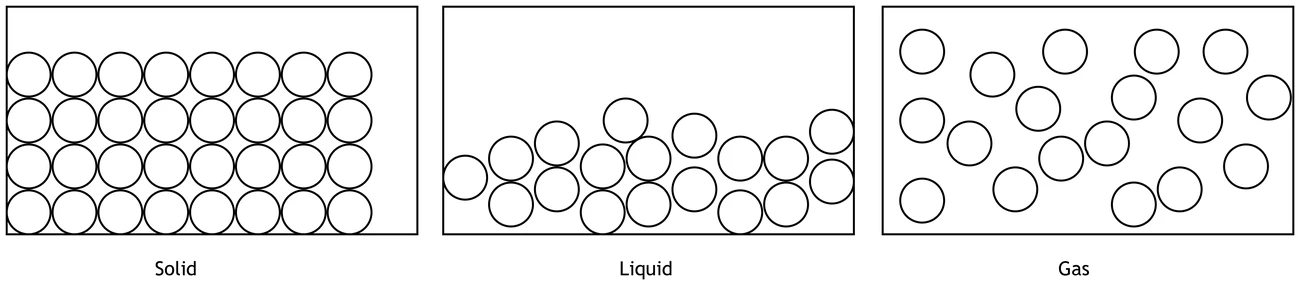
| Arrangement | Regular arrangement | Randomly arranged | Randomly arranged |
| Spacing | Very close together | Close together (still touching) | Far apart |
| Motion | Vibrate in fixed positions | Move around each other | Move freely in all directions |
| Average energy | Lowest | Intermediate | Highest |
| Fixed shape? | Yes | No (takes the shape of its container) | No (fills its container) |
| Fixed volume? | Yes | Yes | No |
| Compressible? | No | Almost not at all | Yes |
Common exam question
Describing or drawing the particles in a state
Question: Describe the arrangement and movement of the particles in a solid, compare their movement in two states, or complete a particle diagram for a liquid or a gas (1–2 marks).
Asked in 6 of the 23 papers. Describing a solid earns one mark for the arrangement (regular, closely packed) and one for the movement (vibrate about fixed positions). Comparing two states earns one mark per state: solid particles vibrate about fixed positions, liquid particles move around each other, gas particles move randomly and quickly; spacing earns nothing there. Avoid "do not move" for a solid: one mark scheme rejects it, though another accepts it.
For a drawing, the marks are in the spacing. Gas particles go far apart, randomly spaced and not touching; liquid particles go close together, mostly touching and filling the box from the bottom, in a random arrangement. A neat regular grid drawn for a liquid scores nothing.
Why state changes need energy
- Particles are held together by attractive forces (intermolecular forces, or ionic / covalent / metallic bonds in giant structures)
- Changing state means giving the particles enough kinetic energy to weaken or overcome those forces
- Stronger forces between particles → higher melting and boiling points
- e.g. iron melts at 1538 °C, sodium chloride at 801 °C
- Weaker forces between particles → lower melting and boiling points
- e.g. oxygen at −183 °C, methane at −161 °C
- A change of state is a physical change, not a chemical one
- The particles themselves are unchanged
- Only the forces holding them in place change
Exam tip
Forces are overcome, bonds are not broken
Whenever a question asks what happens to the particles as a substance melts, boils or evaporates, the credited idea is that the particles gain kinetic energy and overcome the forces of attraction between them. For a simple molecular substance those are the weak forces between the molecules; the covalent bonds inside each molecule stay intact. One mark scheme lets "break the forces between the molecules" through, but another rejects "breaking bonds" outright, so the safe wording is always "overcome the forces between the molecules".
2. The six changes of state
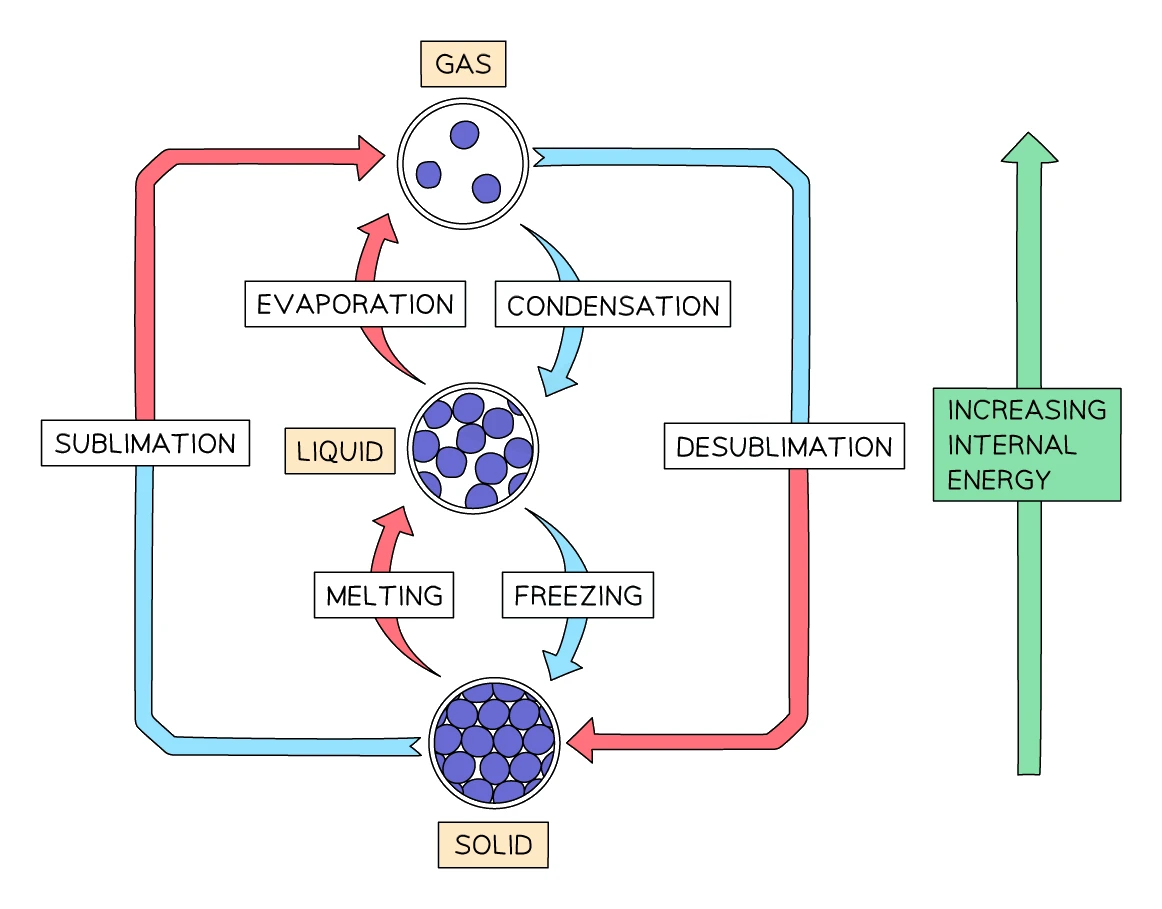
| Process | Direction | Energy |
|---|---|---|
| Melting | solid → liquid | absorbed |
| Boiling / evaporation | liquid → gas | absorbed |
| Sublimation | solid → gas | absorbed |
| Freezing | liquid → solid | released |
| Condensation | gas → liquid | released |
| Deposition | gas → solid | released |
Common exam question
Naming a change of state
Question: Complete a table, or label a diagram, with the name of each change of state, usually choosing from a box of words (1–4 marks, one per change).
Asked in 6 of the 23 papers. The word box carries distractors such as "cooling", "heating" and "crystallising", so match each name to its direction: melting (solid to liquid), freezing (liquid to solid), boiling or evaporation (liquid to gas), condensation (gas to liquid) and sublimation (solid to gas). The verb forms "condensing", "evaporating" and "subliming" are accepted. Freezing and condensation are the pair most easily swapped: both happen on cooling, but only condensation starts from a gas.
Melting
- Solid changes to liquid
- Particles gain kinetic energy and escape their fixed lattice positions, starting to slide
- Happens at one specific temperature, the point (m.p.)
- A pure substance has a sharp m.p. (a standard purity test)
Freezing
- Liquid changes to solid (the reverse of melting)
- Particles lose kinetic energy and lock back into a fixed arrangement
- For a pure substance, freezing point = melting point
- Water freezes / ice melts at 0 °C
Boiling
- Liquid changes to gas at one specific temperature, the point (b.p.)
- Vapour bubbles form throughout the bulk of the liquid
- The temperature of the liquid stays at the b.p. while boiling continues
- Continuous heating is needed to maintain the change
Evaporation
- Liquid changes to gas at any temperature below the b.p.
- A surface-only process: only particles at the liquid surface escape
- The fastest-moving surface particles have enough kinetic energy to break free
- Speeds up when:
- surface area is larger
- temperature is higher
- a draught removes the escaping vapour
Common exam question
Why a liquid evaporates faster when it is heated
Question: Explain why hot water evaporates more quickly than cold water, or why heating a liquid makes it evaporate faster (2 marks).
Set in 2 of the 23 papers. The two marks are two linked ideas: the particles gain kinetic energy and move faster, so more of them have enough energy to overcome the forces of attraction and escape from the surface. Saying only that the particles move faster earns the first mark on its own. "The particles vibrate more", "it has more heat energy" and "there are more collisions" are all ignored. Evaporation happens from the surface at any temperature below the boiling point, so do not describe it as boiling.
Condensation
- Gas changes to liquid on cooling
- Particles lose kinetic energy, and attractive forces hold colliding particles together
- Occurs over a range of temperatures, not at one fixed value
Sublimation and deposition
- Sublimation = solid → gas, skipping the liquid state
- Solid iodine (purple vapour on warming)
- Solid carbon dioxide ("dry ice")
- (also "desublimation") = gas → solid, skipping the liquid state
- Frost forming on cold glass from water vapour
3. Diffusion
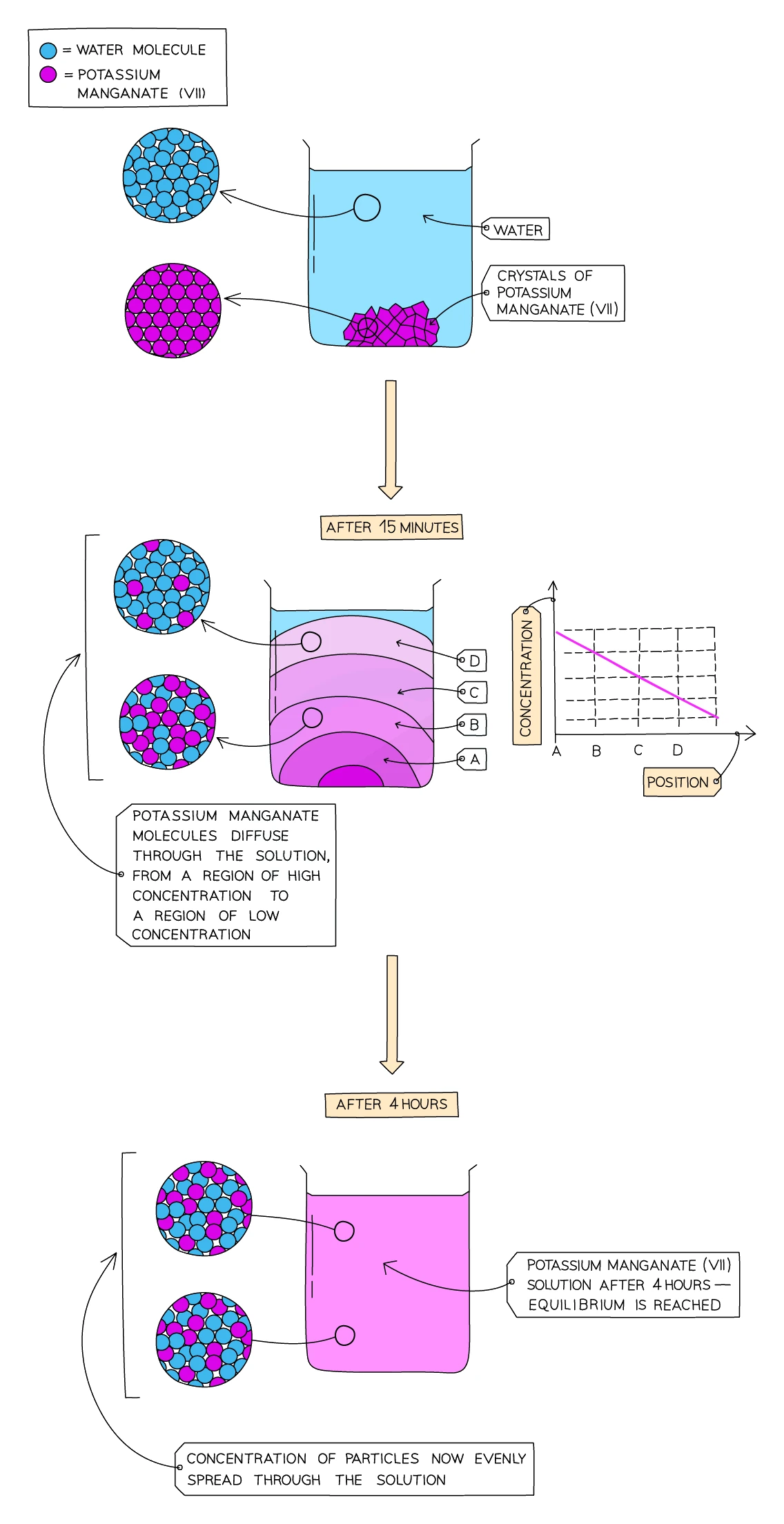
- Diffusion is the net movement of particles from a region of high concentration to a region of low concentration, by random particle motion
- Happens in gases and liquids only. Solid particles vibrate in place and cannot migrate
- Requires no external energy input
- Faster at higher temperatures (particles carry more kinetic energy)
- Much faster in gases than in liquids (gas particles are further apart and move faster)
Common exam question
Naming the process that spreads a substance out
Question: Give the name of the process by which a gas, or a dissolved coloured solid, spreads through the air or the water, sometimes with a reason it happens (1–2 marks).
The name is diffusion, credited in 4 of the 23 papers ("diffusing" is accepted too). For the reason, the particles move randomly and spread from where they are more concentrated to where they are less concentrated until they are evenly mixed. When a crystal dropped into water colours the whole beaker, two processes are wanted: dissolving and then diffusion. "Dilution" is not a process here and earns nothing.
Diffusion in gases: the bromine demonstration
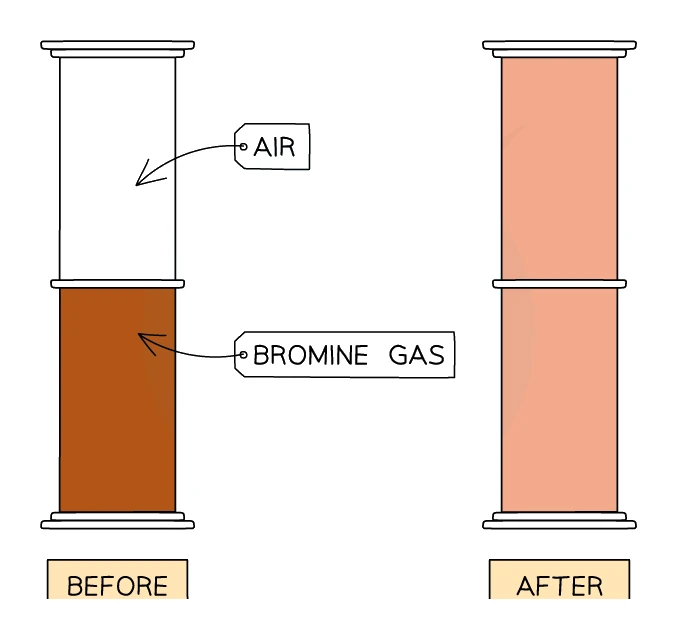
- A gas jar of red-brown bromine vapour is placed beneath an upturned jar of colourless air, separated by a glass cover
- Cover removed → bromine and air particles mix
- After a few minutes both jars show the same uniform pale-brown colour
- Mixing occurs even though bromine vapour is denser than air
Diffusion in liquids: the potassium manganate(VII) demonstration
- A small purple crystal of KMnO₄ is dropped into still water
- The colour spreads outwards through the water with no stirring
- After several hours the beaker is uniformly pale purple
- Much slower than gas diffusion (liquid particles are close-packed)
4. Dilution
- Dilution is the addition of more solvent to an existing solution
- The total number of solute particles is unchanged
- Solute particles are now spread through a larger volume, so the concentration falls
- A coloured solution fades with each stepwise dilution, but does not disappear immediately
- Two conclusions follow:
- a small mass of solute contains a very large number of particles
- particles are not destroyed by dilution, only spread out further
5. Solutions
| Term | Meaning | Example |
|---|---|---|
| Solvent | The substance (usually a liquid) that does the dissolving | Water in seawater |
| Solute | Whatever gets dispersed into the solvent | Sodium chloride in seawater |
| Solution | The single-phase mixture once the solute is fully dispersed | Seawater |
| Saturated solution | Holds as much solute as it can take at the current temperature; further additions stay undissolved | Salt solution sitting over crystals |
| Soluble | Able to dissolve in a stated solvent | Sugar in water |
| Insoluble | Unable to dissolve in a stated solvent | Sand in water |
- Solubility is solvent-specific
- Iodine: insoluble in water, soluble in hexane
- Always quote the solvent when describing a substance as "soluble" or "insoluble"
Exam tip
A saturated solution is defined at a temperature
When you are asked what a saturated solution is (2 marks), give both halves: it holds as much dissolved solute as possible, and it does so at a particular temperature. The temperature is a separate mark and is easy to leave out, yet it is the point: solubility changes with temperature, so a solution that is saturated when cool can dissolve more once it is warmed. Define solute and solvent just as carefully. The solute is the substance that dissolves; the solvent is the substance it dissolves in.
6. Solubility
- Solubility is how much solute a particular solvent will hold at a given temperature (and, for gases, at a given pressure)
- Standard unit: grams of solute per 100 g of solvent (usually water)
- e.g. KNO₃ in water at 20 °C: 32 g per 100 g of water means 32 g dissolves; anything more sinks to the bottom
Effect of temperature and pressure
| Solute | Effect of raising temperature | Effect of raising pressure |
|---|---|---|
| Solid | Usually more soluble | Negligible |
| Gas | Less soluble | More soluble |
- Warm fizzy drinks lose their fizz faster than cold ones (gas leaves on warming)
- Carbonation is achieved by forcing CO₂ into solution under pressure
Solubility curves
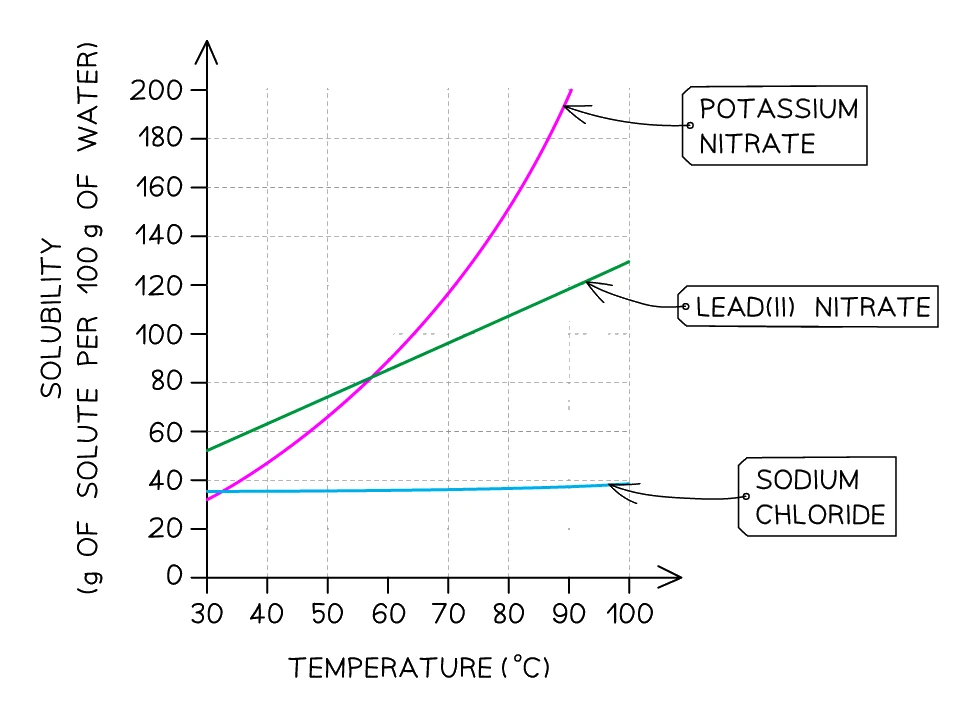
- A solubility curve plots solubility (g per 100 g of water) against temperature (°C)
- Built by measuring the saturation mass at each of several temperatures and joining the points
- Most ionic salts: curve rises with temperature
- Shape varies sharply between salts:
- KNO₃: steep rise
- Pb(NO₃)₂: moderate rise
- NaCl: almost flat across 0–100 °C
Common exam question
Reading and using a solubility curve
Question: Use a solubility curve to find a temperature or a solubility, showing your working on the graph, then work out the mass of solute that crystallises when a saturated solution cools (1–2 marks per part).
Set in 2 of the 23 papers, both times on Paper 2. A value read from the curve needs its construction lines drawn on the graph: one mark is for showing them and one for the reading, which is accepted within a small range. The mass that crystallises on cooling is the solubility at the higher temperature minus the solubility at the lower one, per 100 g of water. Write that subtraction down: in one paper it is the method mark, and a slightly wrong reading still earns the answer mark by follow-through. You may also be asked to plot the points of a table and draw a smooth curve of best fit through them.
Worked example
Crystals formed when a saturated solution cools
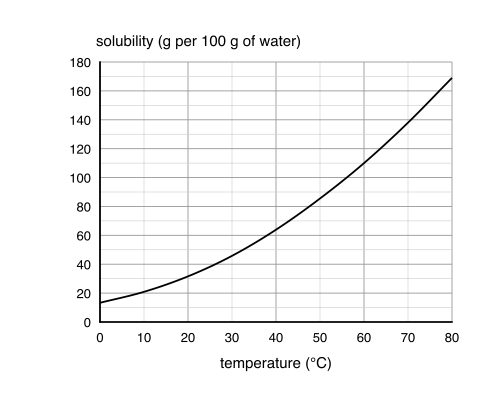
The graph shows the solubility curve of potassium nitrate. A saturated solution is made in 100 g of water at 60 °C and then cooled to 20 °C. Use the curve to find the mass of potassium nitrate that crystallises.
Solution:
- Read up from 60 °C to the curve and across to the axis: the solubility is 110 g per 100 g of water, so that is what the saturated solution holds.
- Read up from 20 °C: the solubility is about 32 g per 100 g of water, which is all the water can now hold.
- The rest can no longer stay dissolved and comes out as crystals.
- Mass of crystals = 110 − 32 = 78 g (per 100 g of water).
Draw both read-off lines on the graph, because that working earns a mark of its own.
7. Practical: measuring the solubility of a solid at a fixed temperature
Aim
- Determine the solubility (g per 100 g water) of a soluble salt, typically copper(II) sulfate or potassium nitrate, at a stated temperature
Apparatus
- Evaporating basin
- Boiling tube
- Water bath (a heated beaker of water will substitute)
- Thermometer
- Balance reading to 0.01 g
- Bunsen burner, tripod, gauze
- Stirring rod
- The chosen soluble solid
Method
- Weigh the empty evaporating basin; record its mass
- Half-fill a boiling tube with water and warm it in the water bath to just above the target temperature (say, just above 30 °C)
- Add the chosen solid in small portions, stirring after each addition, until further additions stop dissolving and a small amount of solid residue settles on the base of the tube
- Cool the boiling tube to exactly the target temperature (30 °C), stirring gently; let the residue settle
- Decant the clear saturated solution into the pre-weighed basin (leaving the residue behind in the tube); reweigh the basin
- Heat the basin gently to evaporate the water; reduce the heat before the basin runs dry, to prevent spitting
- Heat to constant mass: cool, weigh, reheat, cool, reweigh, repeating until two consecutive masses agree
- Calculate the solubility from the recorded masses
Sample calculation
| Reading | Mass / g |
|---|---|
| Empty basin | 30.00 |
| Basin + saturated solution | 90.00 |
| Basin + dry solid (constant mass) | 50.00 |
- Mass of solution: 90.00 − 30.00 = 60.00 g
- Mass of solute: 50.00 − 30.00 = 20.00 g
- Mass of water: 60.00 − 20.00 = 40.00 g
- Solubility at 30 °C = (20.00 / 40.00) × 100 = 50.0 g per 100 g of water
- Mass % of solute in the solution = (20.00 / 60.00) × 100 = 33.3 %
Common exam question
Calculating a solubility from the practical's masses
Question: Use the recorded masses of the evaporating basin, the saturated solution and the dry salt to calculate the solubility in grams per 100 g of water (2 marks).
Set in 2 of the 23 papers, both times on Paper 2. The mass of salt is the basin and dry salt minus the empty basin; divide it by the mass of water and multiply by 100. The marks are split differently: one paper gives one for the salt mass and one for scaling it to 100 g of water, the other asks for the salt and water masses as separate parts and then marks the division and the multiplication. When the question gives a volume of water, take 1 cm³ of water as 1 g. A correct answer with no working scores both marks, but a wrong answer keeps the first mark only if that step is written down.
Sources of error
- Transferring undissolved residue into the basin → overestimates solubility; decant carefully, or filter at the target temperature
- Loss of solid by spitting during evaporation → heat gently near dryness; finish on residual heat
- Solution cooling below the target temperature before decanting → solubility falls; less solid in the decanted liquid; decant promptly
- Incomplete drying → trapped water inflates the apparent solute mass; always heat to constant mass