1. Layout of the periodic table
Arrangement of elements
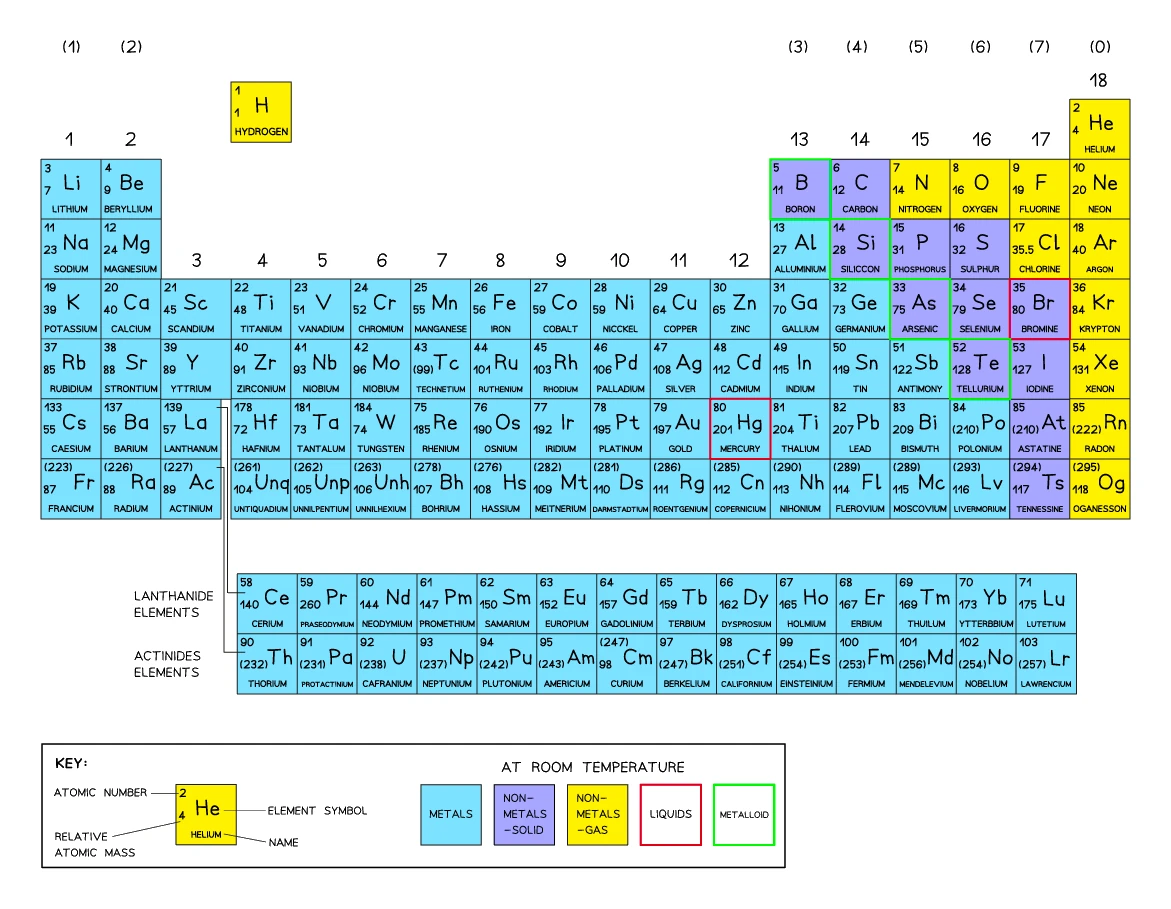
- The periodic table lists every chemical element ever isolated — currently over 100
- Elements are arranged in order of increasing atomic number
- Each successive element has one more proton (and one more electron) than the one before it
- The columns are aligned so that elements with similar chemical behaviour sit above and below each other
Groups and periods
- Periods are the horizontal rows, numbered 1 to 7
- Groups are the vertical columns, numbered 1 to 7, plus 0 on the far right (sometimes called Group 8 in older notations; Edexcel uses Group 0)
- Two links between position and electron arrangement (covered in section 2):
- number = number of occupied electron shells
- Group number = number of electrons in the outer shell (for Groups 1 to 7)
- For example:
- Period 2 elements have 2 electron shells; Period 3 elements have 3 shells
- Group 4 elements have 4 outer electrons; Group 6 elements have 6 outer electrons
Atomic number as a fingerprint
- Every element has its own unique atomic number; no two elements share one
- The atomic number does not change during a chemical reaction; only electrons move
2. Electronic configuration
Writing the configuration
- An atom's electron arrangement can be shown in two ways:
- As an electron shell diagram (nucleus drawn with concentric shells, electrons placed as dots)
- As an electronic configuration (also called electronic structure): the number of electrons in each shell, comma-separated, innermost shell first
- Shell-filling rules for the first 20 elements:
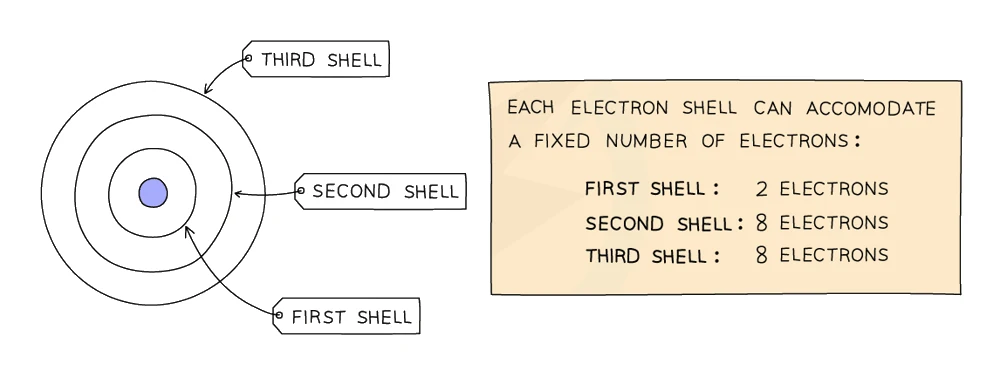
- 1st shell holds up to 2 electrons
- 2nd shell holds up to 8 electrons
- 3rd shell holds up to 8 electrons (a simplification used at this level: once the 3rd shell reaches 8, the 4th shell begins to fill before the 3rd fills further)
- 4th shell starts to fill once the 3rd reaches 8
- Once the 3rd shell has 8 electrons, the next two electrons (for potassium and calcium) go into the 4th shell first, before the 3rd shell continues filling for heavier elements
Electronic configurations of the first 20 elements
| Element | Z | Configuration |
|---|---|---|
| Hydrogen | 1 | 1 |
| Helium | 2 | 2 |
| Lithium | 3 | 2,1 |
| Beryllium | 4 | 2,2 |
| Boron | 5 | 2,3 |
| Carbon | 6 | 2,4 |
| Nitrogen | 7 | 2,5 |
| Oxygen | 8 | 2,6 |
| Fluorine | 9 | 2,7 |
| Neon | 10 | 2,8 |
| Sodium | 11 | 2,8,1 |
| Magnesium | 12 | 2,8,2 |
| Aluminium | 13 | 2,8,3 |
| Silicon | 14 | 2,8,4 |
| Phosphorus | 15 | 2,8,5 |
| Sulfur | 16 | 2,8,6 |
| Chlorine | 17 | 2,8,7 |
| Argon | 18 | 2,8,8 |
| Potassium | 19 | 2,8,8,1 |
| Calcium | 20 | 2,8,8,2 |
Common exam question
Writing the electronic configuration of an atom
Question: Give the electronic configuration of an atom of an element such as phosphorus, from its atomic number or the periodic table (1 mark).
Set in 2 of the 23 papers, both on Paper 2 and both for phosphorus. An atom has as many electrons as its atomic number, the figure printed at the bottom of each element's box on the table (the relative atomic mass is the one at the top), so take that number and fill the shells in order: 2, then 8, then 8, with the fourth shell starting at potassium. Phosphorus has 15 electrons, so its configuration is 2,8,5. Both 2,8,5 and 2.8.5 are credited, and so is a correctly drawn shell diagram. Check that your numbers add up to the atomic number before moving on.
Configurations of ions
- An ion's configuration is its atom's configuration adjusted for electrons gained or lost
- Sodium atom (Na): 11 electrons, configuration 2,8,1
- Sodium ion (Na⁺): 1 electron lost → 10 electrons → 2,8 (same as neon)
- Chlorine atom (Cl): 17 electrons, configuration 2,8,7
- Chloride ion (Cl⁻): 1 electron gained → 18 electrons → 2,8,8 (same as argon)
- Many ions end up with the same configuration as the nearest noble gas, which is why those ions are stable
Reading position from the electronic configuration
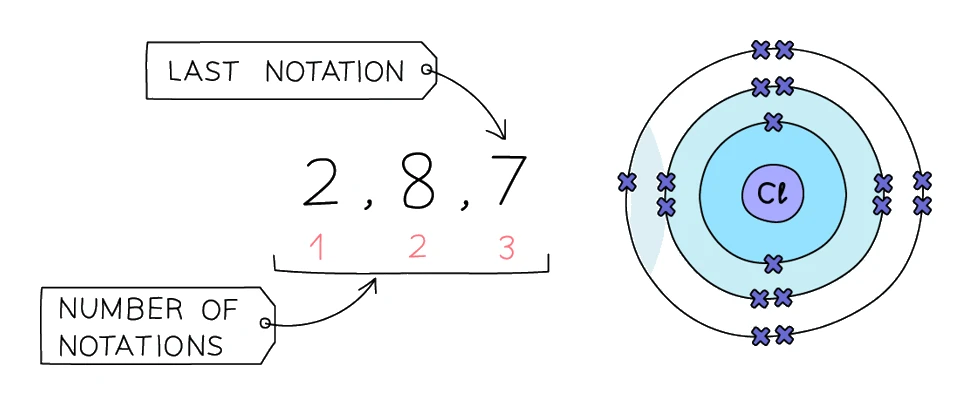
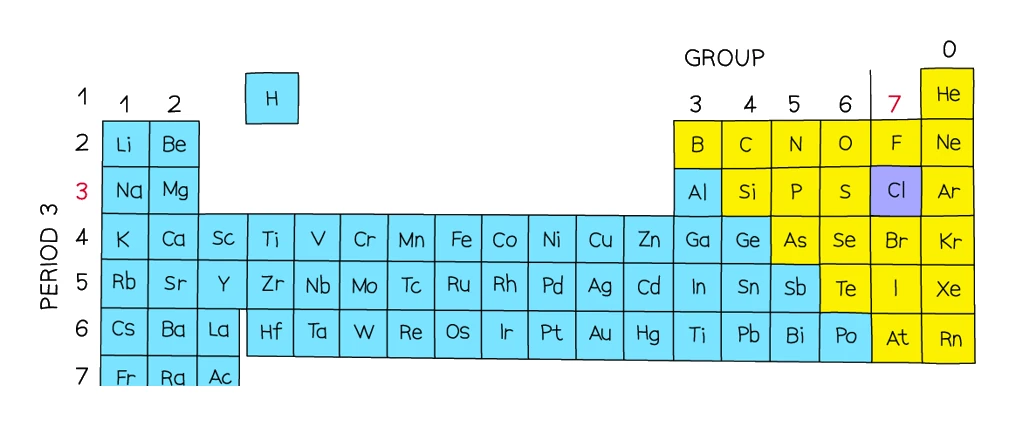
- Period number = number of separate notations in the configuration
- Group number = the last notation (for Groups 1 to 7)
- For example, chlorine has configuration 2,8,7:
- 3 notations → 3 occupied shells → 3
- Last notation is 7 → 7 outer electrons → 7
- Group 0 is the exception
- Group 0 elements have full outer shells, not a single matching outer-electron count
- Helium is in Group 0 even though its configuration is just 2 (only one full shell)
Common exam question
Giving the group and period of an element
Question: Give the number of the group and the period that contain an element, from a diagram of its atom or its electronic configuration (1 mark each, or 2 with an explanation).
Asked in 6 of the 23 papers, twice as multiple choice. Work from the configuration: the number of occupied shells is the period and the number of outer-shell electrons is the group. For a 1-mark part the bare number is enough. In the 2-mark "explain which group" version one mark is for the group and the other for the reason (the outer-shell electron count, or the written configuration), so a bare group number earns only the first.
If the data is a table of particle counts, the electron count works for an atom, but a row whose electrons and protons differ is an ion, so read the protons. Noble gases, helium included, go in Group 0.
3. Metals and non-metals
Comparing the two
| Property | Metals | Non-metals |
|---|---|---|
| Outer electrons | 1 to 3 | 4 to 7 |
| Bonding | Metallic (lose outer electrons) | Covalent (share outer electrons) |
| Electrical conductivity | Good conductors | Poor conductors |
| Type of oxide | Basic oxides | Acidic oxides (a few are neutral) |
| Reaction with acids | Many react with dilute acids | Usually do not react with acids |
| Appearance | Shiny (lustrous) | Dull, non-reflective |
| State at room temperature | Solid (except mercury, which is liquid) | Various: solid, liquid or gas |
| Mechanical properties | Malleable and ductile (can be bent and stretched) | Brittle (shatter when struck) |
| Melting and boiling points | High | Low |
Position on the periodic table
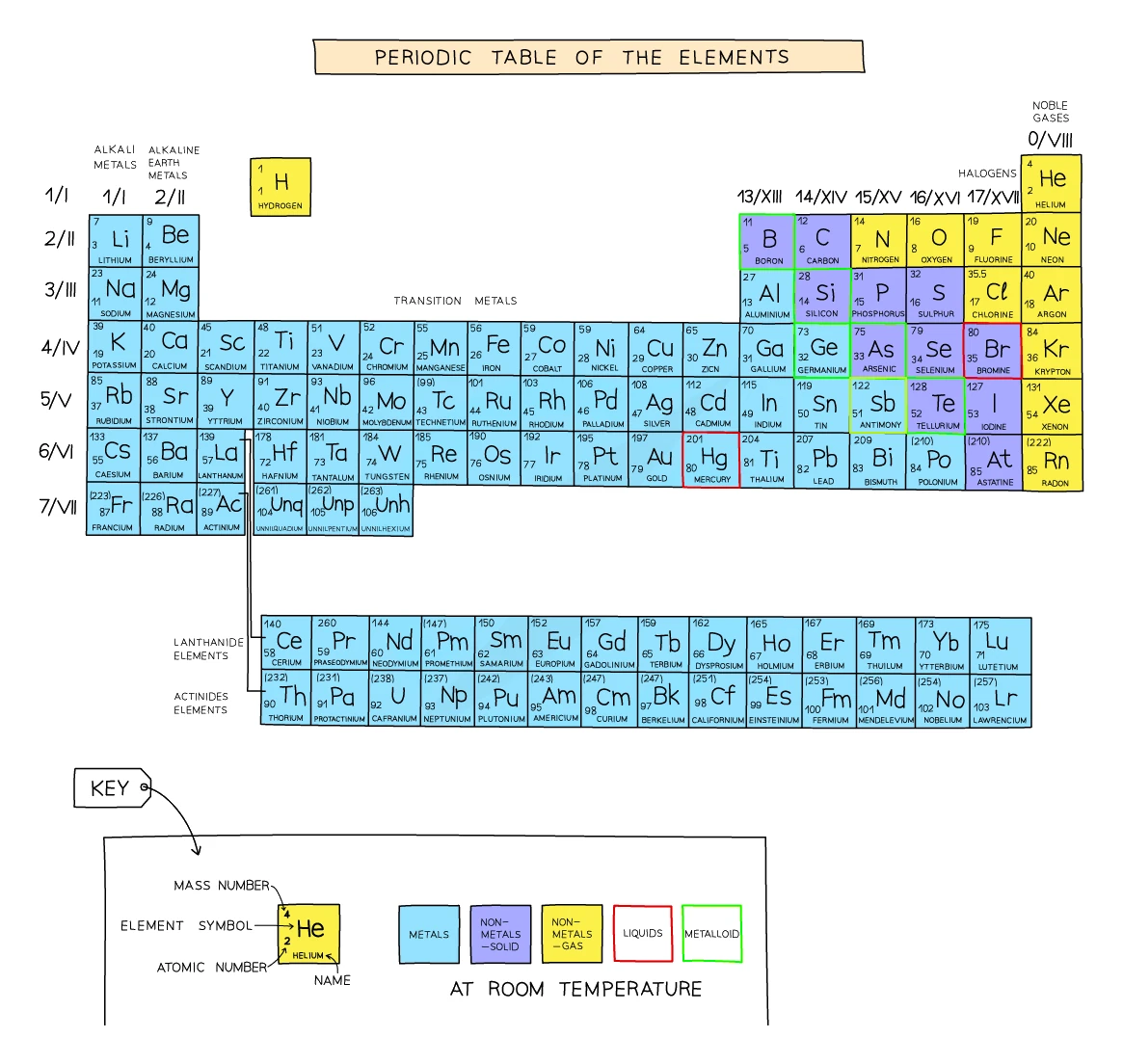
- sit on the left and middle of the periodic table
- sit on the right
- A staircase-shaped zig-zag line on the right of the table separates the two
- The majority of known elements are metals
Common exam question
Picking a metal or a non-metal from a list or a diagram
Question: From a word box or a diagram of positions in the periodic table, name or give the symbol of a metal, a non-metal, an element that forms an acidic or a basic oxide, or an element that is a liquid at room temperature (1 mark each).
Set in 4 of the 23 papers. Metals sit to the left of the zig-zag line and form basic oxides; non-metals sit to the right and form acidic oxides, so "forms an acidic oxide" is asking for a non-metal such as sulfur or chlorine, and "forms a basic oxide" for a metal such as lithium. Only two elements are liquid at room temperature, bromine (a non-metal) and mercury (a metal); mercury is credited when you may name any element, but not when the choice comes from a printed box that offers only bromine. Give the element, not its ion: "bromide" or Br⁻ is rejected. A name or a symbol is accepted, but when one answer is asked for give exactly one, because an extra wrong element cancels a right one.
Metalloids
- Elements sitting right on the zig-zag border have a mixture of metallic and non-metallic properties
- These are called metalloids (also known as semi-metals)
- Examples: boron, silicon, germanium, arsenic
4. Group reactivity and the noble gases
Why same-group elements react alike
- Elements in the same group all have the same number of outer-shell electrons
- Chemical behaviour is set almost entirely by the outer electrons
- So same-group elements:
- Form the same kinds of bonds
- React with the same other elements
- Show similar chemical reactions
- For example, lithium, sodium and potassium are all in Group 1 and all react with chlorine (Group 7) to form ionic chlorides (LiCl, NaCl, KCl)
Common exam question
Why elements in the same group react alike
Question: Give a reason why two elements in the same group, such as lithium and sodium, react in a similar way, or state a similarity in their electron configurations (1 mark).
Asked in 3 of the 23 papers. The one credited idea is that the atoms have the same number of electrons in their outer shell: one each for lithium, sodium and potassium, three each for aluminium and indium. "Same number of valence electrons" is accepted as an alternative wording. When the question says to refer to electronic configurations, state the outer-shell count itself. The answer is about electrons, not protons: elements in the same group have different atomic numbers, so "same number of protons" is simply wrong.
Trends in reactivity down a group
- 1 (): reactivity increases going down the group
- The outer electron is held more loosely the further it sits from the nucleus, so it is lost more easily
- Group 7 (): reactivity decreases going down the group
- The outer shell sits further from the nucleus, so an incoming electron is attracted less strongly
- The detailed chemistry of these groups is in Topic 10 (Group 1) and Topic 11 (Group 7)
The noble gases (Group 0)
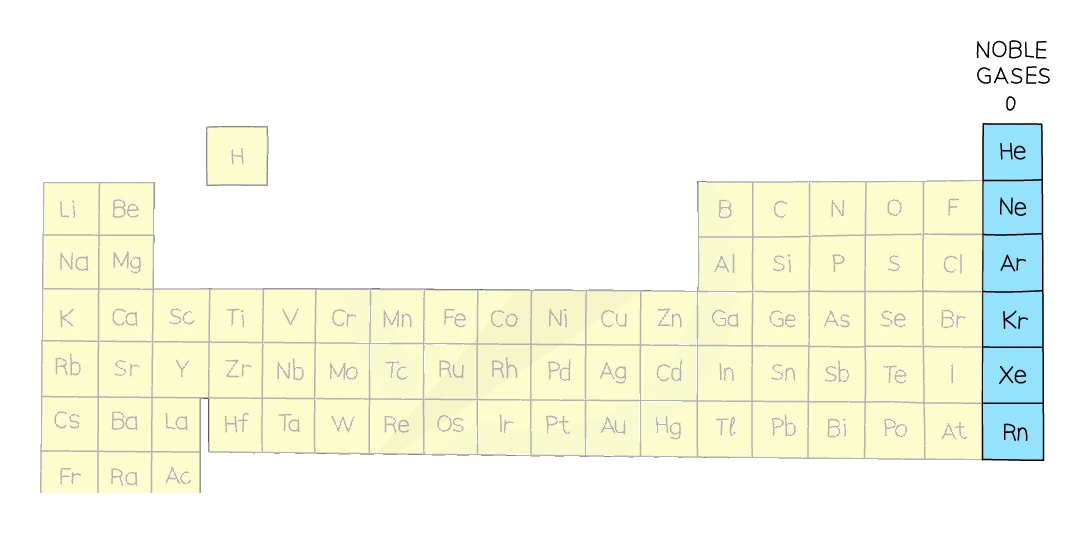
- The Group 0 elements are called the
- Common properties:
- Monatomic (exist as single atoms, not bonded into molecules)
- Colourless gases at room temperature
- Non-flammable
- They are inert (extremely unreactive)
- Most elements react in order to gain, lose or share electrons until they have a full outer shell
- Noble gases already have a full outer shell, so they have no chemical incentive to react
- Outer-shell electrons:
- Helium has 2 (a full 1st shell)
- All other noble gases have 8 outer electrons
Common exam question
Explaining why a noble gas is unreactive
Question: Explain, in terms of electron configuration, why a noble gas such as neon or argon is unreactive, or explain which element in a diagram is the least reactive (1–2 marks).
Asked in 5 of the 23 papers, and a sixth asks only for the group number of the unreactive elements (0, with 8 also accepted). The two credited points are that the atom has a full outer shell (eight electrons, or the configuration 2,8 for neon) and so does not need to lose, gain or share electrons. A 1-mark "state why" takes either point on its own; the 2-mark "explain in terms of electron configuration" version needs both. When you first have to pick the unreactive element from a diagram, naming the noble gas is the first mark and the full outer shell is the second, which depends on the first. "Because it is a noble gas" is ignored: it names the family instead of giving the reason.
Noble-gas electronic configurations
| Noble gas | Z | Electronic configuration |
|---|---|---|
| Helium (He) | 2 | 2 |
| Neon (Ne) | 10 | 2,8 |
| Argon (Ar) | 18 | 2,8,8 |
| Krypton (Kr) | 36 | 2,8,18,8 |
| Xenon (Xe) | 54 | 2,8,18,18,8 |
- From krypton onwards the third shell holds its full 18 electrons (the simplified rule applies only to the first 20 elements)