1. The metallic bond
Metals as giant lattices
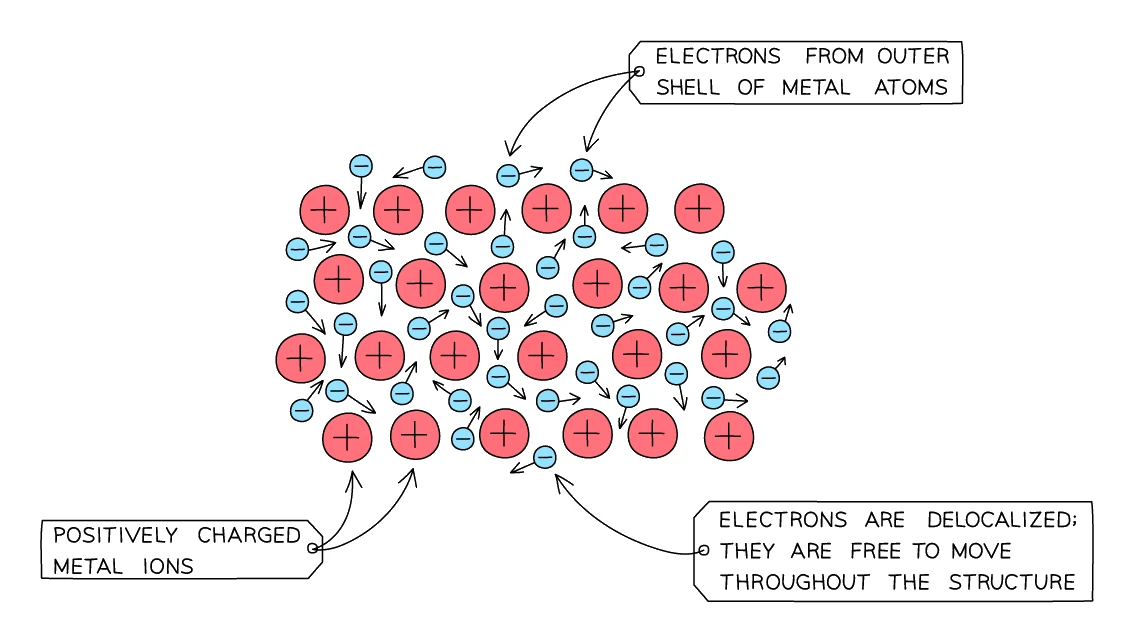
- A metal is a giant metallic lattice of metal atoms packed in a regular arrangement
- Each atom releases its outer-shell electrons into the lattice
- These electrons are no longer attached to any single atom
- They are described as
- They move freely throughout the whole lattice, forming a
- What remains at the lattice positions are the positive metal ions (cations)
What the metallic bond is
- The metallic bond is the electrostatic attraction between the positive metal ions and the surrounding delocalised electrons
- The attraction acts in every direction through the lattice and holds the whole structure together
- The same bonding model applies to pure metals and to alloys, which are mixtures of a metal with one or more other elements
Exam tip
Describing the metallic bond
Asked to describe the attractions in metallic bonding (2 marks, set once in the 23 papers), give both halves of the electrostatic attraction, one mark each: the positive metal ions ("the nuclei of the metal atoms" is also accepted) and the delocalised electrons between them. Any mention of ionic bonding, sharing electrons or intermolecular forces loses both marks. The same idea, with "strong" in front, is the credited reason for a metal's high melting point. Asked to label a printed lattice diagram, use "positive ion" (or cation) and "delocalised electron": "atom" is allowed for the first, "proton" is rejected.
2. Properties of metals
High melting and boiling points
- Most metals have high melting and boiling points
- The electrostatic attraction between the positive metal ions and the delocalised electrons is strong
- Breaking apart the lattice needs a large amount of energy, so the melting and boiling temperatures are high
- Group 1 metals are partial exceptions (sodium melts at about 98 °C) because the attraction is weaker when each atom only releases one electron
Exam tip
Pair every property of a metal with its reason
A 5-mark question, set once in the 23 papers, asked for three properties that make copper suitable for electrical wiring. Three properties with their reasons make seven credit points and any five score, a reason counting only when it is tied to the right property; the malleability reason is worth two (layers of atoms or cations, then the layers sliding). Conductivity and malleability are explained as in the boxes below; the third property is the high melting point, explained by the strong electrostatic attraction between the positive ions and the delocalised electrons. A high boiling point, cost, hardness, strength and shininess are ignored, and mentioning intermolecular forces or ionic or covalent bonding caps the answer at four marks.
Electrical and thermal conductivity
- Metals conduct electricity in both the solid and the liquid state
- The delocalised electrons are free to move through the lattice
- When a voltage is applied, they drift toward the positive terminal and carry the charge
- Metals also conduct heat well
- The delocalised electrons gain kinetic energy at the hot end and pass it rapidly through the structure
Common exam question
Why metals conduct electricity
Question: Explain why metals, or a named metal such as copper or magnesium, conduct electricity (2 marks).
Asked in 4 of the 23 papers, all on Paper 2: twice on its own and twice inside a longer question. One mark is for the metal's delocalised electrons; the other for those electrons being able to move or flow through the structure. The second mark depends on the first naming electrons, and one scheme ignores "free electrons" and "sea of electrons", so use the word delocalised. Any mention of ions or atoms moving costs the second mark, and on two papers ions moving scored zero for the whole question.
When the question contrasts a metal with a molten ionic compound, keep the charge carriers apart: electrons move in the metal, and ions are free to move in the compound once it is molten or dissolved. Electrons moving earns nothing for the compound, and ions moving earns nothing for the metal.
Malleability and ductility
- Metals are malleable: they can be hammered into shape
- Metals are also ductile: they can be drawn into wires
- Both properties follow from the same feature of the lattice
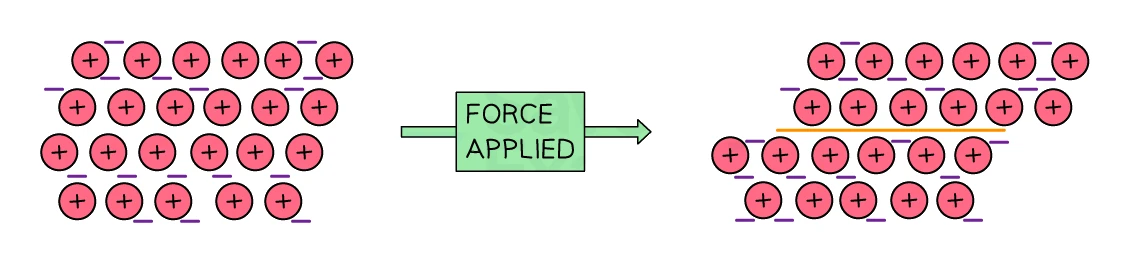
- The metal atoms/ions sit in layers
- Applying a force lets the layers slip past one another into a new arrangement
- The delocalised electrons rearrange around the shifted ions, so the metallic bonding survives the change of shape
- The metal changes shape without breaking
Common exam question
Why metals are malleable or can be drawn into wires
Question: Explain why metals, or a named metal, are malleable, or suggest why a metal can be stretched into wires (2 marks).
Asked in 5 of the 23 papers, all on Paper 2: four times on its own and once inside a longer question on copper. One mark is for the atoms or ions being arranged in layers (rows or sheets are accepted, and particles will do for the atoms or ions); the other is for those layers sliding over one another when a force is applied. On one scheme the second mark depends on the first, so name the layers before you say they slide.
Keep intermolecular forces, molecules and electrons out of the answer. Intermolecular forces are rejected, one scheme gives no marks at all for them or for "the electrons slide", another rejects molecules, and references to electrons are ignored. The particles that slide are the ions or atoms, never the delocalised electrons.
3. Alloys
What an alloy is
- An alloy is a mixture of a metal with one or more other elements (usually another metal, sometimes a non-metal such as carbon)
- Common examples:
- Steel: iron with a small percentage of carbon
- Brass: copper and zinc
- Bronze: copper and tin
Why alloys are harder than the pure metal
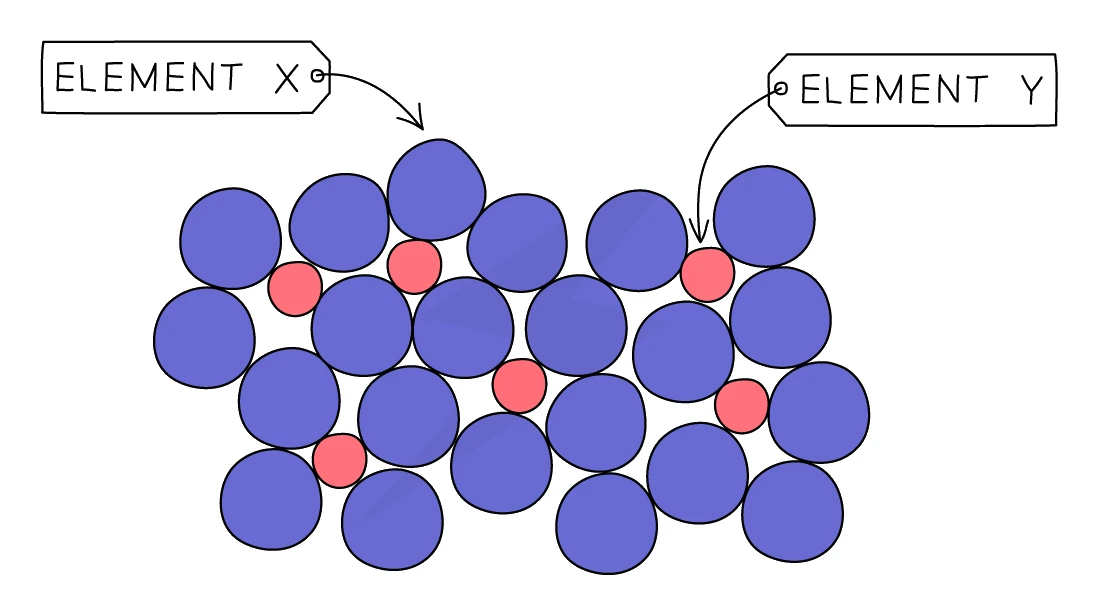
- The added element has atoms of a different size from the host metal
- These differently sized atoms disrupt the regular arrangement of the lattice
- The layers can no longer slide smoothly past each other
- The alloy is therefore harder and stronger, with reduced malleability compared with the pure metal
Common exam question
Why an alloy is harder than the pure metal
Question: Explain why an alloy is harder, stronger or less malleable than the pure metal (2–3 marks).
Asked in 3 of the 23 papers, all on Paper 2. For three marks: in the pure metal the atoms are all one size, so the layers slide over each other easily; the alloy's atoms of a different size disrupt the regular arrangement; so the layers cannot slide. For two marks, the first mark is the alloy idea (atoms of different sizes, or the disrupted regular arrangement) and the second is the layers being harder to slide; saying that the pure metal's layers slide easily earns nothing there. One scheme deducts a mark if layers (rows or sheets) are never named, and labelled diagrams can earn every mark when the question invites them.
Use atoms, ions or particles throughout: mentioning molecules, intermolecular forces, negative ions or ionic or covalent bonding costs one mark, however many of them appear, and saying the metallic bonds are stronger earns nothing. Asked what an alloy is (1 mark), say a mixture of metals, or of a metal and carbon; "compound" is rejected.